Skip to content
DevMeme
3555 of 7435
Discovering a New Species: The Software Developer's Existential Horror
Bugs Post #3892, on Nov 1, 2021 in TG

Discovering a New Species: The Software Developer's Existential Horror

Why is this Bugs meme funny?

Level 1: Monster Under the Bed

Imagine you and your friends each find a surprise. One friend discovers a cute puppy, another finds a funny-looking fish in a pond. But when it’s your turn, you peek under your bed and a monster is hiding there! You’d jump back in fear, right? This meme is joking that being a programmer sometimes feels like that. A software developer is a person who writes instructions to tell the computer what to do (kind of like giving orders to a robot). If there’s a mistake in those instructions – called a bug – the computer might do something really strange and unexpected. Finding a new bug can feel just as startling as finding a monster under your bed.

In the meme, the other people (the biologist, diver, astronaut, surgeon) all found a new living creature that was interesting or exciting for them. But the programmer found something freaky and wrong in their computer. The picture for the programmer is a super creepy face full of glitches, which stands for the “scary” error. Of course, in reality, there’s no monster – it’s just a computer problem – but it feels like a shock or a bad surprise to the programmer. The meme is funny because it shows a programmer’s big reaction in a silly, exaggerated way. Basically, everyone else gets a nice new animal, and the poor programmer gets a crazy computer error that looks like a monster. That twist makes people who deal with computers laugh, because they know that exact feeling of discovering something wrong and going, “Oh no, what is this?!”

Level 2: Monster in the Code

Let’s break this meme down in simpler terms. It jokes about what it’s like to discover something new in different jobs. For a biologist (a scientist who studies living things), finding a new species might mean discovering a new type of frog or butterfly. That’s exciting and usually a positive experience. For a scuba diver, maybe they spot a new kind of fish deep in the ocean – also pretty cool and not too scary. Now, the meme then lists an astronaut and a surgeon. Discovering a new species for them could be a lot more intense: an astronaut might encounter alien life (imagine how shocking that would be!), and a surgeon might find a bizarre organism (like discovering an unusual parasite or growth during an operation – definitely yikes).

Finally, we have the software dev (software developer). Instead of a real animal or alien, the developer’s “new species” is a monstrous software bug. In computer terms, a bug is a mistake or flaw in a program that makes it behave in unexpected or wrong ways. (Fun fact: engineers started calling errors “bugs” after finding a real moth causing trouble inside an early computer!) Now, of course, most software bugs aren’t actual insects – it’s just a nickname for glitches or errors. But the meme is saying that when a programmer discovers a new bug in their code, it can feel as unsettling as finding a creepy creature.

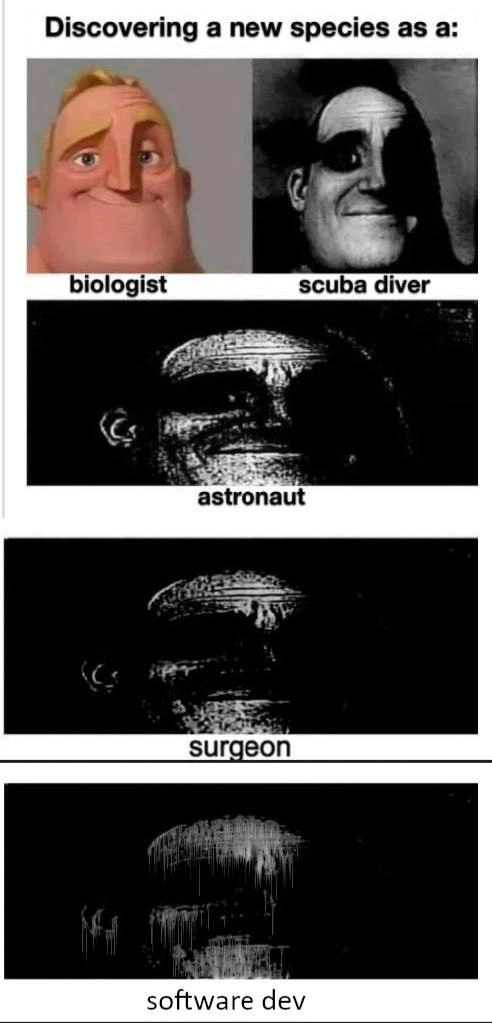
The images in the meme reflect this idea. The biologist and diver are shown with bright, happy faces (because they’re encountering something new and interesting). But for the astronaut, surgeon, and especially the developer, the image used is a black-and-white, distorted face full of static and digital glitches. That spooky face is actually from an internet meme where a character’s face becomes increasingly glitched to show fear or shock. Here, it represents the shock and horror a programmer feels when encountering a crazy bug. In the last panel labeled “software dev,” the creepy glitched image basically says: “Uh oh, the developer found something terrifying in the code!”

In simpler words, the software developer’s "new species" is not a cute animal at all, but a nasty surprise in the code. It’s like when your computer program suddenly starts acting weird – maybe the screen fills with random symbols, or a game character starts stretching in bizarre ways, or the app crashes with a strange error message. Discovering that kind of problem can be pretty scary (or at least stressful) for the person who wrote the code, because they realize something is very wrong but might not immediately know why.

This is where debugging comes in. Debugging (or troubleshooting) means finding and fixing the bug in the code. The meme humorously compares debugging a weird bug to a scientist examining a freaky new creature. The developer has to investigate the strange behavior step by step, almost like they’re dealing with a live thing – poking around to see what it does, trying to understand it, and finally capturing it (fixing the bug). It can be frustrating and surprising, much like trying to catch a wild animal. The meme exaggerates this feeling by giving the developer’s discovery a horror-movie vibe.

This joke is popular in programming circles because it’s relatable. Every coder, even beginners, eventually runs into a bug that makes them go “What on earth is happening here?!” It might not actually scare you like a monster would, but it can definitely make your heart skip a beat when you see your project break in a weird way. The meme just takes that emotion and plays it up. It’s saying: other professionals might find new creatures that are cool or at least manageable, but when a programmer finds a new “creature” in their work, it’s a glitchy computer bug that freaks them out. It’s a light-hearted way to laugh at the frustration and surprise of debugging. After all, if you don’t laugh, you might cry when a bug pops up at the worst time!

Level 3: Beast in the Machine

As a developer with battle scars, I can confirm that stumbling upon a truly bizarre bug can feel like summoning an eldritch horror in your codebase. This meme captures that sensation by contrasting how different professionals react to discovering a "new species." A biologist or scuba diver finds a charming new creature and smiles – just another day at work. But the poor software dev? We get a glitched-out nightmare of a new bug, as if our code decided to spawn a Lovecraftian monster at 2 AM on deploy night.

The visual punchline uses the Mr. Incredible becoming uncanny format. The biologist is shown with a normal, bright face (like Mr. Incredible’s cheerful look), while by the time it says "software dev," we see Mr. Incredible’s face turned black-and-white, distorted with digital noise. It’s a horrifying visage from that meme template, symbolizing how a developer’s “discovery” is not a cute animal but a terrifying glitch. The escalating darkness from scuba diver to astronaut to surgeon to dev implies that in those fields the stakes (and freakiness) are rising. In space or during surgery, finding a new life form is scary enough – but the meme suggests that a dev unearthing a nasty bug is on the same level of dread.

Why is this funny (and painfully relatable)? Because experienced developers know that certain software bugs can be downright nightmarish. We’re talking about those elusive, mind-bending issues that defy logic and only appear in production when thousands of users are watching. It’s that gut-dropping moment when your program starts spitting out gibberish or crashing in a way you’ve never seen. The code that worked fine yesterday now looks like it’s possessed. There’s a running joke in programming that some bugs feel like they have malicious intent – as if the code is alive and hates you. This meme taps into that shared horror. (Ever had a bug so weird you half-jokingly called it a “gremlin in the system”? Yeah, that.)

In practice, such "monstrous" bugs often come from deep, complex issues in the system:

  • Memory corruption can turn normal data into gibberish, much like a photo turning into that glitchy face when read with the wrong assumptions. A stray pointer or buffer overflow in languages like C/C++ will happily create digital nightmares. One minute Mr. Incredible is smiling; the next he’s a corrupted husk – exactly what happens if you mismanage memory in a program. Debugging a memory corruption bug is like chasing a phantom: every time you think you’ve got it, it manifests somewhere else.
  • Concurrency problems (like race conditions in multi-threaded code) can produce baffling, inconsistent behavior. A program might act like Dr. Jekyll in testing and Mr. Hyde (or Mr. Uncanny Incredible) in production, just because two processes finally collided. Seasoned devs have tales of Heisenbugs – bugs that disappear when you try to debug them (observing them changes their behavior, akin to the Heisenberg uncertainty principle). It’s basically a bug that mocks your debugging efforts, hiding whenever you investigate. Talk about a troubleshooting nightmare!
  • Undefined behavior in code (especially in low-level programming) is the ultimate horror: do something the language spec doesn’t allow, and literally anything can happen. There’s an old joke that invoking undefined behavior can make “demons fly out of your nose” – an exaggeration to say it unleashes chaos. In real terms, it might corrupt what’s on screen or cause bizarre side effects that feel like a ghost in the machine. It's the kind of bug where the software isn’t just broken, it’s possessed.

To make matters worse, many of these freaky bugs are the spawn of old technical debt – those shortcuts and kludges inserted to meet deadlines long ago. Perhaps an input check was skipped "just this once," or a piece of messy legacy code was never fully refactored. Under the right conditions, these seemingly small issues mutate and combine into a bug of mythic proportions. By the time it rears its head, every original developer has left or forgotten the context. Fixing it becomes an epic quest that management never budgeted for (because hey, “it worked fine until now”). This is how smart teams end up haunted by the same classes of problems again and again: short-term incentives (ship it now, worry later) inadvertently breed a den of monsters in the codebase.

It doesn’t help that these bugs tend to appear at the worst times (production deploy Fridays, anyone?). The cynical veteran in every developer knows that feeling when an error surfaces at 3 AM, and you find yourself muttering:

“What fresh hell is this?...”

The meme exaggerates this to a cosmic-horror level for comedic effect. The astronaut and surgeon panels escalate the drama (implying even those pros face terrifying unknowns), but then the software developer takes the crown for encountering the ultimate freak of nature (or rather, freak of code). It’s a tongue-in-cheek way of saying: of all the strange discoveries out there, none are as cursed as the ones a programmer finds in a broken codebase at 3 AM.

An extra layer of tech humor: the word “bug” itself was famously popularized when early computer pioneer Grace Hopper literally found a moth stuck in a relay of a Harvard Mark II computer in 1947. They taped the moth into the logbook and joked they were “debugging” the system. That was an actual insect – a plain old moth. If only all our bugs were that simple and cute! Nowadays, our "bugs" are intangible logical monsters that can bring entire applications down. So in a darkly comic sense, modern developers really are discovering new species of digital creatures in their daily work. Every senior dev who’s been on call during a production outage can chuckle (or shudder) at the meme’s implication that finding a wild bug in your software is like discovering a mutant alien – equal parts fascinating and terrifying.

Description

A multi-panel meme using the 'Mr. Incredible Becoming Uncanny' format, which shows the character's face becoming progressively more distorted and horrified. The meme is titled 'Discovering a new species as a:'. The first panel shows a normal, smiling Mr. Incredible for 'biologist'. Subsequent panels for 'scuba diver', 'astronaut', and 'surgeon' show his face becoming increasingly dark, grainy, and terrified. The final panel, labeled 'software dev', presents the most horrifying and abstracted image - a glitchy, melting, almost skeletal version of the face. The humor for experienced developers comes from the escalating sense of dread. While discovering a new species is exciting for a biologist, it becomes progressively more terrifying in more hostile environments. For a software developer, the ultimate horror is discovering a 'new species' of bug, an inscrutable piece of legacy code, or a layer of technical debt so complex and undocumented that it feels alien and monstrous to behold

Comments

25
Anonymous ★ Top Pick Discovering a new species in space might get you killed, but discovering a new species of bug in a 20-year-old production monolith means you've just become its primary caretaker for life
  1. Anonymous ★ Top Pick

    Discovering a new species in space might get you killed, but discovering a new species of bug in a 20-year-old production monolith means you've just become its primary caretaker for life

  2. Anonymous

    Biologists get to name cute axolotls; 20 years in, my “new species” is a distributed Heisenbug that only spawns when a VIP clicks “export CSV” during the nightly shard rebalancing - Lovecraft had it easy

  3. Anonymous

    The only species a senior dev discovers are race conditions that reproduce once every full moon, memory leaks that somehow improve performance, and that one bug from 2003 that's now load-bearing infrastructure nobody dares to touch

  4. Anonymous

    This perfectly captures the software developer experience: while biologists get electron microscopes and astronauts get multi-billion dollar telescopes, we're still debugging production issues by squinting at logs through a terminal that hasn't been updated since 2003, running on a VM with 2GB of RAM because 'it works on my machine' and the budget went to another Kubernetes cluster no one asked for

  5. Anonymous

    Discovering a new species is when the image pipeline renders a gzipped protobuf as UTF‑8 and every avatar becomes cosmic horror - SRE calls it corruption, product calls it a “fun filter.”

  6. Anonymous

    Biologists name discoveries; we file a Sev‑2 for Heisenbugus prod‑only - spotted at 02:17 when tracing was sampled off, a feature flag sat at 47%, and a Turkish‑locale emoji flipped a bit

  7. Anonymous

    Biologists get specimens; devs chase dark matter bugs in unlogged microservices

  8. @feskow 4y

    Dont get about surgeon and software dev

    1. @Odinmylord 4y

      surgeon means that you found some new species inside a patient's body while you were operating

  9. @oleh_kosiakov 4y

    Like alien

    1. @CcxCZ 4y

      SETI still exists, doesn't it?

      1. @oleh_kosiakov 4y

        I guess so

      2. @RiedleroD 4y

        well, christianity also still exists.

  10. @oleh_kosiakov 4y

    But what about Software Dev?

    1. @ArchieWindragon 4y

      Digimon

  11. @oleh_kosiakov 4y

    Maybe something related to specifications?

  12. @feskow 4y

    New male specie (Alpha, beta, omega, sigma)

  13. @Sutetsu 4y

    They probably mean true AI

    1. @sylfn 4y

      bool AI = true;

      1. @ZgGPuo8dZef58K6hxxGVj3Z2 4y

        class AI { public AI() { InitializeArtificialIntelligence(); } }

        1. @qtsmolcat 4y

          Error: 'InitializeArtificialIntelligence' is not a function

    2. @CcxCZ 4y

      The contemporary label is AGI - Artificial General Intelligence. I wholeheartedly recommend the book "AI: A Modern Approach" by Russell & Norvig. The whole first chapter is dedicated to all the various things people might call AI and why and the confusion about the definitions.

      1. @Sutetsu 4y

        Ye, I'm well aware, just figured there wasn't much room for misinterpretation

  14. @Sutetsu 4y

    I do appreciate the gesture regardless

  15. @IlyaOnTheInternet 4y

    English

Use J and K for navigation