The Existential Void of the Mainstream Linux User
Why is this DevCommunities meme funny?
Level 1: Everyone Has the Cool Toy
Imagine you have a really cool toy that no one else has. You feel super special because you’re the only kid in your class who can play with it. 😎 But then one day, suddenly all your friends get the exact same toy too. Now everyone is playing with it, not just you. How would you feel? You might still like the toy, but you’re a little sad because it doesn’t make you unique anymore. You’re not the only special one with that cool thing. This meme is just like that, but for a computer thing called Linux. The person in the picture felt special because he was the only one using that special computer system. Now that everyone else is using it too, he doesn’t feel special anymore and he looks a bit lonely and confused. It’s a funny way of saying, “I liked this thing before it was popular, and now that it’s popular, I miss feeling unique.” It’s like when everyone has the same cool toy – it’s great that others enjoy it, but you kind of miss being the only one.
Level 2: Everyone Uses Linux Now
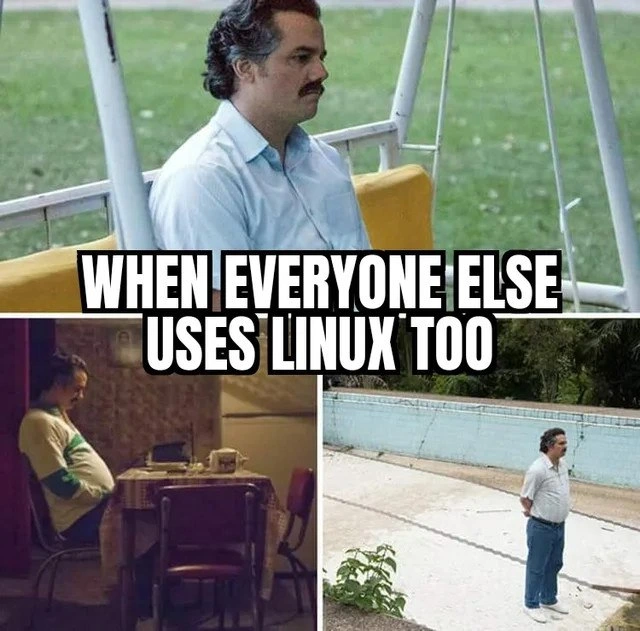
This meme shows a man in three different empty scenes looking bored and alone. The big text says, “WHEN EVERYONE ELSE USES LINUX TOO.” In simple terms, the joke is about a developer who used to feel special for using Linux, but now finds out that everyone around him is using Linux as well. The three panels of him sitting and standing by himself (a popular waiting meme format) make it look like he’s feeling a bit lost or lonely. Why? Because something that made him unique – being a Linux user – isn’t unique anymore. He’s essentially thinking, “I used to be the only one in my group who knew Linux, and that made me cool. Now everyone else does it too, so I’m not special!” The meme humorously exaggerates that feeling.
Let’s break down the key parts. Linux is an operating system (an OS, which is the basic software that runs your computer, managing files and programs) just like Windows or macOS. The big difference is that Linux is open source, while Windows is proprietary. Open source means the software’s code is openly available for anyone to see, use, and change. In contrast, proprietary means the code is closed off and owned by a company (for example, Microsoft owns Windows and you can’t legally modify Windows or see its source code). For a long time, Linux was mainly used by tech enthusiasts, hobbyists, or on servers hidden away in data centers. It wasn’t common to see Linux on everyday desktop computers, especially compared to Windows which was on most home and office PCs. So if you were a developer who ran Linux on your personal machine back then, you stood out. You likely learned a lot of technical skills to get it working smoothly, and people around might have seen you as the “computer guru” or a bit of a rebel for not using the standard Windows.
Now, what does “everyone else uses Linux too” mean in context? It reflects that these days a lot more people (especially in software engineering) have adopted Linux. Over the years, Linux became easier to use and more popular. Friendly versions of Linux (called distributions or “distros” for short, like Ubuntu, Mint, or Fedora) made it simple to install and run. Companies and developers started favoring Linux for programming and deploying applications. Even if someone uses Windows or macOS on their laptop, they might use Linux-based servers or tools (for example, using Linux containers with Docker, or the Windows Subsystem for Linux which lets Windows users run a Linux environment). So in modern dev teams, using Linux isn’t rare – it’s common. Everyone else “switches” too: meaning all the colleagues or fellow coders who used to use something else have now also switched to Linux. The once one-of-a-kind Linux user is now just one of many.
Now, let’s explain the “hipster cred” angle. A hipster (in general slang and in tech culture) is someone who likes things that are unconventional or not popular, often before those things become mainstream. They pride themselves on being different from the crowd. The term cred is short for credibility – basically it means respect or cool points you earn in a community for doing something noteworthy. So, Linux hipster cred refers to the cool-factor or bragging rights a developer got from using Linux back when it wasn’t common. For example, ten years ago if you said, “I run Linux on my laptop,” other devs might react with “Oh wow, that’s cool (and hard-core)!” – that’s cred. But if you say the same thing today, the reaction might just be “Yeah, so do I.” It doesn’t seem special because lots of people do it. The meme is playfully showing that scenario. The man’s lonely, sighing posture in those images is like him feeling bummed out that he can’t feel unique about using Linux anymore.
So, the humor here is about an engineer_identity_crisis in a light-hearted sense. The developer tied part of his identity to being a Linux user – it was something that made him the “different one” among his peers. Now that Linux is widely adopted (linux_mainstreaming), he’s having a mock existential crisis: “If everyone is like me, then am I even cool anymore?” Of course, in reality it’s good news that more people use Linux and open-source software. But developer humor often teases these kinds of feelings. We poke fun at ourselves for how we turn our tool choices (operating systems, text editors, programming languages) into personal badges. This meme, using the well-known “waiting Pablo” image, illustrates that joke in a very visual way. It’s basically saying: Yesterday I was a unique penguin in a world of windows, today I’m just another penguin in the colony.
Level 3: Hipster Cred Kernel Panic
In this meme, a solitary man (the famous “waiting Pablo Escobar” scene from Narcos) sits and stands in empty settings, captioned “WHEN EVERYONE ELSE USES LINUX TOO.” It’s depicting a seasoned developer’s unique Linux identity evaporating as Linux goes mainstream. Once upon a time, running Linux on your personal machine gave you instant tech street cred – a rebel vibe in a world dominated by Windows PCs. In many DevCommunities, your choice of operating system was a badge of honor. Being “the Linux guy” at the office or in your friend group meant you were part of an exclusive club, fluent in command-line arcana and open-source ideology. But fast-forward to today: Linux is no longer a quirky niche, it’s practically the norm in engineering circles. The humorous punchline is that our veteran Linux user, who used to bask in his hipster OS coolness, now sits alone with a bewildered expression. Everybody else uses Linux too, so his once-special identity isn’t so special anymore – cue the hipster cred existential crisis.
This is a classic case of “I liked it before it was cool.” The meme’s comedy stems from that irony. Imagine a developer who spent years mastering shell scripts, memorizing obscure vim keybindings, and compiling custom kernels – partly for the love of it, and let’s admit, partly to stand out as the ultra-geek. There’s even a well-known joke in Linux culture:
Dev A: “I use Arch, by the way.”
Dev B: “We know... you mention it every 5 minutes.”
Arch Linux (and similarly Gentoo, Slackware, etc.) are distributions that require extra tinkering, so bragging about them became a meme for flexing Linux prowess. That was the Linux hipster ethos: doing things the hard way for the glory. Back then, setting up Linux often meant wrestling with hardware drivers and editing config files by hand. Achieving a working Linux desktop in the early 2000s was a minor rite of passage – something not every developer dared to attempt. This effort bought you credibility in certain tech circles. You were the one who could say, “Yeah, I run Linux,” and get nods of respect (or at least a confused why? from the Windows folks).
But now, the landscape has flipped. Thanks to user-friendly distros like Ubuntu and Fedora, and tools like Docker and WSL (Windows Subsystem for Linux), running Linux is easier and more accessible than ever. New developers spin up Ubuntu or a Debian container without breaking a sweat. Heck, even Windows users can open a Ubuntu terminal on Windows 10 as if it were a normal app – no dual-boot acrobatics required. In the industry at large, open source won the war: our servers, cloud infrastructure, and developer toolchains overwhelmingly run on Linux. It’s not just the stereotypical “basement dwelling hacker” OS anymore; it’s the default for deployments and a common choice for development machines. When even the once Linux-skeptical enterprise companies and Microsoft itself embrace Linux, you know the penguin 🐧 has gone mainstream. That once-exclusive Linux club is now a packed house party. Our forlorn meme protagonist is basically experiencing a hipster’s paradox: the joy of seeing your favorite tech become popular, mixed with the silly sadness that you’ve lost your edgy exclusivity.
From a senior developer’s perspective, this meme pokes fun at our habit of tying personal pride to tech choices. It forces a knowing smirk: we all remember something in our career that was niche when we learned it (maybe a programming language, framework, or tool) which suddenly blew up. There’s that moment of, “Well, I asked for this success… but now I’m not the special one.” It’s an inside joke about developer culture. The images of the man listlessly sitting and standing alone dramatize the feeling of “Now what?” The empty swing, the deserted pool – they symbolize the emptiness a geek might jokingly feel when their once-funky thing becomes a common baseline. It’s like an early Linux adopter reminiscing: Remember when installing Debian was an elite skill? Now even our interns deploy code to Kubernetes clusters running Linux. The meme exaggerates this feeling to absurdity, of course – in reality, most of us are happy more people use the better tool. But the comedy lies in that tiny ego sting of losing your hipster aura.
Historically, it’s also a nod to how far Linux and open-source have come. In the ’90s and early 2000s, suggesting Linux at work got you strange looks; today it’s often assumed. The linux_mainstreaming is real: from supercomputers to your smart fridge, Linux is everywhere. The meme’s veteran is essentially experiencing what happens when a counterculture becomes the culture. It’s akin to a punk music fan from the garage-band days hearing their favorite punk song in a supermarket – a mix of pride and playful disappointment. The phrase “When everyone else uses Linux too” summarizes this journey from niche to norm. And yes, it’s a first-world problem for sure – going from being special to being just one of the crowd. The engineer_identity_crisis here is tongue-in-cheek. The meme is saying: “I defined myself by using Linux and being different. Now I’m ironically back to feeling ordinary… time to find a new quirk!”
So, what’s a former Linux hipster to do? Our lonely protagonist in the meme might be pondering exactly that. Perhaps he’ll seek out an even more obscure tech hobby to reclaim that feeling – maybe running a ultra-minimalist BSD distribution or setting up a retro Commodore 64 as his daily driver. In developer fashion, there’s always a next level of nerd cred if you dig deep enough. He might even joke about doing the unthinkable: switching back to Windows or using some niche operating system, just to be different again, now that Linux is the norm! The humor lands because it’s poking at that little part of every senior engineer that wants to be not just good, but uniquely cool in their tool choices. In the end, it’s a self-deprecating laugh at how we geeks can turn even a positive trend (more Linux users! open-source wins!) into a moment of personal melodrama. After all, as Syndrome quipped in The Incredibles: “When everyone’s super, no one is.” Here, when everyone’s a Linux user… no one’s a Linux hipster. 😅
Description
A three-panel meme using the 'Sad Pablo Escobar' format, featuring actor Wagner Moura as the character looking lonely and contemplative in various settings. A large, bold white text overlay reads, 'WHEN EVERYONE ELSE USES LINUX TOO'. The top panel is a close-up of him on a swing, the bottom left shows him sitting alone at a table, and the bottom right shows him standing by an empty pool. The meme humorously captures the identity crisis of a seasoned Linux user who once derived a sense of uniqueness or technical superiority from their choice of operating system. Now that Linux is widely adopted in development environments (e.g., via WSL, Docker, cloud servers), the feeling of being part of an exclusive, elite club is gone, leaving a comical sense of emptiness
Comments
24Comment deleted
I used to feel like a wizard for daily driving Arch Linux. Now my PM spins up an Ubuntu container in Docker faster than I can remember the pacman flags. The mystique is gone
Nothing like the intern showing off their fresh WSL install to remind you the .bashrc you once hand-tuned between kernel recompiles is now just page three of the corporate onboarding checklist
After 20 years of compiling kernels and explaining why systemd is controversial, you finally achieved the dream of universal Linux adoption - only to realize your entire personality was built on being the contrarian who uses 'btw I use Arch' as a conversation starter at every standup
The eternal paradox of the enterprise Linux desktop user: you've mastered systemd, compiled your own kernel, and can recite the GNU manifesto from memory - yet you're still the person IT calls when they need to SSH into production servers, while simultaneously being told your laptop 'isn't supported' for the corporate VPN. At least you're not alone in your loneliness; there are dozens of us. Dozens!
Desktop Linux: scales to one user perfectly, every server cluster begs to differ
When everyone else uses Linux too, the flex shifts from “I run Arch, btw” to “I can explain why PID 1 is eating signals in Kubernetes.”
Now that everyone runs Linux, 'btw I use Arch' isn’t a flex - status comes from upstreaming a kernel patch before the postmortem ends
use freedos then Comment deleted
switch to freebsd Comment deleted
Make your own os Comment deleted
maybe later Comment deleted
oh, nah. There's plenty of elitism inside the linux fandom community. right, @borgar_umlaut? Comment deleted
No longer there is one OS to scoff about. Instead you get hundreds of separate software choices, plus distribution to tie them together. Much harder to not find something you disagree about. What do you mean you don't compile your own kernel? Comment deleted
I do compile my own kernel tho Comment deleted
because there's no binary for the realtime kernel :/ Comment deleted
why do you need one tho? just curious Comment deleted
pipewire and the coolness factor Comment deleted
makes sense. It worked Comment deleted
nice Comment deleted
what do you mean compiling kernel, why dont you write it from scratch? Comment deleted
Can't call it Linux then. But microkernels surely are fun. Comment deleted
also you don't really have a choice about most software if you choose ubuntu - or a similar distro. Comment deleted
No, wrong i would be genuinely happy if they did Comment deleted
Good english = i like Comment deleted