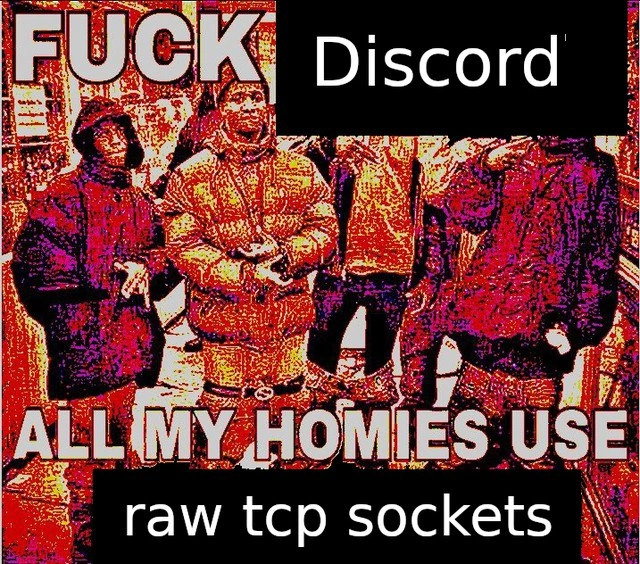
Forget Discord, Real Ones Use Raw TCP Sockets
Why is this Networking meme funny?
Level 1: Two Cans and a String
Imagine you have a bunch of friends who usually talk to each other using a group chat app on your phones – like a big walkie-talkie that lets everyone speak and listen easily. Now picture one day you all say, “Forget this app, we’re going to do it the hard way!” Instead of using the normal app, each of you grabs a long piece of string and connects it to tin cans to make your own little telephone line. 📞 You stretch strings between all your houses so you can talk by pulling the string tight and speaking into the cans. It sounds silly, right? The joke here is kind of like that. Discord is the easy phone app everyone uses to chat, and “raw TCP sockets” is like the string-and-can telephone – a very basic, old-fashioned way to send a message. The meme is funny because it’s as if these friends are bragging, “We’re so cool, we don’t even use regular phones; we talk through our homemade gadget!” It’s an absurd claim, and that’s why it makes people laugh. The idea of ditching something convenient for an unnecessarily difficult method is just plain goofy. It’s showing off in a playful, exaggerated way – like saying, “We’re too tough for the easy stuff, we do everything the hardest way possible!” Everyone knows using the can-and-string (or in computer terms, the raw low-level connection) would be inconvenient, so it’s a fun, over-the-top joke about being overly old-school just to be different.
Level 2: Back to Packet Basics
Let’s break down what’s going on here in more straightforward terms. This meme jokes that a group of developer friends decided to stop using Discord (a popular chat application) and instead communicate by sending network messages directly using raw TCP sockets.
First, what is Discord? It’s an online service (often used by gamers and programmers) that lets you create servers, join channels, send text messages, voice chat, share images, etc. In short, it’s a full-featured chat platform – a polished application that sits on top of lots of technology. When you use Discord, you don’t see any of that underlying complexity; you just type your message or talk, and Discord handles all the networking behind the scenes to get your communication to your friends. That’s abstraction: Discord provides a simple interface and hides the gritty details like network connections, data formatting, and encryption.
Now, what does “raw TCP sockets” mean? This is diving down into the plumbing of how computers talk over the internet. TCP stands for Transmission Control Protocol. It’s one of the core protocols of the internet, responsible for making sure data you send reaches the other end reliably and in order. A socket is like an endpoint for sending and receiving data – you can think of it as one end of a pipe. When two computers chat using TCP sockets, they have a logical pipe between them: one computer’s socket is connected to the other’s. Whatever one side writes into the pipe, the other side can read out.
When the meme says “raw TCP sockets,” it implies they’re not using any fancy chat protocol or application-layer format on top – just the raw pipe provided by TCP. It’s like using the most basic method possible to send text from one computer to another. To give an analogy in tech terms: imagine you want to have a phone call. Using Discord is like dialing your friend’s number and letting the phone network handle everything. Using raw TCP sockets is like stringing a direct wire from your house to your friend’s house just for this call. It’s much more low-level and hands-on.
In practice, how would friends “hang out over raw TCP socket chat”? They’d probably use a simple program or command. For example, there’s a tool called netcat (nc for short) that can open a network connection. One friend might run nc -l -p 1337 on their machine to “listen” (wait for a connection) on port 1337, and another friend would run nc <IP-address> 1337 to connect to them (using the first friend’s IP address). Once connected, anything one types will appear on the other’s screen. This is about as bare-bones as online chat can get – it’s literally just sending characters back and forth, no formatting, no usernames, nothing. You’d have to manually type your name like “Alice: Hello” so the other person knows who’s speaking, because the tool itself doesn’t know about identities or chat rooms. It’s essentially the DIY approach to Communication: you are creating your own little private link and making up the rules as you go.
So why would anyone do this? In reality, they usually wouldn’t for day-to-day chatting – this is largely a joke. But the humor targets the idea of being “too cool for” convenient services. In developer humor, there’s often a theme of going back to the fundamentals. OldSchoolNetworking refers to how people did things in the early internet days or even before modern user-friendly software existed. Back then, if you wanted to chat, you might actually use very simple methods. For instance, early internet users and sysadmins could use commands like talk or open raw connections to communicate, because advanced chat programs weren’t around yet. Over time, better protocols (like IRC, which is Internet Relay Chat, and later things like XMPP or HTTP-based chat) were created to make communication easier and richer. And today, we have ultra-polished apps like Discord that run on our behalf.
What the meme jokes about is essentially throwing away decades of progress in ease-of-use, and returning to a super primitive method – just to be different (or “hardcore”). The phrase “F*** Discord, all my homies use raw tcp sockets” is written in big bold letters to mimic a known meme format. It’s an internet meme style where people say “Forget X, all my friends use Y” to emphasize a strong preference for something that’s usually niche or humorous. The profanity and the bold text are there to exaggerate the attitude. It’s deliberately brash and over the top. Discord gets a black bar over it in the image (like it’s being censored or crossed out), which adds to the aggressive, rebellious tone. Then “raw tcp sockets” is highlighted at the bottom as the cool alternative. This template of meme usually comes from a place of comedic irony – obviously, in real life, not all your friends would be doing this, and probably the person saying it is half-joking to begin with.
From a Networking perspective, using raw sockets means you forego any user-friendly protocol. Usually, when we build network applications, we use some protocol that adds structure. For example, when you send an email, you don’t manually open a socket to your friend’s mail server and type gibberish – your email client speaks SMTP (Simple Mail Transfer Protocol) for you. When you chat using a web app, your browser might be using HTTPS or WebSocket protocols under the hood. In all these cases, the programmer didn’t have to manually handle every little detail; the protocol (and the libraries implementing it) did a lot of work. If you go “raw,” you’re basically saying, “I’ll handle everything myself.” That’s why this is LowLevelProgramming humor – it’s about stripping away high-level help and working at the most fundamental level you can while still functioning.
Let’s clarify some terms from the tags to ensure everything’s clear:
- TCP: A core protocol that ensures data sent between two computers arrives intact and in order. It’s like a certified mail service for the internet – you get confirmations that things arrived, and if they get lost, it tries again. It operates at a low level, concerned with packets of data, not with the meaning of the data.
- SocketProgramming: This is writing code that uses sockets to send/receive data over a network. Many programming languages have socket libraries (like Python’s
socketmodule, or Java’sSocketclass). It’s a step above raw packets – you don’t have to manually construct IP packet headers (the OS does that), but you do have to worry about things like connecting to the right address/port, reading byte streams, etc. It’s a common way to teach network programming because it exposes how data moves without the complexity of writing the actual protocol algorithms (since TCP handles the low-level reliability). - LowLevelProgramming: Generally, programming with very little abstraction, close to the way the machine or network actually works. It might mean C or assembly language in a computing context, or here it means not relying on big frameworks or systems – just the bare essentials.
- Networking Humor: Jokes that land best with folks who understand network concepts. This meme will definitely be funniest to those who know what TCP sockets are. If you don’t, the phrase might sound like technobabble, which is part of the charm too – it’s nerdy by design.
- anti_abstraction / abolish_saas_chat: These tags indicate the theme of rejecting abstraction and SaaS (Software as a Service) solutions. Discord is a SaaS product – a big cloud-based service. The meme’s attitude is “we don’t need this fancy hosted service, we’ll make our own solution from scratch.” It’s a bit of a rebel cry against relying on big platforms.
- hipster_protocol_choice / old_school_networking: This highlights the ironic, counter-mainstream choice of using an old method in place of a new one. Just like a hipster might prefer vinyl records to streaming music (for the aesthetic or authenticity), a “tech hipster” in this meme prefers 1970s-style networking (sockets were introduced with BSD Unix sockets API in the early ’80s) to 2020s style slick apps.
For a junior developer or someone new to networking, it might help to imagine the practical differences: If you use Discord, you join a server or a group with a click, you see who’s online, you have a chat window, you send a message and it pops up labeled with your name, maybe an avatar, and Discord logs it so others can see it even if they come online later. If you use a raw TCP socket, what do you get? Likely a black terminal screen with text. You’d have to type something like “Hi, it’s Bob” and hit Enter, and your friend on the other side sees “Hi, it’s Bob” appear. They might reply “Hey Bob, it’s Alice.” Once that screen closes, the chat is done – unless one of you was saving the text, there’s no history. If one of you was offline, tough luck – you can only communicate when both sides are actively connected at the same time. And if three people want to chat, you have to either open three separate connections or one central program that relays messages. Basically, it’s possible but cumbersome.
The Communication category here underlines the point: this meme is about how we communicate digitally. The normal way (Discord, Slack, Microsoft Teams, etc.) involves tons of infrastructure to make it seamless. The “raw” way is fundamentally just two computers sending bytes. Imagine the simplest phone call vs a conference call with fancy features – the former is akin to raw TCP, the latter akin to Discord. The joke celebrates the simplest form as if it’s the best, with a wink and nod that this is a bit crazy.
One more thing to note is the aesthetic of the meme – the distorted, low-res image and heavy saturated color is purposely evoking a kind of underground or retro vibe. It looks almost like a meme from an earlier internet era (when images were low quality and garish due to limitations). This matches the theme of going “back to basics” technologically. Even the style says: “we’re not polished and corporate; we’re raw and unrefined.” It’s part of the humor package – every element, from the visuals to the wording, leans into the idea of being proudly low-tech in a world of high-tech options.
In summary, the meme is funny because it claims an outrageous stance: “We don’t use a modern chat app that everyone uses; we crafted our own ultra-minimal way to chat, and we act like that’s superior.” It’s tongue-in-cheek. For someone new to tech, just know that nobody is literally expected to chat over raw TCP sockets for fun – it’s a joking exaggeration. The underlying lesson though is kind of interesting: all those fancy apps are built on simpler pieces. This meme just imagines taking away all the polish and using the bare pieces directly – which is simultaneously educational (to think about) and ridiculous (to actually do socially). It’s the contrast between what’s easy and what’s possible that gives the meme its kick.
Level 3: Reinventing the Chat Wheel
On the surface, this meme takes a classic internet trope – “F *bleep* Discord, all my homies use raw tcp sockets” – and uses it to lampoon the hardcore programmer mentality. The image is deliberately over-the-top: a crew of guys in puffy jackets striking a tough pose, with grainy red-orange filtering like a bootleg gangster photo. One of them even has a pixelated face for that anonymized “you don’t mess with us” vibe. It’s a known meme format where you proclaim extreme loyalty to some niche thing (and hatred for the mainstream alternative) as if it’s a street gang allegiance. Here, the mainstream target being dissed is Discord – a hugely popular chat service – and the niche allegiance is to raw TCP socket chat. The humor comes from the absurd mismatch: these dudes look like they’re about to drop a mixtape or run a block, but instead they’re bonded by low-level network programming. It’s an unexpected collision of worlds. In developer circles, that juxtaposition is comedy gold.
Why is this funny to people in tech? Because it’s exaggerating a real phenomenon: the anti-abstraction hipster. We’ve all met that programmer (or maybe were that programmer) who scoffs at whatever convenient tool everyone else is using. “Discord? Slack? Those are for normies. Real geeks use telnet and hand-rolled protocols!” – said no truly sane person, ever… except as a joke. There’s a kernel of truth that makes it relatable: developers sometimes do pride themselves on knowing the gritty inner workings. Maybe you’ve heard someone brag, “I don’t use game engines, I write directly to OpenGL,” or “Who needs WordPress, I’ll write my site in pure HTML and CSS.” It’s that LowLevelProgramming flex, the idea that using bare-bones technology somehow makes you more legit. This meme just cranks that knob to 11, claiming an extreme stance where a whole friend group has supposedly ditched a perfectly good chat application in favor of essentially typing bytes at each other over a socket. The phrase “all my homies use ___” implies a kind of peer pressure and group pride. It’s funny because you can imagine this clique of contrarian dev friends hyping each other up: “Yo, GUI chat is for scrubs. We’re gonna nc into each other’s machines and it’s gonna be lit.” It satirizes that subculture of devs who one-up each other with how close to the metal they can get.
In reality, of course, no one is seriously running a daily group chat via raw sockets (at least, I hope not – unless they really love pain). But many of us have tried something similar on a smaller scale, either out of curiosity or necessity. A senior engineer might reminisce: “Back in the day, before Discord or Slack, some of us actually used simple tools like talk on Unix or basic IRC for group chats. And on occasion, for kicks, we’d open a direct telnet or netcat connection to chat with a buddy in the lab. It was incredibly primitive, but it worked.” That experience is exactly why the meme resonates and amuses – we know first-hand how bare-bones it feels, and how much functionality we take for granted in modern apps. The senior perspective here is a mix of nostalgia and a chuckle at the naivety: Sure, using raw sockets sounds cool until you realize you miss things like message timestamps, or even just scrolling up to see what someone said 5 minutes ago. The meme’s text basically says “screw Discord,” as if Discord is some unnecessary fluff. A seasoned dev knows Discord is not just fluff – it’s there because people got tired of the very hassles our homies are about to face. The joke is almost a cautionary tale: “Go ahead, reject modern comforts… see how fun it is to reinvent the chat wheel.”
Let’s paint the scene that the meme implies. One guy in the friend group, probably the resident tech rebel, says: “Discord is too mainstream, it’s owned by a big company, it’s bloated with Electron, whatever. Let’s just use a direct socket connection to chat.” Instead of clicking a nice app icon, these homies are firing up terminal windows or a custom lightweight client they coded. Perhaps one friend runs a little server script on their machine listening on port 1337 (because of course it’s 1337) and the others connect using an IP address. Now their screen looks something like a hacker movie – just text appearing as they type. Maybe they feel super cool: no usernames, no avatars, just raw text with maybe an IP or a nickname preceding it. It’s basically an IRC experience stripped even further down. (IRC at least has channels and slash commands; these guys have literally nothing beyond what they code.) The image’s aggressive style – that bright red filter and giant block text – parodies how proud they are of this arrangement. One can imagine them saying, with absolute seriousness: “Yeah man, Discord’s for sellouts. We communicate the real way now.” It’s dripping with irony, because to any sane observer, this is a ridiculous length to go to just to send messages to your friends.
We also should appreciate the visual edit in the meme: the word “Discord” is slapped over the original text (which likely was something else in the base meme format). The big “FUCK” in the corner and “ALL MY HOMIES USE ____” are part of a known meme template that usually ends with a punchline replacement. By blacking out whatever used to be there and inserting “raw tcp sockets,” the creator of this meme is explicitly roasting Discord. This resonates with developers who might have a love-hate relationship with Discord or similar platforms. (Discord is awesome for communities, but it’s also somewhat heavy on resources, not open-source, etc. So it has its detractors in the tech crowd.) The meme exaggerates that dislike to a comical extreme. It’s not merely saying “we prefer an alternative chat app,” it’s saying “we’ll drop to the lowest possible level of networking rather than use Discord.” That’s like saying “I’d rather use two tin cans and a string than a telephone” – which is hilarious when the telephone is working perfectly fine.
From a senior dev perspective, the humor also lies in the impracticality. We’ve seen abstraction save our butts time and again. Writing directly to sockets for something as common as chat is like using assembly language to write a blog post – doable, but why?! The phrase “raw tcp sockets” itself is very much a NetworkEngineering term; it’s not something you’d hear outside of programming contexts. So placing it in big bold letters in a meme is already self-parody for techies. It’s essentially a nerdy shibboleth – only those who know what a TCP socket is will fully get the joke. And those who do know are likely chuckling because the idea triggers memories of either college networking class or debugging low-level socket code with Wireshark at 2 AM. It’s the sort of thing that gives experienced devs a mix of amusement and a slight shiver. We recall that implementing even a simple chat on raw sockets means handling newline delimiters and concurrent connections and thinking about what happens when someone’s Wi-Fi drops – all the stuff Discord’s engineers have solved and we don’t want to redo on a lazy Saturday. So the meme is funny because it’s knowingly masochistic. It’s making fun of that impulse some devs have: “I can build this myself!” – which sometimes is admirable and educational, but other times it’s reinventing the wheel with square tires.
To ground it in reality, here’s a small example of what these “homies” would actually do to live out their raw-socket dream:
# Friend A (server) opens a listening socket on port 1337
$ nc -l -p 1337
# Friend B (client) connects to Friend A's machine (IP 192.168.0.42) on that port
$ nc 192.168.0.42 1337
# Now whatever Friend B types, Friend A will see, and vice versa.
# This is literally a bare-bones chat.
(In this nc usage, “nc” stands for netcat, a simple networking utility. It’s basically creating a raw TCP connection between Friend A and Friend B. There’s no login, no encryption, no interface – just text going over the wire.)
Using nc like this is something of a hacker party trick; it proves the point that, yes, you can chat with nothing more than a socket connection. It’s cool for about 5 minutes. Then you realize, hey, there’s no scrollback — if the text runs off the top of my terminal, it’s gone unless I piped the output to a file. And if a third friend wants to join, well, tough luck unless we turn one of our machines into a rudimentary chat server that relays messages. This is where the senior dev shakes their head and grins: the meme is a perfect satire of the “I don’t need modern tools” attitude, showing how quickly that confidence would crumble in a real scenario.
Humor aside, there’s a subtle camaraderie in this joke as well. The phrase “all my homies use ___” implies a sort of united stance. It’s poking fun but also saying “my crew is in on this joke.” In niche tech subcultures, it’s common to bond over inside jokes and exaggerations. Declaring allegiance to Layer4Only communication is a tongue-in-cheek way to signal “I’m a networking nerd and proud of it.” It’s like a club password for those who have spent late nights debugging socket code. The hipster_protocol_choice angle (ditching a popular platform for an esoteric solution) also parodies how in tech, there’s always that one alternative-minded group using some obscure tooling “because it’s cool to be different.” Think of the folks who run Linux on a toaster, or insist on using ed(1) as their text editor – it’s absurd but endearingly so.
In summary, the senior perspective sees this meme as a multi-layered joke: it mocks high-level services in favor of old-school networking, but it’s self-aware. We laugh with it because we know no one’s truly that nihilistic about convenience – the exaggeration itself is the punchline. And we laugh at it a bit too, imagining the chaos and inconvenience if someone actually tried to sustain a friend group chat this way. It’s a send-up of the eternal developer tension between abstraction vs. control. After all, every abstraction (like Discord) is built on layers of lower tech (like TCP). Some of us feel macho skipping layers… until we stub our toes on all the hard problems those layers solved. This meme captures that ironic cycle in one loud, brash, distorted image. F** Discord? Sure, kid. Call me when you’ve written 10,000 lines of code to replace what that one Electron app did for you.* 😏
Level 4: Sockets Over SaaS
At the deepest technical level, this meme pits a bare-metal networking approach against a fully-featured cloud service. Discord lives high up the stack – an application-layer (Layer 7) platform with countless layers of abstraction: TLS encryption, WebSockets or HTTP for messaging, dedicated servers, databases for message history, and an entire app interface. In sharp contrast, raw TCP sockets operate down at Layer 4 of the OSI model (Transport Layer) – just barely above sending raw IP packets. By proclaiming “to hell with Discord, we’re using raw TCP,” the meme glorifies stripping away all those high-level protocols and conveniences. It’s like saying: forget the fancy chat API, we’ll communicate by directly manipulating the stream of bytes flowing between our machines. This is a celebration of LowLevelProgramming – embracing the primitive building blocks of Networking that high-level apps normally hide.
Let’s unpack what using a raw TCP socket entails. TCP (Transmission Control Protocol) itself is pretty fundamental: it provides a reliable, ordered byte stream on an unreliable network. Under the hood, TCP handles segmenting your data into packets, acknowledges their delivery, and retries if packets get lost (thanks to the classic SYN, SYN-ACK, ACK three-way handshake and sequence numbers). But that’s all it does. When our proud developers say they chat over a raw socket, they really get just that: a basic pipe between two IP addresses that guarantees the bytes arrive in order. There are no built-in commands, no user identities, no channels or chatrooms, no message history, no rich text – nothing beyond what the OS’s socket API provides. All the “chat app” functionality lives either in the users’ heads or in extra code they’d have to write themselves. In essence, the friends have to create their own mini-protocol on top of TCP. Want multiple distinct messages? You’ll need to agree on a format or delimiter (maybe newline \n separated text, or a length prefix) because TCP itself doesn’t know about message boundaries – it’s just a stream of bytes. Want encryption for privacy? Raw sockets won’t give you TLS unless you implement it or layer on something like OpenSSL. The meme’s joke is flaunting this manual, do-it-yourself approach as if it’s superior to using Discord’s battle-tested, feature-rich system. It’s a bit of tongue-in-cheek bravado about rejecting “fancy” abstractions in favor of “real” programming.
From a network engineering viewpoint, using raw sockets for group chat quickly hits some serious challenges that high-level services usually solve for you. First off, direct connections require knowing your friends’ IP addresses and opening network ports. In a local LAN this is trivial, but over the internet it’s a minor adventure. Modern home networks sit behind NAT (Network Address Translation), meaning your computer’s IP isn’t directly reachable from outside without special setup. Discord works around this by having central servers (so all clients initiate outgoing connections, avoiding the inbound firewall/NAT issue) or by using techniques like STUN/TURN for peer-to-peer voice. If “all my homies” are truly using raw TCP, at least one homie has to play server: they’d call socket.bind() on a public IP/port and accept incoming connections, and the others must somehow get that IP and connect to it. This probably means someone is texting “hey, my IP changed, it’s 47.92.x.x, connect now” – a far cry from clicking a Discord invite link. And heaven forbid if a friend’s router doesn’t allow the port – that’s a dead homie until network config is fixed. The gritty truth is that bypassing SaaS means taking on all the messy network plumbing yourself.
Then there’s the issue of scalability and group chat. Discord channels can host hundreds of people because a whole infrastructure handles message routing, fan-out, and storage. In raw-socket land, if you want a multi-way chat, you have two options, both crudely amusing. Option 1: designate one friend’s machine as the central server; everyone connects there, and that server app (which one of the “homies” had to code) relays messages to everyone else. Congratulations, you’ve just reinvented a primitive chat server (basically what IRC servers have done since the ‘80s). Option 2: go peer-to-peer mesh – every homie opens sockets to every other homie in some fully-connected nightmare. With n friends, that’s potentially O(n^2) connections and you now have to broadcast your message on n-1 sockets each time you want to say “lol.” It’s distributed systems 101 in the worst way. Handling who is connected, who left, and not flooding everyone’s network? That’s all on you now. This is where the heroic veneer of “raw TCP chat” starts to crack under real-world complexity. The meme doesn’t mention these headaches, but any senior engineer reading it can’t help but smirk, imagining the first time one of these guys has to debug why Homie #5 continuously drops off chat due to a NAT timeout or why two messages collided and garbled each other because there was no message framing.
Ironically, despite all this anti-abstraction swagger, our raw-socket purists are still relying on some abstractions – namely, the OS and the TCP protocol itself (which is quite sophisticated). They haven’t gone all the way down to crafting raw IP packets with their own custom transport protocol (that would be truly “bare metal” communication – and practically a form of masochism). They’re using the system’s built-in TCP stack, which handles congestion control, packet reassembly, etc. In other words, they trust the decades-old TCP implementation to do its job, but they don’t trust a modern chat service to do its job. It’s a selective rejection of layers: Layer 4 is apparently cool, but anything above that, nah, too much hand-holding. It’s a bit like saying, “I refuse to drive a car with automatic transmission, real drivers use stick shift” – even though you’re still driving a car and not, say, riding a horse. There’s a purist mentality in tech that equates lower-level control with virtue or skill. This meme cranks that attitude to an absurd extreme: ditching a polished communication platform in favor of the most rudimentary network mechanism possible and then bragging about it.
In theory, running a chat over raw TCP could be slightly more efficient in terms of overhead – no JSON payloads, no encryption overhead (if you skip TLS), and no electron-based desktop app hogging memory. But in practice, the performance gain or latency reduction is negligible for typical chatting. Discord’s messaging is already essentially realtime and lightweight in bandwidth. The only heavy parts of Discord are things like loading the whole app, UI elements, or very large communities – none of which you’re going to replicate with a raw socket anyway. The meme isn’t really about performance though; it’s about a philosophical stance in programming: the idea that using super low-level tools is somehow more authentic or worthy of respect. It satirizes that mindset by implying these guys trashed a perfectly fine service (Discord) just so they could flex their low-level networking muscles. Networking at the packet level has a certain old-school hacker glamour – you imagine people hunched over hex dumps and RFCs, doing things “close to the metal.” The meme taps into that image, and then dials it up to ridiculousness. After all, proudly saying your entire friend group chats on nothing but send() and recv() calls is about as over-the-top as it gets in the Communication tech spectrum. It’s both a nod to how cool low-level coding can be and a gentle roast of those who fetishize it over practical solutions.
To summarize the technical absurdity with a dash of reality, here’s what our homies have signed up for by rejecting Discord and going with raw sockets:
- Manual Connection Handling: They need to manually manage IP addresses and ports. No friendly usernames or invite links – it’s “yo, what’s your IP today?” and hoping the port’s open. The NetworkHumor here is that they’ve basically become their own IT department for a group chat.
- DIY Protocol Design: Since it’s just a TCP byte stream, the friends must agree on how to mark the end of a message or differentiate users. Maybe they’ll each prefix their name to every line, or use special delimiter characters. They’re re-inventing what established chat protocols (IRC, XMPP, etc.) already solved.
- No UI/UX Conveniences: Notifications, message history, typing indicators, even something as simple as distinguishing one friend’s text from another – all that is gone. At best, they’re staring at a terminal or a very simple custom app. It’s Communication in the rawest form: text in, text out.
- Feature Gap: Sharing images, reactions, editing messages, group voice chat? Not happening over a plain socket unless they build those features from scratch (good luck streaming voice data or screen-sharing without a protocol!). The meme’s TechHumor is partly about imagining these guys boast, “Sure we don’t have emoji or voice chat, but who needs that when you have raw packets, amirite?”
- Reliability and Maintenance: If something breaks – say a friend’s connection drops – there’s no support team or robust infrastructure to handle it. It’s on the homies to debug (“Is it the code? The network? Did someone’s mom turn off their PC?”). They’ve traded the convenience of a managed service for full ownership of every problem. A senior engineer sees this and just chuckles darkly: been there, done that, rather not wake up at 3 AM to reboot the homemade chat server.
In true low-level NetworkProgramming fashion, the group has basically rebuilt a tiny fraction of Discord’s functionality, without any of the safety nets. And yet, that’s exactly what gives the meme its comedic, almost admirable flair – it’s an exaggeration of the developer pride in understanding the fundamentals. “We don’t need your fancy apps, we’ll make our own pipeline!” It’s both ludicrous and technically intriguing. After all, there’s a slight thrill in knowing one could pop open a socket and send a string “Hello?” to a friend’s IP and get a “Hey!” back – it’s like two computers talking with nothing in between but raw data. The meme plays on that thrill, and then magnifies it into a rebellious group activity. To a networking veteran, the whole thing is hilariously impractical; to a networking newbie, it’s mystifyingly cool that such a thing is even possible; and to the meme connoisseur, it’s just a brilliant mashup of gangsta attitude with nerdy subject matter. It’s a perfect storm of NetworkHumor and irony layered on a grainy, over-saturated image.
Description
A deep-fried meme featuring a group of people in winter jackets. The top text says "FUCK Discord" with "Discord" in a black box. The bottom text says "ALL MY HOMIES USE raw tcp sockets" with "raw tcp sockets" in a black box. This meme is part of the 'All My Homies Hate' format, which expresses a strong, often ironically exaggerated, preference for one thing over another. The technical joke contrasts the high-level, user-friendly Discord application with the fundamental, low-level approach of using raw TCP sockets for communication. This resonates with experienced developers who understand the underlying networking principles and appreciate the humor in choosing a difficult, foundational technology over a convenient, abstracted one

Comments
7Comment deleted
Why use a feature-rich, multi-channel communication platform when you can spend three days debugging a single handshake?
Our crew’s chat app is a raw TCP socket: typing indicator is the ACK storm, read receipt is the FIN-ACK, and the only emoji we support is a stray RST when someone rage-quits
"We spent three sprints implementing our own chat protocol over raw TCP before realizing we'd just built a worse version of IRC from 1988 with more race conditions."
Sure, raw TCP sockets sound great until you're manually implementing connection pooling, heartbeat mechanisms, message framing, encryption, authentication, presence detection, voice codec negotiation, and NAT traversal at 3 AM while your 'homies' are already in a Discord call discussing why your custom protocol keeps dropping packets during the demo
Because nothing builds unbreakable team bonds like debugging RST floods over a custom epoll loop at 3 AM
Skip Discord - our standups run over a raw TCP socket; SYN is attendance, ACK is approval, and NAT timeouts are how we prune meetings
We replaced Discord with raw TCP - standups are now SYN, SYN-ACK, ACK; retros end with FIN