The 'Native Experience' of an Electron App
Why is this Frameworks meme funny?
Level 1: The Restaurant That's Secretly a Food Truck
Imagine a fancy restaurant opens in your neighborhood — tablecloths, menus, a host at the door. One evening you show up and instead of dinner, there's a note taped where the kitchen should be: "Sorry, the food truck didn't show up today." Turns out the whole "restaurant" was just a dining room in front of someone else's truck. That's this meme: an app that promised to be a real program on your computer turns out to be a website in a costume, and the moment the website breaks, the costume falls off in public. It's funny because the error message is so plain and honest — like the fake beard slipping off right in the middle of the magic trick.
Level 2: What Electron, 503, and Cloudflare Actually Are
Unpacking the three technical actors:
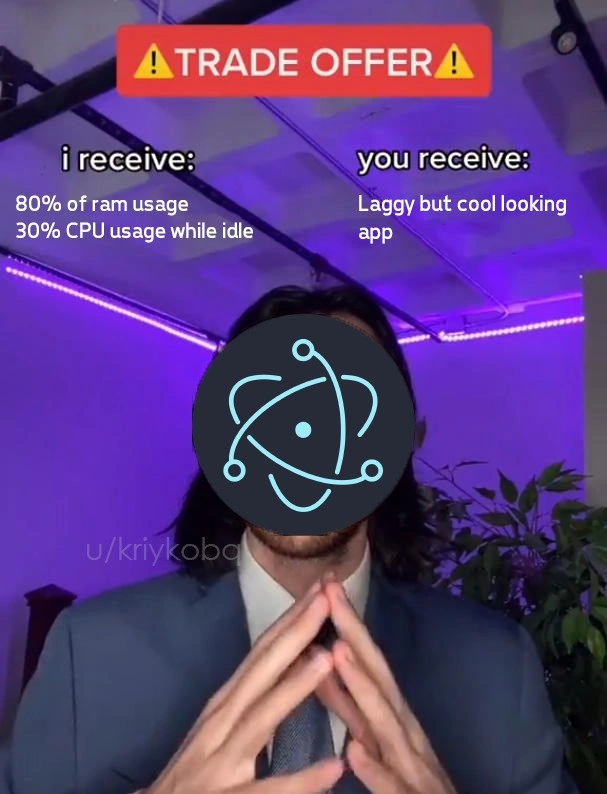
- Electron is a framework that wraps a website in a desktop window. Under the hood it ships a full copy of the Chrome browser engine plus Node.js. Discord, Slack, VS Code, and many others use it — when you "install" them, you're mostly installing another browser.
- A 503 Service Unavailable is an HTTP status code meaning "the server exists but can't handle your request right now" — usually because the backend is overloaded, deploying, or down. It's the server equivalent of a shop with the lights on and a "back in 5 minutes" sign.
- Cloudflare is a CDN/proxy that sits between users and a company's servers, absorbing traffic and attacks. When the servers behind it die, Cloudflare serves its own minimal error page — the unstyled white page you see here, instantly recognizable to anyone who's refreshed a site during an outage.
The "aha" this meme delivers to newer developers: native is supposed to mean software built with the operating system's own toolkit, running locally, owning its pixels. The first time you see your desktop chat app display a web error page, the illusion pops — same energy as discovering your favorite "app" is a website with an icon, or that the kiosk at the airport is just Internet Explorer in fullscreen. It's a formative lesson in reading error pages as forensics: the styling of a failure tells you what the system is really made of.
Level 3: A Webapp in a Trenchcoat
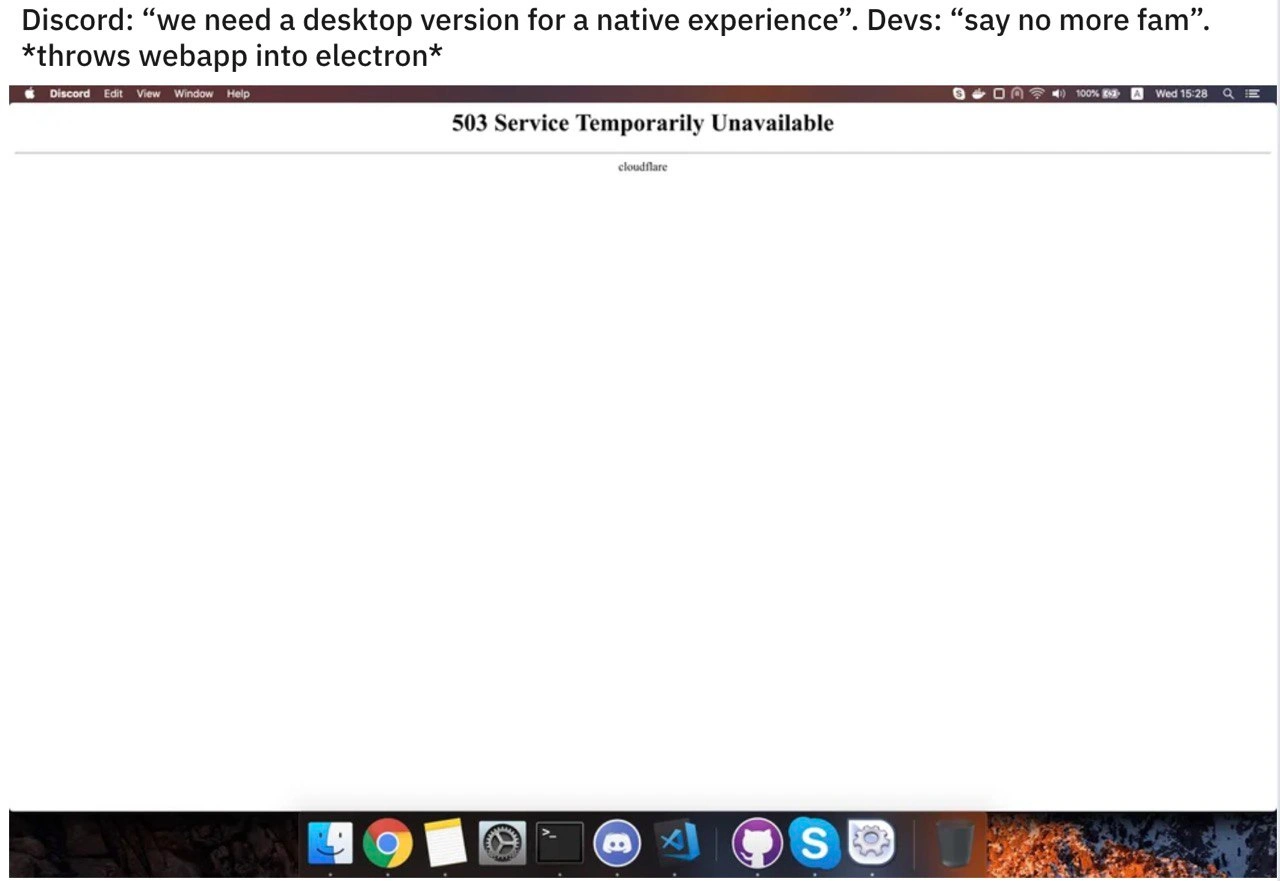
The screenshot is the entire indictment. macOS menu bar dutifully reads Discord Edit View Window Help — all the ceremonial trappings of a real desktop citizen — and the window content is a bone-white page declaring "503 Service Temporarily Unavailable" with a tiny cloudflare signature at the bottom. Your "native" app just rendered a CDN's default error page, raw Times New Roman and all, because that's what it actually is: a browser pointed at a URL, wearing the app icon like a fake mustache.
Discord: "we need a desktop version for a native experience". Devs: "say no more fam". throws webapp into electron
The caption nails the economics that every engineering leader of that era ran and most are still running. Electron bundles Chromium and Node.js into a desktop shell, so your web team ships to Windows, macOS, and Linux from one JavaScript codebase. The alternative — three platform teams writing Cocoa, Win32/WPF, and GTK — costs roughly three times the headcount and ships a third as fast. The trade-off was never secret: every Electron app carries ~150MB of private browser, eats RAM like Chrome (because it is Chrome), and — the part this meme weaponizes — inherits the web's failure modes. A truly native client with the backend down shows its own UI with a friendly "reconnecting…" banner. A thin Chromium wrapper whose HTML shell loads from the network shows you whatever the edge proxy felt like returning, which on a bad day is Cloudflare shrugging in 1996-era typography.
That's the real sin senior engineers spot here — not Electron itself, but failing open to the infrastructure's error page. A 503 from Cloudflare means the origin behind the CDN couldn't answer; well-built Electron apps ship their UI locally and degrade gracefully. Rendering the raw error means the app's entry point itself lives on the other side of someone else's reverse proxy. The funniest detail is in the dock: Chrome, Discord, VS Code, GitHub Desktop, and Skype sitting side by side — which is to say, four Chromium instances and a fifth app that would soon become one. The screenshot accidentally documents the exact historical moment the desktop quietly became a federation of browsers denying they're browsers.
Description
A meme consisting of text followed by a screenshot of a desktop environment. The text at the top reads, 'Discord: “we need a desktop version for a native experience”. Devs: “say no more fam”. *throws webapp into electron*'. Below this text is a screenshot of a macOS desktop. The application in focus is labeled 'Discord' in the menu bar, but the window content is entirely a web error page from Cloudflare, stating '503 Service Temporarily Unavailable'. The macOS dock is visible at the bottom. This meme satirizes the common practice of using the Electron framework to package web applications as desktop clients. The punchline is that these apps are often just web wrappers, and as the image shows, they are susceptible to web-specific failures like a 503 error, completely breaking the illusion of a self-contained, native desktop experience. This is a pointed critique, relatable to developers who debate the performance and reliability trade-offs of Electron versus true native development
Comments
8Comment deleted
The best part of an Electron app is that when the backend is down, you get to debug the entire internet instead of just your application
Nothing like launching a 400 MB Electron ‘desktop app’, spawning two Node processes and a GPU thread, only to admire the exact same Cloudflare 503 you could’ve gotten for free in Chrome
The best part about Electron apps is explaining to your CFO why the chat app needs 2GB of RAM while the entire Apollo 11 guidance computer ran on 4KB
Nothing says 'native experience' like your desktop app having an outage because a CDN between you and your own UI returned 503
Ah yes, the classic Electron 'native experience' - where your desktop app consumes 500MB of RAM to display a 503 error that would've taken 5KB in a browser tab. Nothing says 'performance optimization' quite like bundling an entire Chromium instance just to prove that when the backend goes down, it doesn't matter whether you're running native code or a glorified bookmark with delusions of grandeur
Electron: when “native desktop experience” means your 503 gets a menu bar, a dock icon, and a 500MB RAM tax
Electron: Delivering web-scale 503s to your desktop, because who needs native reliability when you can ship a browser?
Your "native app" is a Chromium process whose SLA equals Cloudflare's - enjoy 800MB RAM to render a 503