Skip to content
DevMeme
A Developer's Honest Definition of a 'Hard Worker'
Interviews Post #43, on Jan 31, 2019 in TG

A Developer's Honest Definition of a 'Hard Worker'

Why is this Interviews meme funny?

Level 1: Making the Bed Harder

A man is asked in a job interview, "Are you a hard worker?" and he proudly says yes — because he makes everything harder than it needs to be. It's like a kid asked to put away one toy who instead builds a giant pulley system with ropes and buckets across the whole bedroom to move the toy three feet — exhausting, impressive, and completely unnecessary. The joke is that "hard worker" is supposed to be a compliment, but he heard it as "person who manufactures difficulty," and honestly, we all know somebody like that. Some of us are somebody like that.

Level 2: Hard Worker vs. Hard-to-Work-With Code

Terms worth knowing behind the laugh:

  • Behavioral interview questions are the "tell me about yourself" genre — "are you a hard worker?", "what's your greatest weakness?" They test self-presentation as much as substance, which is why subverting one is inherently funny.
  • Over-engineering means building something more complicated than the problem requires: ten layers of abstraction for a to-do list, a distributed system where a spreadsheet would do.
  • Unnecessary complexity is what over-engineering leaves behind — code that's hard to read, change, and debug. Note the same word again: complexity makes everything hard for the next person, which in three months is you.

A rite of passage usually triggers this realization: you spend a week building a "flexible, reusable" solution, your tech lead reviews it, and replaces it with six readable lines. The lesson lands hard — working hard and creating hard things are different axes, and great engineers maximize the first while minimizing the second:

// "hard worker" output:
const result = new ValueProviderFactory().create("sum").execute([a, b]);

// what the task needed:
const result = a + b;

Both work. One of them is a future onboarding document.

Level 3: Accidentally Honest in the Behavioral Round

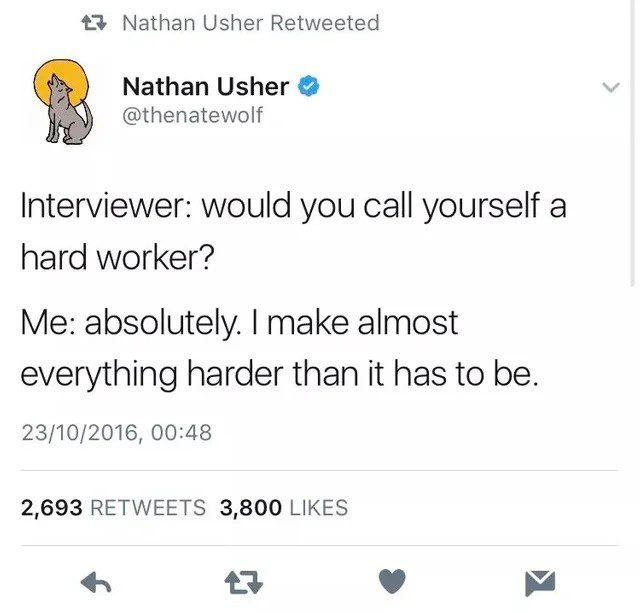
Interviewer: would you call yourself a hard worker? Me: absolutely. I make almost everything harder than it has to be.

The pun pivots on one reparsed adjective — hard migrating from "diligent" to "difficult" — but what makes this tweet immortal in engineering circles is that it's the most truthful answer ever given to a behavioral interview question. The whole genre of "would you call yourself X?" questions selects for confident self-mythology; the joke answers with a confession instead, and the confession happens to be the defining occupational disease of software development: over-engineering.

Every senior engineer knows the shape of this sin because they've committed it. The one-line config change that becomes a configuration framework. The CRUD app that gets event sourcing "for auditability we might need." The premature abstraction — interfaces with exactly one implementation, a plugin system with zero plugins — built because what if requirements change, when the requirement that actually changes is the deadline. There's a name for the discipline that prevents this (YAGNI — you aren't gonna need it) precisely because the failure mode is so universal it needed an acronym to swat it with.

And here's the uncomfortable part the joke smuggles in: the industry's incentive structures actively reward making things harder. Promotion packets want "technical complexity" and "scope." Nobody gets a staff title for deleting a microservice and replacing it with a cron job, even when that's the heroic move. Resume-driven development exists because the interviewer at the next company will ask about Kubernetes, not about the boring monolith you wisely refused to shard. So the engineer who makes everything harder than it has to be isn't lazy or dumb — they're rationally responding to a system that mistakes effort for value and complexity for seniority. The tweet works as self-deprecating humor, but it doubles as a performance review of the whole profession: we say we optimize for simplicity, then we celebrate the person who survived the complexity they created. Firefighter and arsonist, one headcount.

The interview framing is the cherry on top: interviews are exactly where this inversion thrives. Candidates are coached to spin weaknesses as strengths ("I'm a perfectionist"); this answer spins a strength-sounding word into a weakness, which is funnier and — for a hiring manager who's inherited an "elegant" five-service architecture for sending emails — uncomfortably plausible.

Description

A screenshot of a tweet from user Nathan Usher (@thenatewolf). The tweet, dated 23/10/2016, displays a humorous, self-deprecating exchange. It reads: 'Interviewer: would you call yourself a hard worker? Me: absolutely. I make almost everything harder than it has to be.' The humor lies in the literal and unexpected interpretation of the common interview question. For senior developers, this is deeply relatable, touching upon the tendencies toward over-engineering, premature optimization, or simply getting bogged down by self-imposed complexity. It's a witty commentary on the fine line between diligence and creating unnecessary work, a hallmark of the developer experience where solving a problem can often feel like a Rube Goldberg machine of one's own making

Comments

8
Anonymous ★ Top Pick A junior says this and gets rejected. A senior says this and gets an offer to lead the architecture committee
  1. Anonymous ★ Top Pick

    A junior says this and gets rejected. A senior says this and gets an offer to lead the architecture committee

  2. Anonymous

    Proof I’m a hard worker? I turned a one-line awk script into a fault-tolerant, multi-AZ event-driven pipeline - complete with Terraform modules and a post-mortem nobody asked for

  3. Anonymous

    The candidate just described every senior engineer's approach to implementing a simple CRUD API: 'Let's add a message queue, event sourcing, CQRS, and maybe a few microservices... oh, and we'll need Kubernetes for our three users.'

  4. Anonymous

    Hardest worker on the team: turned a config change into a Kubernetes migration, a feature flag framework, and three ADRs nobody read

  5. Anonymous

    This perfectly captures the senior engineer's curse: given a simple CRUD endpoint, we'll inevitably architect a distributed event-sourcing system with CQRS, implement custom serialization protocols, add a message queue 'for future scalability,' and spend three days debating whether to use Protocol Buffers or Avro - all before realizing the original requirement was just to return a user's email address

  6. Anonymous

    I told the interviewer I’m a hard worker - I turned a simple if-statement into an event-sourced, eventually consistent microservice so it could horizontally scale our complexity budget

  7. Anonymous

    Hard worker? I once Saga-orchestrated a hello world app because 'future scalability'

  8. Anonymous

    Interviewer: “Would you call yourself a hard worker?” Me: I once turned a 20-line cron job into an event-sourced CQRS microservice with Kafka and a platform team - so, regrettably, yes

Use J and K for navigation