IBM's Desperate Plea to Be Seen for Who They Are Now
Why is this TechHistory meme funny?
Level 1: "We Don't Sell That Anymore!"
Imagine a famous pizza place that stopped selling pizza fifteen years ago and now only does catering — but every single day, people still walk in asking for a pepperoni slice. Eventually the owner tapes a giant sign to the door: "We REALLY REALLY REALLY don't sell pizza anymore. Yes, really. It's been a while." That's this tweet. A huge old computer company stopped making home computers ages ago, but everyone still thinks of them as "the computer company," and you can hear them sighing through the screen. It's funny because the more times someone says "really," the more you can tell they've had this conversation a thousand times.
Level 2: How a Company Stops Being What You Think It Is
Some context that makes this tweet make sense:
- IBM ("Big Blue") is one of the oldest tech companies on Earth — over a century old — and in the 1980s–90s it was practically synonymous with the personal computer. "PC" originally meant IBM PC.
- A divestiture is when a company sells off an entire business line. In 2005 IBM sold its PC division to Lenovo, a Chinese hardware maker — which is why ThinkPads still exist but say Lenovo on the lid. IBM kept the high-margin stuff: mainframes, enterprise software, consulting services.
- Sprinklr (visible in the tweet's metadata, where personal tweets say "Twitter for iPhone") is software big companies use to manage hundreds of official social accounts with approval chains. Spotting it is the corporate-tweet equivalent of seeing the strings on the puppet.
The career-relevant lesson hiding in a recruiting account's joke: the tech industry's giants rarely die, they transform, and your mental map goes stale fast. The first time you interview somewhere and confidently describe a product they killed years ago, you'll understand exactly why this account felt the need to say "really" nineteen times. Doing thirty seconds of research on what a company actually does now is the cheapest interview prep that exists.
Level 3: Deprecation Notice, Fourteen Years Late
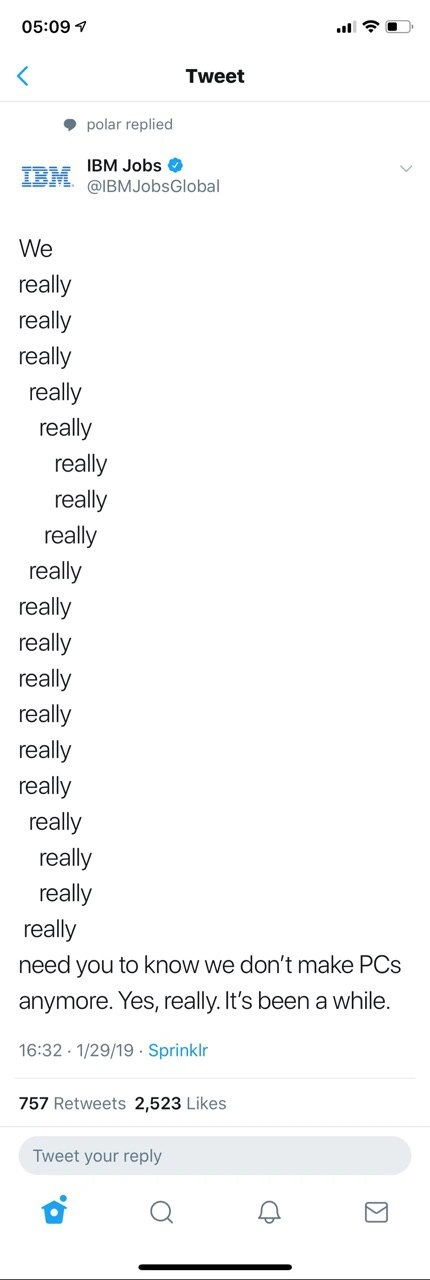
What you're looking at is a verified corporate account — IBM Jobs (@IBMJobsGlobal), posting dutifully through Sprinklr, the enterprise social-media management suite — having a small public breakdown. The tweet is the word "really" repeated nineteen times, the indentation drifting rightward and snaking back like a sine wave of corporate exhaustion, before resolving into:
We really really really… need you to know we don't make PCs anymore. Yes, really. It's been a while.
"A while" is doing heroic understatement. IBM sold its Personal Computing Division to Lenovo in 2005 — ThinkPads, desktops, the lot. By the time this tweet went out, that divestiture was old enough to be in high school. And yet the recruiting account still had to say it, because the public's mental model of IBM froze somewhere around the beige-box era, and a jobs account feels it most acutely: candidates show up expecting to build laptops at the company that invented the PC standard, when the actual business had pivoted to cloud, consulting, mainframes (the Z series quietly prints money to this day), and whatever Watson was supposed to become.
This is the brand-perception half-life problem, and it's brutal in tech precisely because the industry moves faster than collective memory. The deeper irony historians savor: IBM created the very category it's now disavowing. The 1981 IBM PC's open architecture spawned the "IBM-compatible" clone market — Compaq, Dell, the whole commodity ecosystem — which then drove margins so low that IBM was eventually forced to abandon its own invention. The company built the standard, lost control of the standard, and finally sold the remains to a clone-era beneficiary. Selling the division was the textbook-rational move; spending the next two decades explaining it on social media was the unadvertised cost.
There's also a quieter joke for anyone who's worked in enterprise marketing: the wavy formatting is a human being smuggling personality through a Sprinklr approval workflow. Somewhere, a social media manager got this past brand compliance, and 757 retweets later it became the rare corporate tweet that worked — by sounding less like a corporation and more like the engineer who has answered the same Slack question forty times and finally pins a message in all caps.
Description
A screenshot of a tweet from the official 'IBM Jobs' Twitter account (@IBMJobsGlobal), dated January 29, 2019. The tweet uses a dramatic formatting for emphasis, starting with 'We' followed by the word 'really' repeated fifteen times, each on its own line. The message concludes with: 'need you to know we don't make PCs anymore. Yes, really. It's been a while.' This post is a humorous and exasperated public service announcement. The humor stems from the corporate account's desperate tone, breaking from its typical professional voice to address a persistent public misconception. For experienced tech professionals, this is a relatable nod to tech history, as IBM sold its personal computer division, including the iconic ThinkPad line, to Lenovo back in 2005. The meme highlights the incredible inertia of brand identity and how long it takes for public perception to catch up with a company's strategic pivots

Comments
8Comment deleted
Some say the longest TTL in existence isn't in a DNS record, but in the public's cache of the fact that 'IBM makes PCs'
IBM’s 20-“really” tweet about quitting the PC biz feels like my sprint demo: “We’ve totally, really, absolutely sunset the ’99 monolith”… right up until the shiny new microservice quietly shells out to its ancient COBOL buddy
IBM explaining they don't make PCs anymore with the same energy as explaining to your PM that no, adding blockchain won't fix the legacy COBOL system that's been running since 1982
IBM deprecated PCs in 2005, but like every deprecated API, clients keep calling it 14 years later and the maintainers are reduced to shouting in the release notes
IBM's tweet perfectly captures the enterprise pivot paradox: they sold their PC division to Lenovo in 2005, yet 14 years later still need to remind people with emphatic repetition. It's the corporate equivalent of a senior architect explaining to stakeholders that yes, we really did deprecate that monolithic system three migrations ago, but somehow everyone still thinks we're maintaining COBOL on AS/400s. The gap between a company's actual technology stack and public perception is measured in decades, not sprints
IBM buffering 'no' at mainframe scale before flushing the legacy PC feature - classic enterprise revert commit
Brand perception is just eventual consistency - IBM sold PCs in 2005, but the human cache-invalidation TTL seems infinite, hence the ‘really’ retry loop
Hardest prod problem isn’t consensus - it’s invalidating the “IBM PC” key in the world’s cache; TTL looks infinite, so marketing’s using exponential backoff with really^N