Dijkstra's Trolley Problem
Why is this CS Fundamentals meme funny?
Level 1: The Complicated Track
This is like a toy train that has too many tracks and people standing on many of them. Instead of picking just left or right, you have to choose a whole route. The funny part is that programmers look at the mess and think, “This is a graph problem,” even though everyone else is thinking, “This is a terrible situation.”
Level 2: Shortest Path Panic
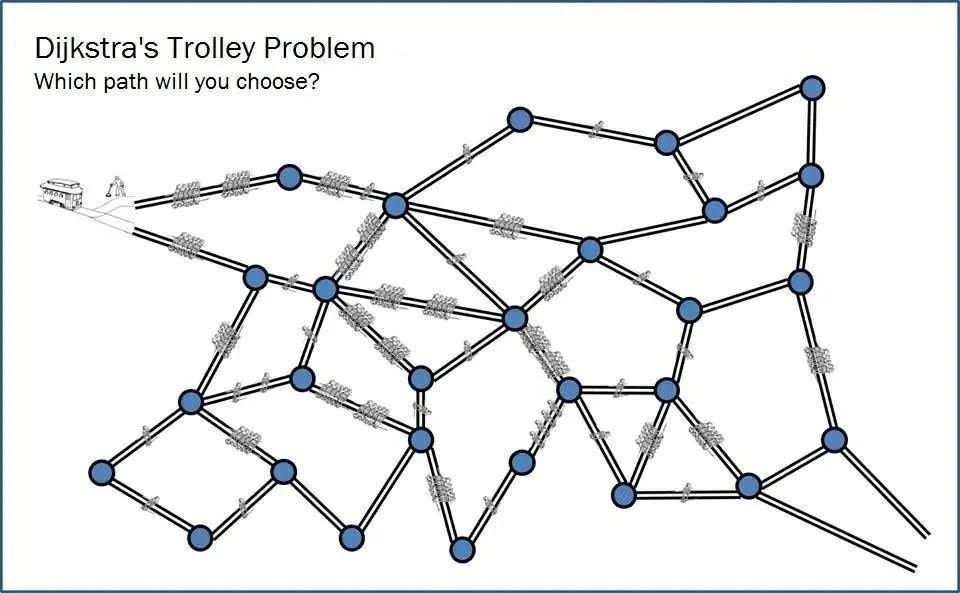
Dijkstra's algorithm is a classic computer science method for finding the cheapest path through a graph. A graph is made of nodes and edges. In the image, the blue dots are nodes, and the black track lines are edges. The trolley can move through the network by following connected rails.
In a normal map app, an edge weight might mean distance or travel time. The algorithm tries to find the path with the smallest total cost. In this meme, the little people on the tracks make the “cost” feel like moral damage. That is why the picture is funny and grim: it treats a human dilemma like a route-planning problem.
The title refers to the trolley problem, a philosophy scenario where someone must choose between bad outcomes. The meme combines that with a graph algorithm, so instead of choosing between two tracks, the viewer gets a complicated network. The question Which path will you choose? suddenly sounds like both an ethics exam and a programming assignment.
For someone learning algorithms, this is a memorable way to see why problem modeling matters. The algorithm can only solve the problem you give it. If you give it a graph with costs, it finds the lowest-cost route. It does not understand guilt, fairness, or why the classroom got quiet.
Level 3: Optimization Meets Ethics
The standard trolley problem is already absurdly clean: one trolley, one fork, one painful choice. This image escalates it into a network of switches, loops, and many possible routes. There are small human figures placed along numerous track segments, so the choice is no longer “left or right.” It becomes “find the route through this graph that satisfies some objective function while minimizing harm.” Somewhere, a product manager just renamed that “decision automation.”
The humor comes from taking a moral thought experiment and subjecting it to algorithmic thinking. Engineers are trained to turn ambiguity into data structures: define the nodes, assign the weights, choose the algorithm, return the result. That instinct is useful when routing packets, planning maps, or finding least-cost paths. It becomes deeply uncomfortable when the input is human lives. The meme exaggerates that discomfort by making the track visually dense, as if the trolley problem has been upgraded from Philosophy 101 to a whiteboard interview nobody survives emotionally.
Experienced developers recognize the trap: once a problem is represented as a graph, the conversation often shifts from “Should we do this?” to “Can we solve this efficiently?” Dijkstra's algorithm is elegant, deterministic, and teachable. But elegance does not absolve the person who picked the weights. If each track segment has a cost based on the number of people on it, what about age, intent, responsibility, uncertainty, or consent? If all of that sounds horrifying, congratulations, you have found the requirements document hiding under the rails.
This is also a joke about misplaced precision. The diagram looks technical enough to imply rigor, but the underlying dilemma resists clean quantification. Software systems do this constantly: risk scoring, moderation queues, hiring filters, fraud models, traffic routing, and recommendation engines all turn human context into simplified inputs. Sometimes that is necessary. Sometimes it is a machine wearing a lab coat and hoping nobody asks who wrote the cost function.
Level 4: Weighted Moral Graphs
The image turns a trolley track into a weighted graph and labels it:
Dijkstra's Trolley Problem Which path will you choose?
In graph terms, the blue circles are vertices, the rail segments are edges, and the trolley begins at the far left. The tiny figures on the tracks become the horrifying equivalent of edge weights. Dijkstra's algorithm answers a narrow question: given a graph with non-negative edge costs, what is the minimum-cost path from a source to every reachable node? It does this by repeatedly selecting the not-yet-finalized vertex with the smallest known distance, then relaxing outgoing edges:
if distance[u] + weight(u, v) < distance[v]:
distance[v] = distance[u] + weight(u, v)
The dark joke is that the classic trolley problem asks for moral judgment, while Dijkstra asks for cost minimization. If each person on a track segment is treated as cost, the ethical dilemma becomes a routing problem. That is funny because it is both grotesque and recognizably algorithmic. The algorithm does not care whether the cost represents distance, latency, fuel, money, or casualties. It only requires consistent weights and a target objective. As usual, the terrifying part of software is not that it is evil; it is that it is obedient.
Dijkstra also has constraints that make the meme sharper. It assumes non-negative weights, so it cannot directly model a path where saving someone produces a negative cost bonus without changing the formulation. It also optimizes one scalar value, which means all messy human concerns must be compressed into one comparable number. That is where real optimization problems become dangerous: the model can only optimize what the system encodes. If the cost function is morally bankrupt, the algorithm will still run beautifully.
The post message mentions Euler's path, which is a nearby but different graph idea. An Eulerian path asks whether a route can traverse every edge exactly once. Dijkstra's algorithm asks for a cheapest route according to weights. The meme's visible title is Dijkstra, and the drawing's many branches fit shortest-path thinking better than Euler traversal. Still, the comment works as graph-theory seasoning: once the trolley track stops being a single fork and becomes a tangled network, every discrete math lecture suddenly looks uncomfortably practical.
Description
A white diagram is titled "Dijkstra's Trolley Problem" with the subtitle "Which path will you choose?" It shows a trolley track drawn as a dense graph: black rail segments connect many blue circular nodes, with a trolley starting at the far left and small human figures placed along many possible routes. The meme fuses the classic moral trolley problem with Dijkstra's shortest-path algorithm, turning ethical choice into graph traversal and path-cost optimization. For experienced engineers, the humor is in reducing a messy human decision to an algorithmic routing problem with horrifying edge weights.
Comments
21Comment deleted
The ethical dilemma gets easier once you assign every casualty an edge weight and pretend the requirements came from product.
Lol Comment deleted
Let me complicate everything This tram carries organs for puppies for urgent transplantation. so that either he will kill a bunch of people by going along the shortest path in terms of distance, or he will go along the shortest path from the point of view of people on the radishes, but then not all puppies will have time to get their organs Comment deleted
Gotta catch 'em all! LET'S GO GREEDY Comment deleted
"Euler's path" -> hilarious Comment deleted
Yes, but... Are all the puppies get their kidneys? Comment deleted
Ok... Comment deleted
Now everyone is dead, everything perfect Comment deleted
Really perfect solution Comment deleted
W8 Comment deleted
YOU MISSED ONE Comment deleted
Ou shit Comment deleted
Even faster Comment deleted
speedrun this Comment deleted
Ахахахахах, хорошая идея Comment deleted
Suck, stupid puppies Comment deleted
I'm satisfied But felling like a piece of sh*t Comment deleted
Fuck, now one puppie still alive. Really hard problem Comment deleted
It would be better to wait a scientific solution Comment deleted
No he isn't The tram was travelling 2 long and he is dead without donor kidney Comment deleted
Yeaaaaa Comment deleted