The Sudden Software Architect
Why is this Management PMs meme funny?
Level 1: The Costume Problem
This is like someone putting on a chef hat in front of dinner guests even though another person has to cook the meal. The guests now expect expert cooking, and the real cook suddenly looks worried. The funny part is the surprised face: it says, “Wait, since when were you the chef?”
Level 2: Titles Have Weight
A manager usually coordinates people, priorities, delivery, and communication. A software architect focuses on the technical design of a system: how pieces connect, how data moves, what tools are used, and how the system can grow without collapsing.
Those roles can overlap, but they are not automatically the same. The meme is funny because the manager introduces himself as a software architect “in front of Clients,” while the person labeled Me looks shocked. The engineer likely knows that clients will treat that title as proof of deep technical authority.
Client expectations matter because what gets said in a meeting often becomes unofficial scope. If a manager describes a feature as easy, secure, scalable, or already planned, the client may remember that as a promise. The engineers then have to make reality match the meeting, which is usually harder than making a slide deck.
For newer developers, this is a common workplace lesson: technical titles are not just labels. They affect who gets trusted, who makes decisions, and who gets blamed when the system behaves differently from the sales-friendly version. The meme captures the moment an engineer realizes the conversation has moved from harmless introduction to possible future incident.
Level 3: Architecture Theater
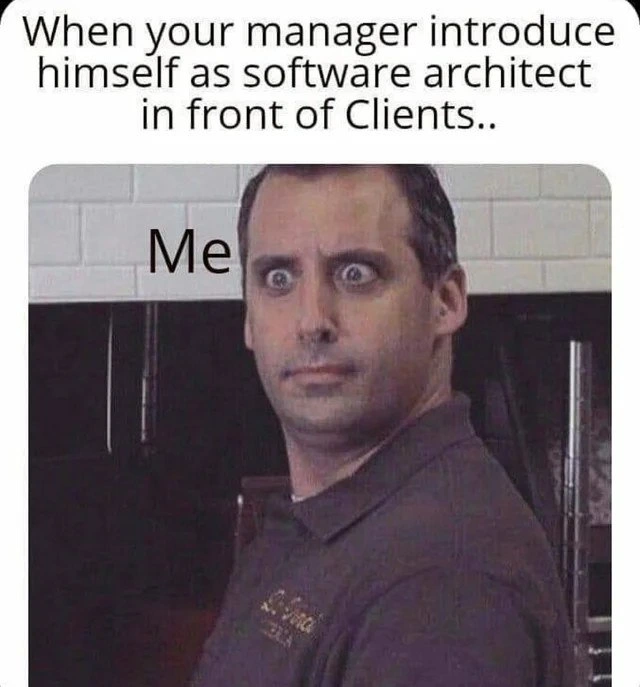
The meme shows an alarmed engineer labeled Me reacting to the caption:
When your manager introduce himself as software architect in front of Clients..
The typo-ridden caption almost improves the joke: the title is precise, the situation is not. A software architect is supposed to own high-level technical structure: system boundaries, integration strategy, data flow, scalability trade-offs, failure modes, and the compromises that will haunt people for the next five fiscal years. When a manager casually claims that title in front of clients, the engineer’s wide-eyed stare says, “Interesting. I was unaware we had issued credentials for this reality.”
The humor is about authority leakage. In client-facing rooms, titles carry weight. If someone says they are the architect, clients may assume technical decisions are settled, risks are understood, and promises are backed by implementation knowledge. The actual engineers know the dangerous part: a confident statement in a meeting can become a requirement, a timeline, or an architectural commitment before anyone has checked whether the system can survive it.
This is not just “managers bad.” Plenty of managers understand architecture, and plenty of architects do management. The joke is specifically about the gap between organizational signaling and technical accountability. A manager may be trying to reassure clients, simplify the communication chain, or present seniority. But if that title does not match real ownership, it creates expectation debt. The client hears expertise. The engineer hears future weekend work wearing a blazer.
The visible reaction matters because it is not anger; it is shock. That is the face of someone performing rapid risk assessment: What did he just promise? Is he about to describe the database? Does he know about the integration nobody wants to mention? Will I have to explain later that “microservices-ready” meant “we have multiple folders”? Somewhere, a spreadsheet is gaining a new milestone.
In software architecture, credibility is expensive because architecture decisions are hard to undo. Choosing a framework, coupling services, exposing an API, storing data in a certain shape, or promising multi-tenant behavior can determine years of maintenance cost. If the person claiming the architect role is not the one who understands those consequences, the team gets the worst of both worlds: client confidence up front, engineering cleanup afterward. A classic enterprise bargain, meaning everyone claps in the meeting and pays interest in production.
Description
The meme has a white top caption reading, "When your manager introduce himself as software architect in front of Clients.." Beneath it, a startled man turns toward the camera with wide eyes, labeled "Me," against a kitchen-like background. The humor comes from an engineer watching a manager inflate or appropriate a technical architecture role in front of customers, creating instant credibility and expectation risk. It fits senior developer concerns about title inflation, client-facing signaling, and the gap between technical authority and organizational performance.
Comments
2Comment deleted
Nothing says architecture review like discovering the load-bearing component is your manager's LinkedIn headline.
murder incoming Comment deleted