Skip to content
DevMeme
2119 of 7435
A Joke with a Higher Base
CS Fundamentals Post #2367, on Nov 26, 2020 in TG

A Joke with a Higher Base

Why is this CS Fundamentals meme funny?

Level 1: Secret Code Numbers

Imagine you have a secret way of counting that only you and your friends know. In your special code, the symbols for numbers don’t mean what everyone else thinks they mean. For example, you write “10”, but in your secret language of numbers, that actually stands for the quantity two. Now, most people would see “10” and think of the ordinary number ten. So if you say, “There are 10 kinds of ice cream,” they might think there are ten flavors. But you and your buddies know the secret: “10” really meant two. You’re sneakily saying “There are two kinds of ice cream” in code — maybe chocolate and vanilla!

Now, let’s say one friend who knows your special number language laughs because they get it: you meant two kinds. But then another super-clever friend chimes in with their own even more unusual counting trick. They say, “What if in my secret code, ‘10’ actually means three?” Suddenly, you’re not talking about two kinds of ice cream anymore, but three kinds! It’s like having different decoder rings for the same symbols. Everyone who knows the codes starts giggling because it’s so silly: the same “10” on paper can mean two or three or ten, all depending on which secret counting system you use.

The meme is doing exactly that, but with computer nerds’ favorite secret codes for numbers. It starts with the classic trick (“10 means two!”), then winks and adds another twist (“hey, maybe 10 means three!”). It’s funny in the way a riddle or a pun is funny — the words (or in this case, the numbers) hide a surprise meaning. Even if you didn’t catch the joke at first, once you know the secret, you can’t help but smile at how clever it is. It’s basically a little numbers game that says: things aren’t always what they seem with "10". In one secret world it means 2, and in an even secret-er world it means 3. The humor comes from that surprise and from feeling “in on the secret” once you figure it out.

Level 2: Base-ic Humor

Let’s break down the joke in plain technical terms. This meme is all about number bases and a play on words (or rather, play on digits). In mathematics and computing, a base (or radix) is the number of unique digits, including zero, that a positional numeral system uses to represent numbers. We are most familiar with base-10 (decimal) because we use digits 0 through 9 in everyday life. But computers operate in base-2 (binary), using only the digits 0 and 1. There are many other bases too – for example, base-3 (ternary) uses digits 0, 1, and 2.

So how does a different base change what “10” means? The notation 10 in any base signifies “one base-unit, and zero of the ones place.” It’s analogous to how in decimal, 10 means one ten and zero ones. The pattern holds for other bases:

  • In binary (base-2), the digits allowed are just {0,1}. Counting in binary goes 0, 1, then (since you’ve run out of single-digit symbols) 10, 11, 100, ... etc. Here, 10 means “1 two and 0 ones,” which equals 2 in our normal decimal understanding.
  • In ternary (base-3), the digits are {0,1,2}. Counting goes 0, 1, 2, then 10, 11, 12, 20, 21, 22, 100, ... and so on. In base-3, 10 means “1 three and 0 ones,” which equals 3 in decimal.
  • In decimal (base-10), 10 of course means “1 ten and 0 ones,” which equals 10.

To summarize that visually, here’s how the string "10" translates in different bases:

"10" in Base Value in Decimal
2 (Binary) 2 (two)
3 (Ternary) 3 (three)
10 (Decimal) 10 (ten)

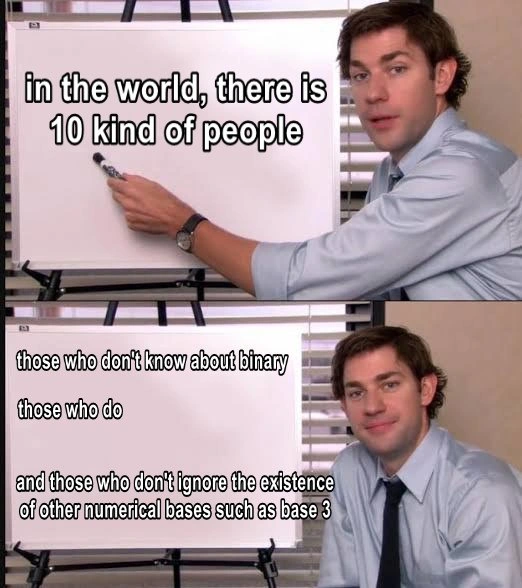
Now, the meme’s text starts with “in the world, there is 10 kind of people”. A person reading that in English might initially think it says “ten kinds of people” (which sounds grammatically odd, actually it should be “there are 10 kinds”). But if you’re a coder or CS student and you see 10 in that context, a lightbulb might go off: “10… aha, could this be the binary joke?”. You suspect “10” is binary for 2, and indeed the next lines confirm it by listing two kinds of people:

  • Those who don’t know about binary – i.e. people who see "10" and think it’s ten (they don’t get the binary gag at all).
  • Those who do – people who recognize "10" as binary 2 and are in on the joke, chuckling because they’re knowledgeable about binary.

Up to here, it’s the classic two-category joke that separates the “uninformed” from the “informed” in a nerdy way. If you’ve learned about binary numbers (which is often one of the first cool things you learn in a computer science class), you belong to the second group. If not, you’re in the first group. It’s an inside joke in tech: the phrase itself tests who understands binary.

But then the meme throws a curveball: a third category appears:

  • Those who don’t ignore the existence of other numerical bases such as base 3.

This line adds an unexpected third type of person, implying that the original number “10” must have been in base-3 to account for three groups. In other words, the joke self-modifies: it starts like a binary joke (2 groups) but then becomes a ternary joke (3 groups). The third type of person is basically someone who says, “Hey, binary isn’t the only base that exists – what about base-3, base-8, base-16, etc.?” They’re the sort of ultra-nerd who not only knows binary, but also likes to remind everyone that numerical bases go beyond just 2 and 10.

If you’re newer to programming, here are some key terms and concepts to clarify why this is funny:

  • Binary: Base-2 number system. Only 0 and 1 are used as digits. Computers use binary at the hardware level because a bit (binary digit) can be represented by two states (off/on, false/true, 0/1). For example, in binary: 10 means 2.
  • Ternary: Base-3 number system. Digits 0, 1, 2 are used. It’s not used in mainstream computing, but it exists as a concept. In ternary: 10 means 3.
  • Numerical base (or radix): The foundational value for a number system. It dictates how place values work. In base-N, each digit position represents a power of N. So the rightmost digit is 1 (N^0), the next is N (N^1), then N^2, etc. That’s why in base-3, the second digit from the right is worth 3^1 = 3, making 10 in that base equal to 3.
  • “There are 10 kinds of people” joke: A famous nerd joke exploiting the ambiguity of “10”. In binary, "10" is 2, so it means "There are two kinds of people: those who know binary and those who don’t." This meme expects you to know this joke already (common among CS students and developers).

When you get the binary joke, you feel a little proud – you’re in the club of those who understand a core concept of how computers count. This meme takes that feeling up a notch: if you also get the base-3 reference, you’re in the next club of people who appreciate even more abstract base humor. It’s like an Easter egg for the especially math-savvy. The phrasing “those who don’t ignore the existence of other bases” is a tongue-in-cheek way to describe people who are aware of and care about different number systems. Most folks, even in tech, will usually stop at binary and maybe hexadecimal. The meme jokingly elevates the base-3 aware folks as this third kind.

From a learning perspective, if you are just encountering this now and maybe didn’t get it at first: don’t worry! Now you know:

  • “10” was not ten – it was representing a number in another base.
  • Initially, it was binary (so “10” = 2, yielding two kinds of people).
  • Then it sneakily became ternary (so “10” = 3) to include a third kind of person.

This plays on the way developers think about numbers. We constantly switch between bases: e.g., binary for low-level bitwise work, decimal for user-facing values, and hexadecimal (base-16, digits 0-9 and A-F) for things like memory addresses or color codes. Being comfortable in multiple bases is a hallmark of computer science education. So a meme that flips the base mid-joke is inherently coding humor. It’s funny because it violates the normal expectation (that “10” is ten, or at most that “10” is 2 in binary) and throws in a nerdy curve by making you consider yet another base.

In summary, this meme is a perfect little lesson and joke wrapped together: it tests and rewards your knowledge of binary and then of ternary. By explaining it, we’ve essentially done a mini tutorial on number systems — which is exactly what an early CS class might do (often accompanied by that very same classic binary joke). So if you followed along, congrats: you’ve decoded the joke’s secret numeric handshake! Now you’re ready to chuckle along (and maybe share it with another geeky friend to see if they get all “10” of it 😉).

Level 3: The Third Kind

For seasoned developers and engineers, this meme is a brilliant subversion of a classic inside joke. The original joke goes: “There are 10 types of people in the world: those who understand binary and those who don’t.” In that well-worn gag, "10" is intended in binary (10₂ = 2 in decimal), so it humorously claims there are two types of people. If you get it, you instantly identify yourself as one of the people who “understand binary,” and you laugh (possibly while those who don’t get it look confused). It’s a rite-of-passage joke in programming and computer science circles – emblazoned on countless T-shirts, mugs, and forum signatures.

Now enter this meme: it extends the binary joke by cheekily adding a third bullet point. The setup text on the whiteboard still says “in the world, there is 10 kind of people”, luring us to assume the classic two-category binary joke. The first two bullet points are exactly what we expect:

those who don’t know about binary
those who do

If it stopped there, it would just be the old joke presented in a Jim Halpert whiteboard format (Jim Halpert, from The Office, is often meme-ified pointing at a board with some reveal or punchline). But here comes the twist – a third line is added:

and those who don’t ignore the existence of other numerical bases such as base 3

This punchline catches even the in-crowd off guard, provoking a second wave of “aha!” laughter. Why? Because by including that third category, the statement “there is 10 kind of people” can no longer be interpreted in binary (which would only account for 2 groups). The presence of a third group forces a reinterpretation: suddenly "10" must have been meant in base-3, since 10₃ = 3 in decimal. It’s a delightful bait-and-switch for anyone smugly expecting the binary joke. Essentially, the meme maker nerd-sniped the nerds – leveraging their own knowledge of the joke format to surprise them with an even nerdier layer.

This number_base_joke exaggerates the obsessive thoroughness developers can have about number systems. It’s poking fun at that one person in the room (perhaps an even nerdier nerd) who, upon hearing the binary version of the joke, would pipe up, “Well, actually, ‘10’ could be interpreted in other bases too…” 😏. By preemptively adding “those who don’t ignore other numerical bases,” the meme winks at the tendency of software engineers to get pedantic about all the possibilities. It lovingly mocks the developer humor culture where someone is always ready to take a joke one abstraction level deeper.

The fact that base-3 (ternary) is used as the example of “other numerical bases” is itself humorous to those in the know. In practice, we rarely use ternary in programming – we’re almost always dealing with binary, decimal, or sometimes hexadecimal (base-16) for things like color codes or memory addresses. Mentioning base-3 is a deliberate choice because it’s just obscure enough: it reminds seasoned devs of computer science theory or math class (where you might have done a few homework problems converting a number into base-3), but it’s not something that usually comes up in day-to-day coding. Inside joke culture thrives on this kind of reference: it’s common knowledge within the tribe of CS majors and engineers that bases are a thing, but mentioning ternary specifically signals a higher level of geek depth. It says, “We’re not stopping at the obvious joke—let’s take it to an even more niche place.”

The meme format amplifies the humor. Using The Office’s Jim Halpert presentation scene is a popular way to depict someone walking an audience through an explanation and then smugly smiling at the end. In the second panel, Jim’s smirking face matches the meme’s tone: he’s basically the presenter who knows he just pulled off a slick stunt by revealing that third bullet. It’s as if he’s saying, “Gotcha! You thought I meant binary, but nope, I’m one of those third-kind of people.” Developers find this relatable humor because many of them have been on one side or the other of such exchanges — either dishing out an over-the-top technical one-liner or being on the receiving end and groaning (while secretly appreciating the cleverness).

In essence, level 3 readers appreciate why this combination is so funny:

  • It references a shared cultural meme in programming (the binary joke).
  • It adds a surprise twist by increasing the base (something only a true geek would think to do).
  • It lightly satirizes the analytical, detail-oriented mindset common among engineers (the ones who don’t ignore other bases even in a silly joke).

The absurd specificity of “such as base 3” makes the joke disarmingly absurd. It’s a playful jab at how we in tech sometimes complicate simple things by considering edge cases or additional layers of theory — even in our jokes. And, of course, if you laughed at this, you just proved you’re at least a level-2 nerd (binary-fluent) if not the level-3 ultra-nerd who revels in binary_vs_base3 humor. Welcome to the club; we have literally cookies in all numeral systems (just kidding… we ate them in base-10).

Level 4: Radix Riddles

At the deepest level, this meme plays with the positional number system theory and the idea of a radix (base) in mathematics. In any positional system, the notation "10" has a value equal to the base itself in decimal. Formally, for a base-b (radix b), the string 10 represents b in our usual decimal system. So:

  • 10 in base-2 equals 2 (decimal),
  • 10 in base-3 equals 3 (decimal),
  • 10 in base-10 equals 10 (decimal, of course).

This is because 10 in any base means "1 × (base) + 0". The meme hinges on this fundamental concept by shifting the radix context unexpectedly. It’s essentially a numerical polysemy gag – the sequence of digits "1" followed by "0" yields different quantities depending on the assumed base.

In computer science and mathematics, we explicitly notate bases to avoid confusion (e.g. writing $10_{2}$ for binary, $10_{3}$ for ternary). The humor here arises from not notating it and letting the reader’s mind do a double-take: initially you assume one base, then realize it’s another. It’s a clever exploitation of the fact that value is base-dependent in positional notation. Developers who studied CS fundamentals recognize that context immediately, as they’ve learned to convert numbers between bases as an early lesson in discrete math or computer architecture.

This joke also nods to the broader spectrum of numeral systems beyond the familiar. We mostly use binary (base-2) in computing because of hardware transistors (on/off states), and decimal (base-10) in daily life because of historical reasons (likely counting on ten fingers). But mathematically, many bases are possible – and some are even practical. In fact, ternary (base-3) has an academic allure: each ternary digit (sometimes called a trit) can represent more information than a bit (~1.585 bits of info per trit). There was even a Soviet-era computer called Setun (circa 1958) that was built around ternary logic. Enthusiasts like to point out that base-3 can be efficient in certain contexts; for example, balanced ternary (allowing digits -1, 0, +1) has elegant properties in arithmetic and minimal representation of integers. These esoteric facts aren’t needed to get the joke, but they form the deep-cut backdrop that yes, base-3 is a thing and not just a made-up punchline. The meme’s tertiary twist tickles those who appreciate that rich mathematical landscape, turning a simple binary in-joke into a mini celebration of multiple bases.

Importantly, the meme format (with a faux presentation on a whiteboard) delivers this radix reveal in a way that mirrors a proof or lesson. It’s as if someone is teaching a cheeky math lesson: first stating a proposition in a misleading way, then enumerating points that force you to reinterpret the premise. This structural humor resonates at a theoretical level – it’s reminiscent of a classic logic puzzle or a self-referencing riddle. In essence, the meme uses a basic truth from number theory (the meaning of "10" depends on the base) as the setup for a brainteaser-style joke.

Description

A two-panel meme featuring the character Jim Halpert from the TV show 'The Office' standing in front of a whiteboard. In the top panel, Jim is actively presenting, pointing to the text on the board which reads, 'in the world, there is 10 kind of people'. This setup primes the viewer for the classic binary joke. In the bottom panel, Jim is sitting down with a smug, self-satisfied look. The whiteboard now has additional text below the first line, listing three categories: 'those who don't know about binary', 'those who do', and 'and those who don't ignore the existence of other numerical bases such as base 3'. The humor is a clever, multi-layered meta-joke. It first sets up the expectation of the well-known binary pun where '10' in base-2 equals 2. It then subverts this by revealing that the '10' was actually written in base-3 (ternary), which equals 3 in decimal, perfectly matching the three categories listed. This makes the joke funnier for those with a deeper understanding of computer science fundamentals
Comments

9
Anonymous ★ Top Pick The original binary joke is for interviews. This ternary version is for the code review comments on the code that passed the interview
  1. Anonymous ★ Top Pick

    The original binary joke is for interviews. This ternary version is for the code review comments on the code that passed the interview

  2. Anonymous

    There are 10 kinds of architects: those who understand binary, those who don’t, and those who’ll burn the sprint debating why our feature flags must be stored in balanced ternary “for future-proofing.”

  3. Anonymous

    After 20 years in tech, I've learned there are actually 11 types of people: those stuck maintaining COBOL systems who only count in decimal, those who understand binary, and those who've ascended to arguing about whether we should be using balanced ternary for quantum computing architectures

  4. Anonymous

    This meme perfectly captures the senior engineer's curse: you can't even enjoy a simple binary joke anymore without mentally compiling a list of edge cases. Sure, '10' equals 2 in binary, but what about ternary? Quaternary? The joke works until you've spent enough time in systems programming to realize that assuming base-2 is just another form of technical debt. It's the numerical equivalent of 'it works on my machine' - yes, your joke works in binary, but have you considered portability across all radix systems?

  5. Anonymous

    Always specify the radix - otherwise your “010” discount gets parsed as octal and finance wonders why $10 rang up as $8 in prod

  6. Anonymous

    There are 10 kinds of outages: the ones from forgetting to pass the radix to parseInt, and the ones from someone finally “fixing” it

  7. Anonymous

    Senior devs embrace base-3 for debugging's three states: 'works on my machine,' prod bug, and 'it was fine yesterday.'

  8. @x_Arthur_x 5y

    In fact, even ternary computers do exist

  9. @Vitalis11 5y

    When you understood everything; Yeah it's big brain time

Use J and K for navigation