Skip to content
DevMeme
1858 of 7435
The Ambiguous Task of 'Model Training'
AI ML Post #2066, on Sep 19, 2020 in TG

The Ambiguous Task of 'Model Training'

Why is this AI ML meme funny?

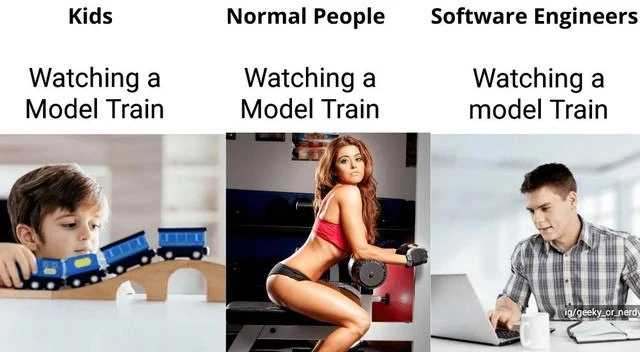
Level 1: Different Trains for Different Brains

Imagine someone says a simple word or phrase, but everyone pictures something different – that’s what’s happening here, and it’s why it’s funny. Think of it like this: if you heard the word “bat,” one person might think of a bat that flies in the night (the animal), and another might think of a bat you use in baseball. They’d both be right in a way, because “bat” can mean two things, but it’s funny when they realize they weren’t thinking the same thing at all. In this meme, the phrase “watching a model train” is the tricky phrase.

  • A little kid hears “model train” and immediately thinks of a toy train, like those electric toy trains that go around on a track. The kid is excited and happy just watching that tiny train go choo-choo! It’s pure, simple fun – like watching your favorite toy moving.
  • A “normal” adult hears “model train” and, in the joke, they imagine watching a model (a really pretty person) do training exercises at a gym. That’s a goofy twist – instead of a toy train, they’re thinking of a completely different kind of “model” and “train.” It’s like a play on words: the phrase made them think of a model doing a workout.
  • Now a software engineer (a computer programmer) hears “model train” and their brain jumps to a computer model being trained. In real life, “training a model” is how we say “teaching a computer program to do something using examples.” So the engineer imagines sitting in front of a computer, watching a program learn, sort of like watching a progress bar fill up or a graph on the screen move. That sounds pretty strange to anyone else, right? But to the engineer, it’s totally a thing they do at work or as a hobby.

So basically, the same words make three different people think of three totally different scenes! It’s funny because it shows how people’s interests and experiences shape what they think about. The kid loves toys, so he thinks of the toy train. A lot of ordinary folks might think of something more human or everyday (and the meme jokingly chose a model at the gym, maybe because it’s a bit cheeky and attention-grabbing). And the engineer is so into computers and AI stuff that even a phrase about a train makes him think of computer code running. The humor comes from that last picture especially, because it’s so unexpected and quirky. It’s saying, in a lighthearted way, “Look how differently an engineer’s brain works!” Everyone is “watching a model train,” but one is watching a toy, one is watching a person exercise, and one is watching a computer learn. It’s like if three friends heard someone say “there’s a jaguar over there”: one imagines a wild animal, another thinks of a luxury car (which is also called Jaguar), and the third friend (who’s a techie) might think of the Jaguar coding framework or something nerdy. They’d all laugh when they realize the mix-up.

In the end, the meme is showing that we all kind of see the world through our own little lens. Kids think of kid things, adults might think of adult things, and computer-loving folks think of computer things. It’s funny and charming because it highlights those differences in a single, simple phrase. And the best part is, even if you didn’t catch the double meaning at first, once you see the pictures, you get the joke and it might make you chuckle. It’s a reminder that sometimes words can trip us up in a fun way – and that nerdy people will always find a way to bring computers into anything, even a toy train. So, “different trains for different brains” indeed: we all ride on our own train of thought, and that’s what makes this joke work so well!

Level 2: One Phrase, Triple Meaning

This meme plays on the fact that the phrase “watching a model train” can mean three different things depending on who hears it. Let’s break down each panel’s meaning in simpler terms:

  • Kids – Model Train (Toy): For a child, a “model train” is a small toy train set. In the left panel, the kid is leaning on the table, totally mesmerized by a little blue toy locomotive going around on a wooden track. Model train here is the traditional meaning: a miniature train you can play with or watch for fun. Kids love watching the train go choo-choo around in circles! It’s straightforward and literal – no trickiness.

  • Normal People – Model + Train (Gym): For the average adult, the meme jokingly suggests a different idea: “model” means a model as in a fashion or fitness model (a person), and “train” means to train as in to work out or exercise. So “watching a model train” in the middle panel is like watching a professional model do her training exercises. That’s why the picture shows a fit female model in workout gear doing dumbbell squats. It’s a pun where the words “model” and “train” are taken literally but in a different sense: not a toy train, but a model who is training. The meme humorously labels this as what “normal people” might think – implying perhaps that a random person might be more interested in watching an attractive person at the gym. It’s a silly play on words, swapping in a completely unrelated meaning of “model” just because it fits the phrase.

  • Software Engineers – Model (ML) Train (Learning): For a software engineer, especially one in the programming or data science world, “model” often means a machine learning model (like a piece of AI software), and “to train” means to train that model using data. “Training a model” is how AI programs learn – for example, feeding a neural network lots of labeled pictures so it learns to recognize images. So “watching a model train” to an engineer means watching an ML model learn in real-time. In the rightmost panel, the developer is staring at their laptop, likely watching lines of output or a progress graph from an ML training session. Those could be things like the current accuracy of the model or the loss (error rate) going down as the model improves. Engineers actually do this – they’ll run a training process and literally watch the logs or charts to see if their model is getting better! It might look just like a bunch of scrolling text, but to the developer it’s exciting feedback. For example, they might see output like:

# Example output from a machine learning model training run
Epoch 1/5 - loss: 0.95 - accuracy: 0.60
Epoch 2/5 - loss: 0.72 - accuracy: 0.75
Epoch 3/5 - loss: 0.50 - accuracy: 0.85

Each “Epoch” here means the model has gone through the training data once. You can see the loss (a number that should go down when the model is learning well) dropping from 0.95 to 0.50, and the accuracy (how correct the model is on training data) rising from 60% to 85%. To a software engineer, watching these numbers change is genuinely interesting – it’s a sign their model is learning. So, the third panel is basically a nerdy twist: where others see toys or fitness, the engineer sees a computer program working hard at getting smarter.

So, the same exact phrase “watching a model train” gets interpreted in three ways:

  • Kid’s interpretation: Watching a model train = watching a toy train go around.
  • Normal person’s interpretation: Watching a model train = watching a model (person) train (exercise at the gym).
  • Engineer’s interpretation: Watching a model train = watching a machine learning model train (run training on a computer).

The meme is funny because of this triple meaning. It’s a classic case of wordplay. The humor comes from the surprise that the engineer’s mind immediately jumps to the geeky meaning (AI model training) instead of the usual meanings. If you’re in the tech world, especially if you dabble in machine learning, you instantly recognize that third panel and think, “Haha, that’s so true – I would think of AI training!” It’s tech humor that plays on our knowledge of jargon: the word “model” in everyday life usually doesn’t mean an algorithm, but in a developer’s world it does. By contrasting these perspectives, the meme also feels relatable – it’s poking fun at how developers can’t help but see the tech angle in everything. Even a simple phrase about a train set turns into something about code and data for us. And to be fair, “watching a model train” (an AI model training) is indeed something AI enthusiasts do – it’s that moment of waiting and hoping your program gets smarter with each epoch. The meme captures that inside joke in a way that’s easy to get once you see all three panels. In short, it’s one phrase with three meanings, and that creative twist is what makes it amusing.

Level 3: From Locomotives to Loss Functions

At first glance, this meme sets up a classic tri-panel joke contrasting kids, normal people, and software engineers – but the real punchline lies in a brilliant bit of tech pun wordplay. The phrase “watching a model train” is being interpreted in three wildly different ways, riffing on the multiple meanings of “model” and “train.” In the first panel, a child is utterly engrossed in a model train—the literal kind, a toy locomotive circling a tiny track. This is the straightforward interpretation: a model (miniature) train providing simple joy. The second panel takes a sharp turn into a playful literal twist: here “model” means a fashion/fitness model (a person), and “train” is the verb for working out. So “watching a model train” becomes watching an attractive model exercise. The image of a fit model doing squats drives home the pun. It’s a bit of cheeky visual wordplay for the “normal people” interpretation – implying that an average adult might rather watch a model at the gym than a toy.

The third panel is where developer humor shines. Software engineers immediately parse “model train” as an AI/ML reference. The caption even uses a lower-case "model" to subtly signal a shift: now “model” refers to a machine learning model, and “train” is the process of teaching that model with data. In other words, “watching a model train” = watching a computer model go through a training process. The photo shows a developer at their desk, coffee in hand, eyes on the laptop screen, presumably gazing at training logs or a live graph of learning curves. This is a scenario AI/ML engineers know well: obsessively monitoring a neural network’s progress as it learns. It’s both nerdy and relatable humor in tech circles – the same kind of quiet excitement a kid gets from a toy train, the engineer gets from numbers scrolling on a console.

Why is this so funny (especially to developers)? It’s highlighting how our developer perspective can completely hijack an innocent phrase. In everyday life, “model train” evokes a hobby or a child’s toy. But to a programmer steeped in machine learning, “model training” is a daily reality – tuning algorithms, watching loss functions drop, and hopefully cheering as accuracy rises. The meme takes advantage of this double entendre (actually a triple entendre!) to bond over a shared quirk: engineers are so deep in tech culture that even a phrase about trains and models makes us think of TensorFlow and PyTorch. This kind of AI humor in dev communities pokes fun at our one-track minds (pun intended). After all, who else would find watching a progress bar or watching ML logs scroll by to be entertainment? Yet, any developer who’s waited on a long training run can tell you there’s genuine suspense in seeing if your machine learning model is improving. The meme perfectly captures that juxtaposition: a child’s wide-eyed wonder at a toy, a “normal” onlooker’s enjoyment of, well, other kinds of curves, and an engineer’s quiet thrill at a slowly converging loss curve. It’s developer humor at its finest – turning an innocent phrase into a clever joke that only makes sense if you speak the languages of both everyday life and tech. This little model_training_pun encapsulates the essence of tech puns: it’s all about context. In a single stroke, the meme manages to contrast a toy train vs. training logs, highlighting how what you do every day warps your interpretation of words. And sure, it jokingly flatters engineers – implying our fun is as inscrutable (or as oddly satisfying) as watching code run, while the rest of the world is presumably watching more conventional sights.

Description

A three-panel comparison meme illustrating different interpretations of the phrase 'Watching a Model Train'. The first panel, labeled 'Kids', shows a young boy playing with a blue wooden toy train set. The second panel, labeled 'Normal People', shows a female fitness model working out with dumbbells in a gym, playing on the words 'model' and 'train'. The third panel, labeled 'Software Engineers', shows a young man intently focused on his laptop, representing the process of training a machine learning model. A watermark 'ig/geeky_or_nerdy' is in the bottom right. This meme derives its humor from the polysemous nature of 'model' and 'train'. For senior software engineers, the punchline is the immediate, specific, and often all-consuming technical meaning they associate with the phrase - the process of feeding data to an algorithm, which is a core and often lengthy part of AI and machine learning development
Comments

7
Anonymous ★ Top Pick For kids, the train goes 'choo-choo'. For normal people, the model gets fit. For us, the model's loss function just plateaus for 12 hours and then it confidently predicts that our cat is actually a Kubernetes cluster
  1. Anonymous ★ Top Pick

    For kids, the train goes 'choo-choo'. For normal people, the model gets fit. For us, the model's loss function just plateaus for 12 hours and then it confidently predicts that our cat is actually a Kubernetes cluster

  2. Anonymous

    I watch model trains too - each epoch chugs along, ETA slips, loss oscillates, and like any railroad, the only thing that shows up on schedule is the overfitting

  3. Anonymous

    The only models we watch for hours are the ones that keep overfitting despite our best regularization efforts, while secretly hoping this epoch will finally be the one where validation loss stops increasing

  4. Anonymous

    While normal people see fashion runways and kids see toy tracks, we see epochs, loss functions, and that one model that's been training for 72 hours and still hasn't converged. At least when a toy train derails, you don't lose three days of GPU time and have to explain to your manager why the validation accuracy is stuck at 0.5

  5. Anonymous

    “Watching a model train” - kids see a toy, marketing shoots a gym reel, engineers stare at tail -f training.log on $30/hr A100s; requirements are case-sensitive

  6. Anonymous

    Model trains loop eternally without merge conflicts; meanwhile, I'm grepping logs to debug why sprint velocity derailed again

  7. Anonymous

    I watch TensorBoard like it’s ESPN - cheering for val_loss to beat train_loss before finance notices the $/epoch burn

Use J and K for navigation