Age Modeled As A Boolean
Why is this Languages meme funny?
Level 1: Too Much Simplifying
It is like asking, "How old are you?" and only allowing the answers "yes" or "no." That might work if the only question is "Are you old enough?", but it is silly if anyone later needs the real age. The meme is funny because the programmer picked the laziest possible answer and acted like it was the smartest one.
Level 2: Types Have Meaning
Data types describe what kind of value a program is working with. A number is broad. An integer is a whole number like 18. A float can store decimals like 18.5. A bool stores only true or false.
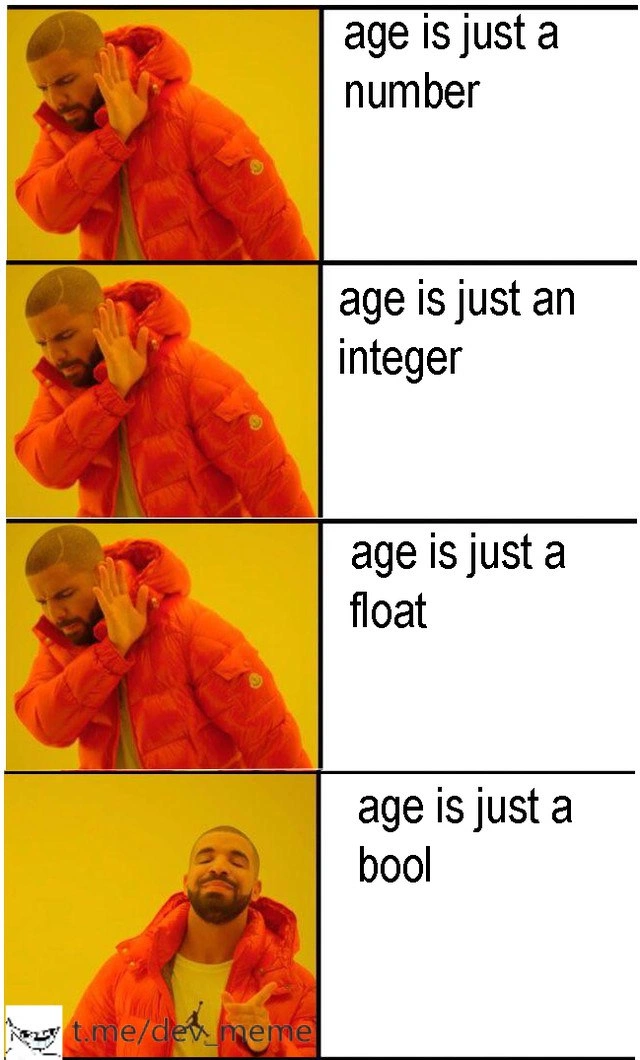
The image uses the Drake meme format to rank those choices. He refuses the first three and approves bool, which is funny because a person's age cannot literally be only true or false. What can be true or false is a rule about age, such as isLegal, canSignUp, or requiresParentalConsent.
This is where TypeSystems, TypeSafety, and BooleanLogic become practical. Choosing the wrong type can make future code confusing. If a database stores only isLegal, the app cannot later calculate birthdays, age brackets, or changing eligibility rules unless it asks for the original date of birth again.
Level 3: Domain Collapse
The meme turns a casual saying into a tiny data modeling crime scene. Drake rejects:
age is just a number
age is just an integer
age is just a float
Then he approves:
age is just a bool
That final line is absurd because age is naturally a value with range, units, validation rules, and time dependency. Treating it as a bool means the system has stopped representing age and has started representing one specific question about age. The post caption, isLegal ?, gives away the likely business requirement: the product does not care whether someone is 17, 18, 35, or 82; it only cares whether a rule returns yes or no.
Experienced developers recognize this as the moment a narrow feature becomes a permanent model. A boolean like isAdult, isLegal, or isOver21 is convenient until the rules change by country, state, product category, consent type, contract date, or time zone. Suddenly the clean boolean is not clean at all; it is a compressed archive of assumptions with no decompressor.
The type ladder also makes the joke sharper. Integer is already more programmer-specific than "number" and is reasonable for age in completed years. Float is suspicious because most apps do not need someone to be 18.42 years old. Bool is the final surrender: great for a yes/no decision, terrible as the source of truth. Somewhere in the backlog, a ticket is already forming: "Show user's exact age on profile," and the database is quietly pretending it did not hear that.
Description
A four-row Drake meme shows Drake rejecting three statements and approving the final one. The visible text reads, from top to bottom: "age is just a number", "age is just an integer", "age is just a float", and "age is just a bool"; a faint bottom watermark reads "t.me/dev_meme". The humor translates a common saying into progressively more programmer-specific type vocabulary, ending with the absurd idea that age should be represented as a boolean rather than a numeric value. For developers, the punchline lands as a tiny domain-modeling anti-pattern: collapsing a rich value like age into one binary flag because the current feature only asks one yes/no question.
Comments
1Comment deleted
Nothing says domain modeling like replacing date arithmetic with `isOldEnough` and hoping product never asks for birthdays.