The Ultimate Risk: Betting Your Career on Facebook's JavaScript
Why is this Frameworks meme funny?
Level 1: All Eggs, One Basket
Imagine you have a favorite toy that’s super popular right now. You decide, “I’m only ever going to play with this one toy, and I’ll ignore all other toys.” It might be fine for a while because that toy is popular and fun. But what if next year everyone stops liking that toy and moves on to something new? You’d be in a tough spot, right? You put all your eggs in one basket – meaning you relied completely on one thing. This meme is joking about a computer programmer doing exactly that, but with his career. He learned one big tool (called React) made by one big company (Facebook), and he’s joking that this is his idea of living dangerously. The woman says she likes guys who take risks, like someone who might do a big crazy stunt. The funny twist is that his “crazy stunt” is just a nerdy career choice – focusing on one coding tool. They then kiss like it’s the coolest thing ever. It’s silly because betting everything on one toy (or one tool) is a bit risky, but it’s not the kind of wild risk most people think of. The joke is basically: in programmer world, using only one favorite tool is seen as a daring adventure! Even though it’s a geeky kind of risk, the meme plays it up like it’s super romantic and bold, which makes us laugh.
Level 2: All-In on React
For those newer to software development, let’s break down why betting your whole career on one framework – specifically React – is portrayed as a risky (and funny) move. React is a popular JavaScript library for building user interfaces, originally created and open-sourced by Facebook. It’s part of the frontend world – meaning it helps developers design what users see and interact with on websites and web apps. React is widely used (Facebook, Instagram, and tons of companies use it), so it might sound like a solid thing to specialize in. Saying “I’m staking my career on React” means the developer has chosen to focus almost entirely on that one framework for their job skills. On the surface, that can be smart: there are many React job openings, and expertise in a big framework can land you a good role. But here’s the catch that makes the meme humorous: the JavaScript ecosystem changes fast.
In web development, frameworks and libraries (like React, Angular, Vue, etc.) are tools to build apps more easily. However, what’s popular today might not be popular in a few years. This constant cycle of new tools replacing old ones is often called “framework churn” or “framework fatigue.” Developers joke about FrameworkFatigue because it feels like there’s a new “must-learn” JavaScript framework every year. If you’ve only ever learned one of them, you might feel panicky when something new comes along. For example, a decade ago many devs used AngularJS (an earlier framework from Google). It was the hot frontend tech. But then newer frameworks like React appeared and stole the spotlight. Google even revamped Angular into a completely different version (Angular 2+), which was not backward-compatible with AngularJS. Suddenly, knowing only old AngularJS was much less valuable, and those developers had to quickly learn new skills. That’s a classic case of FrameworkChurn in action.
Now, React is currently a dominant framework – which might make a junior dev think, “What’s the big risk? React is everywhere!” The meme exaggerates to make a point: no matter how popular a tool is, putting all your eggs in that one basket can be risky in tech. Vendor lock-in is one reason. Vendor lock-in means being dependent on a single company’s technology. React’s vendor is Facebook (now Meta). While React is open source (free for anyone to use and contribute to), Meta guides its development. If Meta one day decided to significantly change React or stop supporting it (unlikely in the near term, but not impossible in the long run), the ripples would be felt by developers worldwide. Even beyond the vendor issue, consider personal career growth: if you specialize only in React, you might neglect learning other programming concepts or tools. What if a project uses a different library, or a new paradigm replaces component-based frameworks entirely? A single-stack specialization – focusing only on one technology stack like the React/JavaScript stack – can leave you with knowledge gaps. Many career advisors and senior engineers encourage newbies to get a solid foundation in core languages (like JavaScript itself, HTML/CSS for web, etc.) and concepts, rather than only knowing one framework’s specifics.
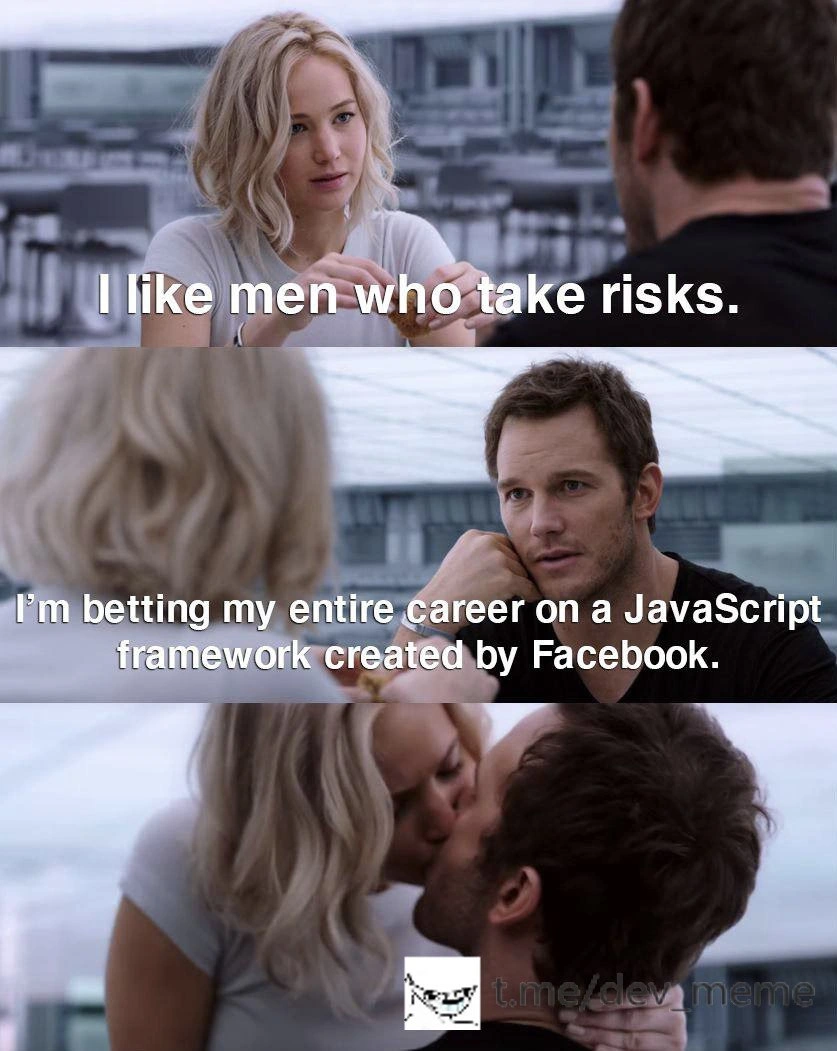
The meme’s scenario uses the movie “Passengers” scene humorously. The woman says, “I like men who take risks.” In everyday terms, that sounds like she admires brave, adventurous behavior (like skydiving or starting a risky business). The man’s reply flips this idea into a nerdy context: “I’m betting my entire career on a JavaScript framework created by Facebook.” He’s basically saying, “I’m daring because I chose to become a React-only developer.” For someone outside tech, that might sound confusing or not risky at all (“Isn’t React a pretty safe choice since lots of sites use it?”). But among developers, this statement is a wink to the fact that tech moves fast and today’s trendy framework could be outdated tomorrow. It highlights the inside joke that a developer’s idea of “danger” is committing to a tech that might become the next MySpace or Betamax of frameworks – famous one day, forgotten the next.
So why are they kissing passionately in the last panel? That’s the punchline. It’s playing with the absurdity that in the developer world, someone might find this niche form of risk-taking incredibly attractive. It’s TechHumor: of course, in real life, saying you use React won’t typically make someone fall into your arms! But the meme imagines a world (loved by DeveloperHumor) where being a daring coder is as romantic or impressive as being an action hero. It’s poking fun at both the Career_HR aspect (making bold career moves) and the Frontend framework obsession. In summary, to a newer developer: the meme is funny because it exaggerates a common career dilemma (specialize in one tool or learn many?) and frames that very nerdy decision as if it were a daredevil stunt worthy of admiration.
Level 3: Framework Roulette
At the highest level, this meme pokes fun at the high-stakes gamble developers take when they hitch their entire career to a single technology – in this case, React, a hugely popular JavaScript framework maintained by Facebook. The humor hits home for seasoned engineers because it riffs on framework churn and vendor lock-in in the front-end world. In the meme’s dialogue, the man proudly declares he’s “betting my entire career on a JavaScript framework created by Facebook.” To an experienced dev, this line drips with irony. Why? Because betting everything on one tech stack – especially one tied to a single corporate vendor – is like putting all your chips on one number at the casino. Front-end frameworks have a notorious history of rising quickly, then being replaced or falling out of favor (hello, AngularJS, Backbone, Ember…). Today’s hot framework can become tomorrow’s legacy code. By choosing React as his one-and-only, our risk-taking Romeo is essentially engaging in single-stack specialization: he’s assuming that React will remain dominant and that Facebook (now Meta) will keep shepherding it for years to come.
To a veteran, this is both hilariously relatable and mildly nerve-wracking. Many of us have felt the FrameworkFatigue: we mastered one front-end tool only to see the industry pivot to another. Betting your career on a single vendor’s technology magnifies that risk. The phrase “peak dev risk-taking” in the meme title exaggerates this feeling – as if using React is akin to base-jumping or riding a motorcycle without a helmet in the developer world. 😅 It’s a tongue-in-cheek acknowledgment that, while no one’s life is on the line, a developer’s career trajectory can indeed be at risk if their chosen framework loses steam. The industry’s volatility means that a framework can be superseded by a new invention or mired in controversy (recall the brief scare over React’s license issues around 2017, which made companies wonder if they should pull React from projects). Vendor dependency is another silent specter here: React is open source, but it’s Facebook’s baby. The community trusts that Meta will act in the project’s best interest, but there’s an underlying awareness that a single company’s shift in strategy could cascade through the ecosystem. For example, Google dramatically changed Angular (from AngularJS to a whole new Angular), leaving many all-in AngularJS developers stranded with obsolete skills. Senior devs nod knowingly at these tales.
So when the woman in the meme says, “I like men who take risks,” and the man responds with “I’m betting my entire career on [React],” it’s extreme DeveloperHumor born from real anxieties. It satirizes how Frontend specialists often do take career risks every time they commit to a tool or framework in the rapidly evolving JavaScriptEcosystem. In a world where there’s a new JS framework du jour, declaring lifetime allegiance to one (even a powerhouse like React) is both a bold move and a laughable one. The final panel’s enthusiastic kiss is the punchline: it absurdly equates technical risk-taking with romantic or heroic daring. It’s as if saying “I use React and only React” is the sexiest, most daring confession a developer can make. The seasoned engineer chuckles because they’ve seen how quickly today’s “top framework” can become tomorrow’s cautionary tale. Career_HR folk might even sympathize – hiring managers know the pain of a resume that’s too narrowly focused on a fading technology. In short, the advanced joke here is about embracing a single tech stack with the reckless passion usually reserved for extreme sports, fully aware that the thrill might be short-lived.
Description
A three-panel meme featuring a scene from the movie 'Passengers' with Jennifer Lawrence and Chris Pratt. In the first panel, Jennifer Lawrence's character says, 'I like men who take risks.' In the second, Chris Pratt's character replies with a serious expression, 'I'm betting my entire career on a JavaScript framework created by Facebook.' The third panel shows them passionately kissing. The humor stems from portraying the adoption of a Facebook-backed framework (implicitly React.js) as a high-stakes, attractive risk. For experienced developers, this resonates on multiple levels: the volatility of the JavaScript ecosystem, the history of controversial licensing with Facebook's open-source projects, and the general distrust of relying on technologies controlled by large corporations that might abandon them. The meme satirizes how career-defining these technology choices can feel
Comments
26Comment deleted
Betting your career on a Meta framework is the ultimate thrill. Will they deprecate it in favor of a VR-first framework, or will they just change the license to require you to post your stand-up notes to Threads?
Committing your whole career to React is like pinning dependencies with ^0.x - technically allowed, existentially reckless
Nothing says 'I live dangerously' quite like building your entire career on a framework that Facebook could deprecate faster than they killed Parse, while your package.json grows larger than the codebase of Apollo 11
Ah yes, the classic developer pickup line: 'I've coupled my entire professional future to a library maintained by a company that deprecated Parse, killed off Flux variants, and can't decide if classes or hooks are the way forward.' Nothing says 'calculated risk assessment' quite like betting your career on a framework whose breaking changes arrive faster than your sprint cycles, maintained by a company whose primary business model is surveillance capitalism. But hey, at least the component lifecycle is more stable than your relationship status - though both require constant reconciliation and occasionally leave you wondering if you should have just gone with Vue
React: the framework where your career's useEffect dependency array is [Zuck'sNextPivot, infiniteRe-renders]
Nothing says risk like betting your career on a Facebook‑born JS framework - somewhere between the old PATENTS file and the next “experimental” API rename
Nothing says risk appetite like coupling your org’s frontend and hiring pipeline to a single‑vendor OSS repo whose license, rendering model, and feature flags pivot with quarterly OKRs
Why? Comment deleted
It is worthless. Comment deleted
translate that please? Comment deleted
It's a Joke, Right? Because this is the stupidest thing that I have seen. Comment deleted
can someone tell me which js framework this is referencing? Comment deleted
React? Comment deleted
oh, thank Comment deleted
Have a good career! ;-) Comment deleted
my career so far consists mostly of avoiding javascript as much as possible Comment deleted
I've had a few javascript assignments in school, and I've written one line of javascript for my website, but that's it. Everything else there is HTML5 and CSS3, and I'm lowkey proud of that. Comment deleted
There are websites that implement scrolling with javascript… Comment deleted
I guess mainly web dev would touch js more... Comment deleted
And thank God! Comment deleted
Nice Starlord learning js Comment deleted
It is other movie Comment deleted
I know Comment deleted
But it's the same actor Comment deleted
but react is not a framework 🤔 Comment deleted
Actually, but most call it as framework Comment deleted