The Definitive Guide to Chasing Compiler Dragons
Why is this FunctionalProgramming meme funny?
Level 1: Serious Book, Silly Idea
Imagine you walk into a library and see a big, official-looking book titled “How to Do Homework on Candy: The Definitive Guide.” On the cover is a very serious-looking owl with giant, loopy eyes. That sounds pretty silly, right? Because doing homework while you’re extremely hyper on candy is probably a crazy idea, not something you’d actually write a textbook about! That’s essentially what this meme is doing. It takes the very serious style of a textbook (the kind you trust to learn something important) and it pretends the subject is something wild and ridiculous – like coding while on drugs. The joke is funny because it’s a mix of opposites: a straight-faced, serious format talking about a wacky, do-not-try-this-at-home idea.
Think of it like this: normally, when we do something complicated like coding or homework, we try to be focused and clear-headed. The meme flips it around and says, “Hey, what if someone wrote a serious guide about doing this difficult thing in the silliest, messiest way possible (while not in your right mind)?” The big-eyed animal on the cover makes it even funnier – it looks like a person who had way too much sugar or soda and is now super jittery trying to work. Even if you don’t get all the tech words, you can laugh because the whole concept is as goofy as a teacher calmly giving a lecture on how to properly eat 5 ice creams before an exam. It’s humor through contrast: taking a sane, sober book style and slapping in a crazy, insane topic. In the end, it’s just joking that sometimes coding can make you feel a little crazy – and it exaggerates that feeling by pretending there’s a literal manual for it!
Level 2: Pure Functions & Side Effects
Let’s break down the technical terms and references in this meme in a way that newer developers can grasp. Despite the wild premise, the humor leans on some fundamental programming concepts and developer cultural references:
Pure Function: In programming, especially in functional programming languages, a pure function is one that given the same inputs will always produce the same output and does nothing else. Importantly, it has no side effects. That means it doesn’t alter any external state, doesn’t modify global variables, doesn’t perform any I/O like writing to a disk or printing to a screen. It’s like a mathematical function:
f(x) = x * 2will only return2xand not do anything else behind the scenes. For example:# A pure function example in Python def pure_double(x): return x * 2 # It uses the input and returns a result, with no side effects. print(pure_double(5)) # -> 10. It will always return 10 for input 5, and nothing else happens.A pure function makes code easier to understand and test, because you don’t have to worry about hidden effects or different outcomes on different runs. Many FunctionalProgrammingConcepts revolve around writing as much code as possible as pure functions.
Side Effects (in code): A side effect is anything a function does that is observable outside of returning a value. This could be changing a variable outside its own scope, modifying a data structure in place, writing to a database, printing to the console, or even just altering a static class member. For instance, a function that writes to a log file or updates a global counter is not pure because it has a side effect beyond just computing an output. Here’s a quick contrast:
total_calls = 0 # global state def impure_double(x): global total_calls total_calls += 1 # side effect: modifying external state print(f"Doubling {x}") # side effect: printing output (I/O) return x * 2 result = impure_double(5) # This function changes total_calls and prints to console each time it's called, so it's impure.In this snippet,
impure_doubleproduces a result but also affects things outside itself (it increments a global counter and outputs text). Those are side effects. In functional programming, side effects are often avoided or controlled, because they can make a program harder to reason about (you have to consider outside interactions, not just the function’s logic).“It would be a pure function if not for the side effects on your sanity”: Now, this part of the meme uses the above terms playfully. It’s saying: Coding on Drugs would have been a pure function (i.e., something that doesn’t mess up anything outside of itself) except it does have one side effect: it messes with your sanity. Of course, in reality, a function can’t directly affect the programmer’s mental health – this is a joke. They’re personifying the coding activity as if it were a function. The “sanity” side effect is a humorous way to say doing this might make you a bit crazy. In normal usage, side effects refer to program state, but here it refers to the human state of the coder, blending a programming concept with a mental health concept. This is why it’s funny: side effects in programming are usually things like a changed variable or a printed line, not the coder feeling loopy!
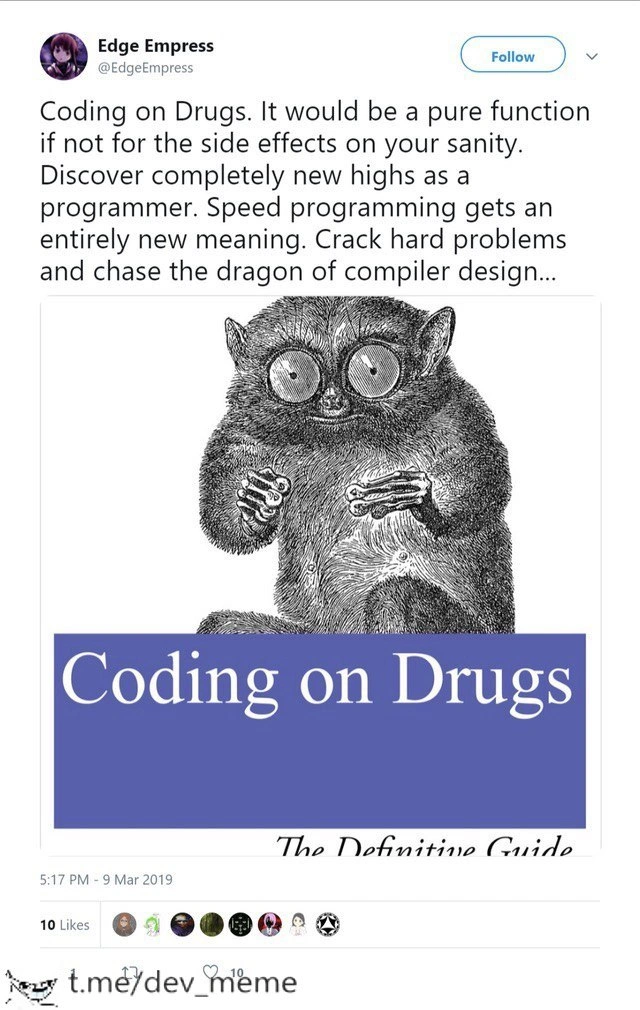
O’Reilly Animal Cover Parody: The meme includes what looks like a cover of an O’Reilly book titled “Coding on Drugs.” O’Reilly Media is a famous publisher of technical books. Developers know their books by the distinctive covers: usually a two-tone cover (often white and some color) with an old-style engraved illustration of an animal on it, and a title like “_____: The Definitive Guide” or “Learning _____”. Some real examples are “Learning Python” (with a python snake on the cover), “JavaScript: The Definitive Guide” (with a rhinoceros on the cover), and the classic “Programming Perl” (with a camel on the cover, leading to its nickname “The Camel Book”). These are staple references on many programmers’ bookshelves. Over time, the O’Reilly animal covers themselves became an icon of developer culture – spawning jokes like “what animal will they choose for the next language’s book?” or countless parodies. In this meme, someone created a fake O’Reilly cover for “Coding on Drugs.” The animal shown is a primate (with huge eyes and hands up as if surprised or jittery). The style is exactly like a real book, down to the purple banner and the subtitle font saying “The Definitive Guide.” This immediately signals to any developer: this is a joke in the format of those serious books we know. The contrast between the professional, authoritative style of an O’Reilly guide and the absurd topic “Coding on Drugs” is what makes it comedic. It’s like seeing a textbook cover for something silly – the seriousness of the format makes the joke about the content even sharper.
Tweet Screenshot Meme: The image is shown as a tweet by Edge Empress (@EdgeEmpress), with the text and the image embedded in it. Often, funny tech quips or one-liners appear on Twitter, and then people take a screenshot or share them as memes. The presence of the Twitter UI (the profile pic, name, handle, timestamp “5:17 PM · 9 Mar 2019”, and the likes/retweet icons) is deliberate. It tells us this was originally a tweet that got some traction or at least was deemed share-worthy. Many developer memes are just witty tweets that get passed around because they capture a truth or joke well in one or two sentences. The watermark
t.me/dev_memesuggests it was posted on a developer meme Telegram channel, which is a common way for dev humor to circulate. So, format-wise, this meme is essentially a tweet + image combo.“Speed programming gets an entirely new meaning”: This line contains a pun. Normally “speed programming” might mean programming very quickly or even a friendly competition where people try to code something in a short time (there’s a notion of speed-coding challenges or hackathons where you build things rapidly). Here, “Speed” is capitalized as the first word of a sentence, but it hints at speed the drug (slang for amphetamines). So it implies programming while on speed (the drug) gives “speed programming” a literal meaning. If you didn’t know, amphetamines are stimulants that can make people feel hyper-focused and energetic (but are illegal without prescription and dangerous). The joke is imagining that term very literally: a coder on amphetamines furiously writing code like a maniac. It’s hyperbole and not endorsing it – just using the pun for humor. For a junior developer, the takeaway is the meme is making a play on words: “speed programming” = coding fast, but also coding on the drug nicknamed “speed.”
“Crack hard problems”: Another wordplay. In everyday language, to “crack a problem” means to figure it out or solve it, especially a tough one (like “I finally cracked the algorithm!” meaning you’ve solved it). “Crack” is also a shorthand for crack cocaine, a powerful stimulant drug. By saying “crack hard problems,” the tweet cheekily combines those meanings. It’s implying, jokingly, “use crack (the drug) to solve difficult problems,” or that solving difficult problems gives you a high like the drug crack. It’s intentionally outrageous because crack is definitely not something you’d actually want involved in your coding process. The shock value of mentioning a serious drug in the context of coding is what makes it funny in a dark, absurd way.
“Chase the dragon of compiler design”: The phrase “chase the dragon” is a bit less common, so it might confuse newer folks. It’s an idiom that originally refers to an addict’s continual attempt to achieve a high equal to the first one they ever got (commonly associated with smoking opium or heroin – they say the swirling smoke looks like a dragon, and you keep chasing that first high, which you never quite catch again). In general use, “chasing the dragon” means pursuing an unattainable goal or repeating something hoping for a great result that keeps eluding you. Now, compiler design is a field in computer science where you create compilers – programs that translate source code written in a programming language (like C++, Java, or Python) into a lower-level language (like machine code or bytecode) that a computer can execute. Compiler design is known to be complex: it involves lexing, parsing, building syntax trees, optimizing code, and a deep understanding of how programming languages and CPU instructions work. It’s often taught in advanced CS courses and is considered one of the tougher, more theoretical areas. By saying “chase the dragon of compiler design,” the tweet humorously suggests that working on compilers is like chasing an elusive, possibly impossible high. It’s kind of true in a sense – many people start writing a compiler as a passion project, only to find it’s a massive undertaking that can consume your life (the ‘dragon’ being the symbol of how daunting it is). There’s even a famous textbook on compilers with a dragon on the cover (so famous that it’s literally called “the Dragon Book” by programmers). So, this line implies that “coding on drugs” will have you undertaking something as crazy as writing a compiler while in a delirious state – a task both magnificent and maddening.
Mental Health and Developer Experience: The meme is tagged with MentalHealth and DeveloperExperience_DX, which highlights that beyond the jokes, it touches on something real: coding is mentally intensive, and developers often joke about being “crazy” or “insane” after dealing with very hard problems or long hours. There’s an element of truth behind the humor: working too hard or in unhealthy ways (like not sleeping, consuming too much caffeine or worse) can have side effects on your sanity. The meme exaggerates it to the extreme (actual drugs), but it resonates with the feeling of being burnt out or frazzled after an intense coding session. LateNightCoding is also a tag – many new developers will soon discover the trope (or reality) of coding till late at night, sometimes aided by energy drinks or just sheer determination, and the next day you feel like a zombie. This meme takes that “coder lifestyle” to a cartoonish extreme for comedic effect.
In simpler terms, for a newcomer: this meme is joking that there’s a (fake) programming book called “Coding on Drugs,” and its pitch is full of puns. It uses technical terms like pure function and side effects from programming and turns them into jokes about literally getting high while coding. It also references the culture of programmers consuming a lot of stimulants (even if usually just coffee) and tackling insanely hard problems (like designing compilers) while half-jokingly sacrificing their sanity. The image making it look like a legit tech book with an animal cover is the cherry on top – it’s presenting a totally absurd concept in a format that new devs will learn is normally very serious. Understanding these terms and references helps you get why it’s funny: it’s the clash between serious software engineering concepts and the outrageous scenario of mixing them with drug-induced craziness.
Level 3: Pure Code, Altered Mind
From a seasoned developer’s perspective, this meme hits home by blending programmer humor with the stark reality of mental health in tech and the extreme rituals of developer culture. The tweet reads like a faux advertisement or a book blurb, and it piles on the puns with a knowing wink to those in the trenches of coding. The humor here comes from layering multiple double-meanings and references that experienced devs will recognize instantly:
“Pure function if not for the side effects on your sanity” – In programming, a pure function (especially in functional programming paradigms) has no side effects and doesn’t depend on hidden state. By definition, it shouldn’t have any impact outside returning a value. The tweet subverts this by saying the only thing preventing this coding experience from being a pure function is the side effect on the programmer’s sanity. It’s a witty way to say: coding while on drugs might produce code that doesn’t mess up your system, but it sure will mess up your head! This tickles developers because it’s a classic play on jargon: side effects are normally a bad thing in programs, and here the only side effect is on the poor coder’s mental stability. DeveloperExperience_DX indeed – your code might be pure, but your DX (developer experience) is pure madness. Anyone who’s chased an intractable bug for 20 hours straight can relate to the idea of losing sanity as a side effect of coding, even without actual drugs involved. It’s funny because it’s true in a metaphorical sense: coding marathons often leave you dazed like you’re on another planet.
“Discover completely new highs as a programmer.” The word highs here is a cheeky nod to drug-induced euphoria, but also to the highs of achievement or excitement in programming. Experienced devs know the rush of a breakthrough – that “Eureka!” high when you finally crack a tough algorithm or fix a production bug at 3 AM. This line suggests that programming on drugs might lead to new highs – as in both novel drug highs and unprecedented levels of coder excitement (or delusion!). It satirizes the idea of chasing productivity or creativity through substances. In reality, many programmers joke about surviving on caffeine (a socially accepted drug of choice in coding culture). The meme takes it up a notch: what about illegal stimulants? It’s edgy humor because it hints at the extreme lengths (or lows) of LateNightCoding sessions – as if someone said “coffee isn’t enough, bring on the hard stuff!” Seasoned devs chuckle (perhaps a tad guiltily) because we’ve all done speed programming in the sense of frenzied coding under deadline, fueled by caffeine or adrenaline. Here, “Speed programming gets an entirely new meaning” explicitly punks the term “speed” – a nickname for amphetamine, a potent stimulant drug. We hear “speed programming” in everyday terms meaning coding really fast (perhaps under time pressure). The meme wryly suggests literal “speed” programming: i.e., programming while on amphetamines. It’s an absurd escalation of the idea that a stimulant might help you code faster. Seasoned devs know that beyond a point, more stimulants (even too much coffee or sugary drinks, let alone amphetamines) just lead to jittery, bug-riddled code and crazy commits at 5 AM that you hardly remember writing – hence the sly warning about side effects on sanity.
“Crack hard problems” – Another layered pun. “Crack” means solve or figure out (e.g. “crack the code”, “crack a tough problem”), which is what we aim to do daily as engineers. But “crack” is also slang for a very addictive form of cocaine. By pairing it with “hard problems,” the tweet suggests programming offers the addictive thrill of solving difficult issues, and simultaneously evokes the idea of crack cocaine for a tongue-in-cheek shock factor. The image of a programmer “on crack” feverishly typing to solve a bug is over-the-top and humorous. Senior devs have probably joked that some code must have been written “by someone on crack” when it’s incomprehensibly weird – here the meme plays with that exact image. It’s self-deprecating too: sometimes when we look back at our own 4 AM code fixes, we wonder “What was I on when I wrote this?!” – as if we’d been high given how insane the solution seems in the light of day.
“Chase the dragon of compiler design” – This line is the crescendo of the joke and a favorite for anyone who’s gone deep into Compilers or low-level programming. As discussed above, “chase the dragon” is a phrase from drug culture about pursuing an unattainable ultimate high. In a coding context, compiler design is an advanced, almost mystical pursuit that can consume your brain entirely. Many see writing a compiler from scratch as a herculean challenge or a kind of pinnacle of programming skill (it’s not called chasing a pony – it’s a dragon, implying something big and formidable!). The meme implies that trying to write or perfect a compiler is like a fever dream: you’ll be perpetually chasing something huge, and perhaps you have to be a bit crazy (if not actually on hallucinogens) to enjoy it. For veteran devs who remember the legendary Dragon Book textbook, this line lands perfectly. It humorously suggests that diving into compilers might as well be a mind-altering experience. Indeed, many who’ve taken a college compilers course recall nights of hallucination-like debugging sessions with finite state machines and syntax trees dancing in their heads. The meme’s author likely chose compiler design as the ultimate “hard problem” to cap off the escalating drug metaphor because it’s known to make even strong programmers sweat (and occasionally cry). It’s the kind of project that will make you question reality at 5 AM – no substances needed! So throwing “chase the dragon” in front of it just amplifies the notion that compiler work is an addictive, overwhelming quest that could consume one’s sanity.
Beyond the text of the tweet, the visual format is a huge part of the humor, and veteran devs will appreciate all the references packed in the image. The screenshot shows the tweet format (with the handle @EdgeEmpress and timestamp), confirming it’s a tweet screenshot meme often seen on dev Twitter and Telegram channels (note the t.me/dev_meme watermark, indicating it’s shared in a dev meme Telegram group). But the star is the O’Reilly cover mockup attached below the tweet. For anyone who has been around tech books, the O’Reilly style is unmistakable: an old-school illustration of an animal and a colored banner with a title in serif font. This meme nails that look with “Coding on Drugs” in a big violet banner, plus the subtitle “The Definitive Guide” partially visible – a spot-on parody of titles like “: The Definitive Guide”, which is an actual naming convention for comprehensive tech texts (for example, “JavaScript: The Definitive Guide” is a real O’Reilly book, as is “UNIX Power Tools” which also sports an animal and a tagline). The choice of a wide-eyed primate illustration is comedic gold. Those gigantic eyes convey a mix of surprise, hyper-focus, and a touch of madness – exactly how a coder at the tail end of an all-night coding marathon looks (especially if they’ve had a pot of coffee or something more illicit). Seasoned developers often joke about the wide-eyed stare after marathon coding: the 1000-yard stare of someone who’s been looking at a screen for 30 hours straight. The primate (possibly a tarsier, known for huge eyes and nocturnal habits) could also be a playful jab: tarsiers look perpetually shocked, as if they just saw the horrifying complexity of a template metaprogram or the MIPS assembly output of their compiler. 😂 It’s the perfect spirit animal for “Coding on Drugs.”
O’Reilly parodies are a beloved form of DeveloperHumor. They take something esoteric or ridiculous and dress it up in the authoritative format of a tech manual. The humor comes from that incongruity. Here, the incongruity is glaring: a reputable publisher’s Definitive Guide on a topic that is definitely not advisable (and not real). It mocks both the intensity of serious tech books and the sometimes extreme coping mechanisms developers use. In the dev world, we often cope with absurdity and stress by making even more absurd jokes. This meme hints at an underlying truth about MentalHealthInTech: programming can be so challenging and brain-consuming that people half-joke about needing drugs to keep up or to unwind. There’s a dark humor in “completely new highs as a programmer” – it nods to the fact that some developers do struggle with unhealthy habits (like over-caffeination, sleep deprivation, or worse) to meet deadlines or spark creativity. It’s laughing so we don’t cry: we take the very real concept of burnout and mental strain, and exaggerate it into a cartoonish scenario of a coder tripping on substances but still cranking out code. The side effects on sanity line especially resonates; many of us have felt a little insane after debugging a gnarly issue for too long. The meme just personifies that insanity as an actual drug side effect, which is both hilarious and a tiny bit poignant.
This meme also contains an implicit word of caution wrapped in humor: “It would be a pure function if not for the side effects on your sanity.” In other words, no matter how clean your code is, sacrificing your sanity is not worth it. A senior dev reading this might chuckle, recalling times they or colleagues pushed too hard – pulling all-nighters or relying on stimulants (even just excessive Red Bull) to code – and the inevitable “crash” or messy end result. We recognize the truth that code quality isn’t just about pure functions and good architecture; it’s also about the coder’s well-being. A mentally fried programmer can produce wild, hard-to-maintain code (no matter how conceptually “pure” it might seem at the time). The phrase “pure function with side effects on your sanity” beautifully sums up the trade-off: you wrote a nifty function that doesn’t affect system state, but it sure affected your state! It’s a tongue-in-cheek reminder that maintaining one’s sanity is also part of sustainable developer experience.
In essence, the meme pokes fun at the extremes of developer life. It’s the kind of joke you appreciate after you’ve been through a few “dragons” yourself – be it a gargantuan legacy codebase, an overnight crunch to meet a deadline, or implementing something as brain-bending as a compiler or a purely functional architecture. It wraps up classic programmer in-jokes (like functional programming purity) with edgy exaggerations (like actually doing drugs) to create a cocktail of humor. For a seasoned coder, it’s both a chuckle at the absurdity and a nod of recognition: “Haha, coding on drugs – sounds insane… and yet, debugging that multi-threaded race condition at 4 AM felt pretty much like an out-of-body experience!” The meme expertly balances CodingHumor with a subtle commentary on MentalHealth. We laugh, but we also know the underlying message: take care of your sanity, because no amount of “speed” can code your bugs away without consequences. And if anyone ever did publish “Coding on Drugs: The Definitive Guide,” we’d add it to our shelf of bizarre tech lore – right between the Dragon Book and whatever wild tools we tried during that one death march project. It’s this shared understanding of the crazy side of coding life that makes the meme so relatable and funny to those in the know.
Level 4: High-Order Functions
At the most theoretical layer, this meme twists core concepts from functional programming and computer science into a psychedelic parody. In pure functional programming (think Haskell or mathematical lambda calculus), a pure function is one that for the same input always returns the same output and crucially has no side effects – meaning it doesn’t alter any external state, perform I/O, or mess with global variables. This guarantees referential transparency: the function call can be replaced with its return value without changing the program’s behavior. It’s a cornerstone of reliable, provable code. Here, the tweet quips “It would be a pure function if not for the side effects on your sanity.” The joke exploits the term “side effects” in a double sense. Originally, side effect is a term from medicine/pharmacology, describing unintended effects of a drug (like a drowsy side effect from cold medicine). Computer science borrowed this term to describe unintended or external outcomes of running code. In a purely mathematical world, functions have no side effects – they’re like well-behaved formulas. But in practice, most useful programs do have side effects (writing to a file, printing logs, modifying memory). The meme cleverly loops the meaning back: drugs cause mental side effects, so “Coding on Drugs” might yield code that is logically pure (no observable program-side side effects) while the programmer experiences wild mental side effects. It’s a nerdy pun because it imagines a function that doesn’t print or change any program state, but does alter the state of the coder’s mind – a side effect outside the program’s scope! In other words, the “function” (our coding session) wouldn’t be considered pure by functional programming standards, since it definitely has a side effect (on the human executing it!). This absurd scenario tickles the part of a programmer’s brain that loves type-theoretic precision: it’s a “pure function” in code broken by an impure execution context.
From a theoretical standpoint, it’s as if the meme asks: what if the only impurity in our code was the computational equivalent of a hallucination? In real life, languages like Haskell enforce purity via clever type systems (e.g. using monads to encapsulate IO so pure functions remain pure). Monads are sometimes jokingly described as tricks to smuggle side effects into pure code. Here, however, no type system could abstract away the “sanity effect” – there’s no SanityMonad to safely contain the fact that the programmer’s mental state is being mutated by external chemicals! The phrase also evokes the concept of state in computing: a pure function has no stateful interactions, whereas a drug-altered coder has an internal state that’s volatile and unpredictable. It’s like an inversion of the usual problem – instead of an impure function in a pure mind, we have a pure function in an impure mind.
The tweet’s latter half ventures into compiler design territory with the line “chase the dragon of compiler design.” This is a rich reference on multiple levels. In narcotics slang, “chasing the dragon” refers to pursuing an ever-elusive high (often associated with smoking opiates, where the first high is euphoric and one keeps trying—and failing—to recreate that initial bliss). Metaphorically, it means chasing something one can never quite catch again. In computer science, compiler design is a notoriously hard problem and something of a dragon itself. In fact, one of the most famous textbooks in CS is the so-called “Dragon Book” (“Compilers: Principles, Techniques, and Tools” by Aho, Sethi, Ullman), named for the red dragon on its cover representing the complex beast of a problem that a compiler writer must slay. By saying “chase the dragon of compiler design,” the meme taps into the notion that diving into compilers can become an endless, obsessive quest for perfection – you solve one optimization or language parsing quirk, only to find deeper challenges, much like a dragon you can never quite vanquish. Building a compiler involves heavy theory: formal grammars, lexing/parsing (automata theory and context-free languages), optimization (solving NP-hard problems like optimal register allocation), and even undefined behavior dragons (e.g. in C/C++). A compiler writer might humorously be seen as “chasing dragons” in both the fantastical and frustrating sense. So this part of the joke hints at the academic high of mastering compilers – a kind of ultimate boss battle in programming. It’s as if the tweet says, “for the ultimate mind-bending experience, try writing a compiler while high; you’ll be chasing an untamable beast and your sanity simultaneously.”
Finally, the meme’s imagery itself – a parody O’Reilly book cover – adds an erudite but absurd layer. O’Reilly Media’s books are legendary in developer circles for being authoritative references (often subtitled “The Definitive Guide”) on technical topics from programming languages to server admin, each adorned with a distinctive black-and-white animal engraving on the cover. By presenting “Coding on Drugs” as if it’s an O’Reilly book, complete with a wide-eyed primate illustration, the meme invokes the gravitas of a formal tech manual and collides it with a zany, not-at-all-formal subject. It’s a delicious contrast: O’Reilly books usually cover subjects like Python programming, Linux administration, or Compiler design (for real) – all sober, if complex, topics. Here we have the authoritative-looking tome “Coding on Drugs: The Definitive Guide”. The primate on the cover (which looks like a tarsier or bushbaby with huge, dilated eyes) is an apt visual gag – it resembles a programmer who’s had way too much coffee or something far stronger, eyes bulging at 5:17 PM (as per the tweet timestamp) after a non-stop coding bender. The animal might be a subtle nod: tarsiers are nocturnal and hyper-active hunters – not entirely unlike a developer hyper-focusing on a bug fix at 3 AM under questionable stimulants. In true O’Reilly tradition, sometimes the cover animal has a sly connection to the topic; here the connection is comedic (big eyes = wired coder, possibly “on something”). The O’Reilly style parody is a known trope in developer humor – it signals that we’re about to nerd out with a “definitive guide”, only to deliver a punchline topic that should never have a guide! It evokes the history of tech publishing (a bit of Tech Historian vibe): those of us who grew up with these books instantly recognize the layout and font, giving the meme a retro authenticity. It’s like stumbling on an artifact from an alternate universe where developer life and illicit substances became an official field of study.
In summary, at this deep level the meme’s humor comes from violating expectations of purity and rigor. It mashes together formal computing principles with informal (and illegal) stimulants, revealing an ironic truth: sometimes coding feels like an experimental drug trip, especially when dealing with esoteric topics like functional purity or compiler dragons. By anchoring the joke in technical lingo (pure functions, side effects, compilers) and framing it in the scholarly aesthetic of an O’Reilly book, the meme tickles the brainy part of developers – the part that loves both academic inside-jokes and creative wordplay. It’s a reminder that behind all the serious computer science theory, developers maintain a rich vein of humor (often slightly dark or loopy) about their own mental state and developer experience (DX) when pushing code to its limits. After all, to quote an old programming proverb with a twist: “All code and no play makes Jack a dull programmer” – sometimes you need a bit of madness (hopefully just metaphorical) to tackle those dragons!
Description
A screenshot of a tweet from the user 'Edge Empress' which includes a parody of an O'Reilly book cover. The tweet humorously suggests 'Coding on Drugs' would be a 'pure function if not for the side effects on your sanity,' and encourages one to 'chase the dragon of compiler design.' The attached image mimics a classic O'Reilly programming book, famous for their animal illustrations. This one features a black-and-white sketch of a Tarsier, an animal with enormous eyes, fitting the 'on drugs' theme. The book's title is 'Coding on Drugs' with the subtitle 'The Definitive Guide.' The meme resonates with experienced developers by using functional programming jargon ('pure function', 'side effects') to describe the intense, sometimes mentally taxing, focus required for deep work, likening it to a narcotic experience. The reference to 'compiler design' is a nod to one of the most complex fields in computer science, framing it as the ultimate intellectual 'high.'

Comments
16Comment deleted
I tried to write a pure function, but after three days of debugging, it had definite side effects: my hair turned grey, my plants died, and I started seeing the ghost of Dennis Ritchie
Who needs psychedelics when you’re tracing a “pure” function’s side effect through twelve layers of lambdas - by the time it hits prod, you’re already seeing compiler dragons
The real irony is that after 15 years of chasing 'pure functions with no side effects,' the only thing that remains pure is our caffeine dependency - everything else has been mutated by scope creep, legacy callbacks, and that one Promise chain from 2016 we're still afraid to refactor
The joke brilliantly plays on functional programming terminology: 'It would be a pure function if not for the side effects on your sanity' - a perfect metaphor for how programming, like a pure function, should be predictable and deterministic, but in reality causes significant side effects on the developer's mental state. The 'chase the dragon of compiler design' reference cleverly parallels the addictive pursuit of the perfect high with the obsessive quest for elegant compiler optimizations - both involve diminishing returns and an ever-elusive ideal state that keeps you coming back despite the toll it takes
“Coding on drugs” is a human runtime hack: throughput spikes, but your personal GC does stop-the-world at 4 AM and you discover the only pure function left is regret - everything else leaks side effects
Pure functions deliver the ultimate high - until side effects in prod turn your monad into a stateful nightmare
Tried “coding on drugs” - my functions stayed pure, but the monad for side effects was ‘self’; enabling -Ofast on the human compiler stripped the sanity checks and we shipped UB to prod
let's implement Radix LSD Sort real quick Comment deleted
Middle out will be awesome. Comment deleted
you have extra words: "Radix" and "Sort" Comment deleted
oh, yeah, sorry. I meant to say "let's do LSD" Comment deleted
Don’t buy into this shit my dudes, you’ll never feel complete coding sober ever again Comment deleted
because somehow you got your IDE to autocomplete random shit when you were high and now you can't turn it off anymore. Comment deleted
Kkkjk Comment deleted
It’s actually cover for book about VIM ) Comment deleted
degeneracy Comment deleted