Skip to content
DevMeme
2921 of 7435
Just Say No to Non-Euclidean Geometries
Mathematics Post #3227, on Jun 13, 2021 in TG

Just Say No to Non-Euclidean Geometries

Why is this Mathematics meme funny?

Level 1: Just Say “No” to Crazy Weekend Projects

Imagine you’re about to enjoy a calm weekend, and a friend bursts in with a gigantic, super complicated puzzle – the kind with thousands of tiny pieces and a picture that doesn’t even make sense. They say, “Hey, let’s solve this right now!” You peek at the box and realize this puzzle is so bizarre it might as well be from another dimension. A responsible adult (that’s you in this scenario 😉) knows that starting this insane puzzle would mean no rest, lots of frustration, and a weekend gone down the drain. So you politely raise your hand and say, “No, thank you.” That’s exactly what’s happening in the meme, except the “puzzle” is a ridiculously complex math idea (a twisty, curvy type of geometry), and the person saying “No” is a wise developer who just wants a peaceful weekend. The meme is funny because it exaggerates a common feeling: sometimes the smart choice is to not start something you know will be too complicated. It’s poking fun at our tendency to get carried away with wild ideas. Just like a kid might need to be told not to eat too much candy at once, a grown-up coder is telling themselves not to bite off a crazy coding project on their day off. In simple terms, the picture says: “I know it looks cool, but nope, not today!”

Level 2: Flat vs. Curved Space

Let’s break down the technical ideas and visual cues for someone newer to these concepts. The meme revolves around non_euclidean_geometry, which means any kind of geometry that isn’t the normal flat kind you learned in school (Euclidean geometry). In everyday Euclidean geometry (named after the ancient Greek mathematician Euclid), shapes behave in the familiar way: for instance, a straight line is the shortest path between points, and if you draw a big triangle, its angles will add up to 180 degrees. Non-Euclidean geometry is what you get when you relax or change some of those rules – most famously, Euclid’s rule about parallel lines. In Euclidean geometry, given a line and a point not on that line, you can draw exactly one line through the point that never meets the original line (that’s the parallel line). But in non-Euclidean settings, that changes:

  • On a sphere (imagine drawing on a globe), if you try the same thing, no lines remain parallel – eventually they meet. This is called spherical geometry.
  • On a hyperbolic surface (imagine a saddle shape or a pringle chip stretched out), you can actually draw many lines through that point that never meet the original line – space “bends” outward in a way. This is hyperbolic geometry.

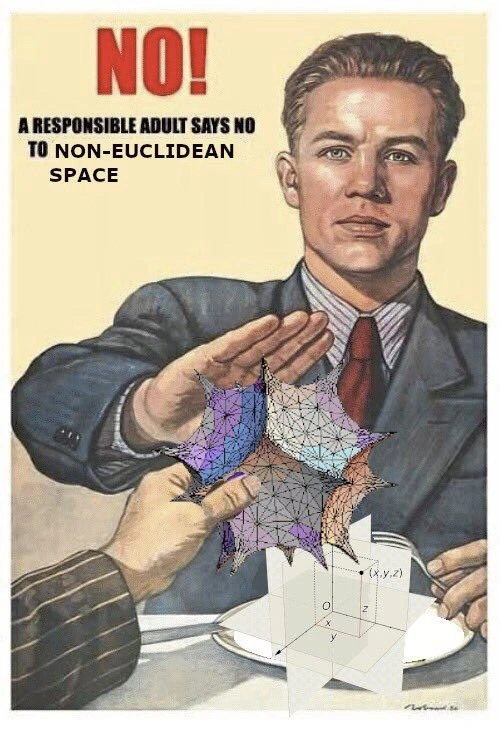
The object being offered in the meme – that weird multi-colored 3D mesh with spiky, wavy surfaces – represents a complicated hyperbolic surface mesh. It’s like a visual symbol for “crazy hard math project.” You can even see a small translucent coordinate axes (labeled X, Y, Z) attached under it. Those axes are a nod to the typical coordinate system used in programming and graphics. In normal GraphicsProgramming, when we draw things on a screen or make a 3D model, we use X, Y, Z axes that stay fixed in a nice, regular grid. That corresponds to flat Euclidean space. If you move one unit in the +X direction and one unit in the +Y direction, on a flat grid you’ve moved to a predictable new point (using good old Pythagorean theorem for distance: distance = sqrt(dx^2 + dy^2)). But if your space is curved, moving “straight” in X then in Y could land you somewhere very unexpected because the axes themselves might bend or the definitions of straight lines change. In a hyperbolic or curved space, the math for adding positions or rotating objects isn’t the same as just using simple trig functions. You might need non-Euclidean trigonometry (yes, that’s a thing!) – for example, formulas that govern triangles on a sphere or saddle differ from the ones we memorize from high school. A concrete example: on a sphere, the angles of a triangle might add up to 200°, and you’d need spherical trigonometric formulas to relate the sides and angles; on a hyperbolic plane, they might add up to 100°. So if a computer program assumes every triangle has 180° (which many graphics algorithms indirectly do), it would get very confused in these worlds.

So what is the meme telling a junior dev or a student? Essentially: “This complicated geometry stuff will cause you pain if you jump into it recklessly.” The man in the suit is labeled as “A responsible adult”, and he’s basically saying: No, I’m not going to mess with that. The imagery is exaggerated for comedic effect, but it reflects a truth in programming: We have amazing power to simulate and explore wild ideas (like a video game level with warped space, or a physics simulation on a Möbius strip), but the more mathematics you put into a project, the more challenging it can become. Beginners might not realize how deep that rabbit hole goes. For instance, writing a simple 3D game is hard enough; writing one where the geometry itself is non-standard means you’d probably have to rip out the guts of the game engine and implement custom math everywhere. Think about something as basic as figuring out an object’s trajectory under gravity. In normal (Euclidean) physics, that trajectory is a nice parabola. In a curved space, “straight down” might not stay straight, and what qualifies as a parabola gets weird. If your ComputerGraphics or physics engine assumes a flat world (which almost all do), introducing curvature could break everything unless you’re prepared to handle it at every step. That’s why the meme text calls it “non-Euclidean space” and then warns against it – it’s shorthand for “altering the fundamental geometry will create endless headaches.”

The retro propaganda style (“JUST SAY NO” vibe) is there to make it lighthearted and clear. It’s as if the programming community had a little tongue-in-cheek public service announcement: Friends don’t let friends randomly dabble in non-Euclidean coding without a plan. It resonates with anyone who’s tried a seemingly small project that exploded in complexity. For a junior developer, it’s a funny cautionary tale: before you take on an advanced topic like non_euclidean_geometry out of sheer curiosity, remember it’s not your average weekend experiment. Maybe start with something simpler (like making a small 2D game or a basic 3D demo) before tackling spaces that would make even your math professors raise an eyebrow!

Level 3: Curvature Conundrum

Why is it funny for a developer to declare “NO!” to non-Euclidean space? It’s because this combines a tempting technical project with the hard-won wisdom of experience. The meme mimics a 1950s-style public service announcement – the kind that might say “A responsible adult says NO to drugs” – but instead of cigarettes or alcohol, the forbidden temptation is non-Euclidean geometry. 😅 Seasoned developers immediately recognize the satire: we’ve all been that eager coder ready to dive into a ridiculously complex weekend project, only to realize by Sunday night that we opened Pandora’s box of math and computer graphics woes. This image shows a well-dressed man sternly holding up his hand in a stop gesture while being offered a weird, warpy 3D model. That twisted hyperbolic_surface_mesh he’s refusing is the embodiment of a seemingly innocent side project that is actually a massive time sink (and brain sink!). The humor lies in treating advanced geometry like a dangerous drug – an alluring but perilous thing a wise developer just won’t touch, at least not on their precious weekend off.

Under the hood, this meme pokes fun at the GeekHumor of over-complicating our hobby projects. Many of us in graphics programming or game development have felt the siren song of a cool concept like “What if I code a game with curved space or weird physics?” It sounds fun and challenging… until you’re knee-deep in rewriting math libraries and debugging why your objects keep falling through a curvy world. The text “A RESPONSIBLE ADULT SAYS NO TO NON-EUCLIDEAN SPACE.” suggests that a mature, battle-scarred programmer has learned to set boundaries. Perhaps in their younger days, they eagerly chased complicated ideas (staying up until 3 AM to tinker with a custom physics engine or an experimental API), but now they’ve got enough scars to know when to politely decline intellectual masochism. It’s a gentle roast of those ambitious all-night coding binges. Sure, implementing a curved universe or a hyperbolic game level is technically possible – some indie games and research demos have done mind-bending things with portals and warped spaces. But a veteran dev knows that “possible” isn’t the same as worth doing for fun. The cost in time, sanity, and debugging is huge. As the saying goes in development circles, just because you can, doesn’t mean you should (at least not this weekend).

In practical terms, attempting a non-Euclidean graphics engine would mean confronting all sorts of engineering nightmares. Most graphics pipelines assume a flat world with linear transformations. For example, your typical 3D engine uses matrices to handle rotation, translation, and projection assuming standard trigonometry. If you suddenly decide space is curved, those trigonometry functions (sin, cos, etc.) and matrix math in your engine no longer apply in the usual way. Imagine trying to get OpenGL or DirectX to render a world where the internal angles of a triangle don’t add up to 180° – the built-in assumptions are all violated! Collision detection algorithms would go haywire, physics formulas (like gravity pulling in a straight line, or objects moving along “straight” trajectories) would all need overhauls. It’s the kind of project where each “cool idea” begets ten new technical problems. Senior developers have a tongue-in-cheek awareness of this cascade. They might joke, “I was just going to write a small demo, and next thing I know I’m deriving differential geometry equations by hand – nope, not again!” The ComputerScienceFundamentals and math required are so far beyond a casual hack that it’s comedic to think of someone stumbling into that on a carefree Saturday.

There’s also a cultural touchpoint here: the retro_propaganda_style of the image makes the joke even richer. In the 1950s, posters would implore citizens to say NO to bad habits or communist influence or what-have-you, painting them as moral choices. The meme uses that hyper-serious style to elevate a nerdy decision – should I play with hyperbolic geometry this weekend? – into a grand moral stance. It’s absurd in a delightful way. The suited man is effectively the seasoned programmer inner voice saying, “Hold on, let’s be sensible.” And the weird hand offering the funky geometric object? That’s the temptation of a new shiny tech idea, the part of us that goes, “Ooh, wouldn’t it be neat to simulate a world on a Möbius strip or inside a Klein bottle?” The TechHumor punchline is that being an adult in software sometimes means restraining your inner mad scientist. After a week of crunching code, the “responsible” choice is to relax or stick to something straightforward – not dive into rewriting the laws of geometry. Every experienced dev recognizes that crossroads: one path leads to a relaxing weekend, the other to a brain-melting coding saga. This meme has us laugh at that scenario by dramatizing it. In essence, it’s an inside joke reminding us that it’s okay (even wise!) to just say no to certain rabbit holes, no matter how geeky-cool they sound.

Level 4: Riemannian Rabbit Hole

At the deepest technical level, this meme touches on the mind-bending mathematics of non-Euclidean geometry and the challenge of bringing those concepts into code. In Euclidean space (the ordinary flat 2D or 3D world we learn in school), the rules are familiar: parallel lines never meet, the angles of a triangle sum to 180°, and the shortest path between two points is a straight line. Non-Euclidean geometry breaks these rules by allowing space itself to curve. There are two classic flavors:

  • Spherical geometry (positive curvature) – like the surface of a globe, where “straight lines” (great circles) eventually meet (think of longitude lines meeting at the poles). A triangle drawn on a sphere can have more than 180° in internal angles.
  • Hyperbolic geometry (negative curvature) – often visualized as a saddle-shaped or warped surface (like the colorful mesh in the meme). Here, there are infinitely many lines through a point that never meet a given line (violating Euclid’s parallel postulate in the opposite way), and triangles have less than 180° total angle.

These curved spaces are described by manifolds in advanced math – surfaces or spaces that might twist or warp in ways our intuitions struggle with. The image’s intricate multi-colored mesh with an attached coordinate axis looks like a patch of a hyperbolic surface, a true non-Euclidean manifold where everyday formulas start to falter. If you were to drop a physics engine or graphics pipeline into such a space, you’d be entering the realm of Riemannian geometry, where you need something called a metric tensor to measure distances and angles instead of the trusty $d = \sqrt{\Delta x^2 + \Delta y^2 + \Delta z^2}$ of flat space. In code, this means rewriting fundamentals: how to calculate lengths, angles, areas, and how objects move or collide. You can’t assume a straight line stays straight or that an object’s path is simple — you might have to calculate geodesics (the equivalent of straight lines on a curved surface), which involve solving differential equations rather than using a constant velocity vector.

From a theoretical computer science and mathematics perspective, trying to implement a non-Euclidean world is like venturing beyond the well-trodden ground of classical geometry into a wilderness mapped by Gauss, Riemann, and Lobachevsky. These mathematicians formalized curved geometry in the 19th century, and today their work underpins things like general relativity (curved spacetime!) and specialized simulations. But those are heavy-duty applications – far beyond the typical scope of weekend coding. The academic papers and algorithms for rendering or simulating hyperbolic space are complex and cutting-edge. For instance, there are entire research projects on how to tile a hyperbolic plane with polygons or how to do trigonometry on a saddle surface. Even modern graphics struggles here: rendering a true hyperbolic 3D world might involve using models like the Poincaré disk or hyperboloid model to map an infinite hyperbolic space into something a computer can display, along with custom shaders and math libraries to handle the distorted distances. This is fascinating, but it’s definitely not plug-and-play. In short, the meme’s “nightmare” scenario is grounded in the reality that fundamental mathematical constraints make non-Euclidean geometry exceedingly complex to implement. It’s humor built on the truth that our CS fundamentals (and brains!) are tuned to flat Euclidean space – and when you step off that flat plane, you quickly plunge into a rabbit hole of exotic math where even simple tasks become fiendishly complicated.

Description

A meme designed as a vintage public service announcement (PSA) poster. The poster features a man in a suit with a serious expression, holding up his hand to refuse something. The text reads 'NO! A RESPONSIBLE ADULT SAYS NO TO NON-EUCLIDEAN SPACE'. He is being offered a complex, multi-colored, spiked 3D wireframe object representing non-Euclidean geometry, while on the table in front of him is a simple, standard 3D Cartesian coordinate system (x, y, z). The joke lies in the absurd application of a moral panic 'say no to drugs' style warning to an abstract mathematical concept. For senior software engineers, particularly in fields like 3D graphics, machine learning, or physics simulation, it's a humorous take on the cognitive overload that comes with working in high-dimensional or complex mathematical spaces, and the occasional longing for simpler, more intuitive Euclidean models
Comments

15
Anonymous ★ Top Pick I miss the days when my biggest worry was off-by-one errors. Now my brain feels like a tensor being passed through a seventeen-dimensional activation function, and I just want my simple XYZ axes back
  1. Anonymous ★ Top Pick

    I miss the days when my biggest worry was off-by-one errors. Now my brain feels like a tensor being passed through a seventeen-dimensional activation function, and I just want my simple XYZ axes back

  2. Anonymous

    Been there - last time we merged non-Euclidean space into the physics engine, the GC couldn’t prove object reachability and QA kept walking in circles back to the same sprint

  3. Anonymous

    After 20 years of wrestling with quaternions, gimbal lock, and trying to explain to stakeholders why their 'simple' portal rendering request requires rewriting the entire physics engine, you realize the real non-Euclidean horror isn't in Lovecraftian game engines - it's in the dependency graph of your WebGL framework

  4. Anonymous

    When your rendering pipeline encounters non-Euclidean geometry and suddenly your perfectly rational mesh starts exhibiting behaviors that would make Lovecraft proud - parallel lines intersecting, triangles with angle sums exceeding 180°, and your raycaster questioning its entire existence. This is what happens when you tell a graphics engineer trained on flat screens that spacetime is actually curved: existential crisis meets computational complexity, and suddenly those 'simple' geodesic calculations in your physics engine require consulting both a differential geometry textbook and a therapist

  5. Anonymous

    Non‑Euclidean levels are how you discover every optimization you shipped - A* heuristics, KD‑trees, and BVHs - were all hardcoded to believe in the triangle inequality

  6. Anonymous

    Non-Euclidean? Nah, my shaders segfault at the event horizon

  7. Anonymous

    Say no to non-Euclidean space? Tell that to our multi-cloud service mesh where A->B != B->A, geodesics route through Frankfurt, and the shortest path to prod bends around compliance

  8. @fie_n 5y

    Heil Hitl**

    1. @nuntikov 5y

      If I am not wrong it's actually a Soviet anti-alcohol poster

      1. @oleh_kosiakov 5y

        Correct

      2. @fie_n 5y

        Yep

  9. @misesOnWheels 5y

    h̶̨̼̫͑͑̀̈è̸̬̩̓̉̈́͘͠ ̸̪̘̤̙̘̟̄c̶͊ ̻̝͊͆o̵̯̞̝̫̠͛͆͛̋̈́̑͊̃̌ͅm̷̛͊ ̗͓̦̞̀͝ ē̶̢̨̡̪̰̪͖͍̘͊̎͌̃̄͗̚ś̶̈́͝ ̨̧̛̖͇̦̙̻̼̖̈́̏̆͜

  10. @pavloalpha 5y

    Det

  11. @nuntikov 5y

    het!

  12. @azizhakberdiev 5y

    He blushed already. He already drunk that vodka

Use J and K for navigation