Skip to content
DevMeme
6684 of 7435
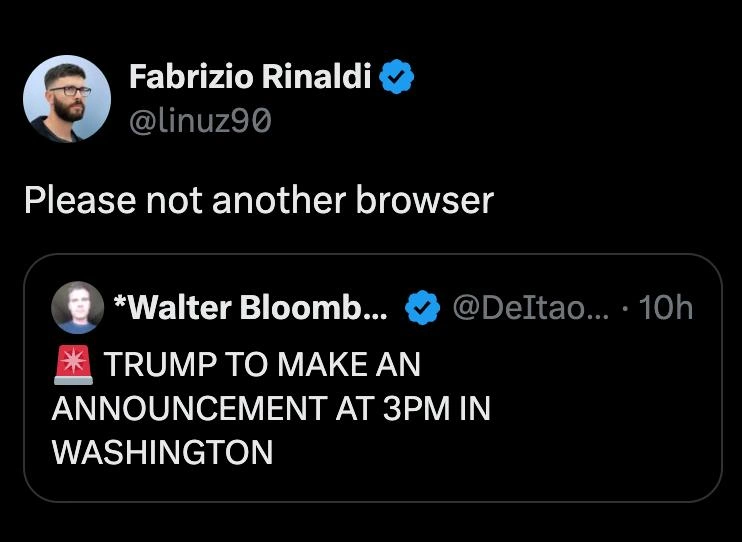
Developer Begs: Please Not Another Browser After Trump Announcement Tease
WebDev Post #7328, on Oct 23, 2025 in TG

Developer Begs: Please Not Another Browser After Trump Announcement Tease

Why is this WebDev meme funny?

Level 1: The More, the Messier

Imagine you’ve just finished a big project for school with four different friends, and each friend had their own special needs. You made four versions of the project so that each friend is happy. Phew! Now, right when you’re done, someone says, “Wait, a fifth friend is joining and they have completely different needs!” How would you feel? Probably a mix of surprise and dread, right?

That’s exactly the feeling this meme is joking about. Building a website is a bit like throwing a party for different friends (the friends are the web browsers like Chrome, Firefox, Safari, etc.). Each browser-friend “likes” things a little different: one might display colors funny, another might not understand a fancy decoration, so the web developer (party host) has to prepare special adjustments for each. They finally get everything working nicely for all the main browsers — and then they hear a rumor that a new browser might show up. It’s like hearing about that fifth friend with a new allergy after you’ve cooked all the food! The developer groans, “Please, not another browser,” just like you’d groan, “Oh no, not another picky eater!”

In everyday terms, the meme is funny because it shows a tired web builder who would rather deal with almost anything else than start worrying about a brand-new browser. It’s an exaggeration — of course a politician’s announcement likely has nothing to do with web browsers — and that silliness makes us laugh. Even if you don’t know about coding, you can relate to the idea of having more work dumped on you at the last minute. The joke here is basically: “I’ve already got my hands full with the ones I have, I really don’t want one more!”

Level 2: The Dread of Another Browser

Let’s break down the joke in simpler terms and explain why web developers groan at the idea of a new browser. In web development, a browser is the application you use to surf the web (like Google Chrome, Mozilla Firefox, Apple Safari, or Microsoft Edge). Each browser is created by a different company and uses a software component called a rendering engine to turn HTML/CSS code into the webpages you see. Ideally, all browsers should follow the same web standards (rules set by bodies like the W3C), so a website looks and works the same everywhere. But in practice, browsers often have slight differences in how they interpret those rules or when they adopt new features. These differences are what we call browser compatibility issues.

Now, when the meme says “Please not another browser,” it’s referencing the pain of cross-browser testing. Cross-browser compatibility means making sure a website functions correctly on all the major browsers. A QA matrix (Quality Assurance matrix) is a fancy term for a checklist covering all combinations of browsers, operating systems, and device types that need to be tested. For example, if you have a web app, you want to test it on: Chrome on Windows, Chrome on Mac, Firefox on both, Safari on iPhone, Safari on Mac, Edge on Windows, etc. You might create a table (matrix) of these to systematically verify everything. The more browsers you support, the more boxes in that table to fill. That’s why developers joke about “matrix explosion” or “testing hell” — adding even one new browser means a lot more testing work. It’s like suddenly having to do homework in an additional subject at school – not fun!

Why would a new browser cause anxiety? History gives us the answer. In the early days of the web, we had the first Browser War: Netscape Navigator vs Internet Explorer. They didn’t agree on standards, so web developers often had to write two versions of their code or include special tweaks for each. Imagine writing a letter where half is in English and half in Spanish so that two readers can each understand it — that’s what coding for two different browsers felt like! Later, other browsers joined (Firefox, Chrome, Opera, Safari), each with their own quirks. For instance, one browser might support a new CSS style, like fancy rounded corners, before the others. Developers would then include extra code so those corners don’t look broken elsewhere. A classic example is CSS vendor prefixes. In the early 2010s, if you wanted to use the new border-radius (rounded corner) style, you had to write it three times with different prefixes so all browsers would understand:

.my-button {
  -webkit-border-radius: 10px; /* Safari/Chrome needed -webkit- prefix back then */
  -moz-border-radius: 10px;    /* Firefox needed -moz- prefix */
  border-radius: 10px;         /* standard property for browsers that support it */
}

Front-end devs maintained many such tricks to achieve consistent layouts – essentially speaking each browser’s dialect. 🗣️ As you can guess, this was tedious and error-prone. A feature might look perfect in Chrome but appear misaligned or broken in Safari, leading to the notorious comment: “But it works on my machine!” (where “my machine” usually means the developer’s preferred browser). Frontend pain points like this turned testing into a big part of a web developer’s job.

Fast forward to today: things are much better. Most modern browsers have aligned on standards and even share underlying technology. (Fun fact: Chrome, the new Edge, Opera, Brave and many others all use the Chromium engine under the hood. That means they render pages very similarly – essentially they’re cousins.) We’ve basically narrowed the field to a few major engines: Chromium’s engine (called Blink for rendering, plus V8 for JavaScript), Mozilla’s Gecko engine for Firefox, and Apple’s WebKit engine for Safari. With only these three engines dominating, web developers can breathe a bit easier than 15 years ago. Fewer engines means fewer discrepancies. In fact, Microsoft Edge originally had its own engine (EdgeHTML) when it first came out to replace IE, but it switched to Chromium in 2019 because maintaining a separate engine was too much effort. That move was celebrated by many devs because it reduced one more unique case to worry about.

Given all this, you can see why the rumor of a new browser triggers eye-rolls and anxiety. If, say, a prominent figure like Trump announced a new browser, two scenarios arise and both make devs groan:

  1. It’s a brand new engine – This would be a huge deal technically. A new engine could have unpredictable issues with existing websites. Developers would need to obtain this browser and start testing their sites on it, discovering new bugs or missing features to work around. It’s like a new video game console being released — now game developers must ensure their game runs on it, which may require a lot of changes.
  2. It’s another Chromium-based browser (a fork) – This is more likely (since building a browser from scratch is really hard). If it’s basically Chrome under a different name, one might think “no biggie.” But even a Chromium fork can introduce slight differences. For example, it might use different default security or privacy settings that block certain scripts or cookies. Or it might lag behind the main Chrome releases, meaning it doesn’t have the latest fixes. Developers then have to remember to test on “Chrome-like Browser X” as well. This phenomenon is what we call chromium_fork_fatigue – being tired of so many Chrome clones popping up (Brave, Vivaldi, Avast Secure Browser, etc.), each requiring at least a quick sanity check to ensure nothing breaks.

The DeveloperHumor in the meme comes from exaggeration and relatability. It exaggerates the likelihood that a political announcement would be about a web browser — that’s absurd, which makes it funny. And it’s relatable because every web dev has felt that sinking feeling when they hear about having to support a new environment. The tweet’s format (a quoted tweet in a Twitter screenshot) is immediately recognizable to developers who spend time on tech Twitter, where such jokes and fears are often shared. The top tweet saying “Please not another browser” perfectly encapsulates the dread: it’s both a plea and a groan. It resonates especially with those who have spent long hours fixing layout bugs that only occur in one specific browser. Even junior developers, perhaps after their first school project looked different in Firefox vs. Chrome, can empathize.

In simpler terms: Web developers want their life to get easier, not harder. We already have to ensure websites work on desktop vs mobile, light mode vs dark mode, fast connections vs slow... and yes, on Chrome, Safari, Firefox, and Edge. Hearing there might be one more browser to worry about is like hearing you’ve got an extra exam added to your finals week schedule. No one is excited about that! That’s why this meme gets shared around in developer circles – it laughs at our own knee-jerk terror by imagining the most ridiculous source of more work. It’s a bit like a chef joking that a new type of food critic is being born – “Oh great, another palate I have to satisfy!” In the end, web devs just hope any big announcement isn’t something that sends them back into cross-browser testing purgatory. 😅

Level 3: Test Matrix Meltdown

At the highest technical level, this meme exploits a front-end developer’s deep-seated trauma from the browser wars era. The tweet’s author quips "Please not another browser" in response to a breaking political news teaser, as if any big announcement (even from a former US President) might herald the birth of yet another web browser. Seasoned web developers immediately chuckle (or cringe) because they’ve lived through the nightmare of supporting apps across a proliferating menagerie of browsers. It’s a classic case of developer humor interpreting real-world news through a Web Development lens: a politician’s mysterious announcement is jokingly assumed to be the launch of a new browser. Why is that funny? Because for veteran front-end devs, few things sound more ominous than an unexpected entrant in the browser market — it’s practically a jump-scare for anyone who’s wrangled BrowserCompatibility issues.

This dark humor is rooted in very real technical pain. A new browser (especially one with a new rendering engine or quirky behavior) can trigger a QA matrix explosion. In QA (Quality Assurance) testing, a matrix lists every combination of browsers, devices, and operating systems that need verification. Each additional supported browser multiplies the number of scenarios to test. For example, if your web app supports 4 major browsers across 3 device types, that’s already 12 combinations; add one more browser and you’ve got 15. It’s combinatorial growth, and it can turn a routine test plan into an extensive cross-browser testing hell. The meme’s imagined scenario — “Trump announces a new browser at 3 PM” — evokes a senior engineer’s nightmare of the cross_browser_testing_hell variety: immediately picturing dozens of new test permutations and dreaded bug reports saying “Doesn’t work on TrumpBrowser v1.0!”. The phrase “yet another browser” in the context tags perfectly captures devs’ exhaustion; it implies they’ve seen too many browsers come and go (each with their own idiosyncrasies) and have zero appetite for one more.

There’s an extra layer of industry satire here. For years, web developers suffered the non-standard quirks of Internet Explorer, the strictness of Firefox, the early mobile oddities of Safari, and countless CSS hacks to please each one. The Browser Wars of the late 90s and 2000s (e.g. IE6 vs. Netscape, later IE vs. Firefox vs. Chrome) left battle scars. If you mention IE6 to a veteran dev, you might see a visible shudder — they recall how that browser would interpret CSS and DOM in bizarre ways. Supporting it meant endless conditional code and layout tweaks. This meme taps into that collective PTSD: the mere rumor of a new major browser triggers flashbacks to the bad old days. Even in modern times, when we ostensibly have web standards, each browser’s rendering engine (Blink for Chrome/Edge, WebKit for Safari, Gecko for Firefox, etc.) has subtle differences. Layouts might shift by a pixel, or a cutting-edge CSS feature might work in one browser but not in another until a future update. Senior devs know that a new player could revive those compatibility headaches or, at the very least, add one more environment to troubleshoot. It’s why the plea "Please not another browser" rings true as a tongue-in-cheek cry of desperation.

Now, consider the specific mention of Trump making an announcement. This is a playful example of a political_announcement_meme format. During Trump’s tenure, “big announcements” were often hyped in media, sometimes leading to surprise initiatives. The meme facetiously imagines that a tech-weary developer’s first thought isn’t about politics at all but about a possible new tech product: “Oh no, is he launching a browser now?!”. This exaggeration works because it parallels real moments in tech history. For instance, when new browsers like Brave or the revamped Edge (built on Chromium) were announced, dev circles buzzed with weary jokes about “yet another Chromium fork”. That chromium_fork_fatigue is real: developers are tired of every organization creating its own slightly-tweaked browser (often just rebranding Chrome’s open-source core) and then expecting web apps to support it. Even if a new browser is based on Chromium (which spares us from dealing with a whole new engine), it can introduce different default settings or privacy features that break assumptions. Imagine a new browser that aggressively blocks cookies or disables certain JavaScript APIs by default — that’s great for users’ privacy, but it might break some web app functionality, leaving developers scrambling to patch things. The FrontendPainPoints are obvious: more work, more testing, and more potential late-night debugging sessions for the dev team.

In summary, Level 3 reveals why this meme packs a punch for experienced web developers. It’s simultaneously referencing the absurdity of a political figure launching a web browser and the very real dread that would instill in those who build websites. The humor lives at the intersection of current events absurdity and hardcore WebDev inside jokes. Seasoned devs see the tweet and nod knowingly: supporting the current roster of browsers is challenging enough — the thought of adding one named after a contentious public figure (imagine something like “TrumpBrowser” with its own quirks) is both hilarious and horrifying. It’s a classic case of gallows humor in tech: DeveloperHumor born from real-world frustration. The meme effectively says: “We’ve finally almost tamed the multi-browser chaos, please don’t make us go through that again.” And every veteran front-end engineer reading it feels a mix of amusement and an involuntary eye-twitch. 🧑‍💻😅

Description

A screenshot of a tweet by Fabrizio Rinaldi (@linuz90, verified) saying 'Please not another browser' in response to a quote-tweeted post from *Walter Bloomb... (@DeItao...) announcing 'TRUMP TO MAKE AN ANNOUNCEMENT AT 3PM IN WASHINGTON' with a siren emoji. The humor comes from a tech industry insider's immediate dread that any major announcement might mean yet another web browser entering an already overcrowded market, reflecting browser fatigue in the developer community

Comments

20
Anonymous ★ Top Pick At this point, launching a new browser is the tech equivalent of opening a coffee shop -- everyone thinks theirs will be different, it's always just Chromium underneath, and web developers still have to add a special CSS hack for it
  1. Anonymous ★ Top Pick

    At this point, launching a new browser is the tech equivalent of opening a coffee shop -- everyone thinks theirs will be different, it's always just Chromium underneath, and web developers still have to add a special CSS hack for it

  2. Anonymous

    Some people worry about the geopolitical implications of a major announcement. A senior dev just worries if it means they'll have to support another browser with a unique, buggy implementation of the CSS grid

  3. Anonymous

    If one more Chromium fork drops, our Selenium bill will need its own budget line

  4. Anonymous

    After 20 years of polyfills and user agent sniffing, the only announcement worse than a new browser would be one that's 'Making Web Development Great Again' with its own proprietary standards

  5. Anonymous

    When you've finally got your CSS working across Chrome, Firefox, Safari, and Edge, and someone announces yet another browser that will inevitably render your flexbox differently

  6. Anonymous

    Trump browser drops: Finally, a new user agent that auto-fills with 'alternative facts' and ignores CORS like a wall

  7. Anonymous

    Every new browser adds one more column to the support matrix and zero headcount. If it isn’t Chromium-based, dust off the device lab; if it is, enjoy a fresh UA string for the same bugs

  8. @hur7m3 8mo

    I stumbled across a video reviewing a paid version of Opera that is centered around AI. The guy went to open his "Browsers" folder and there were like 10 other AI ones.

  9. dev_meme 8mo

    It’s a beautiful browser, a tremendous browser. People have been saying for years - ‘Sir, we have too many browsers.’ And I said, no, we don’t have the right browser. This one loads pages faster than anyone’s ever seen, maybe the fastest ever. Some people say Chrome is good - it’s not good, folks, it’s spies, okay? We’re gonna make browsing great again. Everyone’s gonna be saying, ‘Thank you, Mr. Trump, for the incredible browser.’ Believe me.

  10. @hannybu 8mo

    nah, it will be us-east-0

  11. @Johnny_bit 8mo

    What's wrong with ladybird?

    1. @sysoevyarik 8mo

      But can it open youtube? (Ok, i know it isn't fair. Chrome itself barely able to handle this shit)

      1. @hur7m3 8mo

        It's going to get there eventually. I don't really pay attention but I know developing a new browser engine must be a nightmare.

        1. @chupasaurus 8mo

          A reminder that YT used v0 version of a browser API while there was a standard for v1 simply to mess with non-Chrome browsers. For years.

          1. @hur7m3 8mo

            Well, yeah. Not only do you need to implement stuff that makes sense but you also need to replicate whatever bullshit was caused by decades of competition and backwards compatibility. Sure there is some drama around the development and all, but you can't deny that it takes balls to take on a project like this.

        2. @sysoevyarik 8mo

          it IS a nightmare. special thanks for uncontrollable growth of "spec" size which in practice just describe how chrome may work

    2. @hur7m3 8mo

      It's the "oh no not another chrome with an extra chromosome".

      1. @Johnny_bit 8mo

        but sir, ladybird is NOT built on webkit engine (nor on chromium) so it's definitely not retarded chrome.

        1. @hur7m3 8mo

          I was referring to the meme. "Please not another browser" means "Please not chrome with aids". Misunderstanding, you know.

  12. @sysoevyarik 8mo

    i not familiar much with web dew, i only tried to make http engine & website. http&html&css are so damn braindead-written

Use J and K for navigation