Skip to content
DevMeme
6683 of 7435
You're So Poor That When AWS Goes Down You Can Still Enter Your House
Cloud Post #7326, on Oct 23, 2025 in TG

You're So Poor That When AWS Goes Down You Can Still Enter Your House

Why is this Cloud meme funny?

Level 1: When Fancy Fails and Simple Prevails

Imagine you have a super cool electric lock on your front door that works with your phone. It’s like magic – you tap your phone, and the door unlocks... but only if it can ask a computer far away for permission. Now, one day, the big computer far away (let’s call it a “cloud” computer) has a problem and isn’t answering. You come home and tap your phone to open the door, and uh-oh – nothing happens. The door stays locked because it can’t “talk” to the cloud. You’re stuck outside your own house, even though you didn’t do anything wrong. Kinda scary, right?

Now think of your friend who lives next door and who doesn’t have that fancy lock – they just have a normal key. While you’re standing there locked out, your friend walks up to their door, uses a plain key, turns it, and click, they’re inside in two seconds. They might even peek out and say, “Hey, what’s wrong? Can’t get in?” That’s pretty funny in a silly way: the person with the expensive high-tech gadget is the one who can’t get in the house, and the person with the old cheap key has no problems at all.

It’s like a story of two kids: One kid has a super high-tech remote control for their bedroom light that needs Wi-Fi, and the other kid just has a simple light switch on the wall. If the Wi-Fi goes down, the first kid is left in the dark furiously pressing a remote that doesn’t work, while the second kid just flips their switch and lights up the room. The joke here is showing that sometimes being simple and old-fashioned is better, especially when fancy stuff breaks. It feels a bit upside-down – we expect the fancy new thing to be better, but when the fancy thing depends on something far away (like the internet), it can fail at the worst time. And that’s why it makes us laugh: the situation turns our expectations on their head. The “poor” person with the plain key ends up happy and cozy at home, while the “rich” gadget person is stuck outside, learning that sometimes the old way is the reliable way.

Level 2: Smart Lock Fails, Key Prevails

Let’s break down the scenario for a newer developer or someone not deeply familiar with these terms. The tweet is joking that if you’re “too poor” to have fancy smart home gadgets, you’re actually better off when something like AWS goes down. Why? Because you still have a physical key to your house, and it works no matter what. Here’s what’s happening:

  • AWS (Amazon Web Services): This is a huge cloud computing platform run by Amazon. Tons of companies host their applications and services on AWS servers. When you use a smart home device – say a Wi-Fi smart lock or a cloud-connected doorbell – it often talks to some service running on AWS in the background. An AWS outage means part of Amazon’s data centers are having a problem (could be due to a network issue, power failure, software bug, etc.), and all those dependent services become unavailable. In plain terms, if your smart lock’s “brain” lives in the cloud, and that cloud is temporarily down, the lock might not work at all.

  • IoT (Internet of Things) Smart Lock: An IoT smart lock is an electronic door lock that you can control via the internet – for example, through a smartphone app. It might let you unlock your door remotely, or it could automatically unlock when it senses your phone nearby. Fancy, right? But here’s the catch: many of these locks depend on an internet connection and a remote server. When you tap your phone to unlock, the request might go to AWS where the lock’s service verifies “Is this user allowed to unlock right now?” and then signals the door to open. If that chain breaks anywhere – say AWS is not reachable – your door won’t open. You could be standing right in front of it with your authorized phone, but if the lock can’t contact its server, it’s often designed to stay shut (for security). This is an example of cloud dependency – the device is only as good as its connection to the cloud service.

  • Physical Keys vs. Cloud Reliance: Now compare that to a plain old metal key. A physical key doesn’t need internet, doesn’t run on batteries (beyond the calories in your arm to turn it), and doesn’t check with any server. It just mechanically turns and unlocks the door. That means if there’s a storm and the power is out, or if your Wi-Fi is down, or yes, if AWS itself is having issues, your key still works. The tweet jokingly says “you’re so poor” to have only a normal key, but then reveals that in an outage, that so-called poor person can still get in the house. It’s a form of irony – the situation is the opposite of what you’d assume. Normally, we think being high-tech or “rich” means better stuff. But here, having the high-tech lock leaves you helpless at the worst moment, whereas the low-tech solution is actually more reliable.

  • DevOps/SRE context: In the software world, DevOps engineers and SREs (Site Reliability Engineers) are the folks who make sure services run smoothly and have plans for when things go wrong. They deal with outages and downtime regularly. So, this joke is right up their alley. It’s poking fun at a lack of reliability planning in everyday tech. A seasoned DevOps person would immediately ask, “What’s the fallback if the cloud is down?” In this smart lock scenario, it seems there isn’t a good fallback except having a physical key around (some smart locks do offer a traditional keyhole for backup – because even the manufacturers know not to trust 100% uptime). The tweet’s humor is essentially an SRE nightmare scenario turned into a roast: a critical functionality (entering your home!) put behind a single point of failure (AWS). The phrase “Vendor lock-in” gets a literal twist here: you’re locked out because you locked yourself into one vendor’s service. For a junior dev, the lesson hiding in the joke is: be careful about over-engineering and making your product depend completely on something as unpredictable as the internet. Always have a plan B, especially for core features.

  • Vendor Lock-In & Cloud Humor: Vendor lock-in usually means being so tied to one company’s platform that it’s hard to change. In this case, it’s ironically literal – the vendor (AWS or the smart lock company using AWS) has you locked in if their service fails. This is classic CloudHumor – developers often joke about how we’ve moved our problems to “the cloud” (which is just someone else’s computer). It’s convenient until that someone else has an issue, and suddenly it’s not your code that’s broken, but your product still doesn’t work. The tweet underscores this with a real-life example everyone can understand: not being able to get into your house is a pretty vivid failure mode!

To sum it up in simpler terms: the meme is highlighting the fragility of putting basic home functionality into the cloud. It’s saying, “Hey, fancy tech bro, your cloud-based door lock is cool and all – until the cloud goes down and you’re standing outside. Meanwhile, my cheap old key works rain or shine, network or no network.” It’s a lighthearted way to remind both developers and regular folks: new tech isn’t always better tech when it comes to reliability. Sometimes, simple solutions (like a house key) are more dependable. And as a new developer, it’s a hint to always think about what happens when that super important remote service isn’t available. Because if you don’t plan for it, you might end up like the guy who can’t open his own front door due to an AWS outage.

Level 3: Vendor Lock-In (Literally)

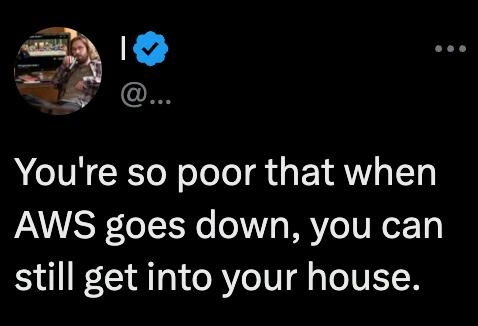
“You’re so poor that when AWS goes down, you can still get into your house.”

This meme delivers a brutal one-liner that makes seasoned engineers smirk and groan in equal measure. It’s framed like a playground insult, but the punchline flips the script: the supposed “poor” person who can’t afford a fancy IoT smart lock ends up having the last laugh during an AWS outage. The humor hinges on engineering irony and shared war stories:

  • Over-Engineered IoT Irony: Imagine a high-end smart home where even the door lock depends on the cloud. It’s the ultimate flex until the internet hiccups. This tweet is dunking on that over-engineering: we took a device as simple and vital as a door lock – something that’s worked with a metal key for centuries – and tied it to a remote server somewhere in Amazon’s cloud. So when AWS has Downtime (and every DevOps veteran knows that even AWS goes down sometimes), the high-tech lock becomes a paperweight on your front door. Meanwhile, the “poor” folks with an old-school key can still turn it and walk right in. It’s a perfect example of “cutting-edge” technology creating a new failure mode for a problem that was already solved. Senior engineers see this and recall countless incidents of over-engineering where adding complexity made things more fragile. As the saying goes, “They added cloud to the door lock and now it has 99 problems and an SLA ain’t one.”

  • Cloud Dependency & Single Point of Failure: The tweet calls out cloud dependency in a cheeky way. Relying on a single cloud vendor (vendor lock-in, literally!) means if that provider has an outage, all your dependent services go dark. Here, AWS is the single point of failure for your ability to enter your own home. It’s funny because it’s true – we’ve seen real scenarios where AWS issues caused smart home devices to fail. (Think of a major AWS us-east-1 outage – suddenly “smart” thermostats won’t heat, smart locks won’t unlock, and everyone on Twitter is ironically praising their dumb thermostat and physical keys.) For senior DevOps/SRE folks, this rings true: critical systems should avoid single points of failure, yet here we are, putting house keys behind one giant SPOF called the internet. The meme exaggerates it as a class thing (“you’re so poor that…”) to highlight how ridiculous it is that NOT having a costly gadget is beneficial when the cloud is down. It’s a jab at tech hubris and VendorLockIn: the fancy lock vendor likely didn’t design for multi-cloud or offline use – they assumed AWS would always be up. Spoiler: it’s not, and Murphy’s Law loves to strike at 5 pm when you get home and can’t open your door.

  • Production Incidents at Home: Seasoned engineers have PTSD from ProductionIncidents triggered by external outages. The tweet’s scenario is basically a mini production incident – except instead of your app being down, you are (locked out!). It’s funny because we’ve all been on calls where someone’s said, “AWS is down, nothing we can do, just wait.” Now apply that to your front door. A senior DevOps/SRE might chuckle darkly at that: “Oh great, now even my door has an SLA.” They know how it feels to be helpless during a third-party outage. The tweet captures that helpless feeling in a home setting. And the kicker? The one who didn’t embrace the shiny new solution (still using a plain key) doesn’t have the problem at all. That’s the kind of bitter lesson you learn in engineering: sometimes the simplest, dumbest solution is the most robust. As an SRE might quip, “My key has 100% uptime independent of AWS – can your IoT startup say the same?”

Let’s illustrate the situation with a bit of pseudo-code, as if the smart lock’s logic were written out:

# Smart Lock pseudo-code logic
if not aws_online:
    print("AWS outage: cannot unlock door.")
    # The system has no offline backup. The "poor" user with a physical key is chuckling now.
else:
    unlock(door)

In a real-world smart lock, that aws_online check is happening behind the scenes. No connection to the cloud service? The fancy lock effectively says, “Nope, you shall not pass.” It’s a cloud-first design that didn’t consider an offline mode (or treated it as an “edge case”, pun intended). A veteran engineer sees this and immediately recognizes the anti-pattern: a single cloud vendor is a dependency for core functionality without a fallback. It’s the kind of thing that gets discussed in post-mortems after a nasty outage: “Perhaps relying on AWS for our door locks was a bad idea.” Meanwhile, the person with a normal lock and key isn’t waiting on a server to approve their entry – they’re already inside raiding the fridge.

  • Shared Trauma and Laughter: The reason this meme hits home (pun intended) for experienced devs is that it’s a hyperbole of things we’ve actually experienced. Maybe not literally locked outside our house (although some early adopters have lived that nightmare during a cloud hiccup), but we’ve all seen critical systems fail because of a dependency we took for granted. The humor has a “there but for the grace of good design go I” vibe. It’s a safe way to laugh at a very real risk. Also, the phrasing “you’re so poor that…” is a tongue-in-cheek reversal. In tech culture, early adopters of expensive smart gadgets might flaunt them as status symbols. This tweet turns that upside down: being “poor” (sticking with cheap, reliable tech) saved your butt when the fancy solution crapped out. It’s a subtle dig at tech elitism and OverEngineering – sometimes the “inferior” old solution is superior under duress.

Finally, consider the commenter’s add-on: “And your bed still works as expected.” It’s a sly extra punch. It implies that even your bed might be IoT these days (there are smart mattresses and wifi-connected beds, believe it or not) – but thankfully a normal bed doesn’t rely on AWS. The subtext is: at least the truly important low-tech things in life (like a bed to collapse on after a long day) aren’t subject to a cloud outage. It’s a nod to the absurd extent of IoT craze and a reassurance that some comforts remain cloud-independent. Senior engineers chuckle at that and think, “Yeah, the day my bed needs a firmware update, I’m out.”

In short, this meme mixes CloudHumor with a cautionary tale. It’s funny because it’s a bit absurd, but it resonates because it’s highlighting a real engineering fiasco in exaggeration. It reminds experienced folks of the value of simplicity and a good backup plan. After all, nothing says “reality check” like being literally or figuratively locked out because of a dependency on someone else’s server. The smartest device in your smart home might just be that dumb lock-and-key that never needed an app or an uptime guarantee to do its job.

Level 4: CAP Theorem at Your Door

In distributed systems theory, even a smart lock can fall victim to the laws of distributed computing. A cloud-connected door lock essentially forms a tiny distributed system: one part is the lock in your house, the other part is a service in an AWS datacenter. According to the CAP theorem, when communication is cut (a network partition), the system has to choose between staying available (unlocking the door for you) or staying consistent with authoritative data (ensuring only authorized access). Most smart locks are designed to be fail-secure, meaning if they can’t reach the cloud, they refuse to open. This sacrifices availability (you can’t get in) in order to maintain security consistency (not unlocking for someone who might have lost permissions). It’s a classic consistency-over-availability trade-off under partition conditions – basically the door says, “No cloud, no entry,” rather than risk an inconsistent state about who’s allowed inside.

This meme highlights how the lock’s engineers implicitly trusted the network and the cloud service. They fell for one of the Fallacies of Distributed Computing: “The network is reliable.” In reality, AWS outages and internet downtime will happen, partitioning IoT devices from their cloud brains. The joke exposes that fragile assumption: when the cloud is unreachable, the fancy lock becomes a brick. From a theoretical perspective, the design introduced a glaring single point of failure – the AWS cloud – into a critical path (your front door). In reliability engineering terms, that’s a big no-no: there’s no redundant fallback when the cloud is down. A mechanical key, by contrast, is a standalone system – no distributed consensus needed to turn a key in a tumblers-and-pins mechanism. The humble physical key avoids CAP entirely by not being distributed at all, achieving near-100% availability (so long as you don’t lose it, which is an independent failure, not a correlated single outage).

There’s also a security engineering concept at play: fail-secure vs. fail-open. In the event of a failure (like power or connectivity loss), do you default to locked (secure) or unlocked (safe)? Cloud-based smart locks usually choose fail-secure – if they can’t verify your access with the mothership server, they stay locked. That’s good for keeping intruders out during a network glitch, but it’s bad if you are the legitimate user stuck outside at 2 AM during an AWS incident. It’s a trade-off between security consistency and availability to rightful users. The meme’s humor points out that the high-tech approach opted for a design that obeys theoretical constraints (CAP and security principles) but fails the basic practicality test when real-world conditions (like a cloud outage) hit.

In essence, the tweet is a sardonic reminder that over-engineering a simple problem (locking a door) with cloud dependencies introduces deep theoretical dilemmas and failure modes. It’s poking fun at the fact that sometimes the most robust, distributed system is… no distribution at all. A physical key may be “archaic,” but it doesn’t need five nines of uptime from a server farm – it’s an offline solution that neatly side-steps the whole consistency vs. availability drama. The cloud can promise eventual consistency and multiple 9s of uptime, but your house key is immediately consistent (it either fits the lock or not) and infinitely available whenever it’s in your pocket. No wonder the “poor” person with a key waltzes right in while the cloud-reliant lock owner is solving a distributed systems problem just to enter their home.

Description

A screenshot of a tweet from a verified user reading 'You're so poor that when AWS goes down, you can still get into your house.' The joke is a 'yo mama'-style roast targeting smart home dependency on AWS infrastructure. The implication is that wealthy people have AWS-dependent smart locks, lights, and home automation that fail during AWS outages, while the 'poor' person with traditional keys and manual locks is unaffected. It highlights the absurdity of critical physical infrastructure depending on cloud services

Comments

25
Anonymous ★ Top Pick The real flex isn't having a smart home -- it's still being able to use a physical key when us-east-1 decides to take an unscheduled nap and half the internet goes with it
  1. Anonymous ★ Top Pick

    The real flex isn't having a smart home -- it's still being able to use a physical key when us-east-1 decides to take an unscheduled nap and half the internet goes with it

  2. Anonymous

    The SRE's dilemma: Your pager goes off because us-east-1 is down, and you can't leave to fix it because your smart lock is also hosted in us-east-1

  3. Anonymous

    Forget multi-AZ: the real high-availability strategy is a $2 brass key in your pocket

  4. Anonymous

    The real high availability strategy is having a door that doesn't require a three-tier architecture and multi-region failover just to turn a deadbolt

  5. Anonymous

    The real high availability architecture is a physical key that doesn't require an SLA

  6. Anonymous

    Ultimate HA strategy: house keys with zero-latency failover and no egress fees

  7. Anonymous

    Real multi-cloud strategy: a brass key - five nines, zero 5xx from us-east-1

  8. @RiedleroD 8mo

    bruh. just stole my post from within the group

    1. dev_meme 8mo

      And you have no idea how many channels already stole it from there 😄

      1. @hur7m3 8mo

        Can't trust no one in this economy

        1. @DerKnerd 8mo

          Well you can trust the grim reaper, he will come at some point

          1. @hur7m3 8mo

            With me he'll come more than once if ya know what I mean

            1. @DerKnerd 8mo

              Some times you call him, and once he gets called for you? :D

              1. @hur7m3 8mo

                "hey baby, WANNA BONE?"

        2. @chupasaurus 8mo

          The only thing I trust in any economy is also the only true infinite thing in this universe😉

          1. @hur7m3 8mo

            My guesses range from "human capacity for evil" to "your mom's weight" and everything in between. Do tell.

            1. @chupasaurus 8mo

              The other side of Hanlon's razor: stupidity.

              1. @hur7m3 8mo

                Reasonable. I approve.

              2. @hur7m3 8mo

                Here is a fox for your trouble

                1. @chupasaurus 8mo

                  My family takes it with gratitude.

                  1. @SheepGod 8mo

                    ooooh cute

                  2. @anilakar 8mo

                    murder marder

                    1. @chupasaurus 8mo

                      definitely not a peaceful species😈

  9. @NikNikovsky 8mo

    And you can still purify your water

  10. @NikNikovsky 8mo

    Or make coffee

Use J and K for navigation