The Scapegoat of the Global Outage
Why is this OnCall ProductionIssues meme funny?
Level 1: Clean Up Your Mess
Imagine you and your friends are playing with a huge stack of blocks that everyone in the school uses. A new kid comes in on his first day, and he excitedly adds one tiny block to the very top of the stack. It seems like a small, harmless addition, and he’s so proud of himself that he takes a silly selfie, making a duck face and a peace sign. Then he happily runs off to recess early, thinking his job is done. But uh-oh! That little block was placed wrong, and the entire giant stack of blocks starts to wobble and crash down. All the blocks topple over, knocking over other kids’ toys in the room. It’s a HUGE mess – toys broken, kids crying, playtime ruined everywhere. Now the teachers and other kids are scrambling to fix the mess and rebuild the stack. And where’s the new kid? Outside, grinning in his selfie, completely unaware of the chaos he caused. The reason this scenario is funny (in a face-palming way) is the contrast: one person made a tiny mistake that led to a gigantic problem, and he’s cheerfully oblivious, leaving everyone else to clean up. It’s like if you spilled a cup of juice on the floor and then just walked away to play, leaving your parents to deal with the sticky spill. Not very fair, right? In the meme, the “duckface” photo of that developer became famous because it captured that exact moment of oops and clueless joy. We laugh a bit because we know he didn’t mean to cause trouble, but wow, did things go very wrong! The lesson in simple terms: if you make a big mess, you should stick around to help clean it up – not just take a selfie and disappear.
Level 2: Small Update, Big Outage
In plain terms, this meme is about a software deployment gone horribly wrong, with a humorous twist. A new developer at CrowdStrike (a cybersecurity company) pushed out a “small” update to the company’s software on his first day. In software, an update means releasing a new version or changes to a program (often to add features or fix problems). He probably thought everything was fine and even took the afternoon off work to relax. He took a selfie making a duckface (pouting lips for a silly photo) and flashing a peace ✌️ sign, proud of his first deployment. **But unbeknownst to him, that tiny change contained a bug (an error in the code) that caused a huge problem: it made Windows computers everywhere crash with the infamous Blue Screen of Death (BSOD). A BSOD is that scary blue error screen you get when Windows has a serious crash – essentially the computer saying “I’ve hit a fatal error and must reboot.” So, instead of being a routine update, his code triggered a production outage across the globe. “Production” refers to the live environment where real users or companies run the software; an outage means it stopped working. In this case, many organizations using CrowdStrike’s security agent suddenly saw their PCs rebooting or failing, which means real businesses experienced downtime (periods when their computers or services were unusable).
To break it down: the meme jokes that this one guy’s first-day code change knocked out computers worldwide. It’s referencing a real incident (often tagged as crowdstrike_update_2024) where a security_agent_update_gone_wrong caused mass BSODs. For a junior developer or anyone new to this, imagine accidentally breaking something that millions of people rely on – that’s the nightmare scenario! This kind of deployment failure is rare but when it happens, it’s all-hands-on-deck. Companies have engineers on call – which means someone is always available (even after hours) to respond if things break. When those Windows computers started crashing, the on-call engineers at CrowdStrike (and at the affected customer sites) would have been alerted immediately to fix the issue. Meanwhile, the meme’s protagonist (the new dev) was offline, cheerfully clueless, not answering panicked calls — exactly when his help was needed. The humor here is a bit tongue-in-cheek: it’s making fun of the situation’s absurdity. OnCallDuty and DeploymentAnxiety are real in IT – pushing code live can be stressful because if there’s a mistake, you might cause an outage like this. And there’s an unwritten rule among developers: Don’t deploy right before you leave (like on a Friday evening or, say, before taking the afternoon off). You’re supposed to stick around and make sure nothing goes wrong. Here, that rule was broken, and of course, everything that could go wrong did go wrong. The “duckface selfie irony” is that the guy was celebrating and posing for a fun picture while disaster was spreading behind the scenes. It’s a classic rookie mistake meme: new guy does something naive that triggers chaos. The story spread so widely that his duckface selfie became famous (much to his misfortune). For a newcomer learning about this meme: the takeaway is even a tiny code change can have big consequences. Always test carefully, and maybe wait a bit before bragging on social media that your deploy went great – just to be sure nothing’s on fire! 🔥🚒
Level 3: One Agent to Crash Them All
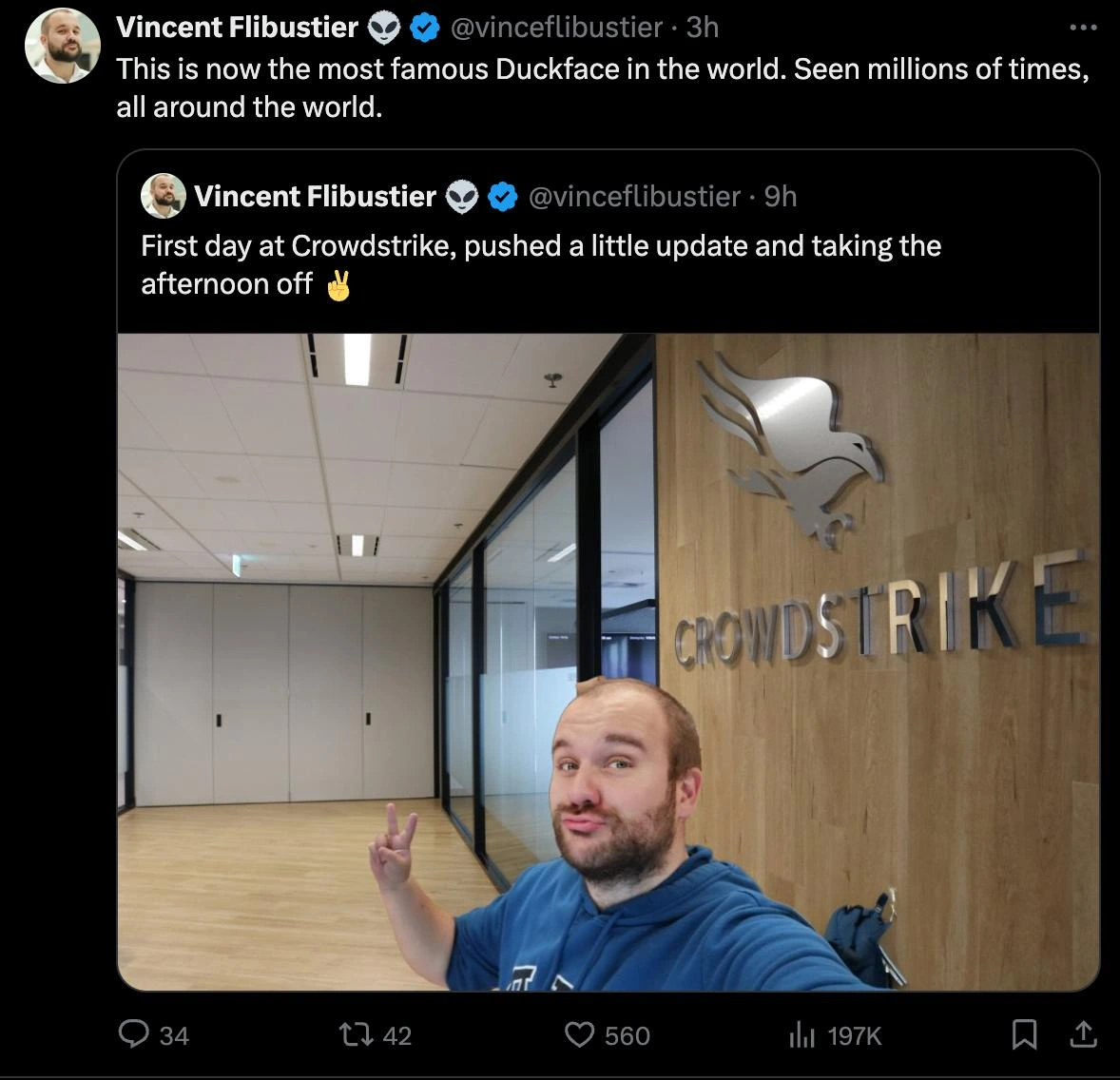
The meme hits on a legendary production outage saga that has seasoned DevOps engineers both laughing and cringing. In mid-2024, a routine security agent update at CrowdStrike (a major cybersecurity firm) went horribly wrong, triggering a wave of Windows Blue Screen of Death (BSOD) errors on machines worldwide. This wasn’t just a blip — it was a global_bsod_outage where thousands of systems crashed in unison. The joke centers on the hapless developer (on his first day, no less) who proudly tweeted:
“First day at CrowdStrike, pushed a little update and taking the afternoon off ✌️”
That “little update” turned into a big problem, and the irony is darkly hilarious. In the photo, the dev is posing with a classic duckface selfie, flashing a peace sign in front of the shiny CrowdStrike logo, blissfully unaware that his code tweak is busy setting off a worldwide fire drill. It’s the ultimate DeploymentFailure: push code, proclaim victory, then walk away — meanwhile, chaos erupts behind you. Every battle-scarred SRE reading that tweet immediately felt a pang of deployment anxiety. We’ve all heard the on-call pager go off right after someone said, “It’s fine, just a tiny change, what could possibly go wrong?” This meme condenses that nightmare into one image: a grinning developer in a hoodie, and invisible behind him, an army of IT teams scrambling to recover from his “tiny” afternoon deploy. The outer tweet jokingly calls it “the most famous Duckface in the world, seen millions of times” because that goofy selfie went viral as the inadvertent face of a massive outage. OnCallHumor often has a grim edge – we laugh because otherwise we’d cry. Here the humor comes from the absurd juxtaposition: a carefree newbie immortalizing his first deploy with a selfie, while unbeknownst to him, he’s also earned a spot in the OnCallNightmares hall of fame.
On a technical level, this incident is a perfect storm of Deployment gone wrong. CrowdStrike’s agent runs on countless enterprise Windows PCs with deep system privileges. Pushing a bad update to an app like that is like deploying a faulty driver to millions of machines simultaneously. One stray pointer or a race condition in kernel-mode code, and boom – BSOD on a global scale. Essentially, one agent to crash them all. The “little update” likely contained a critical bug — perhaps a memory leak or a logic error in a security hook — that the quality checks missed. And because many organizations have these agents set to auto-update for security (gotta patch quickly to stop hackers), the flawed code propagated like wildfire. In resilient systems, we do canary releases or phased rollouts: release to a small subset of users first, verify nothing breaks, then gradually expand. It appears either that process failed or was skipped entirely here. Maybe there was a rush to push out a security fix, or a rookie engineer didn’t realize he wasn’t supposed to hit “Deploy to ALL” on day one. The result? A downtime disaster. It’s a classic ProductionIncident cocktail: a bit of over-confidence, a lack of thorough testing, and a wide blast radius. The fact that this happened at a security company is rich with irony — software meant to protect endpoints ended up bricking them. This kind of bug is worse than many viruses; instead of a hacker causing damage, a trusted update did it inadvertently. (It’s not always DNS — sometimes it’s your anti-malware agent crashing Windows.)
From the senior engineer perspective, the scenario triggers PTSD and rueful grins in equal measure. OnCall duty exists to catch exactly these catastrophes, but here the primary culprit was merrily offline, likely with his phone on silent while the world burned. One can imagine the Slack/Teams war room blowing up: “Who pushed build 5.4.0?!” — and the horrifying answer: “Uh, that new guy… and he already left for the day.” 😱 It violates the cardinal rule of deployments: never deploy and disappear. Experienced teams plan critical updates when folks are around to monitor and rollback if needed. Deploying right before a weekend or vacation (or in this case, a random afternoon off) is begging for trouble. As a result, other engineers and SREs had to jump in to triage: rolling back the update, publishing advisories, helping customers resurrect their BSOD-stricken PCs. The meme’s caption “global ops crash behind duckface selfie” says it all — behind that innocent selfie was a global outage that kept on-call engineers up all night. This is the kind of incident that gets written up in post-mortems and cautionary blog posts. In a blameless postmortem culture, we’d analyze how the process failed: Why was a single newbie able to deploy unreviewed code to production? Why did testing not catch a kernel-crashing bug? Why no staggered rollout? These are systemic issues. Yet, as the comments hint (“p.s. he is fired, ‘Totally unfair’”), management might have scapegoated the individual. Firing the developer might feel like justice to angry bosses, but veteran engineers know that bugs in software are inevitable and defenses (code review, testing, gradual deployment) are what prevent one person’s mistake from becoming a downtime Armageddon. The tweet going viral ensures this incident will be an enduring DeveloperHumor cautionary tale. Rest assured, every dev who sees this will double-check their next “tiny update” – and think twice before tweeting a celebratory duckface selfie until they’re sure no alarms are going off in the NOC.
Description
This image is a screenshot of a viral tweet from user Vincent Flibustier. The screenshot captures two tweets. The main, embedded tweet shows a selfie of a man (Vincent) making a duckface and a peace sign in a corporate office, with the CrowdStrike logo clearly visible on the wall behind him. The text of this tweet reads, 'First day at Crowdstrike, pushed a little update and taking the afternoon off ✌️'. Above this, a follow-up tweet from the same user says, 'This is now the most famous Duckface in the world. Seen millions of times, all around the world.' The image humorously plays on the massive global IT outage of July 2024, which was caused by a faulty update from the cybersecurity company CrowdStrike. Vincent Flibustier became an internet meme and a humorous scapegoat by jokingly 'confessing' to being the new employee responsible for the catastrophic deployment. The joke resonates with developers' worst fears: a junior team member making a seemingly small change that brings down global infrastructure
Comments
15Comment deleted
The ultimate 'blame the new guy' scenario, where the 'little update' had a bigger blast radius than 'rm -rf /' on the root server
His “little update” did what Raft and Paxos never could: every Windows box on Earth reached unanimous consensus… to crash
When you skip the staging environment because "it's just a config change" and accidentally become the most successful penetration tester in history by taking down half the Fortune 500 without even trying
When your kernel-mode driver update has better global reach than most SaaS products' entire user base - except everyone's experiencing the 'blue screen of opportunity' instead of your intended feature set. Nothing says 'move fast and break things' quite like breaking 8.5 million Windows machines before lunch on your first day. At least the rollback strategy was clear: fly technicians to every affected data center with USB drives. Who needs CI/CD pipelines when you have FedEx?
First day at CrowdStrike: shipped a "small" ring-0 update - apparently the rollout rings are "dev", "prod", and "civilization"
Ship a kernel‑mode EDR update to every Windows box at once, skip canaries and a kill switch - congrats, you’ve invented distributed denial of desktop and spent the global error budget before lunch
Falcon channel file skips content validation, deploys to prod - now that's a duckface-level confidence interval on your rollback plan
it's photoshop Comment deleted
look at his head Comment deleted
the community notes aren't rated yet Comment deleted
Obvious fake, however funny Comment deleted
Oh now I get the channel pic choice Comment deleted
guys, the dude has "specialized in Fake News and social networks" in his bio c'mon smh Comment deleted
https://x.com/vinceflibustier/status/1814395720025419832 Comment deleted
Wait, you mean it's not a joke? Comment deleted