Skip to content
DevMeme
5576 of 7435
The Programmer's Guide to Problem Solving: A Hard Reboot
MentalHealth Post #6118, on Jul 19, 2024 in TG

The Programmer's Guide to Problem Solving: A Hard Reboot

Why is this MentalHealth meme funny?

Level 1: Homework vs Nap

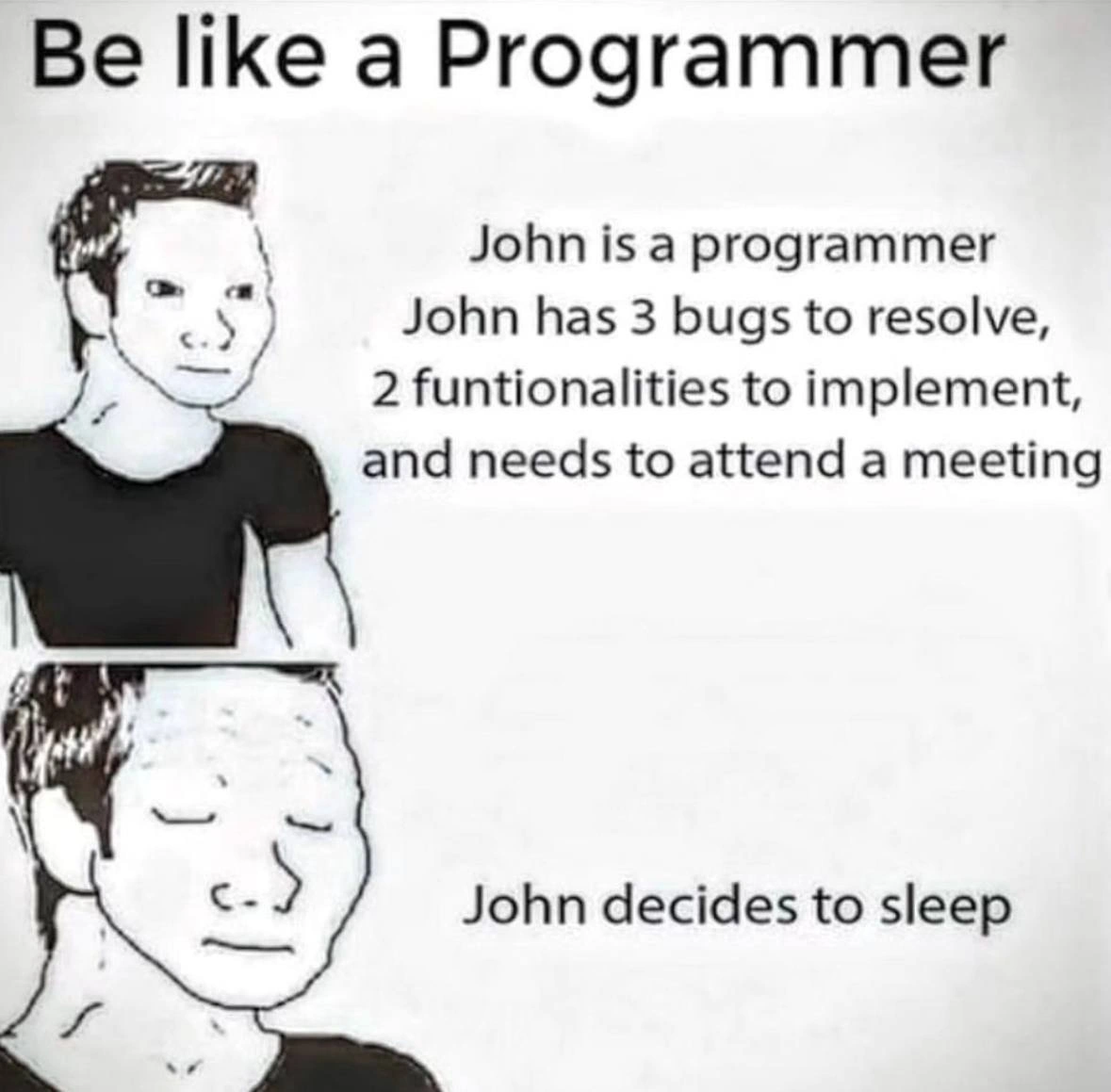
Imagine you’re a student who has three homework assignments due, two chores your parents asked you to do, and even a family meeting you’re supposed to attend. It’s a lot of stuff, and it’s all piling up on the same day. Now picture that instead of doing any of it, you just crawl into bed and take a nap. 😴 Kinda funny, right? You know you’re “supposed” to be doing your homework and cleaning your room and sitting in that meeting, but you’re so tired and overwhelmed that you just fall asleep instead. This meme is like that scenario. John the programmer has a ton of important work to do, but he decides to sleep. It’s humorous in a simple way: when life asks too much of you, sometimes you just want to hide under the covers. Everyone, even grown-ups, sometimes feels like this. It’s funny because it’s a little naughty (he’s ignoring his responsibilities), and also because we totally understand that exhausted feeling. The meme is basically saying: “When you have way too much to do, doing nothing (like taking a nap) suddenly feels like the best idea.” We laugh because we’ve all been there, choosing a bit of rest over work, even when we know we probably shouldn’t.

Level 2: Bugs, Features & Sleep

This meme paints a picture every junior developer will eventually find familiar. John is a programmer with a plate full of tasks:

  • He has 3 bugs to resolve – meaning there are three errors or defects in his code that are causing things to break or behave weirdly. Fixing bugs can be urgent, especially if they’re affecting users (imagine the app is crashing or a feature isn’t working at all).
  • He also has 2 functionalities to implement – in other words, two new features or pieces of functionality that someone (maybe his boss or a product manager) expects him to code. Implementing features is creative work and takes time and focus. (Side note: the meme intentionally spells “functionalities” wrong as “funtionalities,” a little joke hinting that even the task list isn’t perfect!)
  • On top of that, John needs to attend a meeting – probably a team meeting or a planning session. Meetings are when developers have to stop coding to discuss progress, requirements, or issues. They can be helpful, but often they interrupt the flow of coding.

So John has a busy day: fix bugs (which can be like finding needles in a haystack), build new features (which require concentration), and go sit in a meeting (which might feel unproductive or boring if you’re itching to code). That’s a lot for one person in one day. This setup screams deadline pressure and coding frustration – any new developer can imagine the stress. You’ve got your to-do list overflowing and everyone wants everything done now. It’s a prime recipe for developer humor because it’s so exaggerated yet so true to life.

Now, here’s the twist that makes it funny: Instead of tackling any of those tasks, John decides to sleep. The meme format “Be like a Programmer” is parodying the old “Be like Bill” meme style, which usually praises someone for doing the sensible thing. But John’s sensible move is ironically procrastination. He chooses sleep over work. It’s an example of procrastination_humor and a bit of dark comedy about burnout. The image in the second panel shows John drawn as a Wojak character (a popular meme face that often represents an everyday person’s feelings) with his eyes closed, looking calm and indifferent. That blank, closed-eye face represents John basically saying “Nope, not dealing with it.” It’s the look of a developer who is so exhausted and overloaded that they’ve become almost emotionless about the chaos around them.

For a junior developer, this scenario highlights a real struggle: task_overload. When you have too many things to do at once, it can actually be hard to do anything at all. Your brain might freeze up, or you might feel hopeless about where to start. John “choosing sleep” is a funny extreme example of this – it’s obviously not good to ignore bugs and skip meetings, but the meme exaggerates to make a point. It captures that guilty little daydream many coders have had: “What if I just ignore all these tasks and take a nap?” We laugh because we know we shouldn’t do that, but we also know the tempting feeling of wanting to escape the workload for a moment. The humor is in the relatability: everyone in software, from rookie to veteran, has had a day where the bugs and deadlines just feel like too much, and the bed or couch calls your name.

Level 3: Priority Inversion: Sleep Wins

In an ideal world, bugs get fixed, features get built, and meetings magically stay on topic. In reality, when a developer’s task list grows out of control, something’s gotta give. Here we see a classic case of task overload triggering a full system shutdown – John basically calls Thread.sleep() on himself. It’s a darkly funny example of priority inversion: the least urgent task (sleeping) preempts all the high-priority work (bugs, features, and that oh-so-important meeting). Any senior engineer who’s pulled 12-hour days knows this feeling. You’ve got three bugs in software causing chaos in production, two new functionalities (features) with yesterday’s deadline, and a mandatory meeting that’s likely to be a time sink. The punchline? John decides to sleep. It’s an absurd reversal of priorities that evokes a knowing, bittersweet laugh from seasoned devs.

Why is this so funny to the experienced coder? Because it’s painfully relatable. This meme captures the moment when developer fatigue hits critical mass and the brain context-switches straight into standby mode. In technical terms, John’s brain has encountered a deadlock: too many high-priority threads (tasks) competing for limited cognitive resources. The cheeky solution? Abort all threads and run the idle process – i.e., go to sleep. It’s essentially a productivity kernel panic, where the only safe action is to shut down for a bit. The humor here is that John does what every burnt-out developer wishes they could do when swamped: ignore the fire drill and catch some Z’s.

This scenario also satirizes real workplace dynamics. Companies preach about DeveloperProductivity yet often overload engineers with simultaneous bug-fixing, feature development, and back-to-back meetings. The meme’s Be like a Programmer format reads almost like sarcastic career advice: “John has too much to do. John chooses to sleep. Be like John.” It pokes fun at the absurd expectation that devs should handle everything flawlessly. The misspelling “funtionalities” in John’s task list is the cherry on top – even the to-do list has a bug! (How ironic that John has another bug to resolve: a typo in his spec). A jaded developer might quip that whoever wrote that task list could use some sleep too.

The depiction of John transforming into the blank-faced Wojak with closed eyes in the second panel is an image of calm resignation that veteran programmers recognize all too well. It’s that zen-like defeat when you accept that you’re human and can’t fix all the things today. You’ve got deadline pressure squeezing you, coding frustration from stubborn bugs, and a meeting invite popping up like a low-priority interrupt – so you do the only sane insane thing: nothing. As cynical as it sounds, sometimes the choice is between working until 3 AM (and still failing) or getting some rest and facing the chaos tomorrow. John chose rest. Seasoned devs smirk because they’ve lived this — that moment when closing your laptop and sleeping feels like the most logical exception handler for a system about to overload.

Description

This is a two-panel meme with the title 'Be like a Programmer.' It features a simple, sketch-like Wojak character. In the top panel, the character has a weary, neutral expression. The text next to him reads, 'John is a programmer. John has 3 bugs to resolve, 2 funtionalities to implement, and needs to attend a meeting.' Note the typo 'funtionalities.' In the bottom panel, the same character is shown with his eyes closed in a state of peace or sleep. The corresponding text simply says, 'John decides to sleep.' The meme humorously captures the feeling of being overwhelmed by a typical developer workload. It suggests that when faced with a mountain of tasks, the most rational or relatable choice is to simply disengage and rest. For experienced developers, this isn't just procrastination; it's a nod to the very real issue of burnout and the occasional necessity of stepping away from a problem to maintain sanity or even solve it more effectively after a break
Comments

13
Anonymous ★ Top Pick John isn't procrastinating; he's offloading the bug fixes to his subconscious garbage collector. It's more efficient, but the process is non-deterministic
  1. Anonymous ★ Top Pick

    John isn't procrastinating; he's offloading the bug fixes to his subconscious garbage collector. It's more efficient, but the process is non-deterministic

  2. Anonymous

    John’s new “scheduler” wraps every bug, feature, and meeting in a CompletableFuture, then immediately .get() with no timeout - guaranteed four-nines of uptime for his REM cycle

  3. Anonymous

    After 15 years in the industry, you realize John isn't procrastinating - he's implementing the most efficient garbage collection algorithm: letting his brain defragment overnight so tomorrow's debugging session doesn't require a full system restart

  4. Anonymous

    John's decision tree has O(1) complexity: regardless of the input (bugs, features, meetings), the output is always sleep. Some might call it lazy evaluation, but John calls it optimal resource management - you can't fix bugs if your brain's garbage collector hasn't run in 48 hours

  5. Anonymous

    Three prod bugs, two “funtionalities,” one meeting - invoke sleep(); the senior fix for calendar-induced priority inversion while the org scheduler rebalances overnight

  6. Anonymous

    Faced with three P1s, two features, and one meeting, the senior thread invokes sleep(8h) for cache eviction and fewer context switches - adaptive backoff, not procrastination

  7. Anonymous

    John chose the path of least resistance: exponential backoff into dreamland

  8. @mpolovnev 1y

    John decides not to sleep. That's the problem 🙁

  9. @dsmagikswsa 1y

    we need a crowdstrike meme

    1. dev_meme 1y

      But why do you think this one isn’t about crowdstrike? 😲

      1. @dsmagikswsa 1y

        The second picture should be: John doesn't need to choose but sleep

    2. dev_meme 1y

      Though meme or meme + short summary of recent events from someone who researched the driver which lead to collapse of the infra all around the world

    3. dev_meme 1y

      You asked for it, you got it 😄

Use J and K for navigation