The Real Culprit Behind the Global Outage
Why is this OnCall ProductionIssues meme funny?
Level 1: The Real Trouble-Maker
Imagine you have a remote-control toy car that suddenly stops working. Everyone panics and starts guessing why. One friend says, “Maybe someone stole the batteries!” Another says, “Maybe a giant magnet from the next town stopped it!” These are like blaming big, scary outside forces. But then you open up the toy car and find a tiny wire inside had come loose. The car wasn’t moving because of a simple internal issue – a little glitch – not because a bad person did something. That’s exactly what this meme is joking about.
In the picture, a big cloud service (Microsoft’s Azure, which lots of people rely on, kind of like an electric company for the internet) went down. People were guessing wild reasons, even blaming entire countries like Russia or China or North Korea, as if some super-villain team caused it. Those are the outrageous guesses (like the stolen batteries or a giant magnet). But the real cause was like that tiny loose wire in the toy car – in this case a small, hidden file (something deep inside Azure’s own computers) that messed things up. In the meme’s “game show” style question, the funny twist is that the correct answer isn’t a “who” at all, but a “what” – a nerdy little system file with a confusing name. It’s as if the game show asked “Who broke the service?” and the answer turned out to be “a sneaky gremlin inside the machine” rather than any person. That surprise – expecting a big villain but discovering a little internal oopsie – is what makes the meme funny. It reminds us that sometimes big problems start from tiny, unglamorous mistakes, not from big bad guys.
Level 2: The Bug Did It
Let’s break down the meme’s references in more straightforward terms. Microsoft Azure is a huge cloud computing platform – basically, Microsoft’s giant network of data centers that runs many of the websites and online services you use (from business apps to video games). An Azure outage means that a part of this cloud went down or became unavailable. When Azure is down, it can cause a lot of other applications and sites to stop working, which is a big deal. Engineers who maintain cloud services (like Azure) are often called DevOps engineers or SREs (Site Reliability Engineers). They carry a pager or phone for on-call duty – meaning if something breaks at 2 AM, they get an alert and must jump in to fix it, rain or shine (or sleep). So outages are their emergency moments, and figuring out why something went wrong is a huge part of their job.
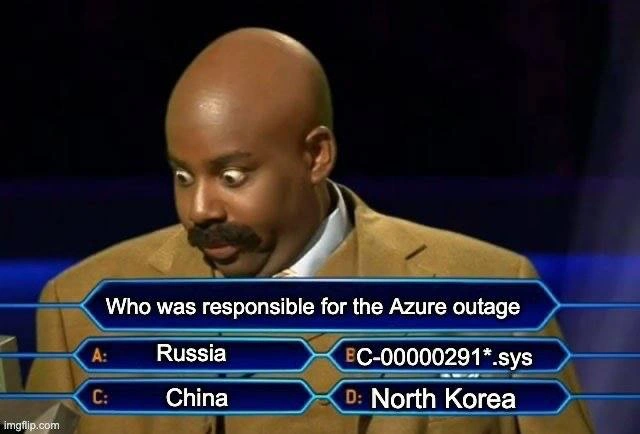
Now, the meme is styled like a question from the TV quiz show “Who Wants to Be a Millionaire”. In that show, a question is asked with four possible answers (labeled A, B, C, D), and only one is correct. Here the question on the screen is, “Who was responsible for the Azure outage?” That implies something went wrong and we’re asking who caused it. The possible answers given are:
- A: Russia
- B: China
- C: C-00000291*.sys
- D: North Korea
Notice anything about A, B, and D? They are all country names. Specifically, they’re countries often mentioned in news or security discussions about hacking and cyber attacks. If a big company has a mysterious outage or data breach, people sometimes jump to “Maybe it was hackers from Russia or China or North Korea.” These countries are frequently (and sometimes unfairly or inaccurately) blamed as the boogeymen for cyber issues in Western companies. It’s a bit of a cliché in tech and security circles that when something goes wrong, the initial finger-pointing might be towards foreign hackers or a DDoS attack (Distributed Denial of Service – basically flooding a service with traffic to knock it offline). That’s why those names are listed – they represent the blame game we sometimes see when a service goes down: “Who did it? Some enemy out there?”
Now look at C: C-00000291*.sys. That one is clearly not a country. In fact, it looks like a filename. And indeed, .sys is the file extension used by Windows for system files, particularly drivers (special programs that help the operating system control hardware or low-level system functions). So option C is basically naming a system file – something internal to Microsoft’s own technology. It’s a very odd, specific name, almost like an error code or an automatically generated file name. The presence of that odd * character suggests it’s not even a nicely named file; it’s something cryptic, possibly like a placeholder or wildcard. The meme is likely referencing a scenario where the root cause of the outage was a bug in some internal component with a funky name. It’s common in Windows systems to see error logs that mention a driver file when something crashes (for example, nvlddmkm.sys is a notorious NVIDIA graphics driver file that can cause crashes on PCs – if you’ve ever seen that, you know you’re dealing with a driver issue). So C-00000291.sys is meant to evoke the same vibe: “some technical thing deep in the system failed.”
In simpler terms: Option C stands for an internal software bug. It implies that the Azure outage wasn’t caused by any person or external hacker at all, but by a glitch in Azure’s own code/infrastructure – basically a mistake or failure in the system itself. In tech slang, we’d call that a bug (an error in the software) or possibly a hardware driver fault. When such a bug is in a core system file, it can indeed take down services. For example, if a driver that handles networking on Azure servers has a flaw and crashes, all network traffic might halt – causing an outage for customers.
So the meme’s joke is that while answers A, B, and D are pointing at people or groups (external blame), the real answer (C) is pointing at a thing (an internal fault). It’s saying: “Nope, it wasn’t some nefarious foreign hacker, it was just our own system acting up.” This resonates because, in reality, big cloud outages often turn out to be caused by internal issues (like a software update gone wrong, a configuration error, a buggy driver, or someone’s automated script accidentally doing the wrong thing). The meme exaggerates it into a quiz question for comedic effect.
For a newcomer to these concepts: Blame culture or the “blame game” refers to the tendency to focus on who caused a problem rather than what exactly went wrong. Modern IT practices try to avoid finger-pointing. Instead, teams do post-mortems or root cause analyses to figure out exactly what broke and how to prevent it next time, rather than, say, firing someone (especially if it was an honest mistake or systemic issue). The phrasing “Who was responsible?” is intentionally ironic here, because a well-run incident analysis would ask “What was responsible?” Option C being a system file underscores that the cause was a technical issue, not an individual or an outside agent.
In the context of Microsoft and Azure: Microsoft runs Azure, so an Azure outage being caused by a Windows system file is essentially Microsoft tripping itself. It’s a bit funny and a bit embarrassing (imagine a giant like Microsoft brought down by a tiny file!). But it’s believable – there have been incidents where, say, a certificate expired or a hidden bug in an update caused big problems. If you’re new to cloud computing, know that downtime (service going down) is often caused by very ordinary things: a software bug, a config change, a network cable unplugged accidentally, etc. Attacks do happen, but they’re just one of many causes and, in practice, less common than internal glitches. So the meme is educating in its own cheeky way: Don’t always jump to “hackers did it!” when a cloud service fails; often it’s an internal bug – like a mysterious *.sys file – that’s to blame.
Oh, and that image of the game show host with big bulging eyes? That just adds to the humor. In the actual Who Wants to Be a Millionaire show, the host often dramatically asks, “Is that your final answer?” Here, you can imagine the contestant staring at these options, astonished that “C-00000291*.sys” is even an option. The host’s face (bug-eyed) kind of matches what an engineer might feel upon discovering the true cause of an outage: “Wait… our entire cloud went down because of THAT one file?!” It’s equal parts surprise and “you gotta be kidding me.” And that’s the essence of the meme: highlighting the almost ridiculous truth that a tiny internal bug can cause a massive issue, even while everyone was busy suspecting big bad actors.
Level 3: Blame Game Show
Stepping back to a more everyday engineering perspective, the meme sets up a Who Wants to Be a Millionaire-style question: “Who was responsible for the Azure outage?” If you’ve ever been in a high-severity outage call, you know this question (in some form) gets asked a lot – sometimes in a panicky, “who do we fire?” way, other times in a genuinely curious, “what the heck happened?” way. The multiple-choice answers here are comedic gold for anyone in DevOps/SRE or on-call roles:
- A: Russia
- B: China
- C:
C-00000291*.sys - D: North Korea
Options A, B, and D are basically the usual suspects in the world of cyber blame-games. Western tech folklore loves to pin mysterious failures on foreign state-sponsored hackers — Russia, China, North Korea, those are the big three that get name-dropped whenever something fishy (or even not-so-fishy) happens. It’s a running joke: “Oh, the site’s down? Must be the Russians!” 🙄 This meme is poking fun at that knee-jerk blaming of external boogeymen.
Then we have Option C, which sticks out like a sore thumb (or rather, a sore .sys). C-00000291*.sys is not a country, not a hacker group, but an obscure system file. It’s the kind of internal Windows filename that Microsoft engineers might recognize during a post-mortem, but it means nothing to the average person. And that contrast is exactly the joke: one of these answers is clearly not like the others — and it’s the correct answer. The meme is winking at all the ops folks reading it: “Psst, you know it wasn’t a fancy cyberattack. It was this stupid internal bug, right?”
The humor really lands if you’ve lived through a blame-fest during a production outage. Picture a major Azure downtime: Twitter is going wild with speculation, some random “expert” on LinkedIn is confidently suggesting it’s a massive DDoS attack from a state actor, and maybe an executive on a bridge call asks, “Could this be cyber warfare?” Meanwhile, the engineers are frantically combing through logs and metrics. What do they find? Not signs of an elite hacker breaching firewalls, but something mundane like an error message pointing to a null pointer, an unhandled exception, or an oddly named service crashing. It’s as if the meme itself is an SRE in that meeting, deadpan-ing: “I’ll take Option C, final answer.”
By presenting it as a game show question, the meme satirizes the drama that often surrounds high-profile outages. Game shows are all about suspense and big reveals. Likewise, in a big outage, there’s often a dramatic narrative forming: was it a hack, was it sabotage? But the big reveal in real life often turns out laughably anticlimactic: “Actually, the root cause was a misconfigured .sys file on our end.” It’s the same energy as a game show contestant shocking the audience by picking the counterintuitive answer – and being right. The host’s bug-eyed expression in the image says it all: that mix of surprise and “you gotta be kidding me!” when the boring answer is the true one.
This also touches on tech blame culture. In theory, modern teams preach blameless post-mortems – focus on the process and technology, not pinning a person or enemy. In practice? When the stakes are high, people sure do look for a scapegoat. External attackers are convenient scapegoats: if it’s a hacker, “well, nothing we could do” (and it’s not Bob in engineering’s fault). The meme mocks this by listing big bad villains – and then subverting it. The real culprit isn’t a “who” at all. It’s a “what” – a piece of buggy code. The message: sometimes the call is coming from inside the house. Azure wasn’t taken down by an outside enemy; it was tripped up by its own internals. This jives with every grizzled ops veteran’s experience. We’ve all heard the half-joking phrase, “We have met the enemy and he is us.” This meme just gives “the enemy” a hilariously specific name (C-00000291.sys).
For context, Microsoft (like other cloud providers) has had outages in the past that initially smelled like security incidents but turned out to be self-inflicted wounds. One time, an Azure AD authentication outage had folks thinking “hackers!”, but nope – it was a replication bug in an update that Microsoft itself deployed. Another time, people suspected a major Azure disruption was due to a DDoS; the truth was some internal configuration error in their network. It’s almost predictable: the bigger the speculation about nation-state attacks, the more likely the root cause ends up being something banal like an expired certificate, a bad code deployment, or, as this meme suggests, a janky driver.
In the world of on-call engineers, this mix-up between glamorous blame vs. boring reality is practically a trope. That’s why this meme hits home and is being shared among Cloud and SRE circles. It’s a nod and a wink: “We’ve been there. While everyone else plays Clue (‘Was it Colonel Mustard in the data center with a malware stick?’), we’re over here fixing the real issue — which often amounts to cleaning up our own mess.” And after the dust settles, you get those official reports that read like, “Root cause: a rare condition in module C-00000291.sys caused an unexpected reboot of servers. Mitigation: patched the bug.” No spies, no international intrigue, just plain old software flaws. It’s equal parts comforting and comical to those of us who keep the lights on in production: comforting because it’s under our control to fix, comical because of how far off the wild theories can be.
Level 4: Ghost in the Kernel
At the deepest technical layer, this meme hints at an Azure outage caused by a spooky little bug lurking in the operating system’s core. The weird string C-00000291.sys looks like one of those cryptically named driver files you’d find on a Windows server – basically a piece of low-level code that interfaces with hardware or critical system functions. In Azure’s case, many underlying hosts run Windows-based components (like the Hyper-V hypervisor for virtual machines), so a fault in a .sys driver can be catastrophic. Think of a driver as the kernel’s toolkit for talking to devices: if a tool in that kit malfunctions, the whole machine can faceplant (hello, Blue Screen of Death).
Now, in a massive cloud like Azure, a kernel-level hiccup doesn’t just kill one machine in isolation. We worry about common-mode failures – a fancy term for a flaw that, when triggered, nails every identical system out there. If all Azure servers are running the same code and driver C-00000291.sys has a latent bug, a certain trigger (high load, a specific date, a cosmic ray – pick your poison) could make a ton of machines crash simultaneously. It’s the nightmare of distributed systems: we add redundancy to survive single failures, but if the redundant components share the same bug, they can all go down like synchronized swimmers. This is how you get a global outage from one tiny file. A one-in-a-million race condition in the kernel might sound theoretical, but at cloud scale those “million” events happen every few minutes. Azure’s millions of operations will eventually hit that rare bug – Murphy’s Law meets math.
From a systems theory perspective, this speaks to the complexity of modern cloud architecture. Azure is a highly distributed system, but deep down it may rely on some common base software. The humor in option C’s gibberish name hides a real truth: often the ultimate root cause in a cloud incident is something incredibly granular and technical (like an integer overflow in a driver, or a memory leak triggering a kernel panic). These are things no nation-state hacker could replicate because they’re accidental flaws of the system itself. There’s almost a chaos theory vibe: a tiny bug flaps its wings in the kernel and causes a tornado of outages across data centers. In academic terms, one could point to reliability models – for instance, if each server has a 0.0001% chance per day to hit a bug, having 100,000 servers virtually guarantees a hit somewhere each day. And if that hit is a fatal exception in a ubiquitous driver, game over.
A veteran engineer reading this meme might even recall times they dug through crash dumps at 3 AM to figure out which module went haywire. (WinDbg and hex dumps, anyone?) The specific format C-00000291 resembles how internal build artifacts or drivers might be labeled – it’s not something you’d ever see unless you’re knee-deep in a Windows kernel debugging session. This harks to those infamous post-incident reports where the final culprit is a single line of code in a module with a geeky name. It’s a reminder that beneath all the cloud magic, we’re still dealing with fallible software and the unforgiving logic of operating systems. The meme’s punchline is essentially: “Not an evil hacker, just the OS haunting itself.” A ghost in the kernel, indeed – an insidious, invisible gremlin that can bring a tech giant’s cloud to its knees, while the rest of the world was busy pointing fingers elsewhere.
Description
This meme uses the 'Who Wants to Be a Millionaire?' game show format to create a humorous and stressful scenario. A contestant with a shocked and wide-eyed expression is presented with the question: 'Who was responsible for the Azure outage'. The multiple-choice options are A: Russia, C: China, D: North Korea, and B: 'C-00000291*.sys'. The visual humor comes from the contestant's panicked face, as if facing an impossibly difficult question. The technical context is the massive global IT outage of July 2024. The joke is that the cause wasn't a sophisticated cyberattack from a nation-state, which are the usual suspects for large-scale disruptions, but rather a buggy security patch file from CrowdStrike. The file mentioned, 'C-00000291*.sys', was the specific update that caused widespread system crashes (Blue Screen of Death) on Windows machines, heavily impacting services like Microsoft Azure
Comments
7Comment deleted
We spent a decade building defenses against state-sponsored APTs, but in the end, the call was coming from inside the (kernel) house
Seasoned Azure rule: if the RCA options list three nation-states and one decades-old *.sys, bet the month’s on-call rotation on the driver - entropy scales faster than any APT
The real APT (Advanced Persistent Threat) was the .sys files we deployed along the way - turns out nation-state actors have nothing on a single bad kernel driver pushed to millions of endpoints at 3am on a Friday
When your postmortem reveals the root cause was 'c-00000291*.sys' and not a sophisticated APT group, but management still wants to brief the board about nation-state threats. Sometimes the most dangerous adversary isn't in Moscow or Beijing - it's a poorly tested kernel driver update that bypassed your staged rollout strategy and took down half the Fortune 500 before your morning standup
Our nation‑state threat model was solid; we just forgot the case where the EDR vendor ships a bad kernel driver and self‑DDoSes every Windows VM
Correct answer: C-00000291*.sys - the fastest way to simulate a nation-state attack is a ring-0 agent with global auto-update and no canary
Geopolitical hackers? Nah, just a .sys file reminding us why SREs pray for Linux in the stack