Skip to content
DevMeme
4329 of 7435
When your “calculated” tech-debt plan is just clown makeup in Slack
TechDebt Post #4731, on Aug 5, 2022 in TG

When your “calculated” tech-debt plan is just clown makeup in Slack

Why is this TechDebt meme funny?

Level 1: Painting Over Problems

Imagine a clown in a circus who accidentally drops all the juggling balls, making a big mess on the stage. Instead of cleaning it up right away, the clown gives a huge grin and says, “I meant to do that! I’ll pick everything up later, I promise!” The audience laughs because they know he’s just saying that to be funny – he obviously didn’t plan to drop the balls, and he probably won’t really fix anything later.

This meme is just like that, but with computer code. It’s saying that when a software team makes a messy shortcut and claims “Oh, we’ll fix it later, we planned it this way,” it’s as silly as a clown pretending his mistakes were on purpose. We find it funny because everyone recognizes it’s a goofy excuse. In simple terms: making a mess now and promising to clean it up later usually just means you’re clowning around.

Level 2: Quick & Dirty Code

Let’s break this down in simpler terms. The meme is about technical debt – a concept in software development. TechnicalDebt is when developers choose a quick & dirty solution to solve a problem or ship a feature faster, even though it’s not the best long-term approach. It’s like cutting corners in code. Why do that? Maybe there’s a tight deadline, a demo tomorrow, or pressure from the boss. The idea is “We’ll do it fast now and improve it later.” In theory, that’s fine: you borrow time now (that’s the “debt”) and you plan to pay it back by cleaning up the code afterward. But if you don’t pay it back promptly, this “debt” grows. The code can become harder to maintain or cause bugs – that’s the interest on the debt. High code quality means writing code cleanly and carefully, but taking on tech debt means you accept lower code quality temporarily. The risk is that “temporarily” might turn into “forever” if you never actually fix it.

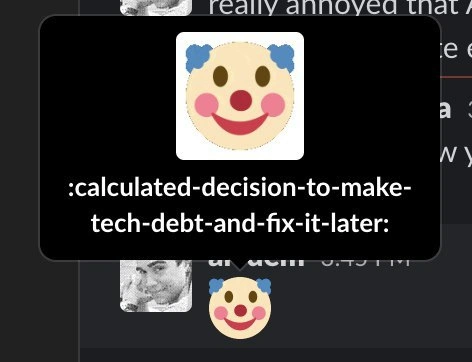
Now, what’s with the clown? The screenshot comes from Slack, which is a chat app many companies use for team communication. In Slack, you can react to messages with emoji (little icons like 🙂👍🤡 instead of writing a reply). Slack even lets you add custom emoji – your own little pictures or inside-joke icons – that everyone in your workspace can use. In the image, someone made a custom emoji of a clown face. They gave it a very specific name: :calculated-decision-to-make-tech-debt-and-fix-it-later:. That’s not a standard emoji name; it’s something this team invented to be funny. When you hover your mouse over an emoji reaction in Slack, a small label (a hover_tooltip) pops up showing the emoji’s name (the code between the colons). So in this meme, hovering over the clown face reveals the joke text of that name. Essentially, the team turned the phrase “calculated decision to make tech debt and fix it later” into an emoji that displays as a clown.

Why a clown? In everyday language, calling someone a clown or showing a clown emoji is a lighthearted way to say “that’s foolish” or “that’s a joke.” Here, the team is indirectly calling the “fix it later” plan a joke. The clown emoji reaction in Slack is a non-verbal, humorous way of saying “this is silly.” It’s like adding a little sticker to a message that says “🤡 = I think that plan is clownish.” In tech circles (and DeveloperHumor memes), clown faces often represent bad ideas or pretending everything’s fine when it isn’t.

The long emoji name is poking fun at a typical tech_debt_excuse. How do managers or teams justify quick & dirty code? They say things like “It was a calculated decision… we’ll fix it later.” It sounds official, almost scientific – calculated! – as if they really thought it through. But developers know that phrase usually means “we didn’t have time to do it right and we’re hoping to clean up someday.” It’s an inside joke among programmers because “someday” often never comes. This is common in company CorporateCulture: business wants features fast, so engineering agrees to cut some corners. Everyone promises to tidy up the technical debt soon, but then new tasks keep coming and the cleanup gets postponed indefinitely.

If you’re a newer developer (or even a student), you might have already encountered something like this. For example, maybe you wrote a school project or a small app and you hard-coded some values or skipped error handling just to make it work. You thought, “I’ll fix that later.” If later never came, you’ve tasted technical debt! In a professional setting, imagine your team is building a website and there’s a big launch coming up in two days. The login feature isn’t working well, so your lead says: “Just put in a quick fix now, we’ll redesign this part next month.” That quick fix might involve some messy code that does work for the demo, but it isn’t how you’d ideally architect it. They even create a ticket in the tracking system (like Jira or Trello) for “Refactor login module”. Then life moves on, the launch happens, and nobody touches that login code for a year. Meanwhile, that code might be causing small bugs or making new updates harder. That’s technical debt in action – the shortcut’s price is paid later in debugging time and headaches.

So, the key terms here: tech debt (agreeing to deal with messy code later), and fix it later (often an empty promise). The clown emoji is the team’s way of saying they suspect this “fix it later” plan is a joke. It’s a friendly jab. In Slack and other tech team chats, adding a clown reaction is a relatively polite, humorous way to express skepticism or self-awareness. Nobody has to say “This plan is dumb” out loud; they just tag it with a 🤡. The person who named that custom emoji “calculated-decision-to-make-tech-debt-and-fix-it-later” was likely being cheeky about their own habit of making such plans, or poking fun at management’s words.

Finally, why is this funny to developers? Because it’s RelatableHumor. Almost every programmer has been in a situation where the team knowingly ships something not-so-great and says “we’ll clean it up soon.” It’s a shared pain – everyone has seen that cleanup either get delayed or forgotten. So when they see that clown emoji with the exact phrase as its name, they laugh and think, “Yup, been there, done that.” It’s humor born from a bit of frustration: we laugh so we don’t cry about the messy code we still need to deal with!

Level 3: Calculated Clownery

In this Slack screenshot, a developer reacted to a message with a tiny clown face emoji. When you hover over it, Slack’s tooltip reveals the emoji’s tongue-in-cheek code: :calculated-decision-to-make-tech-debt-and-fix-it-later:. The visual gag is immediate – a serious-sounding plan (“calculated decision”) is literally labeled with a clown. It’s a perfect satire of how corporate culture often tries to dress up technical debt as a strategic move. The contrast is delicious: on the surface, management says “Yes, we intentionally took on this debt with a plan!” – but the dev team knows that’s as legit as a clown’s makeup.

Seasoned engineers will facepalm at this because we’ve all heard variations of that line: “It’s a calculated risk. We’ll write this quick-and-dirty code now and fix it later.” Sure. And I have a bridge to sell you. In reality, “fix it later” is usually code for “pray it never blows up.” The humor cuts deep: calling something a calculated decision to incur tech debt is just corporate-speak for “we’re cutting corners”. The clown emoji is effectively saying “who are we kidding?”. It’s a shared DeveloperHumor truth that such promises of later refactoring are about as reliable as a clown car – you don’t know how many problems will tumble out, but it’s gonna be chaotic.

This meme shines a floodlight on a classic TechDebt fiasco. Technical debt is the CodeQuality killer that happens when you implement a quick shortcut solution now, knowing it’s not ideal, and promise to clean it up in the future. The term was coined by Ward Cunningham decades ago to explain how doing things the cheap way now incurs a kind of “interest” – the code will be harder to change later. In theory, you take on debt deliberately and then pay it back by refactoring. But in practice? That “later” fix is often a myth. Interest on tech debt compounds: maybe that hacky module makes adding new features slower, or causes subtle bugs that take days of debugging – real pain that keeps piling on. The longer you wait, the harder and costlier it becomes to fix, much like unpaid credit card debt.

Why do smart teams end up clowning around like this? Pressure, mostly. CorporateCulture and deadlines can push managers to declare such shortcuts as “strategic decisions.” The team might be behind schedule, a VP wants the feature shipped yesterday, and suddenly skipping tests or hardcoding a config feels “necessary.” Everyone involved might even nod and tell themselves it’s fine. They add a // TODO: refactor this later in the code and move on. It’s almost ritualistic. But every experienced developer knows that “later” often means “when pigs fly.” Once the feature is out and making money (or getting users), planning time for cleanup is notoriously hard. New business priorities will always outrank invisible code cleanup work. So that tech_debt_excuse of a plan never materializes – the temporary hack becomes a permanent fixture. The team basically painted a clown smile on the codebase and pretended everything’s okay.

Notice how Slack is the stage for this drama. In many dev teams, Slack custom emoji are an art form of snark. A tiny clown emoji reaction is a low-key way to call BS without saying a word. By creating a custom emoji literally named “calculated-decision-to-make-tech-debt-and-fix-it-later,” someone went the extra mile to be crystal clear in their mockery. It’s like a SharedPain badge of honor. The fact that this emoji name is so absurdly specific means this situation happens a lot – enough that the team immortalized it in their emoji list. Slack_custom_emoji like this are the digital equivalent of inside jokes passed around at the office watercooler. Hovering to see that long label is the punchline: we all know this “calculated decision” is a clown show. The chat_overlay_ui exposing the emoji’s name is key to the joke – it’s Slack’s UI unintentionally delivering comic timing. You hover, you see a big clown face labeled as that grandiose plan, and you can’t help but chuckle at how perfectly it nails the truth.

For the battle-scarred developer, this meme hits a nerve. It conjures war stories of TechnicalDebt gone wild. Think of a time you rushed out a feature with a dozen if/else quick hacks because the demo was in an hour. Everyone agreed it was “just for now.” Fast forward a year: that code has grown into an unmanageable spaghetti monster causing nightly on-call alerts. The same manager who approved the shortcut might even forget why the code is so messy and ask, “Who wrote this clown code?!” (Answer: it was the “calculated decision” we all agreed on, remember?). Cue the clown music. 🤡

The meme also pokes at accountability theater. By calling it a calculated decision, management tries to frame the tech debt as a wise, temporary trade-off – implying they’ll be accountable for fixing it. But often nobody explicitly schedules the fix. The Jira ticket for refactoring gets created with great fanfare and then shoved to the bottom of the backlog, buried under new feature requests. Months later, that ticket is gathering dust while the hack is very much alive and kicking in production. CodeQuality suffers, new developers joining the team are horrified (“why does this look like a circus?”), and the cost to clean it up has ballooned. It’s a clown-car effect – one bad decision brings an entourage of problems. Yet if you bring it up, management might just repeat the mantra: “We made a calculated decision at the time.” Round and round we go in the circus.

To summarize the shared joke:

What They Say What It Really Means How It Ends Up
“It’s a calculated decision to take on tech debt.” “We’re knowingly making a mess (trust us 🤡).” The mess becomes permanent tech baggage.
“We’ll fix it right after launch, promise.” “We’ll probably never get around to it.” Months/years later, it’s still unfixed.
“This is a strategic trade-off for speed.” “Just ship it now, we’ll deal with fallout later.” The “later” = never, and fallout arrives.

It’s funny because it’s true. Developers laugh (maybe a bit bitterly) at this meme because they’ve lived it. It’s relatable humor born out of frustration. The clown face reaction is cathartic – an admission that everyone involved kinda knows they’re fooling themselves. In the end, calling a poorly-managed shortcut a “strategic decision” is as absurd as a clown promising he meant to mess up. This meme uses that absurdity to bond over a common industry folly: tech debt dressed up in a suit, but the big red nose gives it away.

Description

Screenshot of a dark-themed chat (likely Slack). A tiny custom clown emoji reaction is visible on a message; hovering over it pops up a black tooltip with a larger clown face on a beige circle, blue tufts of hair, red cheeks, and a red nose. Beneath the big emoji, white monospace text reads exactly “:calculated-decision-to-make-tech-debt-and-fix-it-later:”. The visual gag equates the confident sounding emoji name with an obvious clown, humorously calling out how teams justify shortcuts that create technical debt with the promise of refactoring later. Seasoned engineers will recognize the satire of management framing poor code quality as a “calculated decision.”

Comments

7
Anonymous ★ Top Pick The moment someone reacts with :calculated-decision-to-make-tech-debt-and-fix-it-later:, I translate it as: “We’re securitizing tomorrow’s on-call rotations into clown-backed derivatives.”
  1. Anonymous ★ Top Pick

    The moment someone reacts with :calculated-decision-to-make-tech-debt-and-fix-it-later:, I translate it as: “We’re securitizing tomorrow’s on-call rotations into clown-backed derivatives.”

  2. Anonymous

    The only difference between a junior's "quick hack" and a senior's "tactical technical debt" is the JIRA ticket with acceptance criteria for why we'll never actually fix it

  3. Anonymous

    The custom emoji perfectly captures that moment when you're in sprint planning, staring at the backlog, and someone suggests 'we could architect this properly with proper abstractions and comprehensive testing... or we could ship it Friday.' We all know which option gets the clown emoji - and which one gets merged. The real joke is that 'later' has a half-life longer than most JavaScript frameworks, and that tech debt ticket will still be in the backlog when the heat death of the universe arrives. At least we're self-aware enough to document our descent into chaos with appropriately named emoji reactions

  4. Anonymous

    In our Slack, that emoji means we’ve moved the principal to production and the interest to the on-call rotation

  5. Anonymous

    Tech debt's favorite lie: 'calculated decision' where interest accrues faster than forgotten story points

  6. Anonymous

    In our org, :calculated-decision-to-make-tech-debt-and-fix-it-later: is the approved ADR template; the compounding interest is assumed

  7. @theu_u 3y

    :I-basically-don't-fucking-now-wtf-this-issue-is-about-but-i-hate-you-as-i-have-to-work:

Use J and K for navigation