Skip to content
DevMeme
5792 of 7435
The Legendary IKEA Lack Rack: Enterprise-Grade on a Budget
Hardware Post #6348, on Oct 28, 2024 in TG

The Legendary IKEA Lack Rack: Enterprise-Grade on a Budget

Why is this Hardware meme funny?

Level 1: Blanket Fort

Imagine you really want a special shelf to hold all your awesome toys, but you can’t get one. Instead, you take a little table from your house and turn it upside down. Suddenly, that table’s legs become the perfect spot to tuck in your toys, almost like a custom shelf! It’s kind of funny and clever, right? This meme is just like that, but for grown-up “toys” (which are actually network gadgets). Grown-ups in tech sometimes need a fancy cabinet (called a rack) to hold their blinking internet boxes (routers, switches, etc.). But those cabinets can be super expensive or hard to get. So, what do they do if they can’t buy one? They get creative and use something cheap and simple that they already have – like a tiny IKEA table – to do the job!

Think of it like building a fort with chairs and a blanket when you don’t have a real playhouse. You drape the blanket over some chairs, and ta-da! – you have a cozy little fort to play in. It didn’t cost anything and it works well enough to make you happy. In the same way, the tech person in this joke flipped a cheap table and used it to hold a network device, and it worked! It’s funny because we don’t expect a regular table to be used this way. It’s also heartwarming in a silly way: it shows how people can solve problems with a bit of imagination. Instead of giving up when they lack the “proper” equipment, they improvise – using everyday stuff to create a solution. Just like you might giggle at a chair-blanket fort (because it’s both cute and smart), tech folks smile at the upside-down table rack. It’s a reminder that sometimes, when something important is missing, we can make do with what we have – and that clever fix can be both useful and pretty hilarious to see!

Level 2: IKEA Data Center

So, what exactly are we looking at here? This meme shows an example of a homelab_setup trick where someone needed a network rack but didn’t have one – so they turned a simple piece of furniture into one. In IT and networking, a rack is a frame or cabinet that holds all your equipment (like servers, switches, routers) neatly stacked. Most professional racks follow a 19-inch standard – meaning the front is 19 inches wide, with holes or rails to mount gear. Equipment made for racks is usually measured in U (rack units) for height. For instance, a 1U device is about 1.75 inches tall. In the picture, that silver box with ports is a network switch (could also be a router or server), and it’s a 1U rack-mountable unit. Normally, you’d screw its little side “ears” into a proper rack so it’s secure.

Now, real network/server racks are great but they have a few issues for a home user: they’re expensive, often costing hundreds of dollars, and they’re big and heavy (imagine a tall metal bookshelf but for computers). If you’re an enthusiast building a small homelab (a mini data center at home to learn or host things), you might only have a couple of devices – not enough to justify a huge 42U steel rack in your bedroom or garage! This is where the IKEA LACK side table comes in. The IKEA LACK is a super affordable, small coffee table (price around $10 or £5) known for its simple design. And by coincidence (or perhaps cosmic humor), the distance between its legs is close to that magic 19-inch width. That means you can actually fit a standard rack-mount device between the legs!

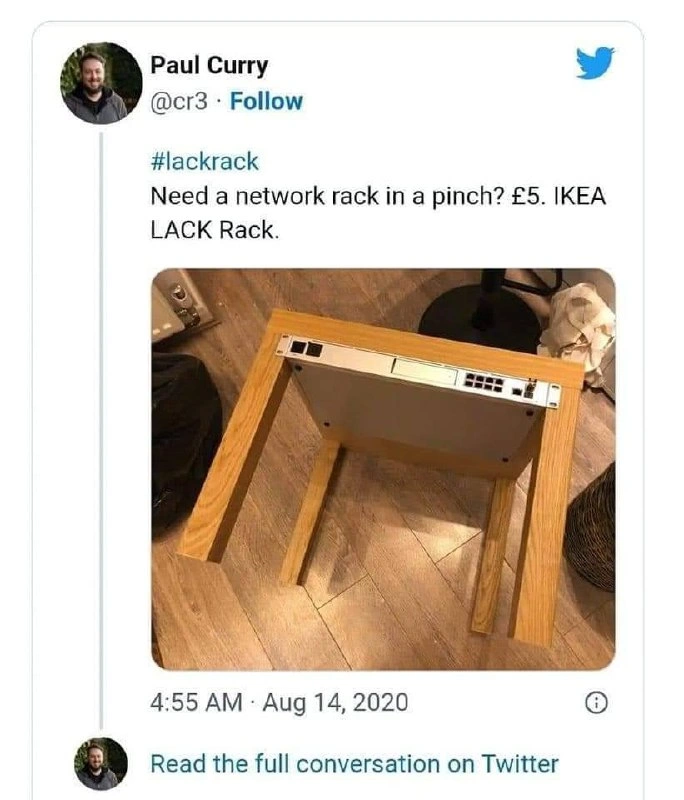
In the tweet, the user @cr3 jokes that if you need a rack “in a pinch” (quickly and cheaply), just spend £5 and get an IKEA LACK table – voila, instant improvised_network_rack. They even use the hashtag #lackrack, combining “lack” (the table’s name) with “rack”. It’s a pun and a known term in the community for this exact DIY project. People have literally taken these tables, flipped them upside-down like in the photo, and slid or mounted their network gear into them. Some folks even stack multiple LACK tables to create a taller rack-like structure (each table adds another “shelf” for gear). It’s like Lego for network equipment! This idea falls under IKEA hacks, where you use IKEA products in creative unintended ways (another tag here is ikea_hack for that reason).

Why do this? Budget_rack_solution is one big reason – a LACK table is vastly cheaper than a real network rack. It’s also readily available and doesn’t look too out-of-place in a home. Setting it up is straightforward: assemble the table (which is just screwing the legs on), then use it normally or upside-down to hold devices. In the picture, the table is flipped, making it kind of a open four-legged stand. The network switch is wedged horizontally between two legs, which keeps it suspended. In some builds, people might drill holes and actually bolt their equipment to the legs, or use zip ties, so the devices won’t fall out. It’s a homelab trick to get a tidy setup without investing in pro gear.

From a junior tech perspective, it’s good to know what each piece here is:

  • Network Switch – the device shown, used to connect multiple devices in a network (like the hub of a wheel). It usually lives in a network rack in offices. Here it’s our star passenger in the LACK table.
  • Network Rack – a standardized metal frame to hold equipment; usually 19″ wide inside, with mounting holes for screws. Comes in various heights (measured in U). Keeps things organized, cool, and safe.
  • IKEA LACK table – a cheap small table (~55x55 cm top). It’s basically hollow with a fiberboard top and four legs. Because it’s simple and almost as wide as a rack, nerds use it as a substitute rack for fun.
  • Homelab – a personal collection of servers/network gear at home. Folks set these up to learn, experiment, or run personal services (like a media server, home automation, etc.). Homelabbers often operate on tight budgets and love creative solutions.
  • Improvised network rack / LackRack – using non-traditional equipment (like our table) to serve the purpose of a rack. It’s an example of a HardwareHumor and HardwareHacks crossover – making do with what you have.

The meme is funny to tech folks because it shows just how far we’ll go to solve a problem pragmatically. It’s Networking meets DIY. Instead of complaining “I don’t have a rack for this switch,” the person literally says “I’ll make one out of a table.” There’s an element of pride in this kind of OpsHumor: it demonstrates cleverness. Even if you’re new to IT, you can appreciate that an infrastructure solution doesn’t always need to be fancy – sometimes a $5 table can solve a $500 problem (at least temporarily!). The image and tweet capture that moment of triumph when you realize a common object can fill an infrastructure need. For a junior learning about networks, it also underlines how standard these devices are in size – so standard that random furniture might accommodate them. And yes, it’s perfectly okay to giggle at how absurd it looks. The switch is meant for a professional rack closet, yet here it is, having a spa day in an IKEA table. It’s a memorable lesson: Hardware doesn’t always require hardware-store solutions; sometimes a bit of creativity (and maybe an Allen wrench) does the trick!

Level 3: Flat-Pack Rack Hack

At first glance, this meme is a nod to the ingenious IKEA LACK Rack hack that veteran network tinkerers know and love. It’s referencing a well-known homelab improvisation where a cheap IKEA side table stands in for a proper 19-inch network rack. Why is this funny to an experienced ops or network engineer? Because it perfectly captures that mix of scrappiness, NetworkInfrastructureDesign creativity, and HardwareHacks that define homebrew infrastructure solutions. In professional data centers, you’d use a heavy-duty steel rack adhering to the EIA-310 standard – the de-facto spec for mounting 19-inch wide equipment in tidy rack units (U). But in a homelab_setup, when your budget or space is tight, you improvise. Here, a £5 IKEA LACK table (yes, the one you put your coffee on) is flipped over to cradle a 1U network switch. It’s a real thing: tech folks discovered that the inner spacing of the LACK’s legs is just about right to fit standard rack-mount gear! The tweet’s hashtag #lackrack is the giveaway – it’s an inside joke and a badge of honor among sysadmin humor circles, celebrating frugal infrastructure ingenuity. Seasoned engineers chuckle because many have been there: cobbling together networking setups with whatever’s on hand, defying the notion that you must spend thousands on a server rack for a small project. The humor is also in the contrast: a sleek enterprise-grade switch or router (often costing hundreds or more) now living inside a flimsy £5 table. It’s like seeing a sports car engine installed in a go-kart frame – absurd but surprisingly effective. This blend of HardwareHumor and OpsHumor resonates because it highlights both the resourcefulness and the ridiculousness of DIY tech solutions. After all, why let a lack of funds stop your project when an IKEA LACK will do? 😉

To a senior IT pro, the LackRack exemplifies that pragmatism-over-perfection ethos. It’s poking fun at the fact that while big companies invest in NetworkInfrastructureDesign with professional racks, at home we’re happily bolting gear to furniture to get the job done. There’s also a bit of history and community pride here: the LackRack meme has been floating around for over a decade – a beloved piece of hardware humor where folks share pics of full mini-data centers built out of LACK tables. (Yes, people stack multiple LACK tables to build a ghetto rack tower!) The tweet’s phrasing “Need a network rack in a pinch? £5. IKEA LACK Rack.” perfectly channels that wry, seen-it-all tone. It’s as if a grizzled sysadmin is saying: Forget waiting for procurement or blowing cash on a fancy rack – grab that IKEA table and let’s ship this thing. It underscores a truth in tech: sometimes improvised_network_rack solutions emerge from urgency and creativity, and they often work shockingly well (at least until you can afford a real fix). This is OpsHumor 101 – laughing at our own duct-tape solutions and sharing war stories of how we kept the network online with zip ties and a prayer.

Let’s break down the comparison for clarity (and a chuckle):

Real Data Center Rack 🏢 “LackRack” DIY 🪑
Purpose-built metal frame, standardized for 19″ equipment (holds dozens of U’s). Repurposed IKEA LACK table, legs conveniently about 19″ apart (holds a couple of units at best).
Costs hundreds to thousands of dollars 💸. Costs ~£5 (basically the price of lunch).
Professional appearance, built-in cable management, cooling, and stability. Quirky homebrew look, cables draped behind, cooling via open air (and maybe a nearby fan).
Designed to support heavy servers and network gear securely. Sturdy enough for a lightweight network switch or router (just don’t put a 50 lb server on it!).
Assembled with bolts and brackets, follows industry standards (EIA-310). Assembled with an Allen key (IKEA style) – actually, just flip it upside-down and you’re done!

The table makes the meme’s point crystal clear: in the infrastructure world, we have fancy gear and standards, but also a hearty appreciation for quick-and-dirty fixes. Everyone from veteran network engineers to hobbyist sysadmins chuckles because it’s a shared experience – that moment when you McGyver your way out of a problem. The lackrack is almost a rite of passage in homelab culture: you learn that budget_rack_solution = embrace the LACK. It’s frugal innovation. Sure, it’s a bit tongue-in-cheek, but underneath the joke is a genuine admiration for how adaptable tech folks can be. In summary, this level of the joke resonates with senior devs/ops because it merges technical knowledge (rack standards, homelab needs) with a healthy dose of HardwareHumor about being resourceful when resources are… lacking. 😄

Description

This image is a screenshot of a tweet from user Paul Curry (@cr3). The tweet, dated August 14, 2020, contains the hashtag #lackrack and the text: 'Need a network rack in a pinch? £5. IKEA LACK Rack.'. The accompanying photo shows a light-colored wood grain IKEA LACK side table turned upside down. A standard 19-inch, 1U silver network switch is perfectly mounted between the table's legs, demonstrating a well-known life hack in the tech community. The 'Lack Rack' is a famous DIY solution for tech enthusiasts, particularly in the homelab and startup scenes. The distance between the legs of the IKEA LACK table is almost exactly the width required for standard server and networking equipment, making it an incredibly cheap and accessible substitute for a professional server rack. This image is a nod to the ingenuity, resourcefulness, and budget-consciousness that many senior tech professionals appreciate and have likely experienced in their own careers, especially when setting up test environments or working with limited resources
Comments

18
Anonymous ★ Top Pick The structural integrity of a £5 particleboard Lack Rack holding a 24-port switch is still more robust than a vendor's promise of '99.999% uptime'
  1. Anonymous ★ Top Pick

    The structural integrity of a £5 particleboard Lack Rack holding a 24-port switch is still more robust than a vendor's promise of '99.999% uptime'

  2. Anonymous

    ADR-404: Replaced 42U cabinet with a £5 IKEA LACK - meets budget, ships next-day, and the Allen key doubles as our entire hardware toolchain

  3. Anonymous

    The only infrastructure decision that's both easier to justify to finance AND easier to assemble than your microservices architecture

  4. Anonymous

    The IKEA LACK rack: proof that the best infrastructure solutions are measured not in nines of uptime, but in how many trips to IKEA you can avoid while still achieving production-grade cable management. At £5, it's the only rack where 'assembly required' is actually less painful than dealing with vendor support, and the MTBF is directly proportional to how well you followed those wordless instruction diagrams. Bonus: when management asks about your disaster recovery plan, you can honestly say your entire infrastructure can be rebuilt with an Allen key and a weekend

  5. Anonymous

    Procurement lead time: eight weeks; outage budget: zero hours - so we shipped an EIA‑310(ish) £5 LACK rack that optimizes CAPEX while catastrophically degrading airflow, grounding, and cable management in a single commit

  6. Anonymous

    IaC evolves to IaF: Infrastructure as Furniture - zero vendor lock-in, infinite wobble under load

  7. Anonymous

    LACKRack: when Finance bans CapEx and Ops still has to ship Friday - 19" compliant if measured diagonally, rails via wood screws, cable management by gravity, airflow by open-plan

  8. @YaDkosti 1y

    Страдает пожарная безопасность

  9. @ifuncuran 1y

    Ножки из картона вроде также как и столешница

    1. @Bitals 1y

      А сколько весит 1-10Гб свищ, выпущенный в течение последних 10 лет?

  10. @ZgGPuo8dZef58K6hxxGVj3Z2 1y

    I cant see a single thing that coukd go wrong

  11. @ArchangelRaphael666 1y

    you know what, i could have some

  12. @SamsonovAnton 1y

    50-centimeter deep metal shelves usually have 19"-compatible horizonal hole spacing. Vertical spacing does not match rack pattern, though. However, with a fixed spacing of 50 mm between pre-drilled holes, it is possible to drill additional holes yourself, resulting in a compatible pattern; only that there will be a small empty space between units compared to regular 1.75" (44.45 mm) interval.

  13. @MrZarei 1y

    that actually looks pretty awesome!

  14. @leandrofriedrich 1y

    They used to cost 5€ here iirc, but i went to Ikea recently theyre 10€ now

    1. dev_meme 1y

      20 PLN -> 40 PLN here, fucking kill me

      1. @leandrofriedrich 1y

        God truly is dead

    2. @echedelle 1y

      I saw it to 8 euros but maybe I confused model

Use J and K for navigation