The Dark Side of IT: Passion In, Burnout Out
Why is this MentalHealth meme funny?
Level 1: From Fun to Fear
Imagine a kid who loves drawing more than anything. Every day, this child grabs crayons and excitedly draws pictures – houses, dragons, rainbows – because it’s so much fun. Now suppose one day the kid joins a really intense art class. The class has a very strict teacher and a big art contest coming up. Suddenly, drawing isn’t just for fun, it’s become serious business. The teacher might yell if the colors aren’t right, and the other kids in class are all bragging about how great their drawings are.
Our little artist starts feeling different. Instead of waking up happy to draw, they feel worried. “What if my drawing is the worst?” they think. Every time they pick up a crayon, their hand shakes a bit because they’re nervous about messing up. Remember how they used to feel proud showing off their pictures? Now they start to feel sad and disappointed in their work, like it’s never good enough. They even begin to think, “Maybe I’m not a real artist. Maybe I don’t belong in this class with the others.”
So, the same kid who went into the class full of joy and passion for art is coming out of the class full of fear and self-doubt. The class was like a magic prism that took one feeling and turned it into a bunch of different unhappy feelings. Drawing, which used to make them smile, now makes their tummy hurt with worry. In simple terms: the fun turned into fear.
This is exactly what the meme is saying about a job in tech (working in IT). You can start out loving it – excited like that kid who loves drawing – and then the tough, stressful environment (like the strict art class) can change those feelings. You might end up scared of making mistakes, sad about how things are going, and unsure of yourself (like thinking “I’m not good at this, I don’t belong here”). The picture of the prism with a rainbow of bad feelings is a way to show how one strong happy light (passion) can get split into many colors of unhappiness. It’s a funny picture, but it talks about a real problem: we have to be careful that something we love doesn’t turn into something that makes us feel awful. In other words, keep an eye on your feelings and ask for help if a fun adventure starts becoming a scary one.
Level 2: Passion to Burnout Pipeline
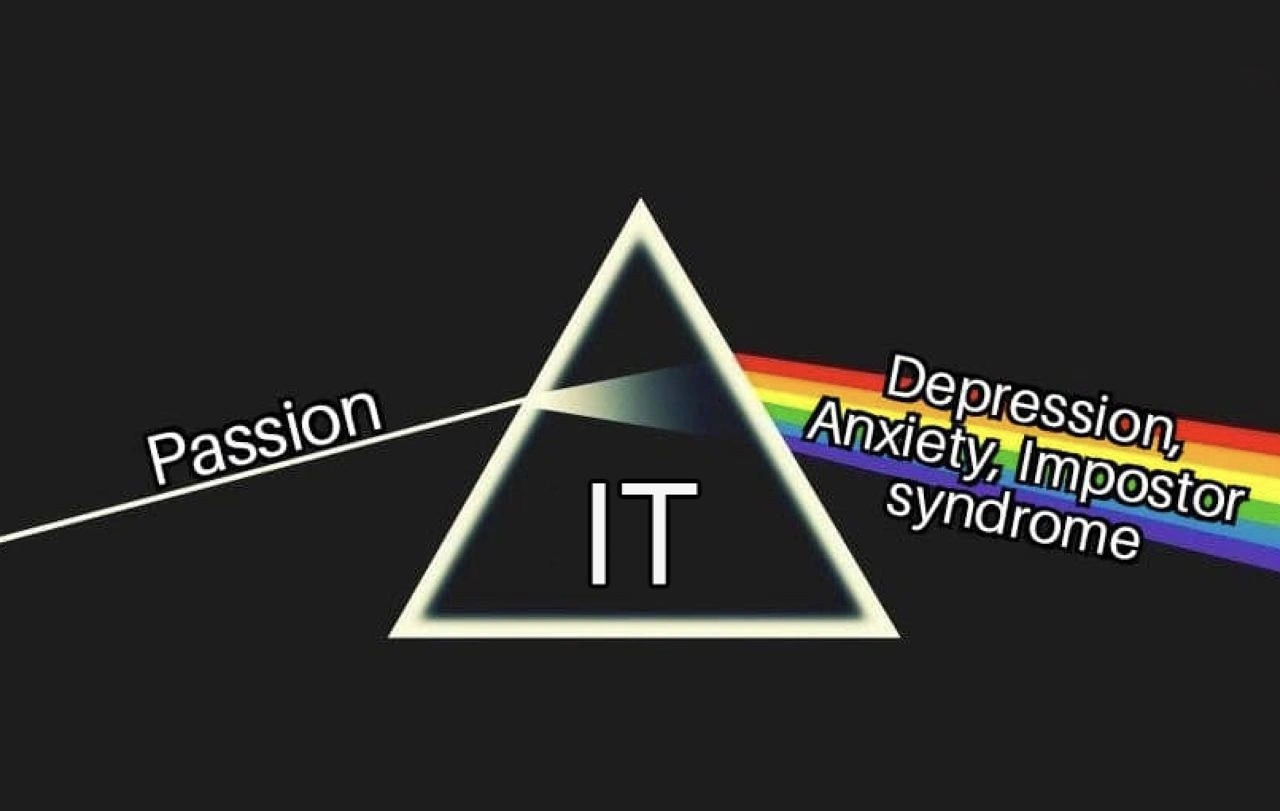
In simpler terms, this meme is showing how working in IT (Information Technology) can transform someone’s passion for tech into feelings of depression, anxiety, and impostor syndrome. It’s using the imagery of a prism – a triangle glass object that separates white light into a rainbow – to make a point about the IT career journey. On the left, you have that bright beam labeled “Passion”. That’s the enthusiasm a lot of developers start with: a genuine love for coding and technology. On the right, instead of a happy rainbow, we see words like “Depression, Anxiety, Impostor syndrome” spread out in different colors. Those represent common negative experiences that many developers end up facing after some time in the industry. The meme essentially says: “You went in with excitement, and out comes a bunch of mental health struggles.”
Let’s unpack the key terms and ideas, especially for someone early in their tech career:
Passion: In this context, passion means a strong enthusiasm or love for programming and technology. Many people enter the tech field because they genuinely enjoy tinkering with code, building apps, or learning new frameworks. You might relate if you spent late nights as a student happily coding up personal projects or if you couldn’t wait to turn your hobby into a job. That pure excitement is the white beam going into the prism – all that motivation and drive you bring at the start.
IT (Information Technology) Industry: This is the overall field of working with computers, software, and systems. When the meme labels the prism “IT”, it’s referring to the work environment and culture of tech companies. Think of the prism as the entire experience of having a job in tech: the projects, the companies, the teams, the deadlines, the late-night debugging sessions – all of that. Just like a physical prism changes light, the IT work environment can change how your passion feels over time. A prism in real life doesn’t destroy light; it bends and splits it. Similarly, working in IT doesn’t kill your passion outright, but it can bend and split your feelings into different directions. Some of those directions, unfortunately, are negative if the environment is stressful. This is a commentary on corporate culture in tech – sometimes fast-paced and high-pressure – which can affect your mental state.
Depression: Here it means a deep, ongoing sadness or loss of interest. In a tech job, someone might start feeling depressed if they’re overworked or if they’re disappointed by how things are going. For example, imagine a developer who once loved coding games but now, after months of crunching under pressure, feels too exhausted to enjoy coding at all. Depression can show up as feeling very down, hopeless, or numb about your work. It’s depicted as one color of the rainbow coming out of the prism, meaning it’s one possible outcome of stress in the IT field. This lines up with the tag DeveloperBurnout – burnout is often connected with feelings of depression and extreme fatigue. Burnout in tech happens when someone has been stressed and working too hard for too long, to the point where they lose their energy and motivation.
Anxiety: This means intense worry or fear. In the developer world, anxiety might come from tight deadlines (“Will I finish this feature in time?”), production issues (“What if the app crashes after my update?”), or just the fast pace of change (“I feel like I can’t keep up with all these new libraries and tools”). A junior developer might get anxious the night before a big deployment or a presentation, imagining everything that could go wrong. Many developers also feel anxiety about job performance – like worrying they’re not fixing bugs fast enough or that they’ll be asked a question they can’t answer in a meeting. The meme includes anxiety as another color in that spectrum, showing it’s a common reaction to the pressures in IT jobs. When you see the tag StressManagementInTech, it’s about ways to handle this kind of anxiety and stress in the technology workplace. Companies often encourage things like taking breaks, doing meditation, or having hobbies outside of work as ways to manage stress (though the effectiveness varies).
Impostor Syndrome: This is a specific term for a kind of self-doubt. If someone has impostor syndrome, they feel like they are an impostor or fraud – as if they don’t really know what they’re doing, and it’s only a matter of time before others “find out.” In tech, it happens a lot because there’s always more to learn and always someone who seems to know more. A junior developer might look at a veteran coder who effortlessly debugs a complex issue and think, “I’ll never be that good, I don’t belong here.” Even senior developers can feel this way about different skills (“Everyone says I’m the database expert, but I just Google things—I’m not a real expert.”). Impostor syndrome is that voice that says “I’m not good enough to be here, I just got lucky.” The meme lists it as one of the outcomes because many developers, after some time in the industry, start experiencing this feeling. Initially, you might have been confident in your coding ability (coming out of college or bootcamp feeling great), but working alongside lots of talented people and facing tough problems can make you question yourself. The tag SelfDoubt is essentially what impostor syndrome is all about. It’s very common in the developer community – so common that there are countless blog posts and conference talks about it, reassuring people that if you feel like a fraud sometimes, you’re not alone.
So, basically, raw passion enters, stressful tech life happens, and mental health challenges exit. The meme humorously calls out a serious issue: the toll that a tough work environment can take on a person. Many developers resonate with this because they remember the arc of their own feelings. For instance, you might recall your first year on the job: you joined super pumped to code cool stuff, but after a while you find yourself really tired, stressed about meeting expectations, and wondering if you’re actually any good at your job. Maybe you pulled a few all-nighters to fix urgent bugs or spent weekends learning yet another JavaScript framework, and you started feeling the burnout.
The reason this image hits home is that it’s very relatable in the tech community. It channels the vibe of posts you see on developer forums or chats, where people share memes about drinking too much coffee, being always tired, or jokingly saying “works on my machine” to cope with frustration. Under the humor, there’s a genuine conversation about mental health in the developer world. Tags like MentalHealthInTech and DeveloperFrustration exist because a lot of folks are trying to highlight that developers are humans, not coding machines, and they need balance to stay healthy.
Another thing to note is the clever use of the Pink Floyd prism parody. The original Dark Side of the Moon album cover is a cultural icon – even if you haven’t heard the album, you’ve likely seen that prism and rainbow image on T-shirts or posters. By referencing it, the meme taps into a visual that many people recognize. It’s a bit of geek culture crossover: classic rock meets tech life. The album itself delved into themes of time, work, money, and mental strain (for example, one track is literally about the pressures that can drive someone insane). Using that imagery for IT is a nod that being in this field can really affect your mindset over time. So if you’re a junior dev who didn’t catch the reference, now you know – it’s linking a famous representation of refracted light to the idea of a mental health spectrum in an IT career. The phrase “dark side of IT” is a play on “Dark Side of the Moon”, suggesting that behind the glamorous surface of tech (cool projects, innovation, good salaries) there is a darker side (stress, burnout, crisis of confidence).
For a newer developer or someone just getting into tech, the meme might also serve as a tongue-in-cheek warning. It’s basically the old-timers saying, “We know you love this now, but be careful – this industry can be tough on you.” It resonates with categories like DeveloperExperience_DX, because it’s commenting on what the experience of being a developer can involve beyond just writing code. The reality check here is: Yes, coding is awesome, but the job around coding can be very demanding. Knowing about stress management and setting boundaries becomes important. A lot of companies nowadays at least talk about avoiding burnout – they’ll mention work-life balance, offer mental health days, etc. – precisely because losing passionate developers to burnout is a real problem. This meme wouldn’t be funny if it wasn’t true to some extent. The fact so many devs share and laugh at it shows that, unfortunately, many have felt their passion dimming and had to contend with depression, anxiety, or impostor syndrome along the way.
In summary, the meme uses a bit of art, humor, and stark labeling to convey a message: Working in IT might change you, and not always in a happy way. For a junior dev, it’s useful to recognize those words (“burnout”, “impostor syndrome”, etc.) because you’ll likely hear them in discussions about developer life. And importantly, the reason it’s shared as humor is to remind everyone – you’re not alone if you experience this transformation. Nearly every developer has moments of frustration or self-doubt. The trick is to manage those feelings, seek support (talk to peers or mentors), and remember to take care of your mental health as seriously as you do your code. After all, no one wants their passion for tech to go completely dark.
Level 3: The Dark Side of IT
Think of this meme as a sardonic tribute to Pink Floyd’s classic album cover – the prism on The Dark Side of the Moon. Only here, the album is titled “Dark Side of IT”. A thin beam labeled “Passion” enters the left side of a glowing triangle marked IT. Out the other side, a rainbow spills forth, but instead of cheerful colors it’s labeled “Depression, Anxiety, Impostor syndrome.” It’s a heavy dose of developer humor: we’re using an iconic rock image to sum up the emotional trajectory of an IT career. The white light of youthful enthusiasm goes into the corporate prism, and a spectrum of burnout comes out. It’s funny in the darkest, most relatable way – a joke you laugh at with a knowing wince.
On a technical note (yes, we’re even getting technical about humor), a prism splits a beam of white light into its component colors by refraction. In physics terms, the prism’s material has a refractive index that bends different wavelengths differently, causing a nice tidy color separation. Now apply that metaphor to the tech industry: your raw passion is a unified beam of optimism, containing all the “colors” of motivation, creativity, and idealism. But the IT industry (the prism) has a certain “refractive index” of corporate culture that bends each part of your spirit in different harsh ways. By the time your passion emerges on the other side, it’s been split into stress, self-doubt, and sadness at varying wavelengths. In plainer terms, the environment of on-call pages at 3 AM, endless feature backlogs, and high-pressure deadlines will diffract even the strongest enthusiasm into a whole spread of psychological side-effects. It’s as if the prism is programmed to output a spectrum of burnout for every ray of hope that enters. Feature in, bug out Passion in, depression out.
Why do seasoned developers smirk (or groan) at this image? Because it hits on an all-too-familiar trajectory in tech careers. Many of us started out as bright-eyed coders, the kind who code for fun at midnight or passionately debate tabs vs spaces. The industry actively recruits passion – job listings say “seeking passionate self-starter,” and new hires dive in eager to make an impact. But once inside the IT prism, that passion often gets exploited and overextended. You volunteer for just one more project (because you’re excited), you agree to the crunch time to meet a release (because you care), you stay late refactoring code (because it matters to you). Fast-forward a year: you’re pulling 12-hour days, juggling a microservice architecture that feels held together by duct tape, and waking up in cold sweats over whether you left a NULL check out in yesterday’s hotfix. The humor of the meme comes from this shared recognition – that feeling when the DeveloperExperience (DX) promised to be all creativity and cutting-edge tech, but the reality is a pipeline from Passion to Burnout. It’s laughing at the moment you realize your dream job has an unexpected “dark side”, much like the hidden face of the moon.
This meme names the three big emotional outputs explicitly: Depression, Anxiety, Impostor syndrome. These are practically the greatest hits on the Mental Health in Tech charts. The fact that they’re shown as a rainbow (something typically bright and positive) is a grim little joke by itself – a rainbow of developer frustration and self-doubt. Let’s break them down from a senior dev’s perspective:
Depression: In a tech context, this often manifests as classic developer burnout. It’s that drained, exhausted, “I can’t write another line of code and nothing I do matters” feeling. After your 4th consecutive weekend dealing with production outages (because, of course, the biggest incident waits for Friday night), you start feeling a deep fatigue and cynicism. Features you were excited about yesterday now just feel like tickets to close. The meme hits the nail on the head – a lot of us have watched our enthusiasm fade into a kind of pervasive gloom. It’s not literally saying every IT job leads to clinical depression, but the mood is unmistakable. We joke that our IDEs have a dark theme not just for our eyes, but for our souls. DeveloperBurnout is real enough that even big companies now acknowledge it – though usually after half their senior staff quits or takes stress leave.
Anxiety: Tech is fast-paced and stressful. There’s constant pressure to not break things (while simultaneously moving fast – fun contradiction there). Deploying to production can feel like diffusing a bomb: one wrong move and you’ve taken down an app with millions of users. Junior devs often discover the joy of the 2 AM PagerDuty alert that spikes your heart rate. And let’s not forget the anxiety of always needing to upskill – today’s hot framework is tomorrow’s legacy code. You’re on a hamster wheel trying to keep your knowledge relevant. This constant high-alert state breeds anxiety: you worry about missing something critical, about that code review critique, about being seen as the one who doesn’t get it. It’s practically an occupational hazard to develop a minor panic reflex whenever someone says, “We need to talk about the last release.” The meme visualizes this as part of the rainbow because DeveloperFrustration and worry beam out of that prism right alongside the sadness. In meetings we might joke “it’s fine, everything’s fine” while stress-eating our catered lunch, but the underlying pressure is real.
Impostor syndrome: Ah yes, the eternal companion of tech workers. This is the part of the spectrum labeled with self-doubt. Impostor syndrome in IT is rampant – it’s that nagging voice that says “I’m not actually good at this, and it’s just a matter of time before everyone finds out.” Ironically, the more you learn, the more you realize you don’t know. A newbie might think a senior knows everything; the senior knows there’s an infinite amount she doesn’t know. The meme’s joke here is that a passionate person enters IT brimming with confidence from, say, acing their coding bootcamp, and ends up questioning if they even belong in the field. Picture a developer who used to proudly push code now quietly panicking that their solution is probably wrong because some Stack Overflow post had a more elegant approach. That self-doubt is common even among experienced devs – we just don’t talk about it until someone breaks the ice. (It’s almost a rite of passage to eventually realize most of your peers feel the exact same fraud complex). The prism metaphor fits because the industry has a way of exposing every flaw in your knowledge, splitting off each insecurity into its own distinct neon color. One minute you’re the “whiz kid” new hire, the next you’re afraid to ask a question about a tool everyone else seems to know. The joke (tinged with pain) is that IT will humbly and efficiently convert initial overconfidence into a vibrant panorama of “I have no idea what I’m doing.”
The fact that this parody uses Pink Floyd’s prism isn’t just random nostalgia; it’s thematically spot-on. That album (Dark Side of the Moon, 1973) is famous for exploring themes of pressure and mental breakdown. (Yes, our meme author knew their classic rock – and possibly felt “Comfortably Numb” by their job). In the original cover, the prism transforms a simple light into all the colors of the rainbow, symbolizing complexity emerging from simplicity. Here, the “dark side of IT” gives that symbolism a twist: what emerges are the multifaceted mental health challenges developers face. It’s poking fun at how an IT career, which outsiders might view as a straightforward happy path to cool jobs and high salaries, actually hides a prism of it_career_disillusionment. Internally, a lot of devs share war stories about the moment their passion started feeling like a burden. This meme resonates because it’s basically a war story in one image – the kind of candid truth you typically only hear after a few drinks at the post-release “celebration” (where half the team is too tired to actually celebrate).
From a broader perspective, the humor lands due to a collective “we’ve all been there” sentiment. That transformation depicted isn’t a one-off – it’s almost an industry cliché at this point. We see it all the time: bright young developers slowly ground down by overwork, unrealistic deadlines, chaotic management, or the relentless pace of tech change. It’s a pipeline problem – call it the passion-to-burnout pipeline. Everyone enters with bright ideas; many exit (if they don’t literally quit) feeling jaded and worn. It’s frankly part of the corporate culture problem in tech: companies praise passion but often reward overcommitment. Hustle culture says if you love your job, you’ll gladly let it consume you. And some folks only realize too late that they’ve sacrificed their mental well-being on the altar of a sprint backlog. The meme shines a light (or rather, refracts one) on this exact issue.
What keeps this from being just sad and makes it darkly funny is the accuracy of the imagery. It’s an exaggeration, sure – not every IT job will chew you up and spit out a rainbow of neuroses. But it happens enough that seeing it summarized so bluntly is cathartic. It’s the type of joke you chuckle at while muttering “too real.” In the developer community, humor like this circulates as a coping mechanism. We laugh at memes about deploys on Friday or endless meetings or in this case, creeping depression, because if we didn’t laugh, we might cry. This image in particular says: “Hey, remember when you LOVED technology? And now you have to bribe yourself to get out of bed and log into Jira? Yeah, me too.” It validates the experience by satirizing it. It also subtly encourages conversation about MentalHealthInTech – by turning it into a joke, it becomes easier to acknowledge openly. Behind the prism graphic lies a serious conversation about DeveloperBurnout, SelfDoubt, and how to balance passion with self-care. But the cynical veteran in all of us can’t help but smirk: “Welcome to the dark side, we have (bitter) cookies.”
Description
This meme uses the iconic album art from Pink Floyd's 'The Dark Side of the Moon' to create a commentary on the tech industry. A single beam of light labeled 'Passion' enters a triangular prism, which has 'IT' written in the center. Instead of just a rainbow, the light emerges as a spectrum of colors labeled with 'Depression, Anxiety, Impostor syndrome'. The visual metaphor is clear and poignant, suggesting that the intense, high-pressure environment of the IT field can transform a developer's initial passion into a range of mental health challenges. For senior developers, this is a deeply relatable piece of dark humor. It acknowledges the unseen struggles that often accompany a long career in tech, such as burnout and the constant pressure to keep up, making it a cynical but validating observation on the industry's culture

Comments
11Comment deleted
In IT, the spectrum of light you produce isn't measured in wavelengths, but in the number of JIRA tickets it takes to question your life choices
After 20 years I’ve confirmed Snell’s Law for engineers: passion enters the IT prism at 42°, exits as a full spectrum of depression, anxiety, and impostor syndrome - refraction coefficient proportional to your pager rotation
After 15 years in tech, I've realized the real distributed system isn't our microservices architecture - it's how we've distributed our mental health issues across depression shards, anxiety replicas, and impostor syndrome load balancers, all while maintaining five nines of dysfunction
Ah yes, the classic IT career trajectory: you enter with passion for elegant algorithms and clean architecture, but the prism of enterprise reality refracts it into a full spectrum of DSM-5 diagnoses. It's like Pink Floyd predicted our industry - except instead of 'Money' on side B, we got 'Technical Debt' and 'Legacy COBOL Systems.' The real dark side of the moon is realizing your passion project became a microservices nightmare maintained by three different offshore teams across five time zones
IT's ultimate refactor: passion in, emerges as sharded emotional microservices - all scaling independently into failure
Our org ships a non‑linear prism: feed in passion at onboarding, and after reorg refractions, Jira diffraction, and 3am pager harmonics, the output spectrum peaks at anxiety with a loud impostor‑syndrome overtone
IT is a prism: shine passion through a few years of on-call, OKR gymnastics, and “blameless” postmortems, and out comes a neat spectrum of anxiety, depression, and impostor syndrome - Dark Side of Prod
IMPOSTER SYNDROME? Comment deleted
Burnout too Comment deleted
Amogus Comment deleted
Definitely burn out too Comment deleted