Skip to content
DevMeme
6140 of 7435
Mathematical Papacy: He Understands Sin and Cos
Mathematics Post #6735, on May 10, 2025 in TG

Mathematical Papacy: He Understands Sin and Cos

Why is this Mathematics meme funny?

Level 1: Playing with Words

This meme is funny because it’s playing with the word “sin.” Imagine someone using a word that means one thing in everyday life but also means something else in math class – that’s what’s happening here. The Pope is a religious leader who teaches about right and wrong, so he definitely understands what a “sin” is (like doing something bad). Now, the joke adds a silly twist: the Pope went to school for math, so he also understands “cosine” (a math idea usually written as “cos” for short).

Think of it like a double meaning joke. It’s as if we said, “This firefighter isn’t just great at fighting fires – he’s also great at Street Fighter (the video game)!” The word “fighter” appears twice but means two different things each time. Here, the word “sin” first means a bad deed, then the second time it secretly means the math term “sine.” By saying “he understands cos,” we hint that “oh, by the way, we’re talking about math now!” Since sine and cosine always come as a pair in math, mentioning cos (cosine) is a wink that the Pope knows his math stuff.

In simple terms: it’s funny because one little word change turns a serious statement into a nerdy math joke. We expect the Pope to know about “sin” (being bad), but it’s cute and surprising to think he knows about “sine and cosine” (math waves) too. It’s the kind of joke where you go, “Oh! I see what they did there!” and you might chuckle. It’s taking a serious topic (the Pope and sins) and giving it a harmless nerdy twist (math) – which makes it playful and light-hearted. Even if you’re not a math expert, just knowing sine and cosine are math terms is enough to get the joke and smile at how cleverly the words were used.

Level 2: Sine & Cosine 101

Let’s break down the joke in simpler technical terms. The humor here is a wordplay pun based on the words “sin” and “cos.” To appreciate it, you need to know what those words mean in each context:

  • Sin (religious concept): In everyday language and religion, sin means a bad or immoral action. In the Catholic Church (which the Pope leads), understanding sin is crucial — it’s the Pope’s job to guide people away from sin and forgive sins. So normally, saying “the Pope understands sin” just means he knows a lot about moral right and wrong. This is a very serious, spiritual meaning of the word sin.

  • Sin (mathematical function): In mathematics, especially in trigonometry, sin is short for sine, a fundamental function that relates to angles in a triangle or points on a circle. If you’ve taken a math class that covered triangles or waves, you might recall sine. For example, in a right triangle, sin(θ) = opposite side / hypotenuse. There’s also a graph of sine that makes a wavy pattern. Sine is often written as sin on calculators and in programming (like Math.sin() in many languages). It’s a pure math term, completely unrelated to doing something wrong.

  • Cos (mathematical function): Cos is short for cosine, the partner function to sine. Cosine is another trigonometric function where cos(θ) = adjacent side / hypotenuse in a right triangle. Cosine’s graph is also a wave, just phase-shifted from sine’s graph (they’re like twin waves starting at different points). In formulas and code, cosine is written as cos. Sine and cosine are a famous pair — they come up together all the time in math. For instance, a key identity in trigonometry is $\sin^2 \theta + \cos^2 \theta = 1$. This essentially says if you take the sine and cosine of the same angle, square them and add them, you get 1. They’re like two sides of the same coin in trigonometry.

Now, why is it funny to mention sin and cos with the Pope? The tweet’s first line gives context: “The new Pope has a degree in mathematics from Villanova University.” This tells us the Pope isn’t just a religious figure; he’s also academically trained in math. That’s a bit unusual and interesting on its own, but it’s setting us up for the second line.

The second line says: “This guy doesn’t just understand sin. He understands cos.” Here’s what’s happening in that sentence:

  • When we start reading “This guy doesn’t just understand sin…”, at first we take it in the obvious way: the Pope understands sin (moral wrong). Of course he does — that’s part of being Pope.
  • But then the sentence continues: “…He understands cos.” This is where our brain does a double-take. “Cos” by itself isn’t a normal English word in this context. It looks like someone wrote “cos” instead of “cause” or “because.” But given the math degree context, we realize “cos” is referring to cosine. Suddenly, “sin” in the sentence isn’t about moral sin anymore, it’s about the math sine! The meaning of sin in that phrase flips from religious to mathematical, because now cos has entered the chat as cosine. The tweet is effectively saying: “The Pope doesn’t just understand sine; he also understands cosine.”

So the humor is a classic play on words. It uses the double meaning of sin and the abbreviation cos to make you think one thing and then switch to another. It’s essentially a trigonometric pun. This kind of joke is common in math memes and tech humor circles, where people enjoy jokes that require a bit of math or science knowledge. Here are the key ingredients that make it work:

  • Trigonometry knowledge: You need to know that sin and cos are linked math terms (sine and cosine). If you do, seeing “understands cos” immediately signals the math angle (pun intended!). If someone didn’t know that, they might be confused and read “cos” as a misspelling or wonder if it stands for something. But the tweet cleverly gave the math degree hint, so even if you vaguely remember sine/cosine from school, you get the hint.
  • Wordplay (pun): The word sin in English normally means something bad or a sin in the religious sense. The pun arises because “sin” (the concept of a sin) and “sin” (short for sine) are written the same. They sound the same when spoken too (mathematicians say “sine” like it’s spelled S-I-N-E, but casual reading of sin is just like the word “sin”). By using cos, which clearly belongs to math talk, the tweet forces you to reinterpret sin in the math way. It’s a bait-and-switch with meanings.
  • Context mixing: It’s also funny because it mixes two very different domains: religion and advanced math. The Pope is usually associated with theology, prayers, and maybe understanding sin in terms of human behavior. It’s unexpected (and a bit giggle-worthy) to imagine the Pope also using sine and cosine formulas, like calculating angles or drawing a sine wave. That contrast between holy duties and nerdy math is inherently humorous. It’s a form of academic humor because it takes an academic subject (mathematics) and puts it into a real-life scenario (the Pope’s life) in a whimsical way.

The visual format as a tweet screenshot adds a few more contextual clues:

  • The text is in two paragraphs (with a blank line in between). On Twitter, people often break a joke into two parts: setup and punchline. The first paragraph is the setup (a straight statement about the Pope’s math degree). The second paragraph is the punchline (the sin/cos joke). Separating them gives the reader a tiny pause to wonder “Where is this going?” before delivering the twist. This formatting is common in twitter_meme jokes.
  • The user “Deedy” has a smiling profile picture and a verified badge. We don’t need to know who that is, but the verified badge and clean formatting imply it’s a tweet meant for a wide audience. Tech folks on Twitter often share quick one-liners like this when something in the news (like a new Pope’s background) sparks a clever thought.
  • The background is black (dark mode), which is a minor detail but one that many developers prefer for their interfaces. It doesn’t change the joke, but it’s almost an inside style preference – many code editors, IDEs, and apps favored by programmers default to dark themes. It subtly says, “this is a joke from someone in our tech culture.”

Let’s clarify the terms from the tags in case they’re new:

  • Trigonometry – a branch of mathematics dealing with triangles, circles, and oscillating patterns. It teaches about sine (sin), cosine (cos), and tangent (tan) functions. These functions are used in fields like engineering, physics, computer graphics, and any domain involving waves or rotations. If you ever plotted a wave or solved a triangle side, you used trigonometry.
  • Wordplay/Puns – a form of humor where you exploit the multiple meanings of a word, or words that sound alike, to make a joke. Here “sin” is the word with multiple meanings (religious vs. mathematical). It’s very much a play on words, because the sentence “understand sin” changes meaning when followed by “understands cos.”
  • Academic Humor – jokes that require some knowledge in a scholarly field (like math, science, history) to get the punchline. This meme is academic humor because you need to remember trigonometry (or at least recall “sin and cos = math stuff”) to fully appreciate it.
  • Tech Humor / HumorInTech – this signals that the joke circulates in tech communities. Many people in tech have STEM backgrounds, so math jokes like this are enjoyed and shared for a light-hearted break from coding. It’s not about programming directly, but the tech community loves a good math joke. Think of it as part of the broader geek culture that overlaps with programmers.

Finally, Villanova University – it’s mentioned as the Pope’s alma mater. Villanova is a real university in Pennsylvania, USA, known for strong programs (and incidentally it’s a Catholic-founded university). Including a specific like Villanova makes the tweet feel almost factual (maybe in this imagined scenario, a Cardinal from Villanova really became Pope). It grounds the joke in reality just enough that when the zinger about sin and cos comes, it’s delightfully absurd. It’s like the setup is sane and the punchline is silly, which often makes a joke land well.

In summary, at this level we see that the meme is doing a pun with “sin” and “cos”. It’s saying the Pope knows more than just the religious idea of sin; he knows the math sine and cosine too. If you understand those two meanings, the tweet is really funny. This is why people who remember their trigonometry got a good laugh – it’s not every day you see the Pope and trigonometric functions in one sentence!

Level 3: Trigonometric Theology

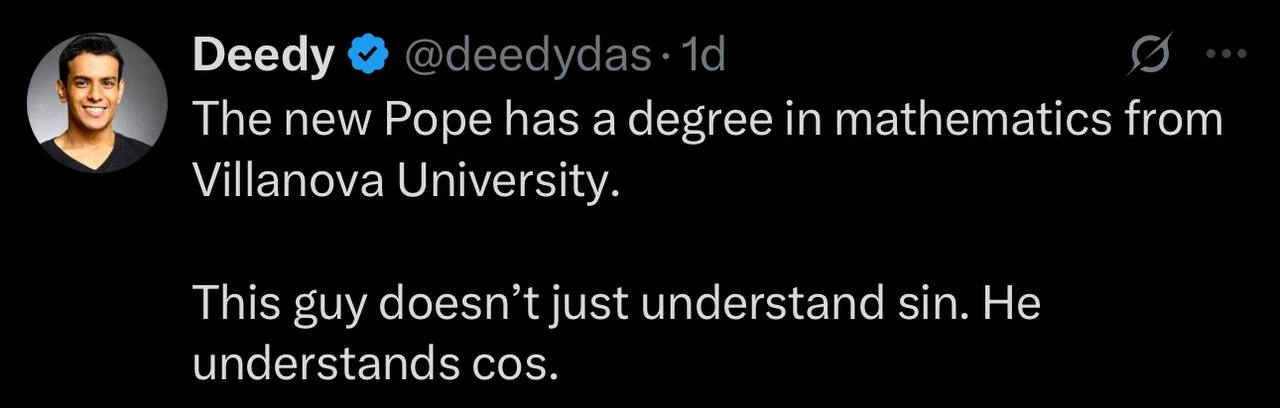
The meme is presented as a Twitter screenshot in dark mode – a familiar sight on tech Twitter. At first glance it looks like a normal tweet with a profile pic (the user @deedydas with a blue checkmark) and white text on a black background. But the content immediately dives into a clever mix of religion and mathematics:

Deedy (@deedydas · 1d):
“The new Pope has a degree in mathematics from Villanova University.
This guy doesn’t just understand sin. He understands cos.”

This punchline is a classic piece of academic humor and wordplay that makes mathematically minded developers smirk. It’s riffing on the fact that the word “sin” has two distinct meanings in two very different contexts:

  • In a religious context (especially Catholicism), sin means a moral wrongdoing – something the Pope is professionally concerned with. The Pope’s role is to understand human sins, offer guidance, and grant forgiveness. So saying “the Pope understands sin” is literally true in the theological sense – a Pope deeply understands matters of right and wrong.
  • In a mathematical context (specifically trigonometry), sin is the common abbreviation for the sine function, one of the fundamental trigonometric functions alongside cos (cosine) and tan (tangent). When someone has a degree in mathematics, they definitely understand sine (sin) and its partner cosine (cos).

The tweet brilliantly pivots on this double meaning. The first sentence sets up a surprising fact: “The new Pope has a degree in mathematics from Villanova University.” Villanova is not only a reputable university; it’s also a Catholic institution, which makes this scenario feel plausibly tongue-in-cheek. This setup primes us for a crossover between scholarly math and papal duties. The second sentence delivers the punny payoff: “This guy doesn’t just understand sin. He understands cos.” In one stroke, sin shifts from meaning “moral sin” to “sine”, and we’re expected to recognize cos as the companion math term cosine. The humor comes from the trigonometry pun hiding in plain sight as a serious statement about the Pope’s expertise. It’s the kind of joke that invokes an “aha!” moment — you realize sin wasn’t about evil at all, and cos completes the joke by referencing the next trig function in line.

For a senior developer or anyone who’s been around tech and math culture, this lands perfectly. It’s cleverly layered: on one level, it’s about a Pope with unconventional expertise (math, of all things!); on another level, it’s a linguistic trick connecting two worlds that rarely overlap. Tech humor often thrives on these inside references. Here, the inside reference is knowing that sin and cos are a paired set. The joke assumes the reader remembers enough high school or college math to instantly map “understands cos” to “masters cosine”, completing the idea that the Pope is fluent in trigonometry. The absurd visual of a Pope solving triangles or graphing a sine wave during a sermon is what makes it funny and absurd. It pokes fun at the stereotype that religious leaders only deal in spiritual matters — this Pope might just derive a cosine curve while also delivering a homily on sin!

This trigonometric theology gag resonates in developer circles because many of us have a foot in both camps of serious and nerdy. We appreciate that a single word like “sin” can be the fulcrum of a joke bridging morality and mathematics. It’s the kind of humor in tech that says, “Yes, I paid attention in math class and I have a sense of humor about it.” We’ve all seen puns where computing terms or math terms double as common words, and they tickle that geeky part of our brain. In this case, the pun also feels elegant. The tweet’s phrasing is concise and punchy, almost like a well-crafted commit message with a hidden joke. The structure — a straight-faced fact followed by a one-liner pun — is a common pattern on Twitter for maximum comedic effect.

There’s even a bit of extra charm in the details. The blue check by Deedy’s name (likely a verified tech personality or a witty developer) gives the tweet an air of authority — as if this fact about the Pope could be breaking news on tech Twitter. And the dark-mode screenshot itself speaks to developer aesthetics (we do love our dark themes). It’s easy to imagine this tweet going viral among engineers, each adding their own riff in the replies (perhaps someone quipping “He can absolve your sins and solve your sines”). The joke is light-hearted and inclusive: it doesn’t put anyone down; it just rewards you for knowing a bit of math vocabulary. In an industry where math memes and programming jokes circulate daily, a pun that ties in the Pope’s sin and the sine wave is a welcome geeky crossover.

From a senior perspective, there’s a subtle satisfaction in this humor. It hints that the new Pope is well-rounded (pun absolutely intended — since $\sin^2 \theta + \cos^2 \theta = 1$ defines a perfect circle!). A Pope who comprehends both spiritual sin and mathematical cosine is balancing faith with reason, tradition with education. Historically, many scholars and scientists were clergy, so it’s not even that far-fetched. This meme playfully echoes that history in modern form. It leaves us imagining a Pope who might drop a little calculus into his scripture interpretations. (Perhaps he’ll explain the Holy Trinity with a Venn diagram or find the cosine of making the sign of the cross! 😄)

In short, this tweet hits a sweet spot of tech humor: it’s quick, it’s smart, and it bonds those of us who remember trigonometric functions (and their notations) with a chuckle. We laugh because we get to feel “in on the joke.” It transforms a serious subject (the Pope understanding sin) into a nerdy punchline (the Pope also understands cosine) with just one extra letter. It’s a reminder that even in software engineering and IT, our broad knowledge — from religion to Math.cos() — can collide in amusing ways. And as trivial as a Twitter pun may be, there’s a tiny shared celebration of knowing that sin() and cos() are more than just concepts in a math textbook; they’re fodder for laughter in our techie corner of the internet.

Description

This image is a screenshot of a tweet from a user named Deedy (@deedydas). The tweet, set against a black background with white text, reads: 'The new Pope has a degree in mathematics from Villanova University. This guy doesn't just understand sin. He understands cos.' The humor is a clever pun that plays on the double meaning of the word 'sin.' In a religious context, 'sin' refers to a moral transgression, a concept central to the Pope's role. In mathematics, 'sin' is the abbreviation for the sine function, a fundamental concept in trigonometry, which is always paired with its counterpart, 'cos' or cosine. The joke lies in the unexpected and witty collision of these two very different worlds, theology and mathematics, appealing to an audience that appreciates nerdy, intellectual humor
Comments

13
Anonymous ★ Top Pick His first papal encyclical will likely be on the divine importance of using radians over degrees
  1. Anonymous ★ Top Pick

    His first papal encyclical will likely be on the divine importance of using radians over degrees

  2. Anonymous

    Finally - a Pope who can absolve your sins and still remind the team that sin(π) ≠ 0 because IEEE-754 doesn’t do miracles

  3. Anonymous

    Finally, someone in leadership who can calculate the exact angle of technical debt accumulation and understand that every architectural sin has a corresponding cos - though I suspect his error handling still involves a lot of prayer-based exception catching

  4. Anonymous

    When your spiritual leader has a math degree, confession becomes a matter of calculating the integral of your sins over time - though thankfully, absolution still runs in O(1) complexity regardless of your accumulated technical debt with the divine

  5. Anonymous

    Sin to cos refactor via co-function identity: this Pope just orthogonally optimized absolution

  6. Anonymous

    Math-major Pope? Great - confession backlog now solvable with an FFT: absolution in O(n log n)

  7. Anonymous

    Finally a Pope who can canonize schemas and normalize vectors - absolving sin while maximizing cosine similarity

  8. Sure Not 1y

    Thanks for domination. Assholes (Palantir + Microsoft)

    1. @deadgnom32 1y

      did bill gates and rhys did this to you

  9. @Art3m_1502 1y

    He understands that you can commit sin of gluttony by overeating pie, because sin of pi is 0

  10. @SamsonovAnton 1y

    A browser integrated in the OS already? Who could possibly need that?! PS. I use Arch, by the way.

    1. Sure Not 1y

      His lawsuit is 6 pages out 200 or something. Everything is scrubbed and now "ai" is trained on that

  11. dev_meme 1y

    So nice to post it in tg by the way

Use J and K for navigation