Skip to content
DevMeme
2977 of 7435
From Magic Wands to Dual Pistols: The Developer Project Lifecycle
ProjectManagement Post #3287, on Jun 18, 2021 in TG

From Magic Wands to Dual Pistols: The Developer Project Lifecycle

Why is this ProjectManagement meme funny?

Level 1: Excited vs Exhausted

Imagine a student at the start of a big school project versus that same student the night before the project is due. At the beginning, the student is like a young wizard: excited, neatly dressed with new school supplies and a big plan, thinking "This is going to be great!". By the end, after days of work and staying up late, the student is a total mess: exhausted, in pajamas with hair sticking out, surrounded by crumpled papers and empty snack wrappers, maybe even panicking a little while trying to finish the last bits. This meme shows a similar dramatic change with a software developer. First the developer feels fresh and magical, and later they look worn-out and desperate. It's funny because we don't expect the person to change so much, but a big project can really tire someone out. We laugh at the pictures because we recognize a bit of truth in them: starting anything is easy and exciting, but finishing something big can be chaotic and draining, turning a happy wizard into a frazzled wreck by the end.

Level 2: The Burnout Spell

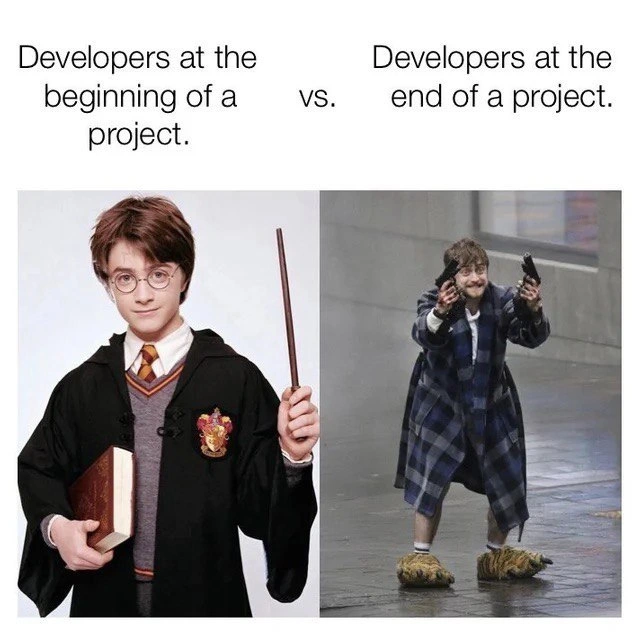
This meme compares the start and end of a software project with a funny visual metaphor. On the left side, the caption says "Developers at the beginning of a project." We see actor Daniel Radcliffe dressed as a neat young wizard (a clear Harry Potter reference). He's in a tidy school uniform robe with a house crest, holding a book and a wand, looking confident and prepared. This represents a developer at the project kickoff: optimistic, well-rested, and armed with knowledge (the "spell-book" could symbolize documentation or a project plan) and tools (the "wand" is like their coding skills or favorite framework). In software terms, at the very start of a project everyone tries to follow the ideal process. Developers might set up a clean architecture, follow the SDLC (Software Development Life Cycle) steps properly, and believe they'll build something great without major issues. The SDLC is basically the series of phases a project goes through: gathering requirements, designing the system, writing code, testing it, and finally deploying. Initially, everything feels structured — kind of like a wizard carefully following a spell recipe from a book.

Now, the right side caption says "Developers at the end of a project." It shows the same actor, but in a wildly different situation. He's barefoot except for big, fuzzy monster slippers, wearing a rumpled blue plaid bathrobe over disheveled clothes, and waving around two guns with a crazed expression. This image is actually a meme-famous scene from a movie (Daniel Radcliffe in Guns Akimbo) often used to depict someone in a state of complete chaos and panic. Here it symbolizes a developer at the finish line of the project: exhausted, stressed out, and in "fight or flight" mode. By this point, the developer likely pulled all-nighters (hence the bathrobe and slippers, as if they've been living at the office or working from home in pajamas) and is tackling emergencies. The two guns humorously stand in for urgent last-minute fixes or critical bugs that need "shooting down" rapidly. In other words, at the end of a project, developers often abandon the tidy approach and do whatever it takes to make the software work. This can include writing quick-and-dirty code patches (temporary fixes) just to meet the deadline and keep the project from crashing.

The overall joke is about developer burnout and the intense pressure of crunch time. Crunch time refers to the final stretch before a project deadline when everyone is rushing and often working extra hours to finish on time. Early in a project, the workload is steady and morale is high, but as the deadline looms, the team might realize they're behind schedule or that there are more problems than expected. Management might also add "just a few more features" or unexpected bugs might appear late in the game. This is often called scope creep – where the project's scope (the list of features and tasks) keeps growing beyond the original plan. When that happens, developers have to suddenly work much harder to catch up, often feeling frustrated as well as tired. They end up putting in long nights and weekends just to hit the deadline. This inevitably leads to developer frustration and fatigue as the team scrambles to adjust. Ironically, this extreme overtime can reduce developer productivity overall. Exhausted programmers are more likely to introduce bugs or write sloppy code. But in the heat of the deadline, teams often feel they have no choice – they have to push through and hope nothing critical breaks.

In a more technical sense, what started as a clean, well-architected codebase can turn into a messy collection of hacks by the end. Developers accrue technical debt during crunch time. Technical debt is a term for the consequences of choosing a quick, easy solution now instead of a better, more robust solution that would take longer. It's like cutting corners: you "borrow" time by skipping best practices, but you pay for it later when the quick fixes cause problems. For example, a team might skip writing unit tests or disable certain error checks just to get the product working in time. Those shortcuts make the code less stable or maintainable (that's the "debt" that will need to be paid off by fixing it properly later). The meme’s second image, with the developer looking haggard and desperate, perfectly captures the feeling of having a lot of technical debt and barely holding the project together for release.

This "beginning vs end of a project" format is very relatable in developer humor. It highlights how a project can transform people. At the start, everyone is bright-eyed and follows the textbook. By the end, it's often panic and improvisation. Deadline pressure can change how people behave: a calm, methodical coder might become a caffeine-fueled bug-squashing machine as the deadline day arrives. If you've ever done a school assignment or hackathon at the last minute, you know this feeling. Early on you plan your time calmly, but near the end you might be scribbling or coding frantically to finish — maybe in your pajamas, surrounded by empty coffee cups and chaos. The meme uses an exaggerated movie reference (wizard vs. armed maniac) to poke fun at this common experience.

In summary, the meme is saying: "Look how a single project can take a developer from feeling like a wizard to looking like a wreck by the end!" It’s funny because there’s truth to it. Developers find it relatable: that excited, prepared person at the beginning and the burnt-out person at the end are often the same individual, just at different stages of the project. The contrast is huge and silly (especially with the dramatic images), so it makes us laugh. But it also carries a gentle warning about developer reality: big projects are hard, and if we're not careful, they can run us ragged. The humor lets us commiserate and say, "Haha, yes, I've felt like that at release time," turning a tough reality into something we can joke about.


Level 3: Wizardry vs Warzone

At the beginning of a project, developers often feel like they're armed with magical powers. Consider the left image: a confident, robed figure (literally Daniel Radcliffe as a young wizard) holding a thick book (all the best practices, architecture guidelines, maybe the latest O'Reilly manual?) and a wand (their favorite new framework or programming language). This symbolizes the optimistic phase of the SDLC when everything seems possible. The team has done Sprint 0, drawn fancy UML diagrams, and believes they can architect a clean, nimble system. There's an almost Harry Potter vibe: we have spells (design patterns) and potions (automation scripts) to vanquish any bug. At this stage, phrases like "clean architecture", "100% unit test coverage", and "no shortcuts" are thrown around earnestly. It's the honeymoon phase of the project: enthusiasm is high, coffee consumption is moderate, and the code repository is pristine.

Fast forward to the end of the project (right image) and it's a radically different scene — a full-on warzone. The same developer now looks like they've been through battle: unkempt hair, disheveled clothes (heck, a bathrobe and monster slippers in a rainy alley), clutching two pistols. Those pistols hilariously represent last-ditch hotfixes or emergency scripts they're dual-wielding to shoot down critical bugs at the 11th hour. By now, the project has likely gone through several crunch time cycles. The clean spellbook (the architecture plans) has been tossed aside in favor of frantic Stack Overflow searches and dark arts quick hacks.

This meme nails the project lifecycle horror story: what started with clean code principles often ends with technical debt and duct-tape solutions. Why is this so funny (and painful) to experienced devs? Because we've all been there. In the beginning, you think you'll build the next scalable, maintainable system the right way. But as deadlines loom and scope creep slithers in (like a sneaky basilisk adding "just one more feature"), best-laid plans get Avada Kedavra-ed.

Real-world scenario: sprint 1 you might create a nice ServiceLayer class, modular and tested. By final sprint, you have a file literally called last_minute_fixes.py full of if/else spells to handle edge cases discovered in final QA. The codebase at project end is basically wearing a bathrobe and fuzzy slippers — comfortable for now, but not something you'd show off with pride.

Let's illustrate that transformation in code:

# Early project code (clean & confident, like a wizard's incantation)
class MagicService:
    def cast_spell(self, spell_name):
        """Follow formal magic protocols to cast a spell"""
        assert spell_name in self.spellbook
        return self.spellbook[spell_name].execute()

# End-of-project code (chaotic & desperate, like a shootout in an alley)
def cast_spell(spell_name):
    # Screw protocols, just try something and catch all errors
    try:
        result = risky_execute(spell_name)
    except Exception as e:
        print(f"Error: {e}, applying last-second patch...")
        result = fallback_fix(spell_name)  # quick patch
    return result

Notice the degeneration: early on, we had a nicely encapsulated MagicService with clear rules. By the end, it's a bare function catching any exception and patching on the fly. This is what deadline pressure does to code quality. Technical debt accumulates like empty coffee cups on a dev's desk during crunch time.

The humor hits hard because the contrast is extreme yet recognizable. The left developer is basically a Hogwarts valedictorian; the right developer looks like they've been living off cold pizza under their desk for a week. It's depicting developer burnout visualized: the bright-eyed engineer has morphed into a sleep-deprived survivor. The two guns hint at the absurd lengths we go under pressure: you might juggle two laptops or two critical JIRA tickets simultaneously, frantically firing off fixes. The monster slippers and bathrobe? That's basically the unofficial uniform of an on-call engineer at 3 AM deploying a hotfix from home.

This side-by-side is a satire of how the software development lifecycle often feels in practice. The theory says we should end a project with a polished product and sane developers if we manage everything right. In reality – the developer reality we all know – even with Agile methodologies, many projects devolve into a mini-death march near release time. It's darkly funny because it acknowledges that our industry sometimes demands magical results under non-magical conditions. When management asks for a miracle to meet an impossible deadline, developers basically go from Dumbledore to John McClane overnight.

In summary, "From eager wizard to exhausted wreck" resonates because it's true enough to sting. It’s a comedic exaggeration of a familiar journey: turning early enthusiasm into late-stage developer frustration. Any seasoned developer chuckles (or groans) at this meme thinking, "Yep, been there, done that — got the monster slippers to prove it."


Description

A two-panel 'vs.' meme comparing the state of developers at different stages of a project. The left panel, labeled 'Developers at the beginning of a project.', features a picture of a young, optimistic Harry Potter (played by Daniel Radcliffe) in his Hogwarts uniform, holding a wand and a book, looking ready and hopeful. The right panel, labeled 'Developers at the end of a project.', shows a frantic, disheveled image of Daniel Radcliffe from the film 'Guns Akimbo'. He is wearing a bathrobe over his clothes and monstrous slippers, with a crazed expression while holding two pistols. The meme humorously illustrates the dramatic shift in a developer's mindset and methods from a project's inception to its conclusion. It contrasts the initial clean, elegant, 'magical' approach to coding with the chaotic, brute-force, and often desperate measures required to meet deadlines and fix last-minute issues, symbolizing the accumulation of stress, technical debt, and burnout
Comments

7
Anonymous ★ Top Pick We start with the magic wand of a perfect architecture. We ship with two pistols: one loaded with hotfixes, the other with regret
  1. Anonymous ★ Top Pick

    We start with the magic wand of a perfect architecture. We ship with two pistols: one loaded with hotfixes, the other with regret

  2. Anonymous

    Sprint 0: drafting a pristine hexagonal architecture and whispering “Expecto Domain-Boundaries.” Release night: barefoot in prod at 3 a.m., dual-wielding curl and psql, shouting “EXPECTO ROLLBACK!” while the circuit breakers strobe like a Dark Mark

  3. Anonymous

    The real magic isn't turning lead into gold - it's convincing stakeholders that the technical debt accumulated from 'temporary workarounds' won't require a complete rewrite in six months, while simultaneously maintaining the illusion that your microservices architecture wasn't just an elaborate way to turn one problem into seventeen distributed problems

  4. Anonymous

    This perfectly captures the journey from 'We'll use clean architecture, TDD, and proper documentation' to 'I've got console.log() in one hand and Stack Overflow in the other, and I'm not afraid to use either.' By the end, you're not debugging code anymore - you're performing digital exorcisms at 3 AM while your test coverage weeps in the corner

  5. Anonymous

    Starts with 'microservices and CI/CD utopia,' ends dual-wielding 'kubectl delete pod --all' in prod

  6. Anonymous

    Kickoff: wands, clean diagrams, type safety. Go-live: bathrobe ops, dual-wielding pagers and bash one-liners, discovering our microservices are just a distributed monolith with better PR

  7. Anonymous

    Kickoff promises hexagonal services, TDD, and trunk‑based dev; GA ships a monolith guarded by three feature flags, a cron watchdog that pets Redis, and a Slack war‑room named temp_final_final

Use J and K for navigation