Skip to content
DevMeme
2978 of 7435
Developer Ergonomics: Painful Coding vs. Joyful Gaming
MentalHealth Post #3288, on Jun 18, 2021 in TG

Developer Ergonomics: Painful Coding vs. Joyful Gaming

Why is this MentalHealth meme funny?

Level 1: Work vs Play

Imagine you have some homework or chores that make you say, “Ugh, I’m so tired, my back hurts, I can’t do this anymore.” Sitting at your desk doing schoolwork feels like it takes forever and your body starts aching. That’s like the first part of the meme: the programmer is doing his work (coding) and he’s all hunched over and complaining because he’s uncomfortable and exhausted. Now imagine the minute you finish your homework, you go to play your favorite video game. Suddenly you’re full of energy and could sit there having fun for hours! All the tiredness magically disappears when you’re doing something you really enjoy. That’s the second part of the meme: the same programmer starts playing a game and now he’s smiling, giving a thumbs-up, and saying silly happy things like “much wow!” (which is just a goofy way to say “this is awesome!” from an old dog meme).

So basically, this funny picture is showing the big difference between work and play. When the man is working on the computer, he’s miserable and his back hurts. When he’s playing on the computer, he feels great and excited. It’s poking fun at how people (especially computer programmers) often complain about sitting and working, but have no problem sitting just as long when it’s for fun. It’s like saying: when you love what you’re doing, even if it’s the same activity, it doesn’t feel like pain at all. Just like a kid might groan carrying a heavy school backpack but happily lug an even heavier toy or game console around – the task makes all the difference. The meme makes us laugh because we recognize a bit of ourselves in it: we all have moments where we go from “I can’t take it anymore” to “actually, this is great!” just by switching from work to play.

Level 2: Work Mode vs Gamer Mode

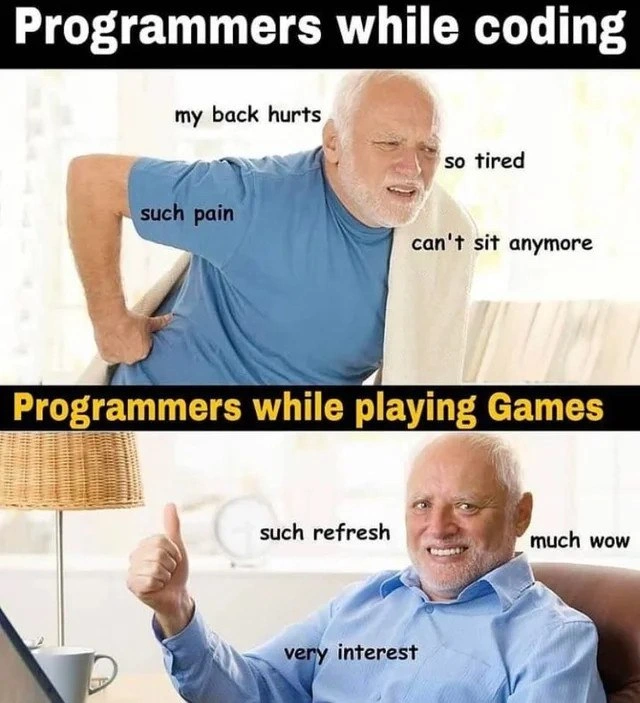
The meme is split into two scenes showing the same person in two different modes. In the top panel, it says “Programmers while coding” and shows the man looking tired and in pain. He’s even holding his lower back like it hurts a lot. Little captions around him say things like “my back hurts” and “can’t sit anymore.” This is a common developer lifestyle scenario: coding involves sitting at a desk (or here, slouching on a couch) for long periods, and it often leads to back pain or other ergonomic issues. Ergonomics means designing your workplace to fit your body’s needs – like using a good chair, keeping your monitor at eye level, and taking breaks so you don’t strain anything. When those needs aren’t met, you get aches and pains. New programmers (and even experienced ones) quickly discover that an 8+ hour coding session can make your shoulders stiff and your lower back ache. It’s a real DeveloperPainPoint: the physical side of programming. That’s why many companies invest in comfy chairs, wrist-friendly keyboards, and standing desks as part of improving the DeveloperExperience (DX) for their team – happy, pain-free developers are more productive. Developer Productivity isn’t just about writing code faster; it’s also about not being distracted by a throbbing neck or a cramped wrist. In the meme’s first panel, our developer is clearly not productive anymore – he’s exhausted and physically uncomfortable (“so tired”, he says). This could even hint at DeveloperBurnout, a state of being completely drained and over it, which often includes mental and physical fatigue from overwork.

Now look at the bottom panel labeled “Programmers while playing Games.” Suddenly the same man is at a desk, smiling wide and giving a thumbs-up sign. The captions around him switch to a playful, meme-y tone: “such refresh”, “much wow”, “very interest.” If you’ve been on the internet in the last decade, you might recognize this quirky speech as the doge language style – an intentionally broken English phrase format made famous by the Doge meme (where a Shiba Inu dog’s inner monologue is written in Comic Sans font, saying things like “such amaze, much wow”). It’s a part of internet MemeCulture and GamingCulture, often used jokingly to express delight or enthusiasm. So, in this second scene, the programmer is acting like a happy gamer, using silly Doge-like phrases to show he’s having a great time. The joke here is obvious and very relatable humor for anyone in tech: that same programmer who was moaning in pain while working can then spend even more hours sitting down to play video games and feel perfectly fine, even energized. We’ve flipped from work mode to gamer mode.

This contrast resonates with a lot of developers. Many programmers are also passionate gamers – it’s a big part of developer lifestyle and GamingCulture overlap. After a long day of coding (which is mentally demanding “computer work”), a developer might relax by… doing more computer stuff, like gaming or personal coding projects. It sounds ironic, but the key difference is mental state. Coding on the job can be stressful or tedious, which makes you hyper-aware of discomfort. On the other hand, playing a game is fun and voluntary, so you might ignore the discomfort. The meme’s text “such refresh, much wow, very interest” implies that gaming feels refreshing and fascinating to our tired programmer. He’s probably still sitting in a chair staring at a screen, but because he’s enjoying the video game, he’s not complaining “my back hurts” anymore. In fact, he’s jokingly acting like everything is amazing. This touches on a bit of mental health wisdom: doing activities you enjoy can actually reduce stress and even make you forget minor pains for a while. It’s like how you might forget you were hungry when you’re playing an exciting game or sport. The excitement and engagement offer a mental break from the day’s fatigue.

Let’s break down some terms and context from the meme and tags:

  • Back pain: Physical discomfort in your spine/lower back. Often caused by poor posture or sitting too long. In coding, you get this if you don’t sit right or skip breaks. In the meme, the man literally holds his back, showing this pain.
  • Ergonomic issues: Problems that come from a workspace that isn’t set up for comfort. For example, a monitor too low/high can hurt your neck, a non-supportive chair can strain your back. Ergonomic issues are common in programming jobs, so devs are encouraged to adjust their setup (get a good chair, maybe use a standing desk, keep wrists straight while typing) to prevent injuries like carpal tunnel or chronic back aches.
  • Coding vs gaming: Both involve sitting at a computer using a keyboard/mouse. But “coding” usually means writing software (which is a job), and “gaming” means playing computer or video games (which is entertainment). The meme compares these two activities side by side.
  • DeveloperExperience (DX): This usually refers to what it’s like for developers to use certain tools or APIs, but here we can also interpret it as the overall experience of being a developer. That includes the day-to-day comfort, environment, and feelings a developer has. A good DX in an office might mean having dual monitors, a fast computer, and a comfy setup, not just good software tools.
  • Developer Productivity: How efficiently a developer can get work done. Pain or tiredness will decrease productivity because it’s hard to focus when your back is throbbing. Conversely, feeling energized (like our gaming programmer) can increase your focus (though in the meme he’s focusing on a game, not coding tasks).
  • DeveloperBurnout: A state of extreme exhaustion (emotional, mental, and physical) caused by prolonged stress or overwork. When the meme’s first panel says “so tired” and “such pain,” it hints the programmer might be burned out or at least very worn down from coding. Burnout can make you feel like you can’t continue your work anymore (just like “can’t sit anymore” because he’s had enough).
  • GamingCulture: The habits, language, and community around gamers. The thumbs-up in the second panel along with the Doge phrases show a classic gamer’s celebratory attitude. Phrases like “much wow” are part of internet and gamer slang indicating excitement or approval in a humorously exaggerated way.
  • RelatableDeveloperExperience: The meme is something many developers find relatable (they see themselves in it). It’s common in tech humor to poke fun at these shared experiences – here being the contradiction in behavior between work and free time.
  • MemeCulture: The way memes (funny images/text that go viral) are used and remixed among communities. This meme actually mashes up a couple of meme references: the top text style (white bold on black) is a common meme format for labeling scenes, the man is a known meme face (“Hide the Pain Harold”), and the captions in the second panel use the Doge meme style. It’s a meme about programmers that’s built from other meme building blocks, which is very meta and common in meme culture.

In summary, the meme humorously compares work vs play for a programmer in a very visual way. It defines a clear before-and-after: coding = tired and sore, gaming = happy and recharged. It’s poking fun at the almost childlike irony of it – how developers (and let’s be honest, lots of us) might complain about being exhausted from work, but then enthusiastically stay up late doing essentially the same thing (sitting at a computer), because now it’s a game. It’s both funny and a gentle reminder: if we can find a bit of that “much wow” energy in our work or take better care of ourselves while working, maybe we won’t be so beat by the end of the day. And if not, well, at least there are video games to save the night!

Level 3: Ergonomic Debt

In the first panel, we see a programmer in obvious discomfort – hand on his back, grimacing. This isn’t just slapstick; it’s commenting on ergonomic neglect in tech culture. Many developers rack up an ergonomic debt over years of slouching at their desks, much like accumulating technical debt in a codebase. Just as quick-and-dirty code leads to bugs later, poor posture leads to cumulative back pain and health issues. Here the developer’s DeveloperExperience is literally painful: his workstation (a sofa in the photo, notably not a proper desk) is doing him no favors. Hunching over a laptop on a couch is a textbook example of an anti-pattern for physical health. The meme captures a common DeveloperPainPoint – after hours of coding, everything hurts. Neck stiff, lower back screaming, eyes burning from the screen. It nails that “I can’t sit anymore” feeling after wrestling with code all day. Every senior dev knows that ironically familiar agony of a late-night coding session where your code is compiling but your spine is segfaulting.

Contrast that with panel two: the same developer, same chair-bound posture, but now he’s grinning and giving a thumbs-up while gaming. Suddenly our tired coder has unlimited stamina! This highlights a paradox in developer lifestyle: the context switch from “work” to “play” somehow replenishes energy. Technically nothing has changed physically – his posture might even be identical – but mentally he’s gone from debugging mode to gaming mode. It’s the same screen time, yet one scenario drains him and the other sustains him. Why? Part of the answer lies in cognitive state and flow. In coding, especially under deadline or debugging gnarly legacy code, stress and frustration amplify every ache (// WHY is this bug still not fixed? cringe as back spasms). In gaming, the challenge is voluntarily chosen; it’s fun stress. A tough boss fight might get your heart racing, but it’s eustress (positive stress) instead of distress. The brain pumps dopamine and adrenaline, chemicals that can mask fatigue and discomfort. So the programmer who couldn’t sit for one more minute while unit testing can suddenly spend two extra hours in a raid without noticing the passing time. The meme exaggerates this, but every programmer-gamer has experienced that magical second wind when fun kicks in.

There’s also a bit of DeveloperMentalHealth commentary here. Burnout in tech is real – a tired developer might be emotionally and physically exhausted by work to the point of DeveloperBurnout, but still find solace and rejuvenation in a beloved hobby like gaming. The first panel’s captions (“my back hurts”, “so tired”) echo the sighs of a burned-out dev at 7 PM. The second panel’s Doge-like captions (“such refresh”, “much wow, very interest”) mimic the joyous nonsense a giddy gamer spouts at 3 AM. This goofy doge_language_style (intentionally broken English like “much wow”) is a hallmark of MemeCulture and GamingCulture, harkening back to the classic Doge meme. It’s a tongue-in-cheek way to say the gamer side feels awesome. The use of Doge-speak here is meta-meme humor: it accentuates how refreshing gaming feels by switching to a meme dialect of pure enthusiasm. In other words, the dev’s inner monologue goes from professional whining to internet dog-goofiness once he starts having fun.

Another layer experienced meme connoisseurs will appreciate is the choice of the meme figure himself. The older man in the photos is actually a famous stock photo model affectionately known online as “Hide the Pain Harold.” He’s iconic in tech meme circles for his awkward smile that seems to conceal deep existential pain. Using Harold is a perfect fit: in panel one he’s literally clutching his aching back (literal pain on display), and in panel two he’s hiding the pain with a big grin and thumbs-up. This adds an extra wink – programmers are hiding their pain when they claim “I’m fine, just one more game!” with a smile. It’s a brilliant casting choice from MemeCulture, instantly recognizable to veteran internet users and developers who’ve seen Harold’s smile in countless Slack threads and subreddit posts. The memetic subtext is that developers might be silently suffering (from burnout or back pain) even while they outwardly act enthusiastic, whether in daily standups or in gaming sessions.

From an engineering standpoint, there’s a darkly comic trade-off under the hood: developers often invest more in their PCs and gaming rigs than in their chairs or health. We optimize our code and our GPUs, but ignore our own BIOS (backs and wrists). In software terms, we prioritize throughput (hours of activity) over latency (immediate comfort), until the “health debt” comes due. The meme implicitly points out this flawed prioritization. Many workplaces now at least offer standing desks or ergonomic keyboards as part of improving DeveloperExperience, acknowledging that comfort == productivity. But ultimately, no fancy chair can completely overcome the fact that sitting 12+ hours a day is unnatural. The human body has no optimizeForLongSitting() setting – it needs breaks. Senior devs learn (often the hard way) that you must schedule maintenance downtime for your body, not just your code. Yet, the punchline here is that the same dev complaining “can’t sit anymore” for work will voluntarily ignore that maintenance window when a new game or a coding side-project hits that flow state. The humor stings because it’s true: we’re brilliant at debugging software, hopeless at debugging our own bad habits.

Description

A two-panel meme using the 'Hide the Pain Harold' stock photo model to contrast a programmer's experience while coding versus gaming. The top panel, labeled 'Programmers while coding', shows Harold looking distressed and holding his lower back in pain. Floating text around him reads: 'my back hurts', 'such pain', 'so tired', and 'can't sit anymore'. The bottom panel, labeled 'Programmers while playing Games', depicts a happy and refreshed Harold sitting comfortably in front of a laptop, giving a thumbs-up. The text here, in a Doge-like grammar, says: 'such refresh', 'much wow', and 'very interest'. The meme humorously captures the relatable phenomenon where the physically similar act of sitting at a computer can feel excruciatingly painful during work but feel effortless and enjoyable during leisure activities like gaming. For experienced developers, it's a commentary on burnout, mental fatigue, and how motivation directly impacts the perception of physical discomfort, suggesting the 'pain' of coding is often more psychological than purely ergonomic
Comments

10
Anonymous ★ Top Pick A full day of coding is a DoS attack on the spine, but a full night of gaming is just a successful patch deployment for the soul
  1. Anonymous ★ Top Pick

    A full day of coding is a DoS attack on the spine, but a full night of gaming is just a successful patch deployment for the soul

  2. Anonymous

    My body’s a legacy monolith: in the coding namespace it throws nonstop BackPainExceptions, but the moment I deploy to the gaming namespace it silently self-heals - classic environment-parity bug

  3. Anonymous

    The same posture that causes agony during a production incident somehow becomes ergonomically perfect for a 6-hour Factorio session optimizing throughput ratios

  4. Anonymous

    The irony is that both activities involve the same chair, same posture, and same screen time - but one generates technical debt in your codebase while the other generates it in your lumbar spine. At least with gaming, the only thing crashing is your character, not your production environment at 3 AM

  5. Anonymous

    CAP theorem for devs: Coding partitions Comfort; Gaming guarantees full Availability

  6. Anonymous

    Funny how my lumbar SLA jumps to five nines as soon as Steam deploys; apparently dopamine is the only scheduler that can preempt the sprint backlog

  7. Anonymous

    Turns out my “ergonomics issue” has an SLO: under Jira load the spine hits p99 latency, but switch the event loop to 144 Hz and the backpressure mysteriously clears

  8. @armanokka 5y

    Really

  9. @adhdnigga 5y

    if (back.isInPain()) { free(back.pain())}

    1. @adhdnigga 5y

      no ;

Use J and K for navigation