The Evolution of a Developer During a Project
Why is this ProjectManagement meme funny?
Level 1: The Excited First Day vs. The Frazzled Last Day
It's like a kid on the first day of school: uniform ironed, backpack organized, every pencil sharpened, totally sure this year will be perfect. Then it's the night before the giant final project is due — same kid, now in pajamas and silly slippers, hair wild, running on snacks, frantically gluing things together at midnight. The picture is funny because it's the same person in both photos, and everyone — not just programmers — knows exactly how the neat, hopeful version turns into the wild-eyed midnight version: big plans meet real life, and real life always runs late.
Level 2: From Wand to Guns Akimbo
For those earlier in their careers, the vocabulary hiding in this image:
- Greenfield project: brand-new code with no legacy constraints — the Hogwarts-letter phase. Everything seems possible because nothing has been compromised yet. Its opposite, brownfield, is inheriting an existing system, usually mid-bathrobe.
- Crunch time: the stretch before a deadline when hours balloon and corners get cut. The right panel is what crunch looks like from outside: pajamas as workwear, hygiene as backlog.
- Technical debt: shortcuts taken to ship faster that make future changes slower. It's why the end of a project feels chaotic even when the start was disciplined — you're paying interest on every "temporary" hack from month one.
- Scope creep: features added after planning without adjusting time or staffing. It's the spell that converts panel one into panel two.
A realistic first experience of this: your team starts a project with a beautiful repo — linter configured, CI green, README pristine. Three months later you're disabling tests "temporarily" to get a release out, and the README still describes the architecture from week two. Nobody decided to become the bathrobe guy. It happens one reasonable-sounding compromise at a time, which is the actual lesson: defend the boring practices early, because by the time you need them, you'll be too busy dual-wielding hotfixes to reinstall them.
Level 3: Greenfield Optimism, Brownfield Casualty
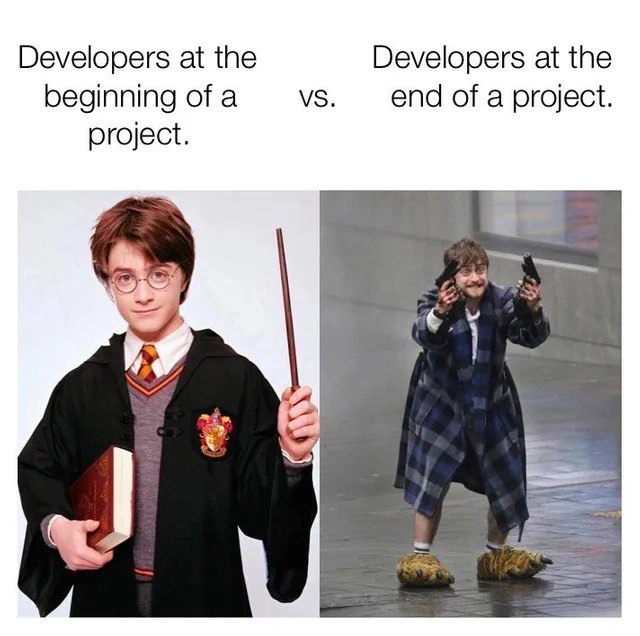
"Developers at the beginning of a project vs. Developers at the end of a project."
The left panel is first-year Harry Potter: pressed Gryffindor robes, tie knotted, glasses clean, book under one arm, wand raised like he's about to follow the syllabus exactly. The right panel is adult Daniel Radcliffe in a paparazzi-style shot from Guns Akimbo — rumpled plaid bathrobe over what's left of an outfit, fuzzy tiger slippers on a wet street, a pistol in each hand, grinning like sleep is a deprecated dependency. The same person. That's the load-bearing detail: this isn't two developers, it's one developer separated by a project lifecycle.
Anyone who's shipped knows exactly which rituals the left panel represents. Kickoff is the only phase where the codebase is perfect, because it doesn't exist. You hold the book — the architecture decision records, the style guide, the testing pyramid diagram — and you genuinely believe them. This time we'll keep modules decoupled. This time test coverage won't decay. This time estimates include buffer.
The transformation isn't caused by incompetence; it's caused by the systemic mechanics the meme compresses into one cut. Scope arrives mid-flight but the deadline doesn't move, because it was promised to a customer before engineering saw the spec. Early shortcuts ("we'll refactor after the demo") compound into technical debt with interest payments due precisely during crunch. The careful process from week one — code review, ADRs, sprint hygiene — degrades under schedule pressure in a predictable order: documentation dies first, then tests, then code review becomes "LGTM", and finally someone pushes a hotfix straight to main at 2 AM wearing, metaphorically or literally, the bathrobe. The dual-wielded pistols are the end-stage methodology: shoot at every bug simultaneously, aiming optional.
The sharper joke is that the right panel guy is still fighting. He hasn't quit; he's feral but operational. That's the part that resonates as the mental health subtext — the industry quietly treats the right panel as normal, even heroic ("crunch", "war room", "death march"). The before/after format works because every team has watched a methodical senior engineer get transmuted into a barefoot-in-slippers incident commander by month six, and then watched the next kickoff deck promise it'll be different. Incentives reward shipping, not staying in the clean robes, so the wizard keeps becoming the gunman.
Description
A two-panel 'vs.' meme contrasting the state of a developer at the beginning and end of a project. The left panel is labeled 'Developers at the beginning of a project.' and features a picture of a young, hopeful Daniel Radcliffe as Harry Potter, dressed neatly in his Hogwarts robes, holding a book and a magic wand. The right panel is labeled 'Developers at the end of a project.' and shows a disheveled, frantic-looking Daniel Radcliffe from the movie 'Guns Akimbo', wearing a bathrobe and monster slippers, while wielding two pistols. The meme humorously illustrates the transformation from initial optimism and idealism, where coding feels like magic, to a state of burnout, stress, and desperation as the project encounters real-world complexities, bugs, and deadlines
Comments
8Comment deleted
At the start of the project, you think you're casting elegant spells with a wand. By the end, you realize you're just dual-wielding `!important` and `git push --force`
Project kickoff: waving a wand over pristine CQRS diagrams; release week: bathrobe, dual-wielding SSH sessions and `kubectl delete --force --grace-period=0` - because every grand architecture eventually degenerates into a street-level gunfight with prod
The real magic isn't turning lead into gold, it's convincing stakeholders that the technical debt accumulated from 'temporary fixes' won't require a complete rewrite in six months - though by then you'll be dual-wielding hotfixes in production like a madman in fuzzy slippers
Day 1: 'We'll do clean architecture, full test coverage, and proper ADRs.' Day 180: two pistols, a bathrobe, and a hotfix pushed straight to main
This perfectly captures the journey from 'We'll use clean architecture, TDD, and proper documentation' in sprint planning to 'git commit -m "fix" && git push --force' at 3 AM before the demo. By project end, you're not choosing between design patterns - you're choosing between weapons to fight the production fires you accidentally started while fixing the fires from last week's hotfix
Beginning: wand and a pristine ADR. End: bathrobe, dual-wielding pagers, hotfixing the "temporary" cron job that somehow became our message bus
Kickoff: everyone brandishes DDD, hexagonal architecture and OKRs; release week: you’re dual-wielding kubectl and curl in a bathrobe, hot-patching prod behind a wall of feature flags
Kicks off diagramming pristine microservices; ends dual-wielding defenses for the unkillable monolith