Skip to content
DevMeme
146 of 7435
The Over-Documented 'Hello World' Project
Documentation Post #183, on Feb 28, 2019 in TG

The Over-Documented 'Hello World' Project

Why is this Documentation meme funny?

Level 1: Instructions for Putting a Spoon in a Drawer

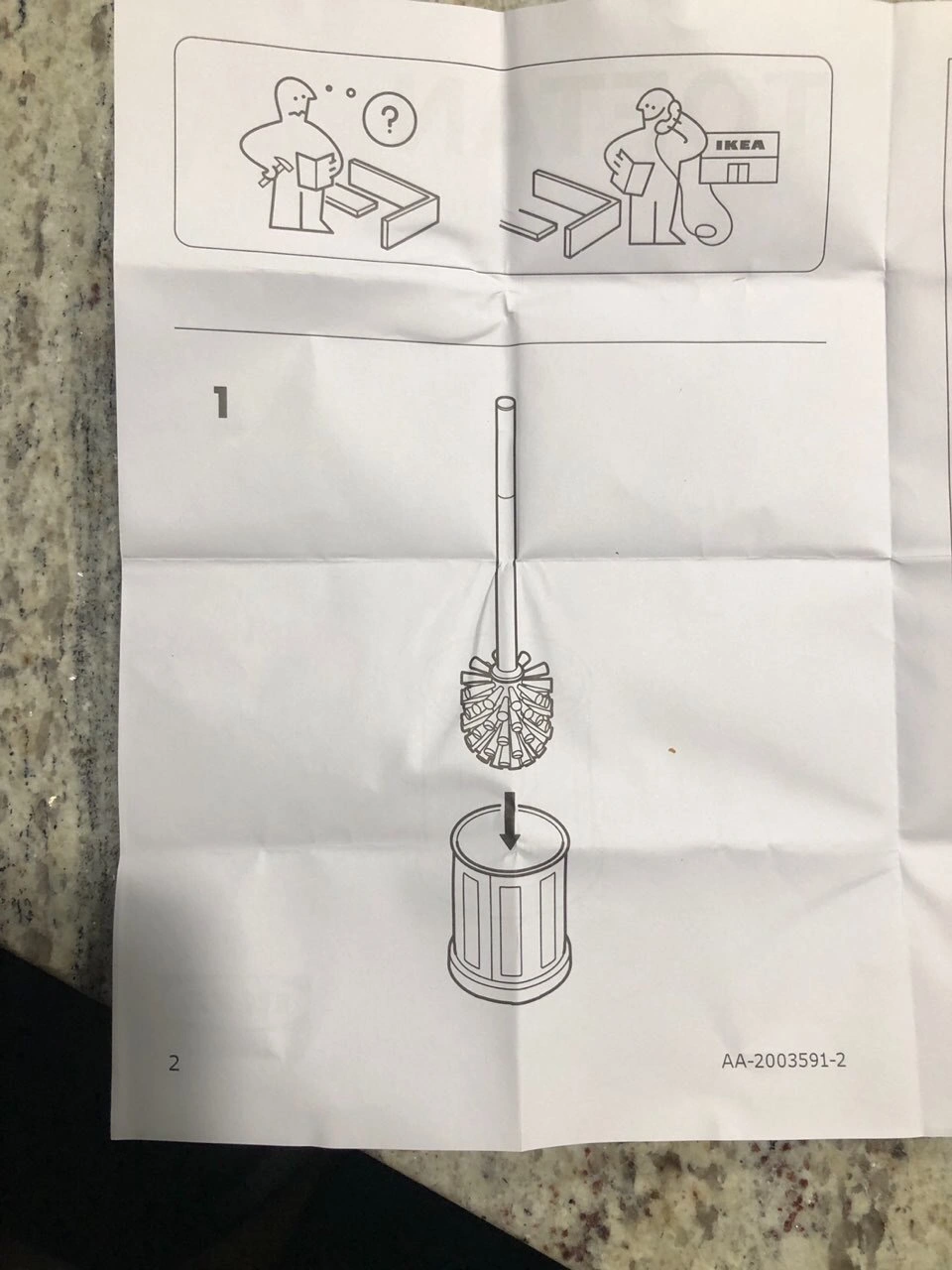
Imagine buying a spoon, and inside the box is an official, numbered instruction booklet with a drawing showing the spoon and an arrow pointing at the drawer — plus a picture saying "if you can't figure this out, call us and we'll help." That's what this is: a real company shipped a real manual explaining how to put a toilet brush into its cup, the one household task literally no one in history has ever gotten wrong. It's funny because all that serious, official effort got spent on something a toddler could do without help — like wearing a helmet, knee pads, and a safety harness to sit down on a couch.

Level 2: Anatomy of Wordless Documentation

A few things worth decoding for anyone early in their career, because this sheet is secretly a masterclass in documentation and developer experience:

  • Exploded-view diagram: the drawing style where parts float apart along their assembly axis with arrows showing how they mate. It's the hardware ancestor of a good architecture diagram — it shows relationships, not just components. Here it relates exactly two parts: brush, holder.
  • Wordless instructions: IKEA pictograms contain no language, so one manual works in every market. Compare with software i18n/l10n — the cheapest string to translate is the one that doesn't exist. Icons-over-text is the same trade-off your design team argues about in every UX review.
  • Document identifiers: AA-2003591-2 is a stable ID, and the page is numbered ("2") even though there's essentially nothing on page 1 worth referencing. Stable IDs and versioning matter because support staff and warehouses need to reference exactly this revision — same reason your API docs are versioned and your error messages include a code.
  • The "confused person" header: this is a pre-emptive support escalation path baked into the doc itself: if stuck, don't improvise — contact the source. It's the IKEA equivalent of "if this runbook fails, page the on-call; do not SSH in and freestyle."

The joke for a junior dev: you will meet this exact energy in your first month. A 40-line PR template for a one-character fix. A mandatory architecture review for a cron job. It feels absurd — and sometimes it is — but you'll also meet the opposite: a production-critical service whose entire onboarding doc is "ask Dave." You'll quickly learn which one ruins your week.

Level 3: The Single-Step Runbook

What you're looking at is document AA-2003591-2, page 2 of an official IKEA assembly manual whose entire instructional payload is step 1: an exploded-view diagram of a toilet brush hovering above its holder, with an arrow indicating — brace yourself — that the brush goes in the holder. And yet the sheet still ships with the full ceremonial apparatus: the pictogram of the confused builder staring at misassembled parts with a question mark over his head, and the follow-up panel where he phones the IKEA store, manual in hand. There is a documented support escalation path for inserting a brush into a cup.

This is why the image lands so hard with engineers: it's a perfect, physical instantiation of process applied uniformly regardless of task complexity. IKEA's documentation pipeline doesn't ask "does this product need a manual?" — every SKU gets the same treatment: wordless pictograms (their famous answer to localization, eliminating translation into dozens of languages), part numbering, page numbers, a versioned document ID with what looks suspiciously like a revision suffix (-2), and the standardized "if confused, call support" header. The pipeline is the point. The toilet brush is just payload.

Every developer has lived both sides of this. On one side: the CI/CD template that demands a rollback plan, a security review, and two approvals to fix a typo in a README. The compliance checklist that asks how your static HTML page handles PII. The Jira ticket with seventeen mandatory fields for "bump dependency version." On the other side — and this is the dark mirror that makes it funny — the genuinely gnarly systems with no documentation at all. The org that produces a versioned, illustrated, internationally localized runbook for a brush-in-cup operation is, statistically speaking, the same kind of org whose Kafka consumer-group rebalancing logic is documented in a Slack thread that got deleted with the channel.

There's also a real lesson about uniform process as a feature, not a bug, which senior people eventually internalize: IKEA's consistency isn't stupidity. Exception-handling is expensive. Deciding which products deserve manuals would require a review process of its own, and the failure mode (customer can't assemble, returns product, calls support) costs more than printing one absurd page. It's the same logic as "all changes go through the pipeline, even one-liners" — the rule survives because evaluating exceptions costs more than tolerating overkill. Everyone mocks the process right up until the day the "trivial" change takes production down.

Description

A photograph of a folded IKEA instruction manual laid out on a marble-like surface. The top of the manual features the classic illustrated IKEA character, first looking confused at assembly parts, then calling IKEA for help, which is a visual trope for complex assemblies. Below this, the main instruction, labeled as step '1', is shown: a simple diagram illustrating that a toilet brush should be placed into its holder. The humor lies in the dramatic contrast between the implication of a difficult, multi-step process (requiring instructions and possibly support) and the extreme simplicity of the actual task. For developers, this is analogous to encountering extensive documentation, complex setup guides, or formal onboarding for a task that is trivially easy, like running a 'hello world' script. It satirizes over-engineering and unnecessarily complex processes for simple outcomes

Comments

8
Anonymous ★ Top Pick This is the README for our new microservice. Step 1: 'docker run hello-world'. We're still debating the 15-page style guide for contributing to the docs
  1. Anonymous ★ Top Pick

    This is the README for our new microservice. Step 1: 'docker run hello-world'. We're still debating the 15-page style guide for contributing to the docs

  2. Anonymous

    Identical vibe to the vendor doc that claims “just add this one-line sidecar YAML” - and quietly omits the 47 CRDs, three IAM roles, and the ensuing existential dread

  3. Anonymous

    When the vendor's API documentation is so bad, you end up implementing their competitor's solution just to flush the technical debt down the drain

  4. Anonymous

    IKEA writes a versioned, localized, single-step runbook for inserting a brush into a cup, while your distributed payment system's onboarding doc is a Slack message from someone who left in 2021

  5. Anonymous

    Every senior engineer knows this feeling: you're handed a 'simple' legacy system with documentation that's just pictograms and a phone number. The left panel is you on day one thinking 'how hard could this be?' The right panel is you three hours later on Slack asking the one person who wrote it five years ago. The real kicker? Step 1 is always deceptively simple - like 'insert the brush into the holder' - but nowhere does it mention the holder is actually a distributed microservice that needs OAuth2 configuration and the brush handle is deprecated in favor of a new REST API that nobody documented yet

  6. Anonymous

    These IKEA instructions are basically our Kubernetes onboarding: 1) put your thing in a container; 2) when it inevitably goes CrashLoopBackOff, call the consultant

  7. Anonymous

    Enterprise runbooks distilled: 1) drop service into the holder (prod) ↓; if confused, call the vendor - because documenting preconditions, invariants, idempotency, and rollback blew the page budget

  8. Anonymous

    Why Terraform was invented: humans kept jamming the pole in upside-down like every vendor config diagram

Use J and K for navigation