Programmer Priorities: Bugs and Fixes Over Affection
Why is this Bugs meme funny?
Level 1: Love Letters, Developer Edition
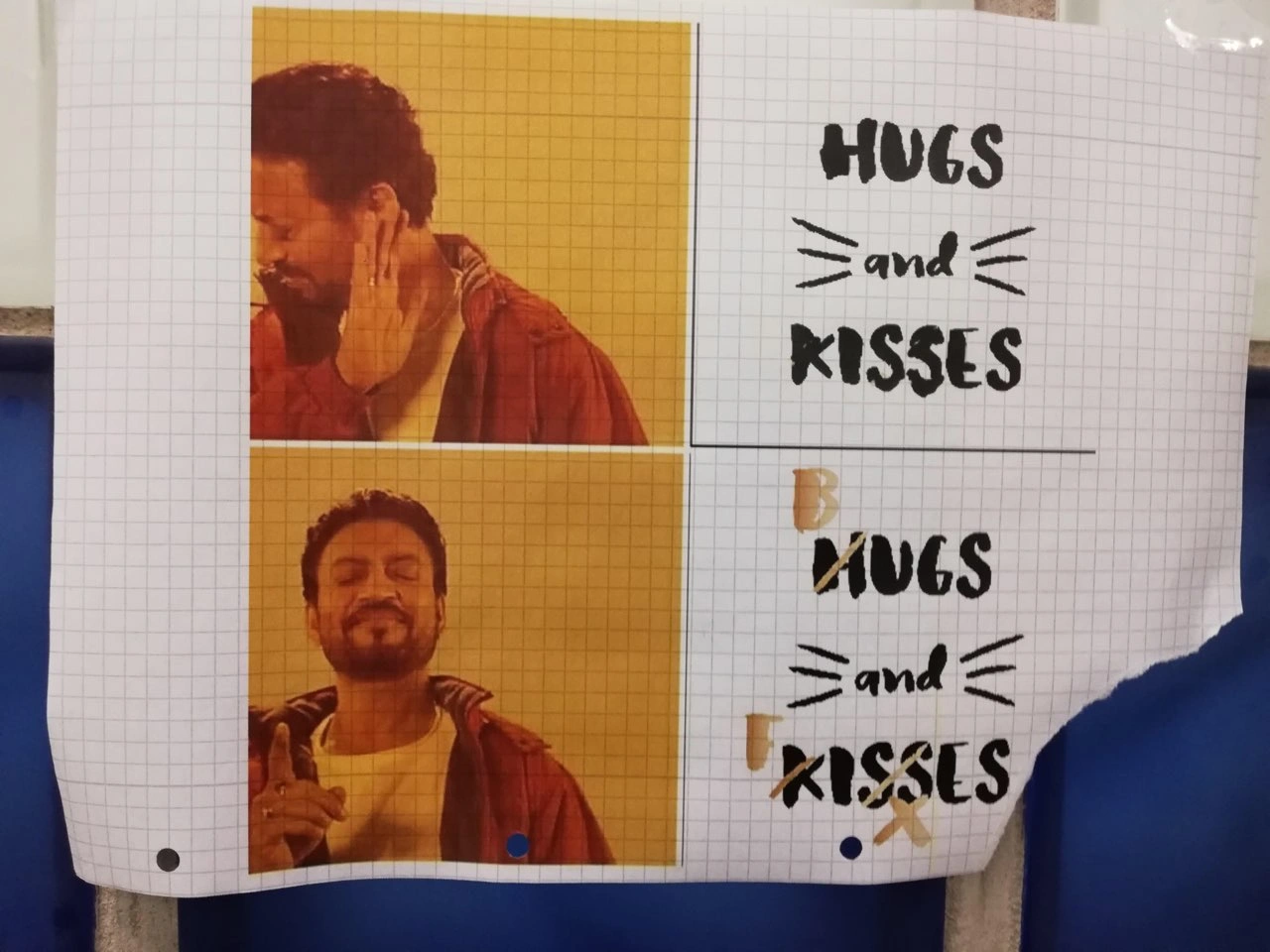
People sign letters "XOXO" — hugs and kisses — to show love. This poster jokes that for programmers, the thing they give and receive all day isn't hugs and kisses, it's bugs and fixes: the computer breaks something, the programmer repairs it, over and over, like an endless exchange of little notes. And the best part is how the joke was made: instead of printing a new sign, someone just crossed out the old letters with a marker and wrote new ones on top — fixing the sign by hand, exactly the way they fix everything else. It's like a plumber whose valentine is a patched leaky pipe.
Level 2: XOXO, but Make It Jira
Quick decoder for the terms this wall-art is riffing on:
- Bug: any behavior where the software does something other than intended — from a typo in a label to a crash that pages someone at 3 AM. Bugs get recorded as issues or tickets in a tracker so they don't vanish into memory.
- Fix: the code change that resolves a bug. The pairing is so fundamental that commit histories are full of messages like
fix: handle null user on login— entire conventions (like prefixing commits withfix:) exist around it. - Hotfix: an urgent patch applied directly to the live system, skipping parts of the normal process — exactly what the marker edits on this printout are: the fastest possible correction with the smallest possible change.
- The meme format: top panel = reject, bottom panel = approve. Knowing the format is part of developer literacy; it's how teams compress opinions ("tabs vs spaces", "rewrite vs refactor") into two images.
Early in your career, the "bugs and fixes" rhythm can feel like failure — you write code, it breaks, you feel bad. The mindset shift this meme celebrates is realizing the loop is the job. You'll fix a bug, the fix will reveal another bug, and eventually you'll feel genuine affection for a well-written bug report the way other people feel about a thoughtful text message. When a teammate hands you a reproducible test case with logs attached, that's the engineering equivalent of a hug.
Level 3: The Issue That Never Closes
The artifact here is better than the joke it contains. Someone printed the Irrfan Khan two-panel approval meme — the Bollywood parody of Hotline Bling that the meme economy adopted as a Drake-format alternative — onto grid paper, taped it to an office wall, and then hand-edited it with a marker. Top panel: Khan recoils from the decorative hand-lettered text "HUGS and KISSES". Bottom panel: he beams, finger raised, at the same text after corrections — an orange "B" overwriting the crossed-out "H", and an "F…"X" patched over the struck-through "KISSES", yielding BUGS and FIXES.
What makes this resonate beyond the pun is that the bug/fix pair really is the structural rhythm of a developer's emotional life, the way XOXO is for everyone else. The cycle is reciprocal and endless: a bug is the system's message to you, the fix is your reply, and like any long relationship, closure is aspirational. Every senior engineer knows the dirty secret encoded here — bugs aren't an anomaly in the process, they are the process. The industry's entire tooling stack (issue trackers, regression suites, git bisect, blameless postmortems) exists because we institutionalized the assumption that the affection will keep arriving. Nobody builds a workflow around being occasionally surprised by defects; we build cathedrals around their inevitability.
There's a second layer in the method of the joke. The original printout said "hugs and kisses"; the developer didn't reprint it — they patched it in place. Crossed out the wrong characters, wrote the corrections above, shipped it back to the wall. That is a literal hotfix: minimal diff, applied directly to production (the production environment being an office wall), no rebuild, visible scar tissue left behind. The torn edge of the paper even reads like an artifact of a rough deployment. A cleaner team would have regenerated the asset from source; this team edited the binary. Honestly, respect.
And the format choice is apt in a way the author may not have intended: the disapproval/approval structure mirrors triage. "Hugs and kisses" — rejected, not reproducible in our environment. "Bugs and fixes" — accepted, assigned, this is the love language we ship with. The fact that it's physically posted in an office makes it a tiny piece of engineering culture infrastructure, the analog ancestor of the team Slack channel's pinned meme.
Description
A two-panel meme using the popular 'Drake Hotline Bling' format, printed on graph paper. In the top panel, the character Drake is shown with a look of disapproval, hand raised to his face. To the right, black text reads 'HUGS and KISSES'. In the bottom panel, Drake is smiling and pointing in approval. To the right of him, the same text 'HUGS and KISSES' is crossed out, and handwritten letters 'B' and 'F' are placed over the 'H' and 'K' to spell 'BUGS and FIXES'. This meme humorously illustrates a common stereotype of software developers: they are often so engrossed in their work that they derive more satisfaction from identifying and resolving technical problems ('bugs and fixes') than from social or physical affection ('hugs and kisses'). It speaks to the deep focus and problem-solving mindset that defines the profession, often at the expense of other life aspects
Comments
8Comment deleted
Some developers prefer bugs to hugs because at least with bugs, you're encouraged to crush them
Marketing promises users “hugs and kisses,” prod delivers “bugs and fixes,” and we’re stuck acting as the consistency layer
After 15 years in the industry, I've learned that the dopamine hit from fixing a race condition at 2 AM far exceeds any Valentine's Day card - at least the bug fix won't introduce three new edge cases when you try to commit
Hugs and kisses is XO XO; bugs and fixes is the same relationship, except the bug always comes first and the fix never fully closes the issue
When your partner asks why you're still at the keyboard at 2 AM, just show them this - they'll understand that 'BUGS and FIXES' isn't just a lifestyle choice, it's a calling. Besides, production incidents don't care about Valentine's Day, and that critical bug won't fix itself while you're out having dinner. The real romance is watching that CI/CD pipeline turn green after a 6-hour debugging session
Valentine's PR: diff -u: -HUGS -KISSES +BUGS +FIXES; PM says 'just two letters,' SRE schedules the postmortem
Devs' love language: XOXO where X is the bug emoji and O is the optimistic commit message
Valentine’s in prod: sed 's/HUGS/BUGS/g; s/KISSES/FIXES/g' - ship behind a feature flag, canary it, and if it doesn’t breach the SLO, that’s love