Skip to content
DevMeme
6018 of 7435
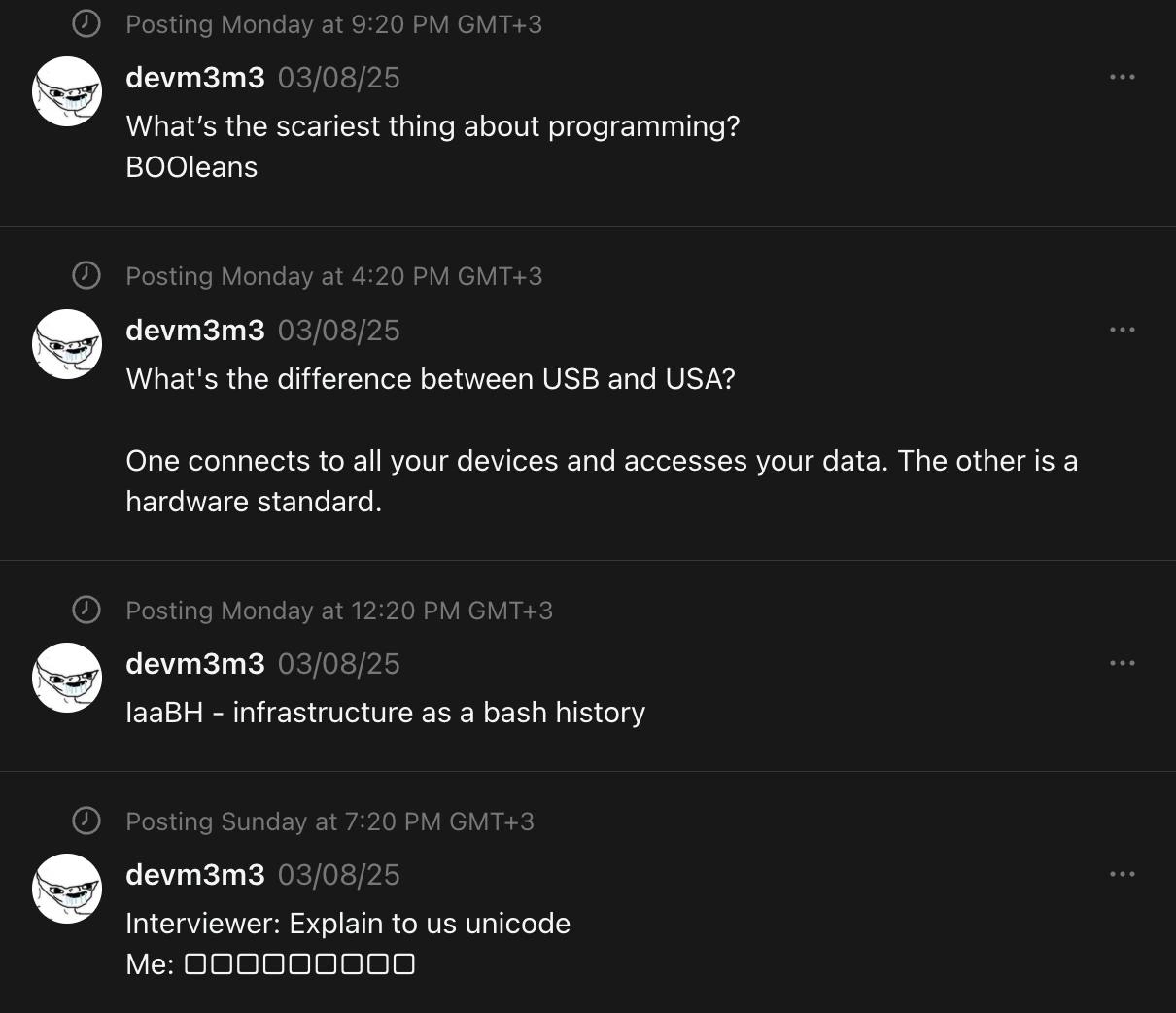
A feed of Booleans, USB privacy, bash histories, and Unicode squares
CS Fundamentals Post #6588, on Mar 27, 2025 in TG

A feed of Booleans, USB privacy, bash histories, and Unicode squares

Why is this CS Fundamentals meme funny?

Level 1: Scared Silly

Imagine you’re a kid at a spooky Halloween party. Someone jumps out and yells "Boo!" — that startle is like the first joke here, where a simple yes-or-no idea in coding (something called a Boolean, like a light switch that’s either on or off) is playfully turned into a ghost saying “BOO.” It’s funny-scary in a silly way, because of course a True/False value isn’t actually a monster, but the joke pretends it is.

Now think about your friendly gadget that charges your tablet – that’s like a USB cable. It’s harmless and super useful. The joke compares that to a big country, the USA, peeking at all your toys and books without asking. One is just a plug, and the other is like a nosy giant who wants to see everything! It’s an exaggerated way to tease about who we trust: we usually don’t fear a little cable, but we might fear a big stranger prying into our stuff. It’s as if saying, “Don’t worry about the charger in your room; worry about the nosy neighbor who might be spying!” Silly, right? But it makes us laugh and think, because it flips what you’d expect.

Next, imagine you built an awesome LEGO castle, but you never wrote down or remembered how you did it. The only way anyone knows is by replaying the exact moves of your hands if they were recorded. That’s like a tech joke where someone set up a complex computer system but didn’t save any instructions – they only have the computer’s bash history (a secret notebook of commands they typed) as a “guide.” It’s as messy as it sounds! Other people would be like, “How on earth did you do this?” and have to retrace every step from that cryptic history. We find it funny because it’s a terrible way to do things – it’s like leaving clues of a treasure hunt instead of a map. Even kids know that if you want your friend to rebuild your LEGO castle, you’d better give them the instructions, not just a shuffled list of moves you made. So this joke is basically pointing and laughing at someone who didn’t share the “recipe” properly.

Finally, picture you’re asked a really hard question in class, and you open your mouth but nothing sensible comes out – maybe just random noises or silence. In the meme, the person being interviewed is asked to explain Unicode (a complicated idea of how computers handle text). Instead of giving a clear answer, they respond with a line of empty squares ☐☐☐☐☐☐☐☐. Those squares are what we see when a computer can’t show a certain symbol or letter – basically a placeholder saying “I dunno what this is.” It’s like answering a question with a big blank stare 🤔. For everyone watching, it’s funny because it’s so absurd: the candidate’s “explanation” literally didn’t show up! It’s as if they answered in an alien language that even the computer couldn’t understand. We laugh because we’ve all had moments where we just didn’t have the words – this joke takes it to a goofy extreme by using actual computer gibberish to say “I got nothing.”

So, all in all, these four mini-stories turn nerdy problems into everyday fun. They take things that might worry or frustrate programmers (like little bugs, privacy worries, sloppy work, or confusing questions) and dress them up in a playful, almost childlike way – with ghosts, nosy neighbors, missing instructions, and gibberish answers. It’s the kind of humor that says, “Yep, our tech world can be spooky or crazy, but we can still laugh about it!”

Level 2: From Boo to Tofu

Let’s break down each joke in this feed and explain the tech terms for anyone who’s not deep into programming yet.

  • BOOlean (Boolean) Pun: The first post asks about the scariest thing in programming and answers “BOOleans.” This is a play on the word Boolean, which in computer science means a value that’s either True or False (often represented as true or false in code). The term comes from George Boole, a mathematician who developed Boolean algebra (logic using TRUE/FALSE values). So, Booleans are about as basic as it gets in programming — every if statement or condition relies on Boolean truth values. The joke adds “BOO” (like a ghost’s boo! to scare you) in front of “leans” to make “BOOleans.” It’s implying that even something as simple as a True/False value can be scary in programming. Why scary? Well, if you use a Boolean incorrectly, it can cause bugs that are hard to find. For example, a beginner might set a Boolean flag the wrong way and the program might take a completely different path (imagine thinking a light is off (False) when it’s actually on (True) — spooky surprise!). The humor here is mostly in the pun, but it resonates because programmers sometimes do get startled by how tricky simple logic can become, especially when debugging. It’s a little nod to CS_Fundamentals with a Halloween twist.

  • USB vs USA (Privacy Joke): The second post compares USB and USA. USB stands for Universal Serial Bus, and it’s a very common hardware interface/standard used to connect devices (like keyboards, phones, cameras) to computers. When they say “connects to all your devices and accesses your data,” that sounds like what USB does — after all, you plug USB into devices to transfer data or power. Meanwhile USA usually stands for the United States of America. The joke flips the script: it implies the country (USA) is the one actually connecting to all your devices and reading your data, whereas the other (USB) is “just a hardware standard.” This is a tongue-in-cheek reference to privacy concerns and government surveillance. In real life, there have been concerns (and actual incidents) where governments, including the US, monitor data or communications (like the NSA programs people talk about). The joke exaggerates this idea: that Uncle Sam has a cable into everything you own 😅. Technically, USB is indeed a hardware standard – meaning it’s an agreed-upon design that manufacturers follow so that devices and computers can physically connect and communicate. Comparing a nation to a cable standard is absurd, and that’s why it’s funny. The line hints that the USA’s global data reach is so vast, it’s like they’re plugged into everyone’s devices (scary thought), whereas the USB cable by contrast is harmless. It’s a quick codinghumor meets privacy_satire kind of joke. If you’re new to tech, the main thing to know is: USB = a plug for devices; USA = a country (sometimes joked about as spying on data). Mixing them up in a riddle makes a witty point about who/what we trust with our information.

  • IaaBH – Infrastructure as a Bash History: This third post might look like gibberish if you haven’t heard the originals it’s riffing on. IaaBH is styled after acronyms like IaaS and IaC.

    • IaaS stands for Infrastructure as a Service, a cloud computing model where companies rent servers/VMs and networking from providers like AWS or Azure (instead of owning physical hardware).
    • IaC stands for Infrastructure as Code, which is a practice where you define and manage your IT infrastructure using configuration files or code. In DevOps, Infrastructure as Code is a big deal because it means you can recreate or change your entire setup reliably using scripts/recipes (think of writing a recipe to configure 100 servers exactly the same — tools like Terraform, Ansible, or CloudFormation do that). It’s reproducible and trackable.

    Now, Bash: that’s the default shell (command-line interface) on many Linux systems (and macOS). Bash lets you type commands to interact with the operating system. It keeps a history of the commands you enter in a file usually named ~/.bash_history. This history is basically a log of what you’ve typed in.

    So, “Infrastructure as a Bash History” jokes that instead of proper infrastructure management (with code or scripts), someone’s entire server setup is just whatever commands they ran manually, recorded in their bash history file. 😬 This is considered a devops_shortcuts anti-pattern (doing things the quick and dirty way). Why is that bad? Because if all your setup steps live only in one person’s shell history,

    • it’s not documented well,
    • not repeatable (you can’t just run one file to set everything up; you’d have to replay someone’s manual steps), and
    • prone to errors.

    Imagine setting up 10 servers by typing commands by hand each time — you’re bound to forget a step or type something slightly different on one of them! With Infrastructure as Code, you’d instead have a script that sets up all 10 uniformly. But with “Infrastructure as Bash History,” the only record of what you did on server #1 might be the scrollback or history on that server itself. If that gets cleared or the person leaves, you’re in trouble. This joke resonates with DevOps and SRE folks because they have seen or heard of situations where, say, a critical server was configured manually by a predecessor and nobody knows exactly how. It’s both funny and cringe-inducing: funny as a joke phrase, cringey because… ouch, some people actually operate that way. For a newcomer: DevOps is all about automating and treating infrastructure with the same discipline as application code, so doing it via bash history is like the opposite of best practices. The joke labels this bad habit in a mocking way, as if it were a cool tech offering (it’s not).

  • Unicode “☐☐☐☐☐☐☐☐”: The fourth post requires a bit of understanding about text encoding. Unicode is a standard that assigns a unique number (code point) to virtually every character in every written language, plus tons of symbols and emoji. It was created because earlier systems (like ASCII or other local encodings) couldn’t handle the vast variety of characters worldwide. Unicode is super comprehensive — over 140,000 characters — and it’s used under the hood in modern software to represent text. However, just because Unicode defines a character (say, some rare Chinese Han character or a new emoji) doesn’t mean your computer can display it. You need a font that has a glyph (a drawn shape) for that code point. When you don’t have a glyph, many systems show a default placeholder, often a square outline or a little box with a question mark. These are jokingly called tofu because they look like little tofu cubes.

    In the interview joke, the interviewer says, “Explain to us Unicode.” The interviewee responds with a series of eight square boxes: “☐☐☐☐☐☐☐☐”. This implies that whatever the interviewee tried to say was not displayable – it turned into tofu boxes. 😂 It’s a cheeky way of saying: “Unicode is so complicated that even my explanation can’t be rendered properly!” Or that the explanation itself ended up being some Unicode text that the interviewer’s computer couldn’t handle, thus resulting in squares. It’s possible the interviewee literally responded with some Unicode text (maybe in an exotic script or full of emojis) to be funny, and the system showed boxes. For someone new to this, think of times you’ve seen a website or message with missing characters – you just see empty squares or �. That’s exactly this. Developers find it funny because dealing with text encoding issues is a rite of passage. You might, for example, save some text with the wrong encoding and all your apostrophes turn into gibberish, or you open a document and see a bunch of boxes because you don’t have the right font. It’s frustrating in real life, but in this meme it’s used creatively as the punchline. Also, explaining Unicode is genuinely hard (it’s a big topic involving code points, UTF-8/UTF-16 encoding forms, etc.), so the joke implies “I tried to explain it, but it came out as nonsense.” The humor lands especially with those who know the UnicodeSupport pain — it’s a nod to every time a text didn’t show up as expected.

In summary, each post in this meme’s feed combines a technical concept with humor:

  • A fundamental concept (Boolean logic) turned into a Halloween-style pun.
  • A hardware term (USB) contrasted with a nation to poke at security/privacy issues.
  • A DevOps practice (Infrastructure as Code) flipped into an absurd worst-practice (shell history as your only guide).
  • A software standard (Unicode) demonstrated via its own failure mode (missing glyph boxes) in a mock interview.

For a junior developer or someone learning: these jokes are a fun way to get introduced to topics like data types, hardware interfaces, DevOps culture, and text encoding. If some of it still seems confusing, don’t worry — as you get more experience, you’ll likely encounter all of these scenarios (and then the jokes will become even funnier!). Keep an eye on your booleans, don’t trust everything that plugs in, write down how you set things up, and always test your Unicode strings… those lessons are hidden under the laughter here. 😄

Level 3: Boo, Bus, Bash & Boxes

The first post hits a classic Boolean pun: "What's the scariest thing about programming? BOOleans". Seasoned devs crack a smile here because it’s a double joke. On the surface, it’s a wordplay — Booleans (the true/false values at the heart of all code logic) sound like "Boo!", the noise a ghost makes. But behind the pun is a hint of truth: even simple boolean logic can be scary in real code. Every experienced engineer has been haunted by a “harmless” boolean flag that caused a nightmare production bug at 3 AM. Maybe it was an isActive flag that mysteriously stayed false, or a misused double negative like not isClosed == false (spooky!). In other words, Boolean bugs sneak up on you like ghosts in the machine. The joke exaggerates that idea by literally calling them “BOOleans”, as if these little True/False gremlins are the ghosts that keep programmers up at night. It’s CS_Fundamentals humor: basic data types turned into boogeymen. A senior developer chuckles because they remember those seemingly trivial True/False checks that led to very real scares in their career.

The second post takes a jab at privacy and hardware in one line: "What’s the difference between USB and USA? One connects to all your devices and accesses your data. The other is a hardware standard." This twist cleverly flips our expectation. USB (Universal Serial Bus) is a well-known hardware standard for plugging in devices — it’s supposed to be the “connector of everything.” Meanwhile, USA (here referring to the United States, notably its government or agencies) isn’t hardware at all… or so we think. The punchline suggests that the real device that “connects to all your devices and accesses your data” is the USA, hinting at mass surveillance (a la the NSA’s exploits). The DevOps_SRE crowd and old-timers remember infamous revelations like government programs silently siphoning data (hello, Big Brother 😏). By contrast, the humble USB cable just charges your phone and transfers files as intended. The humor comes from that reversal: the thing we usually trust (our country or its internet infrastructure) might be intrusively “connecting” everywhere, while the thing we joke about (USB cables plugging into everything) is actually innocent. It’s a bit of privacy satire – a one-liner that tucks a tech policy critique inside a hardware joke. Security-conscious developers laugh (perhaps a tad bitterly) because it feels truthy, and new devs learn that in tech, even a pun about USB vs USA can carry a kernel of paranoid truth.

Next up, the third post drops an acronym that only DevOps folks or sysadmins might immediately get: "IaaBH – infrastructure as a bash history." This is a tongue-in-cheek riff on "Infrastructure as Code" (IaC), which is the modern best practice of managing servers and infrastructure through code files or scripts (think Terraform, CloudFormation, or Ansible playbooks) so that everything is reproducible and version-controlled. Here, it’s been perverted into “Infrastructure as Bash History” – implying that someone set up entire servers or cloud resources not with proper code, but by manually typing commands into a shell (bash) and then relying on the ~/.bash_history file as the only record of what they did. 😱 This is hilarious (and horrifying) to experienced DevOps_SRE engineers because it’s a real anti-pattern they’ve seen in the wild. It’s essentially DevOps done backwards: no Git repositories, no scripts, just ad-hoc commands and hope. The nickname “IaaBH” mocks those shortcuts — it’s the devops_shortcuts nightmare where an entire server’s config lives only in one admin’s memory (or scrollback buffer). Senior engineers might recall a late-night incident where the only documentation for a critical server was buried in someone’s shell history, leading to frantic sleuthing. The joke succinctly labels that chaotic practice as if it were a service offering: “Infrastructure as a Bash History – deploy at your own peril!” Everyone who’s had to untangle a production issue on a box configured by hand will facepalm and laugh at this. It’s funny because it’s painfully true: some infrastructures are held together by duct tape, prayers, and one person’s bash commands 😅.

Finally, the fourth post is an interview gag about Unicode that packs multiple layers of geekiness into two lines: “Interviewer: Explain to us Unicode. Me: ☐☐☐☐☐☐☐☐”. Those little square boxes (often called "tofu" in typography slang) are what you see when a character isn’t recognized or can’t be rendered by the font. Essentially, the interviewee’s answer to “Explain Unicode” is a bunch of unprintable glyphs — which ironically demonstrates one of the biggest issues in Unicode handling (missing character support). For a seasoned developer, this is comedy gold: it’s the ultimate "show, don’t tell." Unicode is a massive DataFormats standard for encoding text in all languages (and emoji), and it’s notoriously complex. Even a stellar explanation might not fit in a short interview answer. Instead, the candidate humorously “answers” with gibberish (those empty squares), implying that any explanation would be incomprehensible or lead to exactly the kind of encoding fail that haunts software demos. It’s also poking fun at the fact that when software doesn’t have a font for a certain Unicode character, you get these ☐ symbols — a universal developer experience from the early days of missing fonts and mojibake to today’s emoji that won’t display on outdated systems. The encoding_humor here is strong: only folks who’ve struggled with string encodings or seen odd characters turn into □□□ will fully appreciate why this non-answer is the perfect answer. In an interview context, it also reads as the candidate essentially saying “Unicode? Yeah, it’s rough – see, even my explanation isn’t showing up!” A junior dev might just see squares and be puzzled, but an experienced dev will nod knowingly and maybe recall the last time a production log or user input had “�” or boxes due to a wrong encoding. This little line captures the perennial Unicode headache in one visual joke.

All together, this meme presents a timeline of insider jokes spanning different corners of tech: from fundamental truths (and falsehoods) in code, to hardware vs. privacy politics, to DevOps war stories, and the quirks of text encoding. Each post is brief, but each hits on something real that developers learn either in school or (more often) the hard way on the job. The dark-mode feed aesthetic and the quick succession of posts mimic how dev humor often appears on social media — one zinger after another, tailor-made for those who speak fluent “geek”. A veteran programmer scrolling this feed would smirk at each one: they’ve been spooked by a Boolean, they’ve joked about government snooping, they’ve cursed sloppy “snowflake” servers set up via Bash, and they’ve definitely experienced the “Unicode tofu” UnicodeSupport problem. This shared understanding makes the meme hilarious and satisfying — it’s like a checklist of “you know you’re a programmer when…” moments.

Description

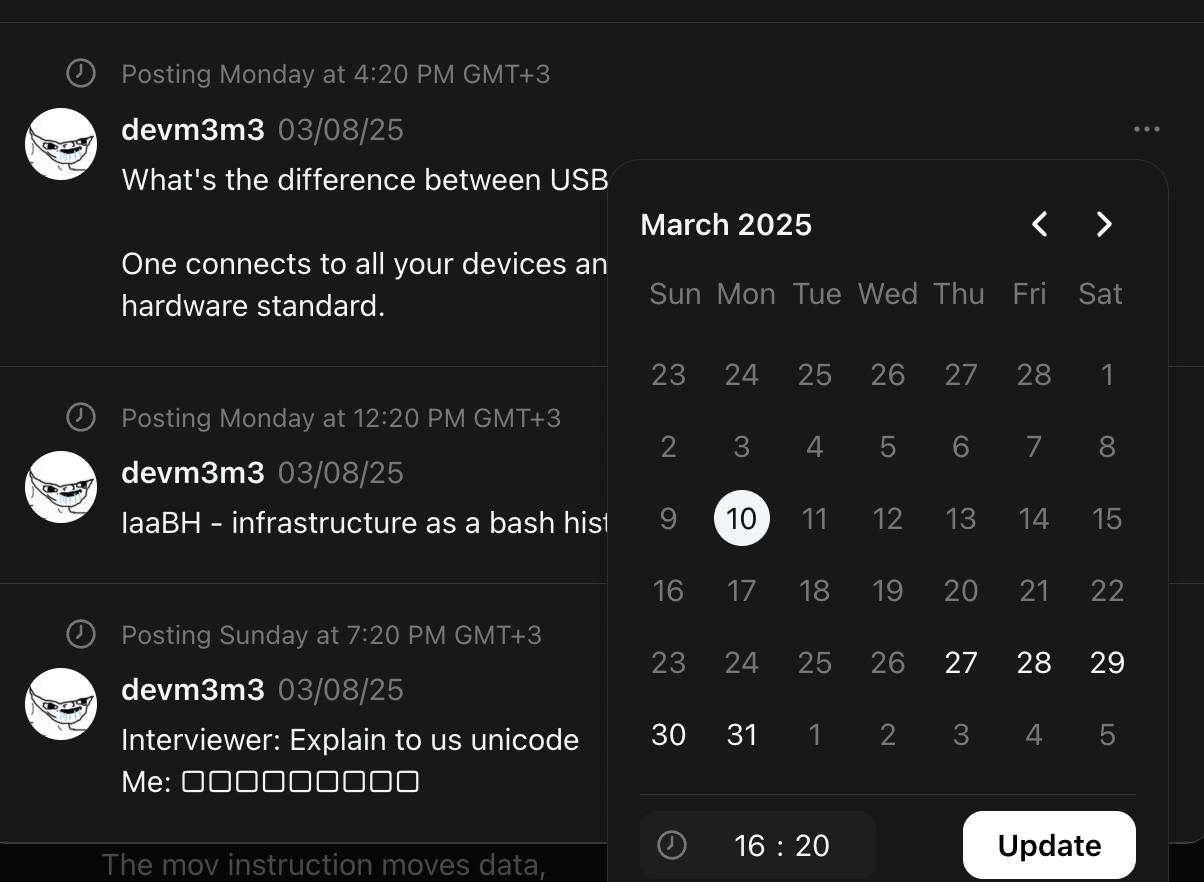
Dark-mode screenshot of a micro-blog timeline showing four consecutive posts by user “devm3m3” (avatar: monochrome hacker cartoon). Visible timestamps read “Posting Monday at 9:20 PM GMT+3”, “Posting Monday at 4:20 PM GMT+3”, “Posting Monday at 12:20 PM GMT+3”, and “Posting Sunday at 7:20 PM GMT+3”, each followed by the date “03/08/25”. Post texts in order: 1) “What’s the scariest thing about programming? BOOleans”; 2) “What’s the difference between USB and USA? One connects to all your devices and accesses your data. The other is a hardware standard.”; 3) “IaaBH - infrastructure as a bash history”; 4) “Interviewer: Explain to us unicode Me: ☐☐☐☐☐☐☐☐”. Grey divider lines and three-dot menus separate the entries, typical of mobile social-app UI. The content satirizes Boolean bugs, surveillance concerns disguised as hardware jokes, DevOps anti-patterns that replace IaC with ~/.bash_history, and the perennial Unicode “tofu” glyph problem - inside jokes seasoned engineers instantly recognize
Comments

6
Anonymous ★ Top Pick IaaBH: because why bother with Terraform state files when ~/.bash_history is already your single source of production truth?
  1. Anonymous ★ Top Pick

    IaaBH: because why bother with Terraform state files when ~/.bash_history is already your single source of production truth?

  2. Anonymous

    Infrastructure as a Bash History - where your disaster recovery plan is hoping someone remembered to add --dry-run to that terraform destroy command they ran at 3am

  3. Anonymous

    The real Infrastructure as Code is when your entire production environment can be reconstructed from your bash history - assuming you didn't use `HISTCONTROL=ignorespace` before those AWS credentials. And let's be honest, explaining Unicode in an interview is just asking the candidate to demonstrate every encoding bug they've ever shipped, one mojibake at a time

  4. Anonymous

    Infrastructure-as-bash-history: the only 'declarative' stack where drift detection is diffing ~/.bash_history, rollback is pressing Up twice, and the audit trail is sudo !!

  5. Anonymous

    Enterprise IaaBH: infra defined by whoever’s bash history survived the outage - change control is scrollback and the Unicode strategy is render-tofu, ship-ASCII

  6. Anonymous

    Unicode interviews: where 'UTF-8 everywhere' meets prod logs full of replacement chars after a legacy DB migration

Use J and K for navigation