Skip to content
DevMeme
6019 of 7435
Scheduling dark-mode dev jokes while fighting the date picker in production
DeveloperExperience DX Post #6589, on Mar 27, 2025 in TG

Scheduling dark-mode dev jokes while fighting the date picker in production

Why is this DeveloperExperience DX meme funny?

Level 1: Lost in Time and Translation

Imagine you carefully wrote down a few jokes to share with your friends at specific times. You give one to your friend to tell during Sunday evening playtime, and two more for Monday – one just before lunch and one later in the afternoon. You even point at the clock and say “Make sure to tell this one at exactly this time!”

Now, picture your friend uses a schedule on their phone to remind them, but there’s a little mix-up: the phone’s clock was set to a different time zone, or the country changed the clocks an hour forward for summer. Uh oh! On Sunday, your friend ends up telling the joke an hour early, before everyone’s even there to hear it. And the next day, the lunch-time joke comes out a bit off schedule too because the calendar was confused by the time change.

To top it off, your last joke had a funny word from another language or a cool symbol in it. But when your friend shows it on their older computer, the special characters don’t show up right – instead of the word or symbol, there are just blank □□□□ squares on the screen. Nobody understands what that was supposed to mean, and it wasn’t the punchline you intended!

It’s a silly situation: you tried to be super organized by planning ahead, but things like clocks changing and unsupported symbols turned your plan upside down. The humor here is in that relatable frustration – even with good planning and tech, little differences (like time zones and text encoding) can mess with us. It’s funny in the same way a prank is funny: not because someone got hurt, but because something small and unexpected made the whole plan go wonky. In the end, we laugh because we’ve all had moments where we go, “I did everything right… and it still went wrong!”

Level 2: Bash, Bytes & Time

Now let’s break down this meme’s pieces in a more straightforward way. It’s essentially depicting a developer-oriented scheduling tool and a few inside jokes that might need some explanation if you’re new to these concepts.

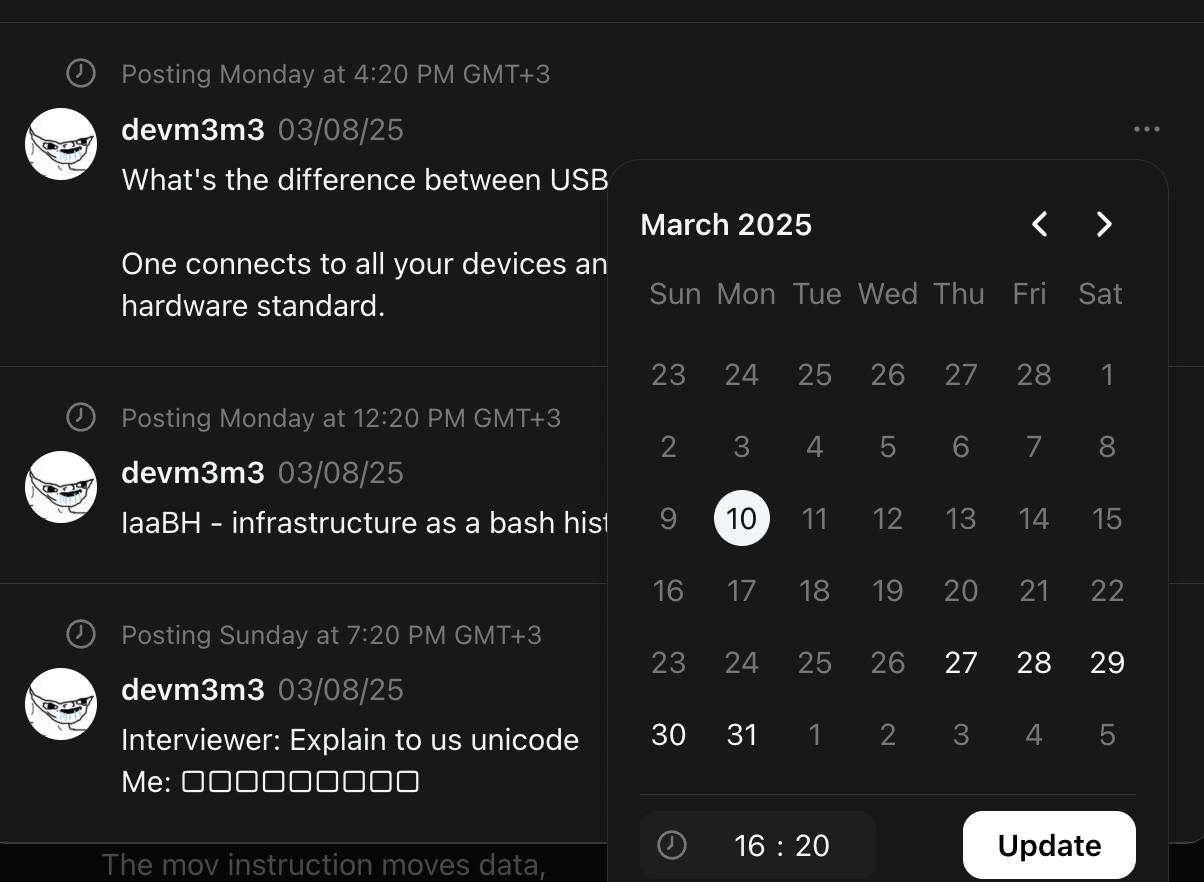
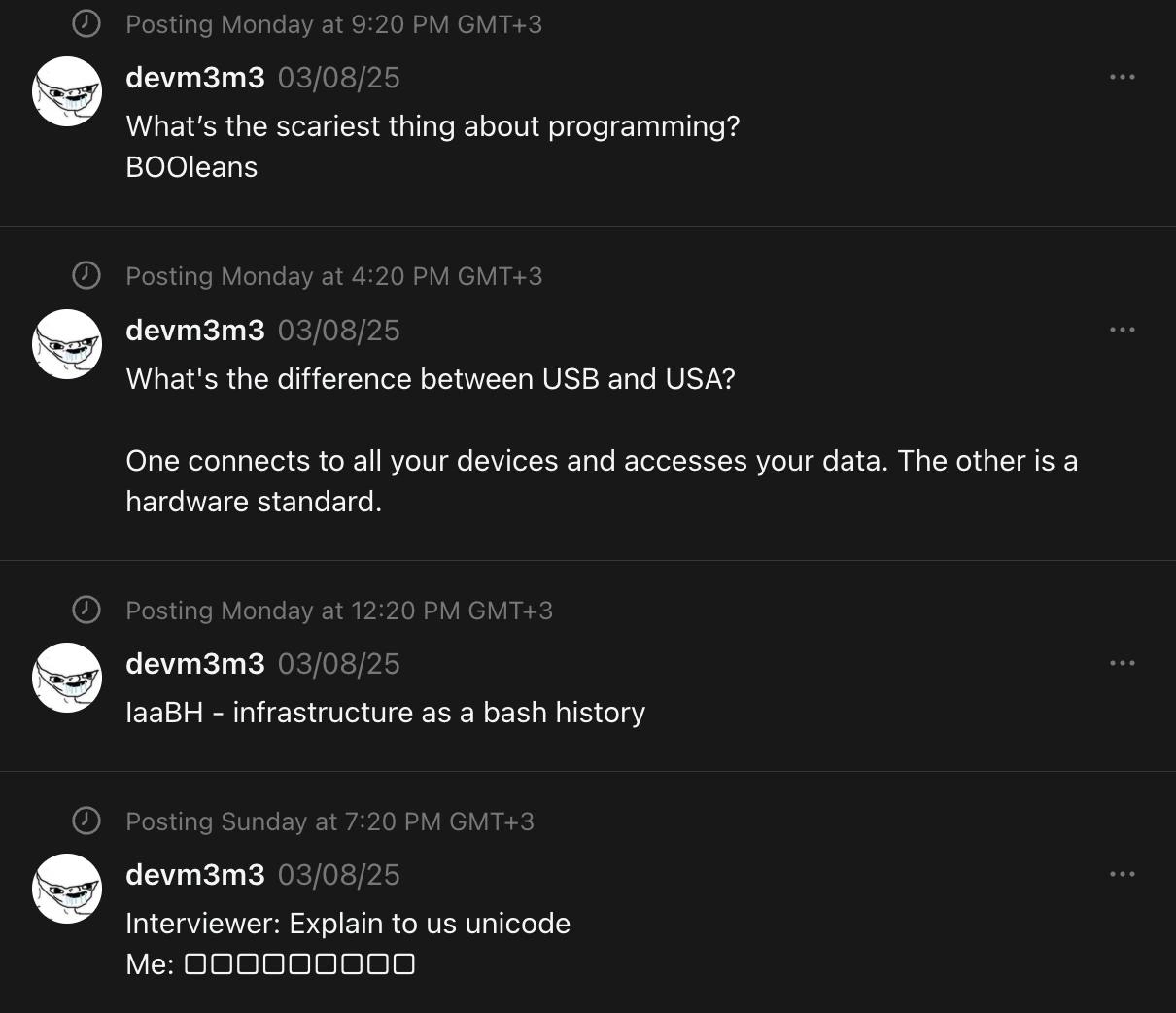
The Scene: On the left, we see a list of scheduled posts by a user named devm3m3 (a playful handle hinting at “dev memes”). Each entry shows:

  • The scheduled time (e.g. “Posting Monday at 4:20 PM GMT+3”),
  • The author (devm3m3) and a date (03/08/25, which here means March 8, 2025, the date it was scheduled or queued),
  • A preview of the post content (the start of a joke or meme caption).

On the right side is a date-time picker pop-up. That’s the little calendar and clock interface where you can choose the exact date (the calendar shows March 2025 with the 10th highlighted) and time (16:20 in 24-hour format, i.e. 4:20 PM) for a post, then hit an “Update” button to save it. This kind of UI component is common in scheduling apps – it lets you pick a day and time without typing it in manually. The whole app is in dark mode UI, meaning light text on a dark background, which developers often prefer for aesthetic and eye-strain reasons (plus, it just looks cool 😎).

So, what’s being scheduled? Three dev humor posts, each containing a tech joke:

  1. USB Joke: “What’s the difference between USB… One connects to all your devices an… (and presumably it continues)”. Here, USB refers to the Universal Serial Bus, which is the standard port/plug used to connect most computer peripherals (mice, keyboards, flash drives, you name it). It’s called “universal” because it was designed to be a one-size-fits-all connector (replacing a bunch of earlier port types). The joke likely compares USB to something else ironically. Without the full punchline it’s a bit mysterious, but it’s probably highlighting that USB’s universality can be ironic. (Maybe it compares USB to some truly universal thing, or maybe it’s a play on how marriage or friendship connects devices? Hard to say exactly, but the humor comes from the expectation vs reality of a “universal” standard.) The key point: it’s a hardware joke. To understand it, you just need to know USB is a super common connector standard that claims to be universal but has many versions (and the running gag that you always try plugging it upside down first!).

  2. IaaBH – “Infrastructure as a Bash History”: This one is clearer if you know a bit of DevOps lingo. Bash is the command-line shell that many developers use on Linux/Mac (the black screen where you type commands). Every time you type a command, it gets saved in your bash history (so you can press the up-arrow to see previous commands). Now, “Infrastructure as Code (IaC)” is a best practice where you define your server infrastructure setup in code or scripts (so it’s repeatable and version-controlled). The joke twists this into “Infrastructure as a Bash History (IaaBH)” – implying someone set up all their servers by manually typing commands into the CLI, and the only record of what they did is in the .bash_history file on their computer. 😅 It’s funny because it’s the opposite of proper automation: if that person leaves or their history gets cleared, poof! Nobody knows how the servers are configured. Many of us have learned (the hard way) that manual setups are risky. The meme is basically winking, “Ever seen an engineer run a bunch of stuff in a terminal and call it a day? Yeah, that’s their ‘infrastructure’ – hope nothing breaks!” This resonates with the DevOps/Automation theme: you’re supposed to automate with code, not by hand every time. Calling it IaaBH parodies those fancy cloud acronyms (IaaS, PaaS, etc.) to label a not-so-fancy reality.

  3. Unicode Interview Joke: The last one shows a mock interview exchange – Interviewer: “Explain to us Unicode.” Me: “▢▢▢▢▢▢▢▢”. Those little squares are the focus here. What is Unicode? It’s the standard system for encoding text in computers, covering virtually all writing systems and symbols. Back in the old days, we had ASCII, which could handle only English letters and a handful of symbols (a limited set of 128 or 256 characters). Unicode came along to support everything – all languages’ characters, emojis, math symbols – by using more bits per character and a huge code space. But here’s the catch: to display a Unicode character, your font and software need to support it. When they don’t, you see those empty square boxes (often called “tofu” in developer slang) in place of the real character. In the meme, when asked to explain Unicode, the interviewee “responds” with a series of squares – implying either they answered in some obscure language or symbol that didn’t render (thus demonstrating Unicode issues), or they simply had no idea and that was the gibberish that came out. Either way, it’s a joke about how Unicode support can be tricky. Even if you understand Unicode conceptually, showing it in practice might literally not show up! If you’ve ever opened a text file and seen weird symbols or question mark boxes instead of normal text, you’ve encountered encoding problems. It’s a rite of passage for new devs to eventually find that handling text isn’t as straightforward as it seems (what with byte orders, UTF-8 vs UTF-16, etc.). This meme jokingly turns that into an interview scenario. It’s also poking fun at the difficulty of explaining something as broad as Unicode in a short answer.

The Automation Angle: All these jokes are being scheduled to post automatically at specific times. This is something content creators and community managers do a lot – they plan posts ahead of time so they can maintain a regular posting schedule without being at the keyboard 24/7. In a dev community context, it means devm3m3 can queue up jokes for the week and have them post at, say, lunch hour or late evening when more devs are online to enjoy them. That’s the DeveloperExperience_DX and Automation tag tie-in: the tool is supposed to improve the user’s experience by automating the posting.

But scheduling in software comes with challenges:

  • Time Zones: The times listed (7:20 PM Sunday, 12:20 PM Monday, 4:20 PM Monday) all say GMT+3. GMT is Greenwich Mean Time (essentially the baseline world time), and +3 means three hours ahead of that. So if it’s 4:20 PM GMT+3, that’s 1:20 PM GMT (or UTC, which is almost the same thing). The user likely set their local timezone, or the app did, so everyone sees times in a consistent way. But if someone in New York (which is GMT-4 or -5 depending on DST) were using this, their Monday 4:20 PM GMT+3 post would actually show up at 8:20 AM New York time, since New York is 8 hours behind GMT+3 when DST isn’t in effect. This can confuse people scheduling across regions. Newer devs learn that dealing with time zones means constantly converting and being careful – which is why many apps internally use UTC (Coordinated Universal Time) then convert to local for display. In practice, you might schedule “Monday 4:20 PM” thinking in your time, and someone else sees it at a different local time. You have to trust the tool to handle it, and that’s why it’s a point of potential failure (we’ve all had to double-check “is that 4:20 my time or the server’s time?”).

  • Daylight Saving Time (DST): This is a specific time zone headache. DST is when clocks shift forward or backward by an hour in spring or fall. If you schedule something during a DST transition (like the night the clocks change), weird stuff can happen. For example, in many places clocks go forward one hour in spring (so the time jumps from 1:59 to 3:00, and the hour of 2:00-2:59 doesn’t happen that day). If someone naively set an event at 2:30 AM on that date, it will never occur, because 2:30 AM was skipped! Conversely in the fall, an hour repeats (clocks go back from 2 AM to 1 AM again), so scheduling something in that overlapping hour could run twice. It’s confusing! The meme alludes to this kind of scenario – that under the hood, scheduling posts might run into DST issues. Usually, libraries handle it, but bugs happen if not configured right. As a new dev, you’ll inevitably come across code or APIs (like JavaScript’s Date or Python’s datetime) where you need to be mindful of these things or use reliable libraries (like moment.js in JS or pytz in Python) to get it right.

  • Locale Settings: A locale is basically the region/language settings of a system, which affect how things like dates, times, and numbers are displayed. For example, US format for dates is month/day/year, while many other countries use day/month/year. If the app or database expects one format and gets another, it can mix up dates (as we saw with that 03/08/25 example). Also, locales determine the language of month names, etc. Ever use software where suddenly the months are in Spanish or French because of a setting? That could break code that isn’t internationalized. In scheduling, you have to ensure that when you say “Monday” or “March,” the system knows what you mean in a consistent way. It’s another layer where bugs creep in – say the system tried to parse “03/08/25” as August 3 instead of March 8, that’s a big difference! In production systems, misinterpreting a date like this could result in posting on the wrong day. The meme’s context implies that even this fancy posting tool could suffer from those classic off-by-one-month or off-by-one-hour mistakes if it’s not built robustly.

Now, the term “fighting the date picker in production” is a fun exaggeration. “In production” usually means on the live system (as opposed to in testing). It evokes an image of a developer literally struggling with a calendar widget as if it’s a bug in their live website. The reason it’s phrased that way is to be dramatic and relatable – every dev has had a moment where a seemingly tiny UI element (like a date picker) caused outsized frustration while on the job. Maybe it didn’t select the correct date, or it was confusing to use, or you weren’t sure if it saved properly. It’s the kind of trivial thing that can feel like a battle when you’re rushing (thus “fighting” it).

Dev Communities and Automation: This meme also touches on how developers share humor within their communities. The posts being queued are all classic DeveloperHumor material – mixing references to command lines, hardware standards, and encoding (Unicode). Platforms like Twitter, Reddit, or Dev.to often see these jokes posted regularly, sometimes even on a schedule like “Meme Monday” or daily dev jokes. So devm3m3 scheduling posts is like a community manager for dev jokes. The fact they’re using automation (a scheduling queue) to do it is both practical and a bit humorous in itself – it’s very in-character for a developer to automate even their jokes deployment! There are even CLI tools and APIs to schedule tweets or posts, so it’s not far-fetched that a dev would set up a whole system just to drip-feed their puns at optimal times.

In summary, each part of this meme connects to a concept a junior dev might encounter soon:

  • The CLI vs UI theme: using a GUI calendar vs scripting tasks. You’ll find both in the real world. Sometimes clicking a calendar is easiest; other times writing a bash script to schedule tasks with cron is more flexible. This meme shows even when we have a nice UI, the old CLI-centric problems (time zones, etc.) still need attention.
  • The idea of Infrastructure as Code vs doing things manually: It’s a gentle introduction to why automation and proper devops practices exist (to avoid the “bash history as documentation” scenario).
  • The trickiness of Unicode and internationalization: Not everything is ASCII, and when you venture beyond, you might see those squares or have to understand what Unicode is. For instance, printing emoji on your first project might lead you down a path of “why does it show as � on my page?”.
  • The perennial hassle of time zones and DST in programming: if you haven’t dealt with it yet, you will. It’s one of those common pitfalls (there are famous blog posts like “Falsehoods Programmers Believe About Time” enumerating how many ways you can get it wrong).

And importantly, the meme is funny to developers because it’s true – we joke about these things precisely because they have tripped us up. It builds camaraderie: “Hey, we’ve all written something that blew up due to a silly time/locale issue or had an interview go sideways on an unexpected question, right?” Seeing these jokes queued up for posting just brings all those shared experiences together in one image.


Level 3: Time Zone Turmoil

At first glance, this meme shows a developer’s sleek dark mode UI for scheduling posts – complete with a calendar widget and queued jokes – but under the hood it’s poking fun at the perennial headaches of time zones, locale, and other gotchas that haunt even seasoned engineers. Here, user devm3m3 has three humorous posts lined up in a social post queue with specific future times (e.g. “Posting Monday at 4:20 PM GMT+3”). The right side displays a calendar scheduler UI (the date-time picker) used to set those times. To a senior developer, the humor cuts deep: we’re automating our witty dev jokes with the very tools that often break due to locale settings or daylight-saving quirks – it’s irony layered on irony.

Let’s unpack the queued posts themselves, because each one is a nod to a classic tech gag or pain point:

  • USB vs. “Universal” Standard: The first scheduled joke starts with “What’s the difference between USB…”. USB stands for Universal Serial Bus, a hardware connector meant to be universal. The punchline (partially visible) hints that one “connects to all your devices” and the other “is a hardware standard.” It’s an ironic jab at USB’s not-so-universal reality. Senior devs remember the chaos of different USB plug types (Type-A, Micro-B, USB-C…) and the legendary “USB orientation test” (flip it three times before it fits). Calling USB “universal” while it keeps changing shape is peak hardware humor – we’ve lived through the glorious simplicity headache of too many standards. The joke is essentially saying: one of these things truly connects everything, and the other is just a standard on paper. It’s a tongue-in-cheek way to mock how hardware standards often fail at being as universal as they claim.

  • IaaBH – Infrastructure as a Bash History: The second item, scheduled for Monday at 12:20, reads “IaaBH – infrastructure as a bash his…”. This is a play on the term Infrastructure as Code (IaC) and the cloud acronym IaaS (Infrastructure as a Service). Instead of using proper scripts or configuration management, some poor soul set up servers step-by-step in the shell and basically said “my bash_history file is my deployment plan.” It’s an automation anti-pattern that every cynical ops engineer has seen: servers configured with fragile one-off commands nobody documented except in their command history. 🤦‍♂️ In real life, this leads to technical debt so thick you could cut it with a knife – rebuilds are impossible because only the original person’s CLI remembers what they did. Senior devs chuckle (or cringe) because they’ve likely untangled such a mess at 3 AM, wishing the previous engineer had used Ansible or Terraform instead of an SSH session and hope. Infrastructure as a bash history perfectly satirizes that cowboy DevOps approach.

  • Unicode “Squares” Interview Question: The third post, set for Sunday at 7:20 PM, shows an interview scenario: Interviewer: Explain to us Unicode. Me: ▢▢▢▢▢▢▢▢. Those white square blocks (often called tofu) represent unrecognized characters. This joke works on multiple levels. First, it’s a classic bit of InterviewHumor – the candidate is ostensibly trying to demonstrate Unicode by using some fancy characters, but they just render as empty squares, effectively proving how tricky Unicode can be. Or maybe the candidate had no clue and just answered with nonsense, which the system literally couldn’t render. Either way, for those who have wrestled with UTF-8 vs latin-1 vs Windows-1252 encodings, it’s a knowing laugh. Senior devs recall times when logging an emoji or foreign character resulted in □□□□ in their logs or when a production page showed � (the dreaded replacement character) because of a Unicode mix-up. The interview prompt “Explain Unicode” is comically broad – Unicode is complex, covering millions of code points, combining characters, emoji skin tones, right-to-left scripts… Explaining it off the cuff is hard. The meme’s punchline is effectively “Here’s my explanation: [unintelligible output]” – which is the experience of dealing with Unicode on an unprepared system. It’s the perfect developer humor: demonstrating the problem as the answer.

Now, the irony that really makes experienced devs smirk: all these jokes about tech snafus are being meticulously scheduled via a modern app interface – something that itself can suffer from tech snafus like time zone conversion errors and finicky date pickers. We have a slick scheduler for “thought leadership” dev posts, but using it can feel as fraught as deploying code to production on Friday. The meme specifically highlights “fighting the date picker in production,” which is hilariously relatable. Anyone who’s dealt with scheduling systems knows how a simple date-time picker can become an adversary:

  • Time Zones and DST: The posts are scheduled for specific times in GMT+3. Any senior dev’s spider-sense tingles here: “Will this go out at the right moment in every locale? What about DST?” We’ve all seen scheduling jobs or calendar events go haywire around Daylight Saving Time changes. That Monday 4:20 PM GMT+3 post? If GMT+3 is a region that observes DST, what happens if a clock change occurs on Sunday? Is Monday still GMT+3 or did it shift to GMT+4? One classic bug: events magically moving an hour forward/back in your calendar because the DST boundary wasn’t handled. The meme copy even nods to this: these tools “still break on locale settings and daylight-saving shifts.” Falsehoods programmers believe about time could be its own gospel, and here those ghosts loom in a silly context. It’s funny because scheduling a joke post shouldn’t require thinking about the IANA time zone database – but in practice, it might. Senior devs have learned (often painfully) that Time is one of the hard problems in computer science.” If not for DST, GMT offsets, and leap seconds, a Monday 16:20 would be straightforward. But in reality, we’ve had production incidents where a job scheduled at 2:30 AM skipped or ran twice because the clocks changed. That memory turns a simple content calendar into a battlefield scenario in our minds.

  • Locale and Date Formats: Notice the date notation “03/08/25” next to devm3m3’s name. Depending on where you’re from, “03/08/25” could mean March 8, 2025 (if you use MM/DD/YY) or 3 August 2025 (if you use DD/MM/YY). The UI likely means March 08, 2025 (since the calendar shows March 2025 with the 10th highlighted for Monday). But a slight locale mix-up, and you’d schedule for the wrong day or be utterly confused. Senior engineers have encountered systems where the frontend was in one locale and the backend in another, causing off-by-one-month errors or failed parses. For example, a quick illustration in code:

from datetime import datetime
print(datetime.strptime("03/08/25", "%m/%d/%y").strftime("%B %d, %Y"))
print(datetime.strptime("03/08/25", "%d/%m/%y").strftime("%B %d, %Y"))
# Output:
# March 08, 2025
# August 03, 2025

Whoops! The same "03/08/25" string can be March 8th or August 3rd depending on locale-specific format. A junior dev might accidentally deploy code that assumes one format, and suddenly the content calendar is posting in August instead of March. Locale settings also affect things like weekday names, time 12h vs 24h, etc. If the scheduler app or user’s browser isn’t consistent, you get scheduling bugs that are maddeningly hard to trace. This meme squeezes a chuckle out of that pain – the senior crowd knows that an innocuous date picker can hide a minefield of assumptions.

  • Friction in the UI: That date_time_picker_friction is real. Ever tried clicking a tiny clock icon, selecting a date three weeks out, and then realized the time reset to 00:00 or AM/PM flipped? Or the picker was in UTC by default without telling you? We have. 😑 What should be a quick task (“set it and forget it”) turns into multiple tries. In a production environment, “fighting” such a widget might mean your scheduled announcements or cron jobs don’t go out as planned. The meme exaggerates it as a battle, which rings true to anyone who’s wrestled with an uncooperative scheduling UI while a deadline looms.

The DevOps folks in the room will also appreciate the contrast between doing things in a slick GUI versus via code. Many senior devs would say, “Forget the UI, I’ll write a quick script with cron or GitHub Actions to post at 16:20 every Monday.” That’s the engineer mindset: if a GUI tool gives trouble, automate it with code. But here, the dev is using a UI – maybe because it’s a shared DevCommunity platform or they wanted a visual calendar. It’s a bit of a role reversal: the command-line guru scheduling memes with a mouse click, and encountering the kind of finicky issues we usually inflict on end-users. There’s comedic justice in that.

And speaking of automation irony: the meme’s caption notes “automating thought-leadership posts” with tech that can fail in basic ways. It lightly roasts how even Developer Experience (DX) tooling can be polished on the surface (dark mode, intuitive layout) yet still trip on fundamental issues. It’s like deploying a cutting-edge microservice that – oops – crashes because of a timezone parsing error in logs. We build fancy systems, but the basics (time, text encoding, etc.) can still humble us. Senior engineers have a term for this feeling: yak shaving – you just wanted to schedule some jokes, but now you’re debugging timezones or character sets.

Finally, there’s an Easter egg: scheduling a post at 4:20 PM. The choice of “4:20” is likely not random – it’s a wink for those in the know (a culturally meme-worthy time of day). It’s the kind of cheeky detail a dev with a sense of humor sneaks in (much like committing code at 4:20 or overusing 420 or 69 in examples). Senior devs notice these little signals of meme literacy. It tells us the person scheduling these posts is having fun and knows their audience.

In sum, the deepest layer of this meme revels in shared technical pain. It comedically combines automation and friction: a developer auto-posting clever CLI and Unicode jokes, all while grappling with the age-old tech demons of time zones and encoding. Seasoned developers are laughing because they’ve been there – deploying fixes for “off-by-one-day” errors, unraveling mysteriously garbled text, or recovering infrastructure that existed only in someone’s head and bash history. The meme manages to be absurd and truthy at the same time: even our joke-posting pipeline isn’t safe from the Time Zone Turmoil and other gremlins. It’s a reminder that in software, no matter how advanced we get, the simple things (like dates and strings) can still slap us in the face – and sometimes all we can do is schedule a laugh about it.


Description

A dark-themed social-posting dashboard shows three queued items by the user “devm3m3”. Lines read, “Posting Monday at 4:20 PM GMT+3 | devm3m3 03/08/25 | What’s the difference between USB… One connects to all your devices an…”, followed by, “Posting Monday at 12:20 PM GMT+3 | devm3m3 03/08/25 | IaaBH - infrastructure as a bash his…”, and, “Posting Sunday at 7:20 PM GMT+3 | devm3m3 03/08/25 | Interviewer: Explain to us unicode Me: ▢▢▢▢▢▢▢▢”. On the right, an overlay date-time picker shows “March 2025” with the 10th circled, a time field set to “16 : 20”, and an “Update” button. The visual juxtaposes terminal-centric humor (IaaBH), hardware/Unicode quips, and the all-too-familiar struggle of aligning content calendars. Senior engineers will recognise the irony of automating thought-leadership posts with the same tools that still break on locale settings and daylight-saving shifts
Comments

6
Anonymous ★ Top Pick Infrastructure-as-Bash-History is perfect - right up until git blame prints “!!” instead of a commit hash and your DR strategy boils down to the up-arrow key
  1. Anonymous ★ Top Pick

    Infrastructure-as-Bash-History is perfect - right up until git blame prints “!!” instead of a commit hash and your DR strategy boils down to the up-arrow key

  2. Anonymous

    The calendar picker is the only component in our app that actually knows what day it is, which explains why it keeps trying to schedule meetings during production incidents

  3. Anonymous

    When your infrastructure documentation is just `history | grep terraform` and you call it IaaBH (Infrastructure as a Bash History), you've achieved peak DevOps efficiency - until someone runs `history -c` and takes down production. Meanwhile, explaining Unicode to interviewers is easy: just show them □□□□□□□□□□ and watch their terminal struggle with the same encoding issues that have haunted us since the '90s. At least USB is simple: one standard connects to all your devices... assuming you can figure out which of the 47 USB specifications and connector types you're actually dealing with

  4. Anonymous

    IaBH: when your architecture diagram is `history | tail -50` and your Unicode interview prep is nine tofu squares - the only thing harder is scheduling 16:20 in GMT+3 without accidentally turning it into a Friday deploy

  5. Anonymous

    Every “simple” scheduler is secretly a distributed-systems problem with daylight saving as your chaos monkey

  6. Anonymous

    USB: versioned specs. IaC: 'Ctrl+R until it works' versioning

Use J and K for navigation