Skip to content
DevMeme
376 of 7435
Senior Devs Welcome Juniors to the 'Broke Prod' Club
OnCall ProductionIssues Post #440, on Jun 5, 2019 in TG

Senior Devs Welcome Juniors to the 'Broke Prod' Club

Why is this OnCall ProductionIssues meme funny?

Level 1: We’ve All Been There

Imagine you’re a kid who just accidentally knocked over a big glass of juice on the living room carpet. It’s your first time making a really big mess, and you’re sure you’ll be in huge trouble. You feel scared and start to panic. But then, instead of yelling, your older brother or sister just gives a little smile and says, “First time spilling something big, huh?” They seem so relaxed, maybe even a bit amused, because they remember the first time they did something like that too. In fact, they’ve knocked over plenty of drinks and made plenty of messes over the years.

This meme is playing on that exact feeling. The new developer is like the scared kid who spilled juice, and the senior developers are like the older sibling smiling and saying “Yeah, we’ve all been there.” It’s funny because you’d expect everyone to be mad or frightened when a big mistake happens, but instead the experienced people are super calm. They know that mistakes happen to everyone, and the best thing to do is just fix the problem and learn from it. The phrase “First time?” in the picture is their gentle, joking way of saying, “Don’t worry, you’re not the first and won’t be the last to mess up. Welcome to the club!” It’s a warm kind of humor — reminding us that even when we feel really upset about messing up, chances are the people around us have made the same kind of mistake before and understand exactly how we feel. In other words, we’re never alone in making a big oops, and that shared understanding is what makes this scenario oddly comforting and funny.

Level 2: On-Call Crash Course

So what’s going on in this meme? It’s showing a junior developer who accidentally broke something important in the production environment, and the senior developers reacting in a surprisingly chill way. Let’s break down the terms and scenario in simpler words:

  • Production: This is the live system that real users are using. It’s not a test environment or your local laptop; it’s the real deal (the website, app, or service running for customers). When we say “broke something in production,” we mean the rookie did something (perhaps a bad code deploy or a misconfiguration) that caused a major problem or outage in that live system. It’s every new developer’s worst nightmare: you push an update, and suddenly the website is down or a critical feature stops working for everyone.

  • Sev-1: Companies classify incidents by severity (how bad the problem is). “Sev-1” stands for Severity Level 1, which is the highest level of crisis — think of it as a code red emergency. A Sev-1 typically means the service is completely down or a crucial part of it is broken for a lot of users. It’s the kind of incident that wakes people up at night. Lower severity levels (Sev-2, Sev-3, etc.) might be partial outages or bugs that can wait a bit, but Sev-1 is all-hands-on-deck, drop-everything-now. In the meme, the rookie has triggered a Sev-1 outage, and they’re likely freaking out because the stakes are so high.

  • On-call: Many DevOps teams have an on-call rotation, meaning at any given time, a specific engineer is responsible for responding to emergencies. If something breaks at 2:00 AM, the on-call person’s phone (or pager app) will go off. Being “on-call” is like being a firefighter for software: you have to be ready to put out the fire (fix the issue) whenever it happens. These incidents can indeed feel like nightmares if you’re not used to them — hence the tag OncallNightmares. Senior devs have probably taken many on-call shifts, so a late-night emergency is almost routine for them. Newcomers, on the other hand, might be on-call for the first time and suddenly get that heart-stopping alert saying something is down. It’s a baptism by fire.

  • Incident response and war room: When a Sev-1 happens, the team goes into incident response mode. This usually means everyone hops on a group chat or call (informally called a “war room”) to collaborate on fixing the issue ASAP. It’s called a war room because it’s like crisis command central — people are communicating rapidly, sharing findings, and executing fixes, all in real-time. For example, you might see messages flying: “Okay, database CPU is at 100%, investigating queries…” “Rolling back the last deployment now…” The rookie in question might be in that war room call panicking, while the seniors are calmly dividing up tasks to tackle the problem.

  • Runbook: A runbook is a prepared guide or document with step-by-step instructions on how to handle common issues. Think of it like a firefighter’s manual for software emergencies. For instance, a runbook might have: “If the database is down, do X, Y, Z.” Experienced engineers rely on runbooks during incidents. Instead of guessing, they follow proven steps: check the logs here, restart that service there, etc. In the meme scenario, while the newbie is flustered (“Oh no, I broke it, what do I do?!”), a senior dev might already be flipping to the known outage procedure: restart service, clear cache, call database admin, and so on. Their calm comes from familiarity – they might have done this process 5 times before.

  • Blameless postmortem: This is a meeting after the incident has been resolved, where the team analyzes what happened. “Postmortem” literally means “after death,” and while thankfully no one dies from a server crash, it’s the term used for the after-action review of an outage. Blameless means they approach it without accusing or punishing the person who made the mistake. Instead, they focus on the root cause analysis: figuring out the chain of events and causes that led to the failure. For example, the root cause might turn out to be “We didn’t have a safeguard on the deployment script, so it ran on the wrong server,” or “This configuration wasn’t caught in testing.” The idea is to learn and improve the system, not to make the newbie feel awful. Senior developers will often share their own past mistakes during a postmortem to emphasize that everyone slips up. The whole process is about making the system safer and the team wiser. In many modern tech cultures, a blameless postmortem is standard practice after a Sev-1. This way, the rookie who broke production can openly discuss how it happened without fear, and the team can add new checks or warnings so that particular mistake is less likely to happen again. It’s constructive and turns a scary event into something beneficial for the future.

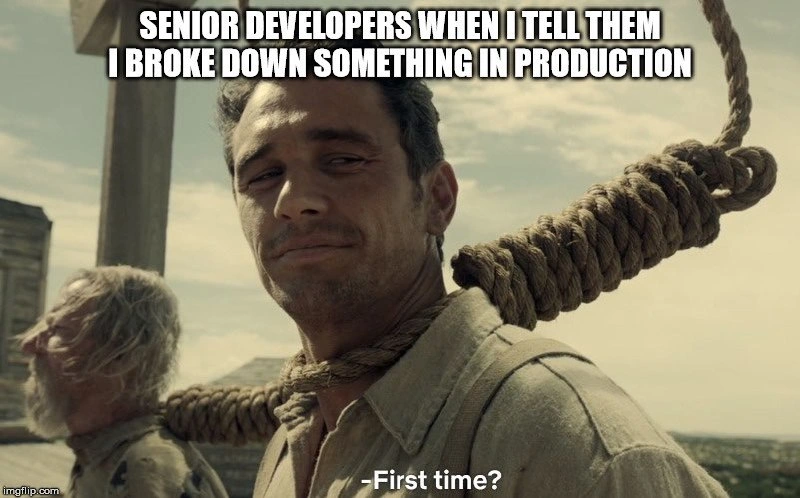
Now, the meme’s punchline is the senior guys saying “First time?” to the panicking rookie. This image actually comes from a movie scene that has become a popular meme template for any situation where someone is going through a tough experience for the first time, and another person who’s been through it before is just calmly like “Yeah, I’ve been there.” It’s a form of gallows humor – making a joke in a dark situation. Here the “dark situation” is a production outage (in the image it’s literally people with nooses, which symbolizes how dire and grave it feels when you think you’ve made a career-ending mistake). The senior developers have a calm, almost joking manner because, to them, this is familiar territory. The rookie’s freaking out because they think “Oh no, I took down the site, this is the worst thing ever!” Meanwhile, the seniors are basically shrugging and smirking because they recall their own first big screw-up and how HUGE it felt at the time. They’re not actually happy the site is down; they’re just not surprised by it.

For a newer developer, it’s important to know that making mistakes is normal. If you accidentally deploy a bug or misconfigure something that causes a problem, you’re definitely going to feel awful — that’s natural. But the reason the seniors are so relaxed (and why this is a relatable developer experience turned into humor) is that every developer, even the best, has a story of “that time I broke production.” Maybe they deleted the wrong database table, or pushed code that crashed an app, or took down an internal service by accident. It’s almost like a tech industry rite of passage. The first time, you feel like the world is ending. The second or third time, you’re still upset, but you’ve gained perspective: you know it can be fixed, and you know you’re not going to be fired as long as you handle it responsibly. The meme is basically the older devs telling the newbie, in a teasing but empathetic way, “Hey, first big outage? You’ll survive. We all did.”

So, the key takeaway in plain terms: Production issues happen to everyone. Being on-call and facing a serious outage is scary at first, but with experience, engineers learn to stay calm and follow procedure. Senior developers might even joke about these crises because humor makes the stress more bearable. The image of them saying “First time?” shows they recognize the rookie’s fear, but they also know this incident is just the beginning of that developer’s journey towards becoming seasoned. In the end, this meme is popular in developer humor circles precisely because it’s true – it’s simultaneously comforting and funny to realize that the terrifying “first big mistake” you make doesn’t actually single you out. The veterans have all been through it too – and they’re still here, coding away.

Level 3: Sev-1 Rodeo

For a senior developer or battle-hardened SRE, a Sev-1 outage is just another rodeo. The meme captures this perfectly with an Old West gallows scene: the newbie is panicking at the noose, while the grizzled veteran next to him manages a wry smile. In text form, it’s essentially:

Rookie Dev: (wide-eyed terror) "I... I broke production, the site is down!"
Senior Dev: (with a slight smirk) "First time?"

That calm, almost amused response “First time?” is dripping with gallows humor. It implies the seniors have been “hung” by production issues many times before and lived to tell the tale. They greet the rookie’s first big screw-up not with anger, but with a sort of friendly cynicism: “Oh, you tripped over a wire and blew up the server? Welcome to the club.” It’s an initiation ritual in DevOps culture. In fact, there’s a popular inside joke: “There are two types of engineers: those who have broken production, and those who will.” Breaking something in production is almost a rite of passage — a grim one, sure, but nearly every experienced engineer has their war stories. The meme resonates because it’s so true. Seasoned devs immediately recognize that mix of panic and fatalistic resignation. They’ve been on both sides: once the terrified newbie who thought a single mistake might end their career, and later the veteran who’s seen so many ProductionIncidents that one more barely raises their blood pressure.

Why is this funny? It’s the contrast between expectation and reaction. You’d expect a production outage (also known as a P1 incident or OncallNightmare) to be met with shouting, alarms, chaos. And yes, there’s certainly adrenaline in a real Sev-1. But veteran engineers often develop a strangely calm demeanor during crises. It’s not that they don’t care — it’s that they’ve been through the fire so many times that panic is a wasted emotion. They know the drill: jump on the war room call, check the monitors, follow the runbook. The image of a man calmly standing on the gallows is a perfect metaphor for that fatalistic calm. When your pager has dragged you out of bed for the 7th time this month, you might just yawn, make a dark joke about ProductionIssues, and get to work fixing things. As the meme subtitle says, “First time?” — implying the seniors are thinking, “This isn’t my first outage rodeo, kid.”

The specific scenario hinted by the meme (“I broke something in production”) is painfully familiar in tech teams. Maybe the rookie toggled an innocent-looking feature flag that unexpectedly caused a cascade of errors. Or they deployed a patch on Friday evening (classic mistake — seasoned devs live by “never deploy on a Friday” for a reason) and it brought down a critical microservice. The veterans have seen it all: from accidentally deleting the production database with a stray script, to a misconfigured DNS entry taking out an entire region. Some incidents are downright bizarre — the kind of bugs where a senior might shake their head and mutter “It’s always DNS or some config we forgot about.” They’ve learned that root cause analysis often reveals systemic issues, not just “junior made a typo.” Sure, the newbie flipped the switch, but why did that bring everything down? Perhaps the system had a single point of failure, or an untested edge case. The senior engineers know the real fixes usually involve improving infrastructure or processes (like adding a safety check, better testing in staging, or more redundancy), rather than simply scolding the individual.

This meme also pokes at the blameless culture that good DevOps and SRE teams strive for. Notice, the senior devs aren’t angry at the rookie — they’re almost sympathetic, even lightly amused. In a healthy engineering culture, the response to a Sev-1 caused by a newbie isn’t “Who screwed up? Fire them!” Instead it’s “Okay, let’s solve this now and figure out how to prevent it next time.” That’s where the blameless postmortem comes in after the dust settles. The experienced folks will gather everyone (including the chastened rookie) to do a post-incident review: What exactly happened? How can we improve our tooling or training so one mistake doesn’t take down production? The focus is on Production system weaknesses and process gaps, not on shaming the person who happened to trigger the failure. This approach both fixes the actual problem and teaches the rookie without scaring them off. The meme’s dark joke, however, is that before all the retrospective learning, there’s that moment of sheer horror for the first-timer — and the seniors recognize it instantly because they’ve been there. They likely exchanged knowing looks over the conference call or Slack: “Ah, she pushed a bug to prod and is freaking out… first time, huh? Poor kid.”

We also see an implied camaraderie. Seasoned devs swap outage stories like veterans swap battle tales. Being “on-call” and handling 2 A.M. crises tends to bond teams in a mix of trauma and humor. It’s common to hear semi-sarcastic lines like, “We survive on coffee, sarcasm, and a well-documented runbook.” If you wander into an SRE team’s chat during a firefight, you might even catch a kind of jokey calm:

  • Alert: “Disk space 100% on primary database – services failing!”
  • Rookie: “Oh no oh no, what do we DO?!”
  • Senior: “Alright, looks like the logs filled the disk again. Classic. Time for the usual cleanup script. First time hitting this one, eh?” 😏

(The senior might even throw in that smirking emoji, embodying the “First time?” attitude.) It’s not that senior devs take outages lightly – they just don’t panic because panic doesn’t solve anything. They know incident response is a process: check the dashboards, communicate with stakeholders, apply mitigation, verify recovery. Experience has taught them to be methodical. As a result, their heart rate during a Sev-1 might barely tick up, whereas a newbie’s heart might be pounding out of their chest.

To put it in perspective, here’s how the reactions tend to differ:

Rookie in a Sev-1 Senior in a Sev-1
Panic: heart racing, thinking “I’m fired.” Calm: takes a deep breath, pulls up the monitoring dashboard.
Scrambles without a plan, maybe tries random quick fixes. Follows the runbook playbook step by step, checks known failure points.
Profusely apologizes on chat: “I broke it, I’m so sorry!” Stays objective: “Service X is down, looking at logs now.” (No time for blame, just facts.)
Feels personal guilt and fear. Focuses on technical resolution and team coordination, then postmortem learning.
After resolution, is shaken, dreads the review. After resolution, cracks a joke: “Well, add that one to our war stories,” and starts planning the postmortem.

The humor in the meme comes from that final row: the senior’s almost casual “add it to the war stories” attitude contrasted with the junior’s shaken state. It’s a dark comedy born from the RelatableDeveloperExperience of anyone who’s done on-call duty. The image uses a literal gallows to symbolize a Sev-1 outage: it feels life-or-death in the moment (even though in reality, it’s just servers and software on the line, not lives). The older-looking guy calmly accepting his fate represents the senior devs who have accepted that outages happen. The newbie with the noose around their neck for the first time captures that “oh no, this is the end” feeling every developer has the first time they accidentally take down a system. The senior’s quip “First time?” both acknowledges the gravity and trivializes it at once – a perfect gallows humor encapsulation of DevOps life.

Interestingly, this meme format itself (the “First time?” scene from a James Franco movie) became popular because it’s so flexible. In the context of DeveloperHumor, it nails the dynamic between Senior vs Junior developers. You’ll see it used whenever a novice is freaking out about something and the veteran next to them has seen that movie before. Production outages are basically the pinnacle of that scenario in tech. It’s practically tradition for the first major blunder of a junior dev to be met with a joking empathy from seniors. They might even share their own first-time horror stories in response, turning the whole situation into a learning moment and a humorous bonding experience. After all, nothing builds team spirit like collectively bringing a dead service back to life at 4 AM, then reminiscing about it over coffee the next day. In a strange way, these OncallNightmares become the stuff of legend that define an engineer’s career growth. Today’s panicked rookie is tomorrow’s wise old-timer saying “Been there, done that” to the next generation – and so the cycle continues.

Level 4: Inevitable Outage Theorem

In the grand scheme of distributed systems and DevOps engineering, the scenario depicted isn’t just anecdotal – it’s practically mathematical. Modern services are enormously complex: hundreds of microservices, distributed databases, caches, and networks all interwoven. According to reliability theory, as the number of deployments and components grows, the probability of something going wrong at some point approaches 1. In formal terms:

$$ \lim_{n\to\infty} P(\text{no incident after $n$ deployments}) = 0, $$

meaning given enough code pushes or config changes, an outage will happen. This is like an unwritten Inevitable Outage Theorem in Site Reliability Engineering. We even have grim aphorisms like Murphy's Law ("anything that can go wrong, will go wrong") which practically becomes a natural law of production. Every seasoned SRE internalizes this. It’s why we design systems with resilience in mind – not to prevent every failure (an impossible task), but to handle failures gracefully.

There are fundamental computer science and systems limits that guarantee occasional downtime. For instance, the CAP theorem shows that a distributed system can't simultaneously have perfect Consistency, Availability, and Partition tolerance – so if a network partition occurs, you must sacrifice either consistency or availability. In practice, that may mean a Sev-1 incident (loss of availability) is inevitable under certain conditions. Similarly, the FLP result in distributed consensus proves that no algorithm can guarantee reaching agreement in an asynchronous network with even one faulty node. These theoretical constraints ensure that even with great design, your cluster might hit a scenario where it can’t respond or coordinate – cue another page at 3 AM.

Rather than chasing mythical 100% uptime, advanced teams use strategies to cope with guaranteed failures. Chaos engineering (like Netflix’s famous Chaos Monkey) actively injects failures into systems in controlled ways. Why? To expose weaknesses and ensure the system can survive when real chaos strikes. It's an acknowledgment that outages will happen, so better to practice surviving them. Likewise, SREs manage error budgets in their SLO (Service Level Objectives): for example, accepting a few hours of downtime per quarter as the price of rapid innovation. This concept of an “error budget” is mathematically and pragmatically derived: if your target is 99.9% uptime, that translates to ~43.8 minutes of allowed downtime per month. Even top-tier “five nines” (99.999%) reliability permits about 5 minutes of downtime a year. In other words, some production failure time is literally built into the plan. Veteran engineers know that zero downtime indefinitely is a fantasy – so the game becomes about minimizing blast radius, not pretending you’ll never mess up.

This meme’s darkly humorous calm in the face of a disaster reflects that deep truth of complex systems: failures are normal events, statistically certain and even necessary for learning. As one war-weary principle in engineering management states, “failures are the crucible of improvement.” Experienced teams treat a Sev-1 not as an if but a when, and they architect systems with redundancy, graceful degradation, and rapid recovery in mind. They’ve read the research papers on fault-tolerant design, they’ve seen the chaos drills, and they might even cite the Normal Accident Theory (from systems engineering) which posits that in any sufficiently complex, tightly-coupled system, accidents (incidents) are inevitable – not caused by gross negligence, but by unpredictable interactions. The gallows humor of the meme – senior devs smirking “First time?” while metaphorically on the execution scaffold – is essentially a coping mechanism rooted in this theoretical inevitability. When you grasp that entropy eventually comes for every live system, you stop treating each outage as a shocking anomaly and start treating it as Tuesday.

Description

This meme uses the 'First time?' format from the movie 'The Ballad of Buster Scruggs'. The image features a man with a noose around his neck, looking calmly at the viewer with a slight smirk. The top text, in a bold white font with a black outline, reads 'SENIOR DEVELOPERS WHEN I TELL THEM I BROKE DOWN SOMETHING IN PRODUCTION'. The subtitled text at the bottom says '-First time?'. The watermark 'imgflip.com' is visible in the bottom left corner. The joke centers on the rite of passage for developers of causing a production outage. A junior or less experienced developer is likely to panic, but a senior developer has been through this situation so many times they've become desensitized. The senior's calm, almost welcoming response humorously highlights their experience and the inevitability of such failures in a complex software environment
Comments

6
Anonymous ★ Top Pick In any major incident, the calmest person in the war room is either the seasoned principal engineer who has seen it all or the intern who just force-pushed to main. The trick is telling them apart
  1. Anonymous ★ Top Pick

    In any major incident, the calmest person in the war room is either the seasoned principal engineer who has seen it all or the intern who just force-pushed to main. The trick is telling them apart

  2. Anonymous

    Remember: a true senior doesn’t panic when prod falls over - they just open the runbook, start the Zoom bridge, and ask if you want cream or sugar while the rollback script runs

  3. Anonymous

    The senior dev who says "first time?" has three production outages named after them and a custom Grafana dashboard that just displays their git blame percentage next to the company stock price

  4. Anonymous

    The real difference between junior and senior engineers isn't the number of production incidents they've caused - it's that seniors have learned to keep their resume updated and their LinkedIn profile set to 'Open to Work' on private mode. They've also mastered the art of the blameless postmortem where 'I broke production' becomes 'We discovered an opportunity to improve our deployment process and monitoring capabilities.'

  5. Anonymous

    First prod break? Adorable - mine taught me CAP theorem via a cross-region cascade at 3AM

  6. Anonymous

    If you’ve never broken prod, you either don’t have prod access or your feature flags are quietly doing SRE for you

Use J and K for navigation