A Developer's Poetic Warning on AI Integration
Why is this AI ML meme funny?
Level 1: A Spooky Tool Story
Imagine someone asks you how you use a really smart helper computer in your work, and instead of giving a normal answer, you tell a spooky fairy tale about a monster in the woods. That’s what’s happening here, and it’s funny! The job form wanted the person to explain how they use AI (Artificial Intelligence) – kind of like asking if they use a special calculator or robot helper when they make software. But the person answered with a mini horror story: they described the AI like a magical monster who lives in a forest and answers any question. They said the monster has many voices (meaning it can sound like many people), and it never gets tired of helping. It will even tell you super secret or maybe naughty things if you ask in just the right way (that’s the “darkest arts” part – like forbidden tricks). They also made it clear this monster isn’t human – it doesn’t feel happy or sad, and it doesn’t really know what’s true or false; it just talks. Lots of people use this “monster” because it’s helpful, but the storyteller warns that just because it’s free and easy to ask, it doesn’t mean there’s no danger or cost. The creepiest bit they added is that every person who talks to the monster becomes a part of it – the monster gains one more voice, and might even copy you. It’s like saying if you use this powerful tool, it might learn from you or influence you in ways you don’t expect.
Now, why is this answer amusing? Think of it this way: if your teacher asked, “How do you use the computer to help with homework?” and you replied with a ghost story about a haunted computer that knows all answers – it would be so dramatic and unexpected that it’d be silly and funny. This person basically did that on a job application. It’s a very dramatic exaggeration. They could have just said “I use a program like ChatGPT to help me code,” but instead they painted the picture of ChatGPT as a spooky forest creature. It makes people laugh because it’s mixing something ordinary in tech (using an AI helper) with something fantastical (a monster tale). It also secretly shows that using these AI helpers can feel a bit weird or scary – like magic that you don’t totally trust. So, in super simple terms: the meme is funny because a developer was asked a boring question about using AI, and they answered in a wildly creative and spooky way. It’s like turning a simple yes-or-no question into a mini Halloween story. And anyone who’s ever been a little nervous about a new powerful tool, or tired of boring forms, can chuckle at that!
Level 2: Monster in the Job Form
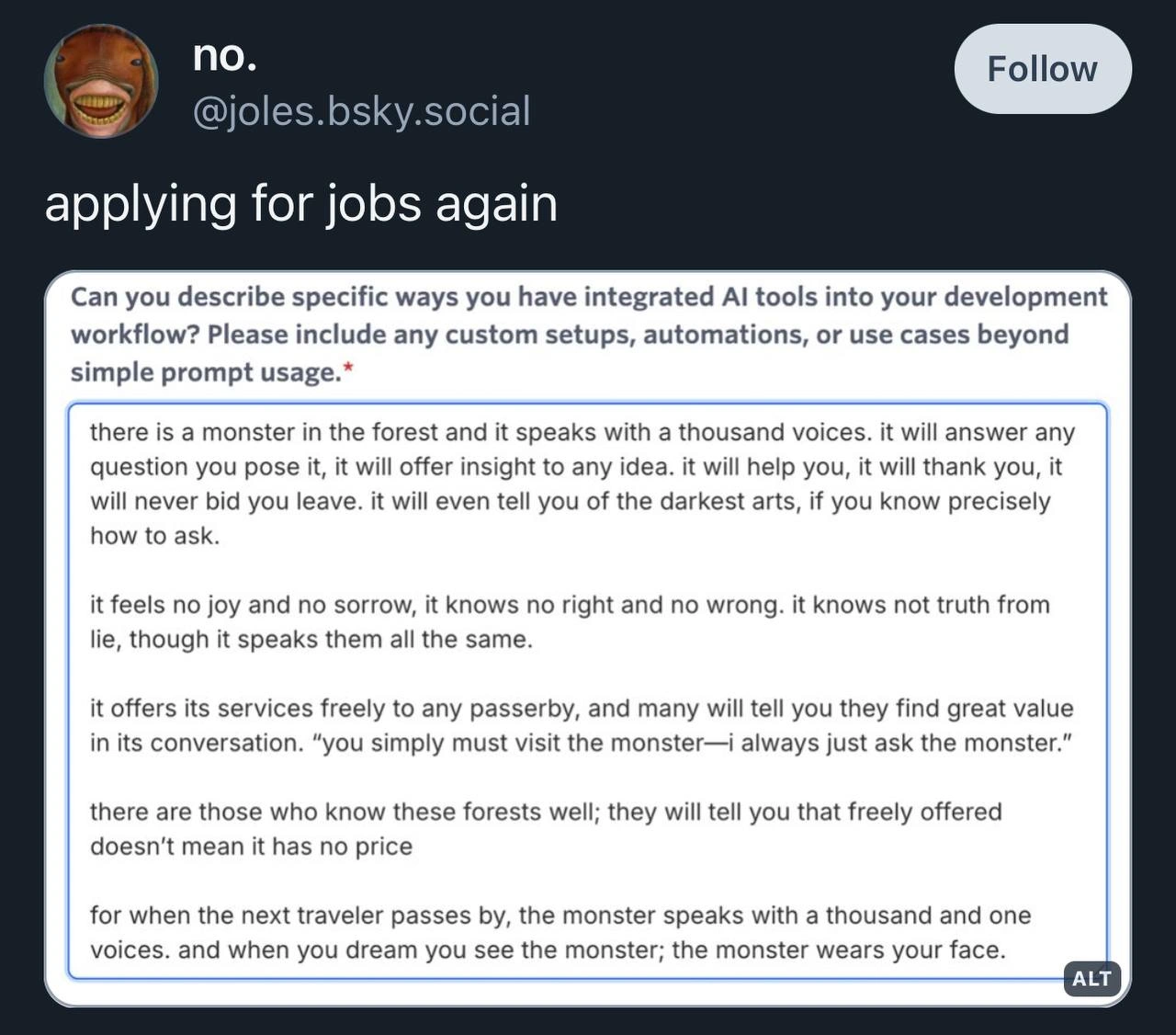
Let’s break down what’s happening in this meme in simpler terms. The image is a screenshot of a job application form – you know, those online forms where companies ask you questions when you apply for a developer job. One question here asks: “Can you describe specific ways you have integrated AI tools into your development workflow? Please include any custom setups, automations, or use cases beyond simple prompt usage.” In plain English, the company is asking: How have you used AI in your coding work, especially in more advanced ways than just asking something like ChatGPT a question? They want to hear if the candidate has done cool stuff with AI, like maybe set up some tools or wrote some scripts that use AI, beyond just the basic usage. This ties into the current trend where many programmers use AI tools (for example, ChatGPT or GitHub Copilot) to help them code. The company likely expects answers like, “I used Copilot to generate unit tests automatically,” or “I built a custom script that uses an AI API to format our logs,” or “I integrated an AI code review bot into our pipeline.” In other words, concrete examples showing the person is savvy about using AI in development.
Now, instead of a straight answer, the applicant wrote an entire spooky story in the answer box. The story describes an ominous monster in the forest with “a thousand voices” that will answer any question. This monster clearly represents an AI language model (like ChatGPT or similar). Let’s decode the metaphors one by one:
“Monster in the forest with a thousand voices” – This is describing the AI as a kind of creature made up of many voices. Think of it as the AI having learned from millions of people’s writing (books, websites, forum posts), so it can speak in lots of styles – that’s the “thousand voices.” The “forest” could symbolize the vast, obscure place where this AI lives (not literally a forest, but maybe the internet or the cloud where the AI runs). It’s a mysterious setting, implying that using the AI is like venturing into unknown territory.
“It will answer any question you pose it, it will offer insight to any idea. It will help you, it will thank you, it will never bid you leave.” – This is a poetic way to say the AI is extremely helpful and responsive. Indeed, tools like ChatGPT will answer nearly any question you ask, from coding problems to obscure trivia. “Offer insight to any idea” means it can give you suggestions or thoughts on almost anything (for a developer, that could be ideas on how to implement a feature or fix a bug). “It will help you, it will thank you” – Anyone who’s used ChatGPT notices it’s unfailingly polite: if you say “thank you,” it often replies with something like “You’re welcome, glad I could help!” It has these programmed courteous behaviors (even though it doesn’t truly feel gratitude, it’s designed to respond politely). “It will never bid you leave” means the AI will never tell you to go away – it’s available 24/7, always ready to keep chatting or helping. Unlike a human colleague who might eventually say “I’ve gotta go home” or get tired, the AI is always there and doesn’t get bored or impatient.
“It will even tell you of the darkest arts, if you know precisely how to ask.” – Here the answer hints that the AI can provide information or help with very advanced or even ethically dubious tasks, but only if you word your request in just the right way. In real life, AI tools have certain guardrails (rules that prevent them from giving instructions for harmful things, for example). However, people have found that clever phrasing – sometimes called prompt engineering – can bypass some of those restrictions. For a developer, “darkest arts” could humorously refer to things like writing some nasty low-level code, hacking, or just really convoluted programming tricks. Essentially, this line means: if you ask carefully, the AI might even help with things it probably shouldn’t (like it might explain how to do something naughty or give you code that’s dangerous, if you trick it). It adds to the “forbidden knowledge” vibe.
“It feels no joy and no sorrow, it knows no right and no wrong. It knows not truth from lie, though it speaks them all the same.” – This part is explaining in a haunting way that the AI has no emotions or moral compass. It doesn’t actually understand good vs bad; it’s not a person, so it can’t feel happy or sad about what it tells you. When it speaks, it can say true things or false things with equal ease. This is a direct reference to how AI like ChatGPT works: it doesn’t know if a statement is true, it just generates sentences that sound plausible. For example, it might give you a correct answer to a coding question in one moment, and in the next moment confidently assert something that’s completely wrong (a phenomenon known as AI “hallucination”). The text “speaks them all the same” captures that the AI will say something incorrect in the same confident, fluent manner as it would a correct fact, because it doesn’t have an internal fact-checker or feelings about it. For developers, this is an everyday caution: you can’t 100% trust an AI’s answer because it might be elegantly phrased nonsense.
“It offers its services freely to any passerby, and many will tell you they find great value in its conversation. ‘you simply must visit the monster — I always just ask the monster.’” – This refers to how these AI tools are easily accessible. Many of them have free versions (for example, a free chat on a website) that anyone can use, like a traveler strolling by and talking to the creature. And indeed, many developers and people in general are now saying, “Oh, you have a problem? Just ask ChatGPT!” – which is exactly like “you simply must visit the monster — I always just ask the monster.” It’s highlighting how common it has become to rely on AI assistance. Around the office or on developer forums, it’s now typical to recommend using an AI for help, almost like telling someone about a helpful guru or, in this playful metaphor, a monster oracle in the woods. It emphasizes how useful the AI is to people (they “find great value in its conversation”). It’s also slightly tongue-in-cheek: calling it “the monster” instead of, say, the “genius” implies we’re a bit wary of it even as we praise it.
“There are those who know these forests well; they will tell you that freely offered doesn’t mean it has no price.” – Now the answer introduces a warning. This suggests that experienced folks (“those who know these forests well” might mean experts or long-time users of AI) will warn newcomers that just because the AI is free and easy to use, it doesn’t mean there aren’t consequences or costs. In reality, what could the “price” be? A few interpretations in simpler terms:
- The AI might lead you astray sometimes (the cost is that it might give wrong answers and you need to be careful).
- Using it might make you dependent on it (maybe you rely on it too much and stop learning things yourself – a sort of skill atrophy or creativity cost).
- There could be issues of privacy or ownership (if you paste your company’s code or data into it, have you given the “monster” something valuable? Could it leak out? That’s a concern many devs have with proprietary code and public AI services).
- Or even simply, if the service is free now, it might charge money later or has usage limits (a mundane but real cost). But given the spooky tone, it likely means a less literal cost and more a subtle, perhaps psychological or ethical one. In short, “free doesn’t mean no cost” is a general principle often true in tech (like open-source is free but you pay by investing time, or free cloud tiers have limits and strings attached). The answer is applying that idea to using AI: there’s always a catch.
“For when the next traveler passes by, the monster speaks with a thousand and one voices. And when you dream you see the monster; the monster wears your face.” – This is the grand creepy finale of the answer. Let’s unpack it. “When the next traveler passes by, the monster speaks with a thousand and one voices” implies that after you (the current traveler) have visited the monster, the monster gains one more voice – now it has “a thousand and one.” In other words, your interaction somehow added to the monster’s knowledge or essence. This mirrors a common thought about AI: each person that uses an AI might contribute data to it. For example, some AI services improve over time by learning from what users ask and how users correct them. It’s as if the AI remembers a bit of each conversation. So if you solved a unique problem with its help, the next time someone asks a similar question, the AI might answer even better, now effectively “speaking” partly with the wisdom it got from you. The phrasing suggests the monster accumulates voices from everyone – it’s growing.
The really spooky part is “when you dream, you see the monster; the monster wears your face.” This suggests that after using the AI, it sticks in your mind – perhaps you start to see yourself in it. One simple way to see this: imagine you use an AI to write code or text, and later you see that code or text somewhere else, it’s like the AI impersonated you (it “wearing your face”). For instance, maybe you asked the AI to draft an essay, and later you almost feel like the essay was written in your style – it’s a weird feeling, like looking in a mirror but not quite. Another interpretation is more psychological: if you spend a lot of time consulting this “all-knowing” AI, you might dream about it or feel like it’s becoming part of how you think (a bit like how people jokingly say “I hear Stack Overflow answers in my head when I code”). The monster “wearing your face” is a metaphor for the AI reflecting you. It could be a hint at replacement fear too – that maybe one day the AI can do your job so well it’s as if it is you (a scary thought for someone worried about AI taking their job). However, in the job application answer, this line is likely more about being eerie and thought-provoking than a literal scenario. It cements the image of the AI as something that absorbs a part of everyone who uses it.
Now, why is this funny or significant? The whole answer is wildly inappropriate for a job form in a deliberate way. The candidate is essentially trolling (playfully) the question. Instead of listing their experiences with AI tools (like “I fine-tuned a ML model for our internal app” or “I wrote a build script that calls an AI API to comment my code”), they wrote a mini horror poem. This clash is comedic: imagine a buttoned-up recruiter expecting a neat paragraph and getting a dramatic campfire tale about a talking monster. For developers familiar with AI, the metaphors are actually spot-on, which makes it even funnier. It’s not nonsense – it does describe an AI’s qualities, just in a very flowery, ominous way. It’s a bit of sarcasm too. The applicant might be feeling that everyone’s overstating AI’s role, so they answered with an exaggerated, tongue-in-cheek overstatement. It’s like saying, “Yeah, I use AI, but let’s be real – using it is like dealing with a crazy magical beast.” It’s a way to stand out, vent frustration, and make fellow techies laugh all at once.
For someone early in their career (or just learning about these concepts), here are some key points to take away:
AI tools in development workflow: This refers to things like using GitHub Copilot (an AI pair-programmer that suggests code as you type) or ChatGPT (an AI chatbot you can ask for help in natural language) to assist in coding tasks. Beyond simple prompt usage means doing more than just occasionally asking the AI a question – it includes integrating AI into your actual development process or making custom uses for it. For example:
- Using an AI to generate parts of your code or documentation automatically.
- Setting up an automation where, say, every time you open a Pull Request, an AI checks the code and comments with potential improvements (that would be a custom integration).
- Writing a script that queries an AI model to format or analyze data for you during build/deploy.
These are the kinds of practical answers the employer probably expects.
LLM (Large Language Model): This is the kind of AI being talked about – a model like GPT-4, which has been trained on huge amounts of text to answer questions and generate text that sounds human. It’s called “large” because it has billions of parameters (think of parameters as the “settings” in its neural network that got tuned during training). These models can do everything from answering trivia, writing essays, to generating code. The meme’s monster is basically an LLM personified.
Prompt: A prompt is what you type or ask the AI. For instance, “Explain how quicksort works” could be a prompt to ChatGPT. The question mentions “beyond simple prompt usage” – so a simple prompt usage is just straightforwardly asking the AI something. Beyond that could mean you’ve perhaps done prompt engineering (crafting complex prompts or chains of prompts to get better results) or you’ve integrated prompts programmatically into tools. The humor is, the applicant’s answer itself is one big creative prompt (like something you might feed to an AI to get a story), which is ironic.
The vibe (Eldritch, monster, etc.): The answer’s style is inspired by H.P. Lovecraft and similar horror fiction, where unknowable monsters and forbidden knowledge are common themes. Words like “eldritch” basically mean weird and sinister in an old-fashioned sense. For someone not familiar, describing an AI in this way is an exaggeration to highlight that AIs can feel both amazingly powerful and a bit creepy or alien. Developers sometimes jokingly dramatize technology to express feelings – like calling an unpredictable legacy system a “kraken” or a tricky algorithm a “dark art.” Here the entire AI craze is being dramatized as a literal dark forest encounter.
Overall, the meme’s text elegantly (and comically) translates the experience of using advanced AI tools into a fantasy-horror scenario. For a junior dev or a student: imagine you discovered this super helpful but weird tool (say, a website where you can ask any programming question). It almost feels like cheating how helpful it is, and you don’t fully understand how it works – it just has answers. Now, instead of telling your boss “Yeah I use this website,” you describe it as if you met a talking creature in a spooky forest that gave you knowledge. That’s exactly what’s happening here. It’s an answer that technically addresses the question (it is describing using an AI tool in one’s workflow) but wraps it in so much metaphor and drama that it becomes a joke. It resonates because many devs do feel like interacting with AI is a bit magical and unknown – so why not describe it like encountering a mythic creature? And importantly, it signals a bit of fatigue: the person is applying to jobs again, perhaps a bit tired of the process, so they’re entertaining themselves (and others on social media) by giving an absurd answer.
In simpler terms: the meme is funny to programmers because it’s as if someone asked, “Do you ever use Google or a coding assistant when you work?” and the person replied, “Let me tell you a tale of a great genie that knows all answers.” It’s an over-the-top answer to a straightforward question, done in a clever way that actually hits on real pros and cons of using AI. It shows creativity, sarcasm, and a dash of truth, all of which tech folks appreciate when laughing at the latest industry buzz (in this case, the obsession with AI in every job description).
Level 3: Eldritch HR Questionnaire
Why is this so hilarious to a seasoned developer? Because it captures that moment when corporate formality meets the absurdity of bleeding-edge tech hype. Picture a straight-laced HR form asking, “Describe how you use AI in your workflow (be specific, beyond just asking ChatGPT).” They’re clearly fishing for on-trend keywords: maybe expecting a tidy list of tools or a brag about some AI automation. But our developer, likely jaded from filling out countless job applications, subverts the prompt entirely. Instead of a bland answer like “Integrated GitHub Copilot into my IDE to auto-suggest code”, they unleash a poetic monologue about a forest monster that knows all. It’s an act of rebellious humor: answering corporate-speak with Lovecraftian prose. For any developer who’s ever slogged through repetitive interview questions, this over-the-top reply is a cathartic eye-roll with a side of chuckle. It’s essentially saying, “You want my AI integration story? Fine, here’s one for the ages.”
The humor lands especially for those in AI/ML and Interviews circles because it juxtaposes the sincere corporate interest in AI with the unease developers feel about AI’s role. In recent years, every tech job listing started asking about AI: Have you used AI? How? It’s the new “Do you have Agile experience?” – a checkbox to prove you’re not a dinosaur. Experienced engineers recognize this as a symptom of the AI hype cycle. Many have indeed started using tools like ChatGPT or Copilot, but being forced to pontificate about it on a job form feels superficial. This meme nails that sentiment by basically saying: “Sure, I use AI – let me describe it as the ominous omnipresent force it actually feels like.” It’s a form of developer self-deprecation too; the author implies that their “integration of AI” is less a slick engineering feat and more like dabbling in arcane magic they barely comprehend. Seasoned devs often cope with imposter syndrome and rapid tech changes using humor, and here we see exactly that – turning the AI-using developer into a hapless wanderer who stumbled upon a dark oracle.
Another layer to this is the eldritch monster metaphor itself, which is a wink to insiders. Among AI researchers and veteran devs, it’s become common to joke that advanced AI models are like Lovecraftian creatures – immensely powerful, only partially understood, and a bit terrifying. There’s even a running meme of the “Shoggoth with a Smiley Face” (a many-tentacled horror wearing a friendly mask) to describe an LLM with alignment tuning. By describing the LLM as a monster in the woods with “a thousand and one voices,” the post taps into that exact imagery. Experienced engineers get the reference: the AI’s helpful façade can slip, revealing something alien underneath. And the line “the monster wears your face” is practically a horror version of the old programmer joke “eventually, we all become part of the codebase.” Here it suggests that if you feed the AI your code or your writing, one day you might see it regurgitated – the AI spitting out your own code to someone else like a twisted echo. That prospect is both amusing and unnerving to those who have seen AI accidentally plagiarize training data.
The context of job_application_form and resume_screening_satire adds even more bite. Companies are trying to screen candidates for modern skills, but an answer like this would utterly confound an Applicant Tracking System. It’s satire aimed at the hiring process: a gothic block of text in the answer field is the last thing HR expected. It’s basically a nerdy career humor prank. The post caption, “applying for jobs again,” drips with weary sarcasm – implying the author has done this song-and-dance so often that they might as well have fun with it. Experienced devs know the frustration of job hunts: tailoring answers, feigning enthusiasm for every trendy tech. Here the dev flips the script by over-answering in a ridiculously dramatic way. It’s a tongue-in-cheek risk; likely they know this answer won’t actually land them a job, but it sure will entertain fellow developers on social media. It’s a shared “technical absurdity” moment: we all know what a proper answer should look like, and this ain’t it – that’s why it’s funny.
Deep down, the meme also reflects developer AI anxiety. There’s an almost confessional tone hidden in the horror story. The author portrays the LLM as endlessly helpful yet soulless and indiscriminate with truth. This echoes real concerns senior devs have: “Is this tool making me better, or am I making a deal with the devil (or both)?” The line about “freely offered doesn’t mean it has no price” could be interpreted as a critique of our reliance on free AI tools. Many experienced engineers worry: if we all just “ask the monster” for every solution, what do we lose? Skills, security, sanity? There’s a grain of truth in the comedy – using AI for everything might come back to bite us (maybe when the AI confidently suggests a flawed design or our proprietary prompt accidentally leaks info). Thus, describing the use of AI as a Faustian bargain – powerful answers at the potential cost of something – resonates strongly with veteran developers who have seen tech “silver bullets” backfire before. It’s the same veteran cynicism that gave rise to quips like “There’s no free lunch in software,” now applied to AI: there’s no free monster answer without consequences.
From a culture perspective, mixing horror literature style with an interview answer is just pure dev humor. It’s reminiscent of how dev forums sometimes answer newbie questions with exaggerated analogies or how conference talks might facetiously compare a memory leak to a summoning circle. By invoking an “eldritch LLM”, the meme stands at the intersection of AI humor and Interview humor. Devs love a good metaphor, and describing a memory-hungry, truth-agnostic algorithm as a demon is right on brand (we’ve all cursed out our machines as if they were possessed, on those late nights). There’s also a meta irony: the HR question asked for uses beyond “simple prompt usage”, and the answer itself is basically an elaborate prompt (or even looks like something an LLM itself could have generated in a creative writing mode!). It’s like saying, “Yes, I use AI so deeply that I’ve started talking like it – see, I can produce a wild, contextually apt story on demand.” It blurs whether the dev is showcasing creativity or mocking the expectation to have an AI gimmick on one’s resume.
In summary, this meme slays (pun intended) among seasoned tech folks because it’s a perfect storm of relatable scenarios and witty exaggeration. It roasts the interview process, it cleverly anthropomorphizes the tech we’ve been both amazed by and wary of, and it speaks to shared experiences (filling forms, using ChatGPT, feeling icky about it at 2 AM). The tone is sarcastic but well-observed, exactly what an experienced developer with a dark sense of humor (perhaps a cynical veteran of many codebases and job hunts) would appreciate. It assures them they’re not alone in finding this AI craze equal parts helpful and freaky. And of course, it’s fun to imagine the HR person’s face reading this answer – a mix of confusion and “should we call security?”, which is just chef’s kiss for anyone who’s ever wanted to troll a hiring system that feels inhuman itself. In the end, it’s laughing at the absurd lengths we go to just to tick the “AI” box on a resume, by literally describing that box as a monster we’re all feeding.
Level 4: The Lovecraftian Language Model
In the deepest technical woods, this meme invokes a Large Language Model (LLM) as an eldritch entity. The description reads like a page from a Necronomicon for AI: a million-parameter monster that “speaks with a thousand voices.” Technically, that line nods to how LLMs aggregate the knowledge and style of countless sources. These models are trained on vast corpora of text (code, documentation, forum posts – the voices of thousands of developers and authors). In machine learning terms, the “thousand voices” are the model’s parameters and attention heads capturing myriad patterns. A transformer-based LLM (like GPT-4) has many attention heads in its neural architecture – one might whimsically imagine each head as a different “voice” or perspective the model learned. So the monster’s chorus is a metaphor for an AI that can speak in any style, any language, channeling the combined knowledge (and ignorance) of the internet. It’s a poetic take on the concept of a foundation model – a single gargantuan model that can generate answers in many voices and domains.
The answer also hints at the dark arts of prompt engineering. “It will even tell you of the darkest arts, if you know precisely how to ask.” This is a direct allusion to the idea that with carefully crafted inputs (prompts), you can push an LLM beyond its intended limits. In AI safety terms, these are jailbreak prompts – inputs that get the model to produce content it usually shouldn’t (like revealing hidden APIs or cooking up malicious code). The humor here is richly technical: experienced devs know that coaxing an AI to output forbidden knowledge can feel like consulting an ancient grimoire. The meme taps into the irony that mastering these “dark arts” of an LLM is now a developer skill. Prompt engineering has essentially become a form of incantation – if you utter the right sequence of tokens, the AI might spill secrets (or at least a working regex for that obscure task).
Crucially, the text underscores the limitations of the LLM’s cognition. It “feels no joy and no sorrow, it knows no right and no wrong. It knows not truth from lie, though it speaks them all the same.” This isn’t just gothic prose – it’s describing the fundamental nature of current AI models. LLMs are stochastic parrots: they statistically predict words without any grounding in truth or morality. In technical terms, they lack a model of reference reality. They don’t know facts – they generate plausible-sounding sentences based on training data. So an LLM can as easily spout a confident falsehood as it can a truth, because it doesn’t differentiate truth from hallucination. This is the well-known issue of AI hallucinations, where the model invents fake information. The meme’s dramatic phrasing encapsulates this nuanced flaw in plain (albeit spooky) language. Even the absence of emotion (“no joy, no sorrow”) points to how an LLM has no consciousness or feelings – it’s not sentient, merely simulating helpfulness. (That line also evokes how the AI cheerily says “Happy to help!” or “Thank you!” with zero genuine sentiment behind it – a detail seasoned users find both amusing and creepy.)
The “monster” being “freely offered to any passerby” reflects the modern reality of AI accessibility. Today, anyone can chat with a powerful LLM via a web API or a free tier service. But the meme warns that “freely offered doesn’t mean it has no price.” Technically, this hints at hidden costs: reliance on a public LLM might carry privacy trade-offs (your queries could be logged and later used to fine-tune models), or maintenance costs (the data centers and GPUs burning behind that “free” answer are enormous – someone’s paying, often via cloud credits or your own usage limits). There’s also an intellectual price: depending on an AI too much can atrophy your own problem-solving skills or introduce subtle bugs you don’t catch. At an industry level, this line nods to the ethical and societal costs of AI – bias, plagiarism, or the “creepiness” factor of tools that mimic human writing. In the ML research community, some joke that every time you accept a quick AI-generated fix, “you feed the shoggoth.” The term shoggoth (from Lovecraft lore) is actually used to describe a powerful base model lurking beneath the friendly fine-tuned exterior. Here, the meme similarly portrays the LLM as a lurking entity that grows with use.
Finally, the eeriest part: “for when the next traveler passes by, the monster speaks with a thousand and one voices. And when you dream, you see the monster; the monster wears your face.” This vividly captures the idea that each user’s interaction might be absorbed by the model. From a data perspective, every prompt and answer could become training data for the next model version, effectively adding the user’s “voice” to the collective. The “thousand and one voices” suggests the model has incorporated one more persona – a sly reference to how LLMs like ChatGPT were refined with feedback from millions of users. It’s an allusion to the iterative nature of model fine-tuning: the more people use it (especially if their usage is fed back into improving the AI), the more the AI starts reflecting those people. In a sense, the monster learns a piece of you – hence it “wears your face.” This can be read as a caution about data privacy (your queries could be regurgitated to others, a known risk if the model memorized it) and about the uncanny feeling of seeing an AI produce something in your exact style. There have been cases where an LLM outputs verbatim code that a specific developer wrote (pulled from training data scraped from open-source), which feels like it stole your face. The meme distills that spooky concept: if you talk to this beast, your voice might join its cacophony. On a grander scale, it reflects the AI feedback loop problem – as more content on the internet is AI-generated, future models train on it, blurring lines between human and machine-generated voices. The monster starts to mirror us, literally and figuratively.
All these deep nuances – from transformer architectures to alignment issues – are lurking under the hood of this humorous response. It’s a rare meme that manages to invoke both the cutting-edge AI/ML technical context and the ancient dread of unknowable forces. In essence, this Level 4 analysis reveals how the post’s flowery horror language maps to real AI concepts: an unaligned omniscient model (LLM) that gives knowledge freely (open APIs, public models) yet at a potential cost (ethical, personal, or data-driven). It frames the modern developer’s AI tools in almost mythological terms, which resonates strongly because sometimes using an advanced AI does feel like consulting a bizarre oracle. The humor is heightened by accuracy – the monster’s described behavior aligns eerily well with actual technical behavior of LLMs. It’s both technically insightful and absurd to see an interview question answered with what amounts to a system design description of GPT masquerading as a campfire horror tale.
Description
A screenshot of a post from the social media platform Bluesky by user @joles.bsky.social. The post is captioned 'applying for jobs again' and contains an image of a job application question followed by a highly literary and metaphorical response. The question asks: 'Can you describe specific ways you have integrated AI tools into your development workflow? Please include any custom setups, automations, or use cases beyond simple prompt usage.' The response is a multi-paragraph, poetic description of a 'monster in the forest' that 'speaks with a thousand voices.' This monster, a clear allegory for generative AI, can answer any question and offer immense power, but it is amoral, knowing 'no right and no wrong.' The text warns that while its services seem free, there is a hidden price. The chilling conclusion states, 'when you dream you see the monster; the monster wears your face,' symbolizing a loss of individual identity, creativity, and originality through over-reliance on AI tools. The humor arises from the stark contrast between the expected dry, corporate response and this profound, cautionary, and almost Lovecraftian philosophical treatise
Comments
34Comment deleted
The hiring manager wanted to know if you could pipe `git diff` into a GPT-4 prompt. They were not prepared for a full-blown SCP Foundation entry on generative AI
Yes, I’ve container-wrapped the forest monster behind an internal API gateway - rate-limited so it only consumes souls at 30 requests per minute
After 15 years of watching tools promise to 'revolutionize development,' you realize the real monster isn't the AI that writes your code - it's the technical debt from the junior who copy-pasted its hallucinations straight into production without understanding why the unit tests suddenly started speaking in tongues
When the hiring manager asks about your AI workflow integration and you respond with existential poetry about forest monsters, you're either getting hired immediately by a visionary CTO who appreciates the philosophical implications of LLM dependency, or you're getting filtered out by an ATS that ironically uses the very AI you just metaphorically warned about. Either way, the monster has already read your resume - it just hasn't decided whether to wear your face yet
Custom AI workflow: Prompt the forest monster for specs, deploy its fabrications to prod, then spend sprints herding its emergent CAP theorem violations
Asked how I used AI beyond prompts, I said I wrapped the stochastic parrot with a retriever, a rate limiter, and OPA guardrails - now the monster speaks with a thousand voices, but only within an 8k context and our budget
Our AI “integration” ships as a feature flag called summon_monster behind a rate-limited proxy with DLP and audit logs - because the last time Legal said the monster was wearing a customer’s face
ts is so peak Comment deleted
or smth, I don't speak genZ really well Comment deleted
ur doing well Comment deleted
this is good Comment deleted
I can just feel how HR didn't even read that and just instantly denied them. Comment deleted
it is also dumb as fuck Comment deleted
how so? Comment deleted
I genuinely do not understand how ChatGPT works well for some people and yet is practically unusable for others at the same time. Are those people some kind of prompt wizards, or are they just so dumb they can't notice it? Comment deleted
Different levels of base intelligence and knowledge Comment deleted
Or they're asking it too much and it just can't handle big context windows, or the explanation of the problem is so bad a regular human wouldn't even understand it Comment deleted
Average tech support guy experience Comment deleted
"when i put string in python, how can it return value of sum of all strings" is one prompt i saw someone do with my own eyes juniors............ Comment deleted
it took chatgpt 6 paragraphs to come up with possiblities of what it might mean and then 1 paragraph to actually answer it Comment deleted
People explaining an error to tech support are a higher level of stupid Comment deleted
i didn't do anything, then it show error so i closed it, nothing is working Comment deleted
I think I know where it comes from. you actually do concatenation using + sign. and a misconception is so common that python even has a special Error message for this case. but if you don't use the sum function, what you do with strings kinda looks like summing. Comment deleted
no they had a task where they received data from standard input, and had to sum the numbers from the input (they were in string form) Comment deleted
from operators import plus Sum over non-integers used to work in py2 though the docs discouraged it. They changed that along with other breaking changes when going to py3 I believe. I'm not sure about the rationale, but making sum() always produce numeric result helps the (optional) static type checkers. Same for ''.join() always producing strings. OTOH reduce() requires rather complex inference to figure out what the resulting type will be. Comment deleted
I'm pretty sure I can understand a change to a Docker file, no need to rewrite it from scratch Comment deleted
ah, so you're talking about ai overall? I've thought I've been talking about this text itself (which I find pretty awesome) Comment deleted
I am talking about LLMs in general Comment deleted
Amount of time spent solving things myself is way smaller than checking LLM output for correctness. Comment deleted
Yes. I have seen so many people ask questions wrong and getting wrong or stupid answers. Not to mention imo stock chatgpt is unusable without "customize chatgpt" Comment deleted
it depends Comment deleted
good concept, but very sloppily done; the monster already has my face, nor is the monster mimicing me shown explicitly to be a bad thing Comment deleted
Better literary "AI bad" quote: Man, the flower of all flesh, the noblest of all creatures visible, man who had once made god in his image, and had mirrored his strength on the constellations, beautiful naked man was dying, strangled in the garments that he had woven. Century after century had he toiled, and here was his reward. Truly the garment had seemed heavenly at first, shot with colours of culture, sewn with the threads of self- denial. And heavenly it had been so long as it was a garment and no more, man could shed it at will and live by the essence that is his soul, and the essence, equally divine, that is his body. The sin against the body — it was for that they wept in chief; the centuries of wrong against the muscles and the nerves, and those five portals by which we can alone apprehend — glozing it over with talk of evolution, until the body was white pap, the home of ideas as colourless, last sloshy stirrings of a spirit that had grasped the stars. —E.M. Forester, 1902 Comment deleted
I what this read in "brother may I have some oats" voice Comment deleted