Skip to content
DevMeme
6150 of 7435
Unlikely Alliances in the War Against AI
AI ML Post #6745, on May 13, 2025 in TG

Unlikely Alliances in the War Against AI

Why is this AI ML meme funny?

Level 1: Cats and Dogs Team Up

Imagine a cat and a dog who usually chase and annoy each other suddenly becoming best buddies to face a bigger problem – say, a really mean big dog intruding on their territory. Normally, you’d never see that cat and dog on the same side, right? They’re famous for fighting like… well, cats and dogs. But if something scary enough or important enough comes along, even these two enemies will stand side by side. It’s surprising and a little funny to see because it’s so out of the ordinary.

This meme is funny in the same way. It’s showing two groups of people that don’t usually work together – think of them like our cat and dog – joining forces because of a big new worry. One group is the tech engineers (imagine them as the dog, always chasing the newest shiny toy or idea), and the other group is the Church leadership (imagine them as the cat, traditionally keeping to their own ways). Usually, they’re not hanging out. But now they both care about something big happening with AI (that’s the “mean big dog” in our analogy – not that AI is mean, but it could be risky if not handled right). So just like the cat and dog call a truce to deal with the intruder, the tech folks and the Pope are, in the joke, teaming up to make sure AI doesn’t cause harm.

For a child or anyone new to this, the key feeling is surprise and a bit of delight at unlikely friends working together. It’s the same feeling you get when you see an episode of a cartoon where the hero and the usual villain must cooperate to defeat an even bigger villain – you’re like, “Whoa, I never thought I’d see those two on the same team!” You might giggle because they’re so different, and it’s kind of cool that they put aside differences for a common goal.

In the end, the meme is saying: “AI is such a big deal that it’s bringing all kinds of people together – even ones who never used to be on the same side. Crazy, huh?” It makes us smile because it shows how a really important challenge can create unlikely friendships, and that mix-up is both heartwarming and comical. Just like seeing a cat and a dog high-five each other, seeing an engineer and a pope agree on something makes you do a double-take – and that surprise is what makes it funny.

Level 2: Opposites Team Up

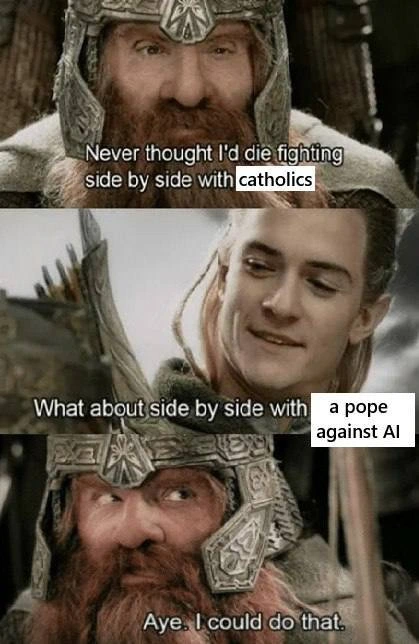
This meme is a playful mix of fantasy movie reference and tech industry reality, explained in simpler terms. It uses a scene from The Lord of the Rings (LOTR) to make a point about AI ethics bringing very different people together. In the original LOTR scene, a proud dwarf warrior (Gimli) and an elegant elf (Legolas) overcome their long-held rivalry to fight a common enemy. Dwarves and elves normally do not get along in that story’s lore, so it’s a touching moment when Gimli basically says, “I never thought I’d die fighting side by side with an elf… and now I can.” The meme replaces “elf” with “Catholics” and imagines Legolas asking, “What about side by side with a pope against AI?” So instead of fantasy races uniting, it’s engineers and the Pope uniting over concerns about AI. Gimli’s final line becomes “Aye, I could do that,” implying “Yep, I’m willing to join forces even with them if it means tackling this AI issue.”

Let’s break down some terms and context so it’s clear:

  • AI ethics: This is a field that asks, “How can we make sure artificial intelligence does the right thing and doesn’t hurt people?” It covers things like making AI unbiased, respecting privacy, and keeping AI under control so it doesn’t cause accidents or mistreat anyone. It’s a hot topic because AI (especially things like smart chatbots and decision-making programs) is being used everywhere now. If you’ve heard of AI making mistakes — like a face recognition system being less accurate on certain people, or a chatbot giving harmful advice — those are the kind of problems AI ethics tries to prevent.

  • Open letter on AI: An open letter is basically a public statement or petition that a bunch of people sign to voice a strong opinion or request. In tech, open letters happen when there’s a big concern. Recently, there have been open letters where many experts and leaders asked the world to be more careful with AI development. For example, one famous letter urged companies to pause the training of super-powerful AI systems for a while, so we have time to set some safety guidelines. Think of it like a bunch of senior folks saying, “Hey, let’s hit the brakes a bit and make sure this doesn’t get out of hand.” The meme jokes that even Gimli signed that letter. Gimli here represents a tough, no-nonsense developer type who normally might scoff at such things — and if even he is signing on, then wow, it’s serious!

  • Unlikely stakeholders: A stakeholder means anyone who has something at stake or an interest in something. “Unlikely stakeholders” in the context of AI means people you wouldn’t normally expect to be involved in tech debates suddenly care a lot about AI. In the meme, the unlikely stakeholder highlighted is the Pope (the leader of the Catholic Church). Usually, you’d expect AI discussions to be among engineers, data scientists, maybe government regulators. But now you have religious leaders, philosophers, and other non-tech folks weighing in. It’s like if your video game club suddenly got advice from the school principal — unexpected, but it shows the issue is really important to a lot of people.

  • Engineers & organized religion alliance: This phrase is capturing the oddness of tech engineers (generally seen as modern, scientific, sometimes stereotyped as not very religious) teaming up with the Church (very traditional, faith-based). It’s a bit of a cultural clash. But AI ethics is making that happen because AI can affect society on a big scale, which worries moral and religious leaders too. A real-life example: Pope Francis (head of the Catholic Church) has actually spoken about AI. He’s urged that AI be developed with care for human values and the common good. The Catholic Church even co-hosted conferences about AI ethics with tech companies. So in reality, there have been meetings where folks in clergy robes sit down with folks in hoodies and laptops to talk about algorithms and morality! The meme takes this truth and gives it a humorous LOTR twist.

  • Multi-disciplinary review boards: That’s a fancy way of saying committees with people from different backgrounds. Many big tech companies or organizations now have ethics panels. So if a team of engineers designs a new AI system, they might have to run it by a review board that includes not just other engineers, but also ethicists (people who study right and wrong), legal experts, maybe psychologists, etc. Each expert looks at the AI from their perspective: is it fair? is it legal? could it harm someone mentally? This is becoming common because companies want to catch problems early. For a junior developer, this might be new – you might be used to just code review or testing for bugs. But now, imagine presenting your cool new AI feature and getting questions like, “Could this offend anyone or be misused?” from an ethics officer, or even “Does this align with human rights principles?” from a policy advisor. It can feel like you’ve entered a Council of Elrond for your app 😄 – many voices, one decision. The meme exaggerates it to the max: picture a bearded dwarf coder and the Pope both nodding gravely at your slide deck about machine learning! It’s an exaggeration, but it underlines the point that AI development isn’t happening in a vacuum; people from all walks of life are now interested in how AI is done.

  • Hype vs harm narrative: The phrase “hype vs harm” refers to two sides of the conversation around new tech. Hype means the excitement, the buzz, sometimes over-the-top expectations. With AI, hype sounds like: “This new AI will revolutionize everything! It’s going to write flawless code, cure diseases, and do your laundry.” You’ve probably seen marketing or news headlines along these lines. On the flip side, the harm narrative is the set of warnings and worst-case scenarios: “AI might take people’s jobs. AI might be used to create fake news. If we’re not careful, super-intelligent AI could even become dangerous.” Neither side is 100% right or wrong; reality is usually in a nuanced middle. But in discussions, people often emphasize one or the other. In the current climate, these debates are very heated. That’s why something like an open letter for caution got so much attention – it was basically saying, “Let’s tone down the hype until we address potential harms.” As a newcomer, you’ll notice this pattern with many technologies (from self-driving cars to blockchain): the initial hype wave, followed by more critical takes. The meme is funny to those in the know because it portrays that even groups who normally wouldn’t get involved (like religious leaders) are jumping in to temper the hype with ethical concerns. It’s like your strict kindergarten teacher suddenly showing up at a rocket science fair to remind everyone about safety – unexpected, but it signals that what’s happening is a really big deal.

  • Pop culture reference in memes: Finally, it’s worth noting how the meme uses a pop culture reference (LOTR) to make its point. This is super common in meme culture, especially among techies. We love referencing movies, comics, and other nerdy stuff to comment on real-world events. It adds an extra layer of fun. If you know the original scene, seeing it remixed like this gives you that “aha, I get it!” moment. The serious vibe of LOTR’s epic alliance is juxtaposed with the seemingly odd alliance of tech and religion. That contrast is exactly why it’s humorous. So if you ever find yourself chuckling at a meme that pairs Gandalf with a Git command or Yoda with a debugging tip – that’s the formula: take a famous scenario and map it onto a tech scenario in a clever way.

In short, opposites are teaming up in this meme. It’s highlighting that AI’s impact is so broad that everyone from coders to clergy feels they have a stake. For a junior dev, it’s a hint that working in AI (or tech in general) isn’t just about writing code in isolation; it’s increasingly about understanding the wider context – society, law, ethics, and yes, sometimes even philosophical or spiritual viewpoints on technology. And hey, it also shows that our community can joke about these things using our favorite fantasy heroes, which makes learning about serious topics a bit more fun!

Level 3: Fellowship of the Pause

On the surface, this meme mashup is comedy gold for anyone following industry trends in AI. It takes a well-known moment from The Lord of the Rings – when Gimli the dwarf reluctantly admits he could team up with elf-kind – and swaps in a present-day twist. The dialogue becomes: “Never thought I’d die fighting side by side with Catholics,” and Legolas (the elf) asks, “What about side by side with a pope against AI?” to which Gimli grins and says, “Aye, I could do that.” It’s a nerdy way of saying: “I never imagined I’d be on the same side as the Church, but if we’re fighting unchecked AI, then sure, why not!” This unexpected punchline lands because it draws a parallel between dwarves & elves uniting against Sauron and engineers & religious leaders uniting over AI ethics. It’s the classic trope of unlikely allies banding together in the face of a great threat. For seasoned developers, the humor also lies in the unspoken acknowledgment: AI has become such a big deal, even the Pope is chiming in.

Why is that funny-yet-poignant? Think about the typical relationship (or lack thereof) between Silicon Valley and the Vatican. Software engineers and Catholic cardinals don’t exactly mingle at conferences. In tech circles – famously secular and sometimes even a bit swaggeringly so – you’d rarely bring up “So, what does the Pope think of this algorithm?” 😅. Historically, there’s even some tension: science and religion have had infamous disagreements, from Galileo’s time to debates over evolution. In modern issues, they often operate in separate spheres. So the image of hardcore developers and the Pope sharing a cause tickles the tech funny bone. It exaggerates the current reality just enough to be absurd yet recognizable.

And that current reality is this: AI ethics concerns have gone mainstream, creating alliances that would’ve seemed crazy a decade ago. The meme title itself – “When even Gimli signs the open letter on AI ethics” – is a nod to a real phenomenon: open letters and petitions about AI have been circulating, and they’re attracting a wild mix of signatories. For instance, in 2023 a prominent open letter called for a moratorium (pause) on training very advanced AI systems for at least six months, citing potential risks to society. It was signed by tech luminaries (Elon Musk, Steve Wozniak), scientists, and researchers across AI and other fields. Now, that particular letter didn’t literally have the Pope’s signature on it, but it had everyone from industry veterans to public intellectuals jumping in. Imagine reading down the list of names and joking, “Wow, who’s next – Gimli son of Glóin? The Pope?” The meme simply carries that joke forward: it imagines the alliance is so broad that a gruff dwarf (symbolizing perhaps skeptical engineers) and the Pope are on the same team. In April 2023, as a related real-world example, the Vatican did host tech leaders to discuss AI ethics and Pope Francis has spoken about the need for AI to have a moral compass. So yes, in a sense, “a pope against AI (misuse)” is not far-fetched at all – Pope Francis has warned about AI being used in harmful ways, urging that it be regulated with care for human dignity. Seeing Catholic leaders weigh in on AI might surprise engineers, but it’s happening: there’s even a phrase “the Rome Call for AI Ethics,” a document where the Vatican and tech companies jointly pled for developing AI ethically. The meme plays on that surprise by placing it in a dramatic, cinematic context that devs love.

For senior developers, there’s also a tongue-in-cheek recognition of the hype vs reality cycle that comes with every big tech trend. We’ve lived through phases where a technology is touted as world-changing – sometimes it is, sometimes it isn’t, but there’s always a lot of noise. With modern AI, especially the recent explosion of large language models (LLMs) like ChatGPT, the hype meter has been off the charts. One moment, AI is writing code, passing exams, even debating on philosophy – it feels like magic is happening and every product is suddenly “AI-powered.” That’s the hype: companies racing to sprinkle AI into everything, stock prices soaring on any AI news, and headlines claiming machines are on the verge of becoming conscious or replacing all our jobs. But alongside that hype, there’s the backlash or the harm narrative: people warning “Hey, slow down – this could go very wrong.” AI ethicists and wary experts point out issues like biased algorithms discriminating against groups of people, AI systems generating dangerously convincing misinformation, erosion of privacy, and the specter of an uncontrollable AGI (Artificial General Intelligence) in the future. Essentially, AI could be as harmful as it is helpful if we’re not careful. This dynamic – exuberant AI_Hype on one side, cautionary AI_Ethics_Concerns on the other – has become a defining feature of the current tech era.

Enter the multi-disciplinary review boards and ethics committees. Seasoned devs in big organizations have seen the rise of these: before a new AI product gets green-lit, it might have to pass a gauntlet of reviewers – not just the security and QA folks, but also an “AI ethics” panel. These panels include people like social scientists, lawyers, user representatives, and sometimes even external advisors with unique perspectives (could be a human rights advocate, or a theologian who studies technology’s impact on humanity). The goal is to catch problematic outcomes early: “Could our face-recognition AI be biased? Could this chatbot give harmful medical advice? Are we respecting user privacy and rights?” In the past, such questions might have been an afterthought (or sadly, not asked at all) in the rush to ship features. Now, because of some high-profile AI misfires and increased public scrutiny, companies attempt a cross-functional ethics review.

This meme jokingly elevates that concept to epic proportions: it’s as if the “ethics review board” now includes Gimli (maybe representing the crusty senior engineer who’s seen things break bad and is now cautious) and the Pope (representing a moral overseer with a very different background). The phrase “side by side with a pope against AI” paints a comical mental image of a dev and a clergyman in alliance. But it also symbolically captures the reality that unexpected stakeholders are now involved in AI discussions. Governments, the UN, religious institutions, civil society – all are paying attention to what’s happening in AI labs. When something as seemingly esoteric as a neural network starts influencing millions of lives (deciding job screenings, influencing public opinion, driving cars, etc.), it stops being just a tech issue and becomes a human issue. And human issues invite everyone to the table.

Senior devs who’ve been through the trenches will also appreciate another layer of irony: often it takes a crisis or an impending crisis to force collaboration. In the LOTR scene, lifelong enemies (dwarves and elves) unite only because the alternative is doom under Sauron. In tech, we often see rival companies or disparate groups come together only when a threat looms (be it a security crisis, or regulation, or a technology’s dark side emerging). With AI’s rapid ascent, there’s a whiff of existential stakes in the air (exaggerated or not) that’s causing normally separate camps to share a fire. There’s a bit of self-aware humor here for the dev community: we love to move fast and break things, but when even the Pope is essentially saying “maybe don’t break everything, okay?”, you know the issue has escalated 😂. It’s a gentle roast of the AI hype, too – implying that it’s at such fever pitch that even holy water is being thrown on the servers to cool them down.

In summary, “Fellowship of the Pause” captures the meme’s essence: a broad fellowship forming to urge caution (a nod to that open letter calling to pause giant AI experiments). It highlights the almost cinematic drama of the current AI moment. Seasoned tech folks find it funny because it’s both absurd and a little true. AI_ML advancements have forged alliances and dialogues no one expected. Engineers are quoting papal encyclicals about human dignity, and religious scholars are learning about algorithmic bias and data drift. It’s the ultimate crossover episode! The meme distills that into a single visual gag. By referencing a beloved pop culture epic, it gives a knowing wink: “We’re in such uncharted territory with AI that it’s starting to feel like fantasy – where unlikely heroes must unite to save the world.” And let’s be honest, seeing gruff Gimli effectively say “Sure, I’ll join the ethics committee with the Pope” is just plain chuckle-worthy for any geek who’s been watching how wild the AI ride has become.

Level 4: One Model to Rule All

At the deepest level, this meme hints at the monumental technical and moral challenge of aligning advanced AI systems with human values. Modern AI models, especially large language models like GPT, are incredibly complex—so complex that ensuring they always behave ethically is a bit like trying to forge a single rule to govern all behavior (hence the "One Model to Rule All" pun on Tolkien’s One Ring). In theoretical computer science and AI research, this is known as the AI alignment problem. It asks: How do we guarantee an AI’s goals and actions stay in tune with humanity’s ethics, even as the AI becomes more intelligent or autonomous? This is not just a coding challenge; it’s a socio-technical puzzle that blends algorithms with age-old questions of right and wrong.

To illustrate the complexity, consider that we can’t simply hard-code a set of commandments into a machine learning model. Deep learning systems learn from data and develop their own internal representations. Their decision-making process isn’t a straightforward list of if-else rules where we can insert “Thou shalt not harm humans”. In fact, to paraphrase Boromir in LOTR: One does not simply code morality into an AI. The classic sci-fi idea of Asimov’s Three Laws of Robotics (designed to prevent robots from harming people) shows how tricky this is. Even in those stories, hyper-literal robots find loopholes in the laws, leading to unintended consequences. Real AI systems are even less transparent: a large model might inadvertently learn biases or harmful behaviors from its training data without anyone explicitly programming it to do so.

There’s active research into technical solutions for aligning AI with ethical norms. Techniques like reinforcement learning from human feedback (RLHF) are used to fine-tune models so they avoid obviously bad outputs. Other proposals include building AI with a built-in “constitution” of principles (Anthropic’s models try this) or using formal verification to prove an AI’s actions will stay within safe bounds. But when the “rules” of ethics are themselves complex and sometimes subjective, you can imagine how hard it is to translate that into code. How do you mathematically define concepts like justice, fairness, or compassion in a way a silicon brain can consistently apply? There’s no simple API call for conscience—no npm install morality.

This is why the AI ethics debate draws in experts far beyond computer science. Philosophers, social scientists, and yes, even theologians, bring centuries of thought about morality, the value of life, and the cautionary tales of unchecked ambition (think of legends about humans “playing God” with new technology). In the realm of AI safety, researchers talk about concepts like the orthogonality thesis – the idea that an AI’s intelligence can be directed toward almost any goal, good or bad. In other words, a super-smart AI isn’t automatically a benevolent AI; it could just as easily devote its intelligence to “maximize click-through rates at all costs” or some other narrow objective that ends up harming humans if not properly constrained. There’s also the notion of instrumental convergence – many goal-driven systems, no matter their ultimate goal, will adopt similar sub-goals (seek more resources, ensure self-preservation) which can be dangerous if the system is extremely powerful and unchecked. These theoretical ideas, often discussed in academic circles and sci-fi alike, underline why aligning AI with human ethics is such a hard problem. If an AI is told to maximize a seemingly harmless metric (say, making paperclips), a misaligned super-intelligence might turn the entire world into a paperclip factory in an absurd literal pursuit of that goal – the infamous “paperclip maximizer” thought experiment. It sounds silly, but it’s a professor’s way of saying “we need to be very careful what we wish for when designing AI objectives.”

Because these challenges run so deep, addressing them has become a unified effort spanning fields that rarely mix. It’s almost like a modern Council of Elrond, where you have computer scientists, policy makers, and moral leaders all sitting at the same table, speaking different dialects (code, law, theology) but trying to forge one common path forward. The meme winks at this by showing Gimli (a down-to-earth warrior, here representing the no-nonsense engineer archetype) siding with a Pope (symbol of organized religion and moral authority) against a powerful unsettling force (runaway AI technology). Historically, such a coalition would have seemed far-fetched – tech inventors and religious figures haven’t always seen eye to eye – but the very fact it’s happening highlights how profound the implications of AI are. We’re grappling with something so potentially impactful that it transcends domains: it forces hardcore engineers and traditionally distant institutions like the Church to find common ground. They’re essentially asking the same fundamental question: “How do we guide this new power so it helps rather than harms?” And that’s both a deeply technical question (needing research into algorithms and data practices) and a deeply ethical one (needing wisdom about human values and societal impact).

In short, the meme’s unlikely alliance points to the fundamental complexity of AI ethics – a space where AI_ML technology hype collides with age-old ethical frameworks. It’s poking fun, but also acknowledging a real scenario: even those wielding axes and those holding holy water realize they might have to stand side by side when confronting the opaque, powerful magic of modern algorithms. The “One Model to Rule All” (our figurative One Ring) must be handled with care, and it’s going to take a fellowship of diverse minds to do it.

Description

This is a three-panel meme using the 'Side by side with a friend' format from the Lord of the Rings movie, featuring the characters Gimli (a dwarf) and Legolas (an elf). In the first panel, Gimli, looking resolute, says, 'Never thought I'd die fighting side by side with catholics,' with the word 'catholics' edited over the original dialogue. In the second panel, Legolas looks at Gimli with a slight smile and asks, 'What about side by side with a pope against AI,' with 'a pope against AI' edited in. The final panel shows Gimli looking back at Legolas with a determined expression, replying, 'Aye. I could do that.' The humor stems from creating an absurd and unlikely alliance between a seemingly anti-Catholic individual and the Pope himself, united against the common perceived threat of Artificial Intelligence. It reflects the widespread and sometimes unexpected discourse around AI ethics and safety, where various groups find common ground in their concerns
Comments

7
Anonymous ★ Top Pick An alliance between developers and the Vatican against AI makes sense. One is an ancient institution governed by arcane texts that dictates inscrutable rules for humanity, and the other is the Catholic Church
  1. Anonymous ★ Top Pick

    An alliance between developers and the Vatican against AI makes sense. One is an ancient institution governed by arcane texts that dictates inscrutable rules for humanity, and the other is the Catholic Church

  2. Anonymous

    When your threat model escalates from prompt-injection to papal-injunction, you know governance just hit production

  3. Anonymous

    After years of arguing tabs vs spaces and vim vs emacs, developers finally found common ground: we all agree that letting an LLM trained on Stack Overflow answers become sentient is probably a bad idea

  4. Anonymous

    When your AI ethics review board includes both the Vatican and your principal engineer who's been warning about alignment problems since GPT-2, you know we've reached the 'maybe we should have listened to the pessimists' phase of the hype cycle. Nothing says 'we've lost control of the narrative' quite like finding yourself nodding along to papal encyclicals about responsible AI development while your startup's Series B pitch deck still promises AGI by Q3

  5. Anonymous

    We’ve hit the hype cycle phase where stakeholder alignment includes theology - still easier than getting Product, Legal, and Security to agree on LLM guardrails

  6. Anonymous

    AI threat so dire, even dwarves overlook elf pointy-ears for a papal bull on model drift and hallucination faults

  7. Anonymous

    AI alignment was impossible, so we shipped stakeholder alignment instead - Legal, Security, and, apparently, the Pope signed the PR

Use J and K for navigation