Skip to content
DevMeme
6148 of 7435
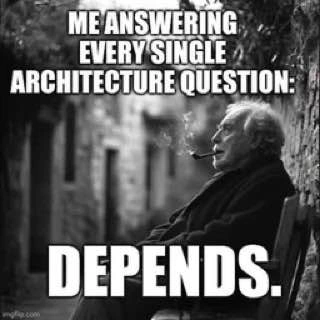
The Senior Architect's Universal Answer
DesignPatterns Architecture Post #6743, on May 12, 2025 in TG

The Senior Architect's Universal Answer

Why is this DesignPatterns Architecture meme funny?

Level 1: Grandpa’s Wisdom

Imagine you ask your wise old grandpa, "Grandpa, is it better to use a hammer or a screwdriver for everything?" Grandpa takes a slow puff on his pipe, just like the elder in the meme, and says, "Well, that depends." You frown – you wanted a simple answer! Then he explains: if you’re trying to put a nail in the wall, a hammer is the right tool. But if you need to tighten a screw, that hammer won’t help at all – you’d need a screwdriver. In other words, there’s no one tool that’s best for every job. It all depends on what you’re trying to do. This is the heart of the joke in the meme. The text shows a seasoned expert saying "depends" to every question, which is funny because it’s like when you ask an adult a yes-or-no question and they give you a huge “maybe.” It might be a little frustrating when you just want an easy answer, but the wise person knows that choosing the right thing means asking, "for what situation?" Just like you wouldn’t wear rain boots on a hot sunny day (unless you really love sweaty feet – ew), in programming you wouldn’t pick a super fancy, complex design for a tiny simple app. The humor here is that the older and wiser someone is (in life or in coding), the more they say "it depends" – because they’ve learned that making good decisions means considering the situation. It’s a bit like how a teacher might answer a question with more questions to guide you. So, the meme is funny and true at the same time: the best answer to almost any big question is “It depends!”

Level 2: Trade-Offs 101

Stepping back from the witty cynicism, let’s break down what this meme is actually saying in simpler terms. In software development, architecture refers to how you design a system at a high level – basically, how all the pieces of a big software project fit together. This includes decisions like what kind of database to use, how different services or modules talk to each other, what frameworks or design patterns to follow, and so on. An architecture review is a meeting or discussion where the team evaluates these design decisions. It’s the stage where people ask questions like, “Should we split the application into multiple services or keep it as one?” or “What’s the best way for these components to communicate?”

Now, when the meme shows an old, wise-looking person saying "DEPENDS." in huge letters, it’s highlighting that an experienced architect’s answer to almost any such question is always “It depends.” But… depends on what exactly? Essentially, it depends on the specific context and requirements. In engineering, a trade-off means you can’t have it all; if you gain something, you usually lose something else. There are always choices and consequences. Let’s define a few of the big terms hinted at in the meme:

  • Monolith vs. Microservices: A monolithic architecture means building one big unified application. Everything is packaged together, which makes it straightforward to deploy and test initially. Imagine one giant LEGO structure – all pieces stuck together in one unit. In contrast, microservices architecture breaks the system into many smaller, independent services (like separate LEGO models that connect). Each microservice handles a specific feature or module and communicates with others often over a network. Microservices can make the system more modular and scalable with teams working in parallel, but they also add complexity. Instead of managing one app, you manage lots of little apps, which means more things that can go wrong in how they communicate or deploy. So which approach is better? If you ask a senior engineer, they’ll say “It depends.” It depends on factors like the size of your project and team, how frequently you need to update parts of the system, and whether you have the infrastructure (and people with expertise) to manage many services. For a small project with a tiny team, one cohesive app (monolith) might be easier. For a huge project with many teams, splitting into services might prevent everyone from stepping on each other’s toes – but only if you’re prepared to handle the extra operational work.
  • ACID vs. Eventual Consistency: ACID is a set of properties that traditional databases (like PostgreSQL, MySQL) follow to ensure reliable transactions. It stands for Atomicity, Consistency, Isolation, Durability – which is a fancy way of saying when you make changes (transactions) in a database, you either apply all the changes or none (atomic), the data is always left in a valid state (consistent), concurrent transactions don’t mess each other up (isolated), and once a transaction is done it won’t be lost (durable). In plain terms, if you transfer $10 from savings to checking, ACID guarantees that either both the subtraction and addition happen, or neither does – and everyone sees the final correct balances. Eventual consistency, on the other hand, is something you hear with certain NoSQL databases or caching systems, especially in distributed systems. It means if no new updates are made to a piece of data, eventually all reads will return the last updated value. But in the short term, different parts of the system might not agree. For example, when you post a photo on a social network, you might immediately see it on your profile, but a friend across the world might not see it for a few seconds – that system is eventually consistent. It favors availability and speed over instantly perfect consistency. So which do you choose? If you ask our friendly architect, “Should we require full ACID transactions or can we go with eventual consistency for better performance?” you’ll hear “It depends.” It depends on what your application is for. If it’s something like a banking system, you really need ACID – money can’t just “eventually” be correct, it must be correct now. If it’s a social media app or an analytics dashboard, maybe eventual consistency is fine – a little delay in data being synced is acceptable if it means the system is faster and more tolerant of outages.

The key point for a newcomer to understand is that every choice has pros and cons. When a senior engineer says "it depends," they're not trying to be frustrating. They’re saying the best answer changes based on the details. If you change the requirements or the constraints even a little, a different solution might be better. This is why architecture discussions can feel long and indecisive – you have to consider a lot of "What if…?" scenarios. ArchitectureDecisions are about weighing trade-offs: you trade some benefits to get others. A fast system might use more memory; a super secure system might be a bit slower; a design that's easy for developers to work on might use more computing resources, and so on.

Think of an architecture review like planning a road trip: one person might ask, "Should we take the highway or the scenic route?" and the experienced guide would reply, "It depends" – on whether you value getting there faster (highway) or having nicer views (scenic). In tech, it's the same idea with more jargon. 🤓 The meme gets a laugh because developers recognize this common situation. Especially for junior developers (people who are new to the industry), it can be surprising or even a bit annoying that their straightforward questions get such a qualified answer. But as you gain experience, you start to see why. There are always hidden details and future consequences to consider. The relatable developer experience here is that moment when you transition from wanting a clear rule or best practice for everything, to appreciating the nuance – essentially leveling up from "tell me the right answer" to "let’s figure out the right answer for this case." So the next time you ask, "Should we always use technology X?" and your senior teammate smirks and says, "Well, it depends…," you'll understand that you're about to have a deeper conversation about why the context matters. And that's a good thing! It means you're thinking like an architect, not just a coder.

Level 3: Context is King

In more practical terms, this meme pokes fun at the default architect answer that every senior engineer eventually learns: “It depends.” Picture an architecture review meeting: a bright-eyed developer eagerly asks, “Should our new system be a microservice architecture or a monolith?” All heads turn to the experienced architect in the room, who exhales like the wise old person in the meme and responds, “Well... it depends.” 😏 Immediately, what was a straightforward question transforms into a seminar on context and trade-offs. The joke lands because this scenario happens all the time in real engineering discussions. Architecture decisions are never made in a vacuum. The meme’s large-impact text DEPENDS. captures that almost comical inevitability that any simple architecture question will bloom into a nuanced conversation once a seasoned pro gets involved.

Why is this so relatable? Because anyone who’s been around the block in software design has learned the hard way that there is no one-size-fits-all answer. The meme resonates especially with those suffering a bit of ADR fatigue – that feeling when every Architecture Decision Record you write includes a laundry list of “if X, then Y, otherwise Z.” After dozens of design docs and system diagrams, you start to feel like that elder on the bench: amused and slightly exhausted that every “simple” question unravels into 20 follow-up questions. Senior architect wisdom often sounds like fortune-cookie paradoxes to the uninitiated. The veteran engineer has become a trade-off connoisseur, expertly sniffing out hidden assumptions and side-effects in any proposal. Ask them something basic like “Should we use ACID transactions for this service or go with eventual consistency?” and you’ll trigger a cascade of considerations: data integrity requirements, performance SLAs, network reliability, team expertise, future feature roadmap, etc. The final answer will invariably be, “It depends on what trade-offs you’re willing to make.” The relatable humor is that sometimes it feels like architects just love saying "it depends" as a flex of wisdom – but in truth, they’ve been burned by absolute answers before. 🤷‍♂️

Consider a few classic debates that every engineer eventually encounters:

  • Monolith vs. Microservices: Monolithic architectures (all-in-one applications) are simpler to deploy and test as a single unit, but can become unwieldy as the codebase and team grow. Microservices (many small, independently deployable services) offer flexibility and isolate faults, but introduce complexity in communication, monitoring, and deployment. Which is better? It depends on your team size, domain boundaries, deployment frequency, and tolerance for operational complexity. A scrappy startup with 3 developers might move fastest with a monolith, while a 500-engineer enterprise with diverse product domains might benefit from microservices – or maybe not, if their devOps isn't mature.
  • ACID vs. Eventual Consistency: An ACID compliant database (think traditional SQL) guarantees that transactions are rock-solid consistent and durable – great for banking where every penny must be accounted for immediately. But that strong consistency can come at the cost of latency or availability in distributed setups. On the flip side, an eventually consistent system (common with NoSQL or distributed caches) will let different parts of the system see slightly out-of-sync data temporarily in exchange for higher availability and speed. Which do you choose? It depends on the business needs: if you're building an ATM system, you choose consistency (no one wants an account balance that's “maybe” correct); if you're running a worldwide social media feed, you might accept eventual consistency so users can always post and read with low delay, even if that like count updates a second later.
  • Prebuilt Platform vs. Custom Build: Should you use a known platform or framework (which is quick to start but might be opinionated) or build a custom solution from scratch (fully tailored but costs more time)? Yep – it depends. If time-to-market is critical and the problem is common (like setting up an e-commerce site), a framework is your friend. If your problem is highly specialized or the off-the-shelf tools all impose painful constraints, a custom build might pay off – but only after weighing the long-term maintenance burden.

In each of these cases, the meme-worthy moment is when someone in the room bravely asks “Which is best?” expecting a confident recommendation, and instead gets a knowing chuckle and that single-word answer. The senior perspective recognizes that every choice has ripple effects. Often the most productive response is to open a dialogue about requirements: "What are our scaling expectations? What's our team’s expertise? What failure scenarios matter most?" The phrase “it depends” is essentially shorthand for “let’s examine the parameters and trade-offs.” It’s funny (in a slightly painful way) because it’s true: architectural decisions live in the grey areas. Seasoned engineers have seen silver-bullet solutions turn into maintenance nightmares because context was ignored. They’ve endured those 3 AM incidents where some “best practice” backfired in an edge case nobody considered. So now, like the pipe-smoking elder, they approach every grand idea with a gentle puff of skepticism and a calm, "Depends." The meme nails this dynamic – turning what could be a frustrating non-answer into a badge of earned wisdom (and a bit of an inside joke) among experienced developers.

Level 4: CAP and No Silver Bullets

At the deepest level of software architecture, every design decision is fundamentally a balancing act between competing forces, often constrained by theoretical limits. Seasoned architects have internalized concepts like the CAP theorem (also known as Brewer's theorem) from distributed systems theory. CAP formally states that in a distributed data store you can only have at most 2 out of 3 guarantees: Consistency, Availability, and Partition tolerance. This isn't just academic mumbo-jumbo — it's a mathematical proof that you cannot simultaneously ensure a system is always consistent and always up (available) if network partitions (failures in connectivity) are possible. In plain terms, if you want a globally distributed database to never disagree on data (consistency) and also never go down (availability), the universe says "pick one when the network is unstable." So when someone naively asks, "Should we use an ACID-compliant relational database or a sharded NoSQL store with eventual consistency?", the wise architect reaches for "it depends" because fundamental trade-offs are at play. The choice will hinge on which aspect you’re willing to sacrifice under failure conditions – immediate consistency or total uptime – a dilemma baked into physics and math.

Beyond CAP, there's a broader computing principle at work often summed up as "No Silver Bullet" (coined by Fred Brooks in 1986). This famous essay argued that no single technology or design paradigm will magically solve all software problems by an order of magnitude. In other words, no one architecture is a cure-all – each comes with pros and cons. This is akin to the No Free Lunch theorem in optimization: an algorithm that performs best for one class of problems will perform worse for another. Likewise, a design that excels under one set of requirements will struggle under a different set. For example, a highly normalized SQL schema ensures consistency and saves space (great for banking software), but throws performance out the window on complex analytical queries (where a denormalized or NoSQL approach might shine). The more you zoom out, the clearer it becomes that every architectural pattern inherently optimizes for certain scenarios at the explicit expense of others. There’s a kind of conservation of complexity at play – if you simplify or optimize one aspect of a system, you invariably push complexity into another area. Embracing microservices might reduce code complexity in each service, but it injects complexity into operations (network calls, deployment orchestration, distributed monitoring). Centralizing into a monolith can simplify deployment and consistency, but often at the cost of flexibility and speed of development for independent teams. These trade-offs aren’t accidental; they're inevitable consequences of computing constraints, finite resources, and even human cognitive limits.

In essence, the seasoned architect’s world-weary "Depends" isn’t laziness or evasiveness — it's an acknowledgement of these underlying principles. They've seen the CAP theorem play out in real outages, learned that curing one bottleneck can create another, and read the research (or war stories) proving that every "best practice" has a breaking point. The humor in the meme belies a core truth: in software design, absolutes crumble in the face of context. The only universally correct answer might indeed be "it depends," because only by analyzing the specific context can we navigate which fundamental compromise to make. The old architect on the bench, puffing a pipe, isn’t being coy; they're silently recalling decades of tech wisdom – from academic proofs to production post-mortems – that back up that single, sighing word: "Depends."

Description

A black and white meme featuring a photograph of an elderly, seemingly wise man with white hair, sitting back in a chair and smoking a pipe. He has a pensive and experienced look. The top text, in a bold white font, reads 'ME ANSWERING EVERY SINGLE ARCHITECTURE QUESTION:'. The bottom text, in a larger, more definitive font, simply says 'DEPENDS.'. This meme perfectly captures the quintessential response of any experienced software architect or senior engineer. Complex system design questions rarely have a single correct answer; the optimal solution is always contingent on specific constraints, requirements, scale, and trade-offs. The phrase 'it depends' has become a humorous trope signifying that the person asking the question has overlooked the necessary context, and the architect is about to embark on a lengthy discussion about those very dependencies

Comments

9
Anonymous ★ Top Pick A junior dev will give you an answer. A senior dev will ask for more context. An architect will say 'it depends' and then bill you for a three-hour discovery session
  1. Anonymous ★ Top Pick

    A junior dev will give you an answer. A senior dev will ask for more context. An architect will say 'it depends' and then bill you for a three-hour discovery session

  2. Anonymous

    If "it depends" were a microservice, its SLA would be "consult ADR first" and its latency would scale with every follow-up question

  3. Anonymous

    After 20 years in tech, I've learned that 'it depends' is actually the most honest architecture answer - it's just shorthand for a 3-hour whiteboard session explaining CAP theorem, Conway's Law, your team's velocity, budget constraints, and why your CEO's nephew's blockchain idea won't solve your scaling problems

  4. Anonymous

    The architect's Schrödinger's answer: simultaneously the most frustrating and most accurate response to any technical question. After 20 years, you realize 'it depends' isn't evasion - it's the hard-won wisdom that context, constraints, team capabilities, timeline, budget, existing tech debt, organizational politics, and that one legacy system nobody wants to touch all matter more than the theoretical purity of any pattern. The junior dev wants a definitive answer; the senior architect knows that anyone who gives one without asking follow-up questions is either selling something or hasn't been burned enough times yet

  5. Anonymous

    After 20 years, “it depends” is shorthand for: what’s the workload shape, latency budget, consistency model, failure domains - and who’s paying the cloud bill?

  6. Anonymous

    'It depends' - the only design pattern that survives every tech stack pivot without refactoring

  7. Anonymous

    It depends - on your consistency model, P95 latency, team topology, RPO/RTO, and the CFO’s egress-fee allergy

  8. @paranoidPhantom 1y

    Be like George Costanza, fake being an architect

  9. @Usarian7 1y

    "Technically yes, but ..."

Use J and K for navigation