Spending 4 Story Points on Bugs Instead of 0.5 on Writing Tests
Why is this Testing meme funny?
Level 1: Shortcuts Backfire
Imagine you have a small chore you really should do, like cleaning up a little spill on the kitchen floor. It would only take a few minutes, but you ignore it to save time. The next day, that spill has attracted a bunch of ants and made a sticky mess. Now you have to spend an hour scrubbing the floor and dealing with insects. Not so “time-saving” after all, right? This meme is joking about the same idea but in software coding. It’s like someone didn’t want to spend a tiny bit of time doing something helpful (checking their work), and because they skipped it, they ended up spending a LOT more time fixing problems. In simple terms: if you skip doing the small good thing now, you’ll just face a big bad thing later. It’s funny in the meme because the people are admitting, “Yes, we tried to save a little effort, and now we’re losing a ton of effort. Oops.” It’s a reminder that shortcuts can backfire – sometimes the “fast” way ends up being the slow way in the end.
Level 2: Pay Now or Pay Later
This meme highlights a simple software lesson: spend a little time now to save a lot of time later. It’s talking about writing tests versus fixing bugs, using the language of Agile teams. In Agile development (like Scrum), teams plan work in sprints (typically 1-2 week cycles) and estimate tasks in story points. Story points are just a gameified way to measure effort or complexity – for example, a 5-point task might be something big, while a 0.5-point task is tiny. Here, 0.5 story points represents a very small effort (maybe a few hours of work) to write tests for new code. Writing tests means creating additional code (like unit tests) that automatically checks if the main code behaves as expected. It’s a key part of maintaining good CodeQuality because tests catch mistakes early.
However, some teams under pressure choose to skip writing those tests in order to claim they “finished” the feature faster. In the tweet conversation, someone (the voice of reason named Dave) asks incredulously: “So you spend 4 story points a week on patching bugs?” and the team admits “yes, Dave.” Then Dave asks, “Just to avoid spending 0.5 story points on writing tests?” and they say, “that’s correct, Dave.” This reveals the irony: they wouldn’t spend a measly half-point on prevention, and now they’re spending 4 points every week on cures. Bugs are errors or flaws in the software that make it behave incorrectly, and “patching bugs” means writing fixes for those errors. Four story points a week on bug fixes is a LOT – it could be like an entire developer’s week, or a big chunk of the team’s sprint capacity, devoted purely to rework. Meanwhile, 0.5 points is almost negligible. The exchange shows how absurd that trade-off is. It’s a bit like a student refusing to study for 30 minutes, then having to retake the exam and study 5 hours to catch up on what they failed.
The term false economy is used to describe this kind of poor trade. A false economy is when you think you’re saving time or money, but you end up spending more in the long run. In our context, skipping tests seems to save effort in the current sprint (yay, we finished the feature “faster”!). But it’s false savings, because that time comes out of later sprints many times over when things break. One bug can consume far more time than writing a simple test would have. For example, imagine you add a new feature without tests. Everything looks fine until a user finds a crash or a wrong result caused by that new code. Now developers have to stop whatever new work they were doing, investigate the issue (which can be tricky and time-consuming), come up with a fix, test that fix, and deploy it. That could easily take a day or more – which might equal 1-2 story points of effort – for just one bug. If multiple bugs slip through due to lack of tests, those costs add up rapidly. Suddenly the team’s velocity (the amount of work they can deliver in a sprint) drops because they’re busy cleaning up past mistakes.
This is also where the idea of technical debt comes in. Technical debt is a metaphor in software: it’s like taking a shortcut or a “loan” by doing things the quick and dirty way now, but then owing extra work later to fix or improve that quick solution. Skipping tests is a form of technical debt – you get a short-term gain (no time spent writing tests, woohoo!), but you incur a liability. The “interest” on that debt is the extra bugs and maintenance you have to do afterwards. Just like with money, a little debt can grow into a lot of pay-back if you’re not careful. Teams that continually skip tests often find their project becoming harder and more fragile over time: new features keep breaking old ones because there’s no safety net of tests to catch issues early. It’s much more costly to fix a bug that sneaks into a released product than to catch it during development. In fact, industry studies and common sense agree: a bug found by a developer in five minutes during testing is far cheaper than a bug found by a customer in production that might take days of emergency work to diagnose and patch. So investing that 0.5 story point upfront on tests can save 4 story points (or even more) later. That’s the cost-of-quality trade-off in a nutshell.
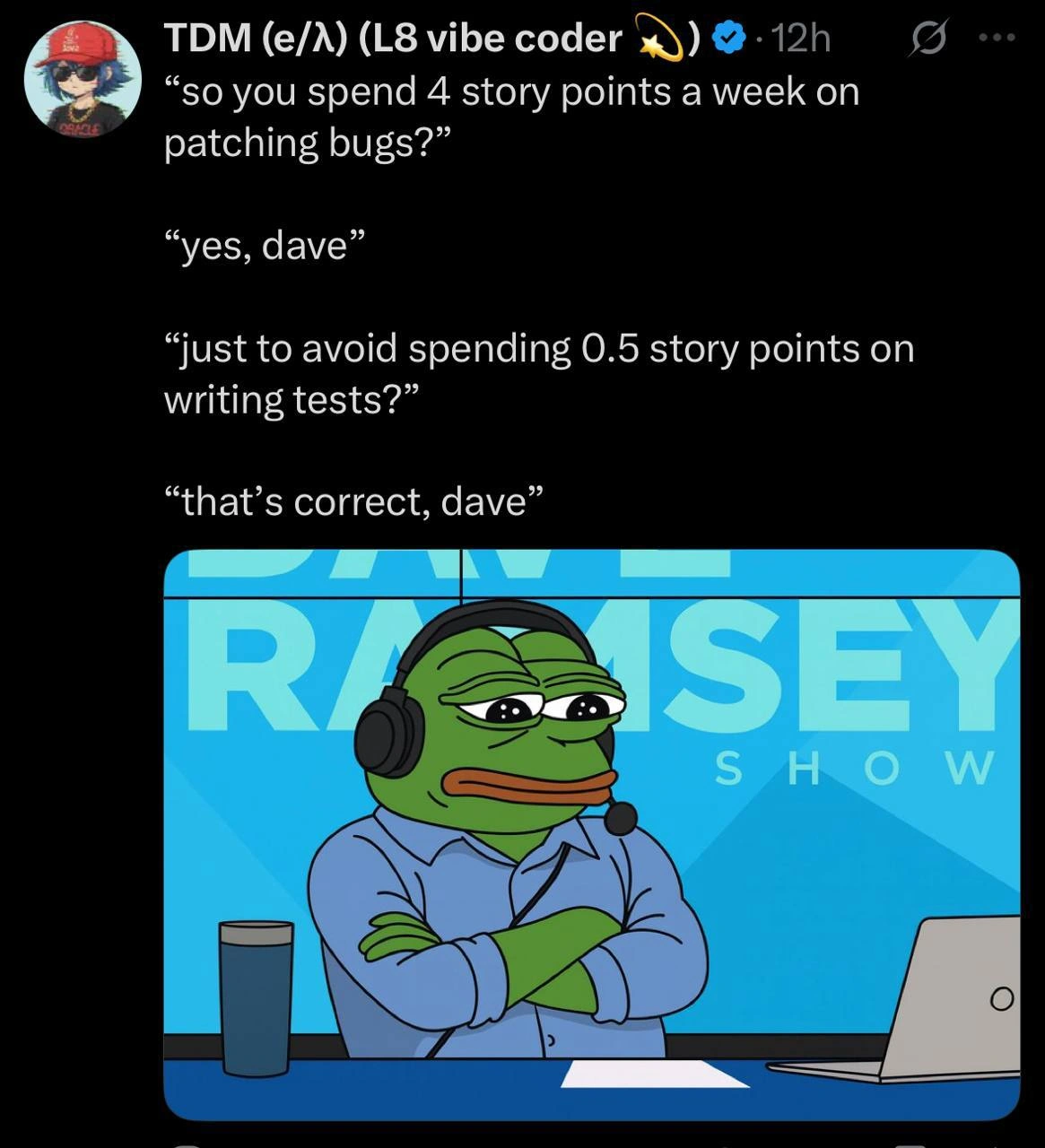
Let’s break down the meme imagery as well, since it adds another layer to the joke. The bottom panel shows Pepe the Frog wearing a headset and sitting at a studio desk labeled “DAVE RAMSEY SHOW”. Pepe the Frog is a popular internet meme character often used to convey feelings like sadness, frustration, or resignation in a humorous way. Here, Pepe is playing the role of Dave Ramsey, who is a real-life radio host known for giving financial advice, especially telling callers to avoid bad financial decisions and get out of debt. Dave Ramsey often uses a tough-love approach, pointing out when someone is being “penny wise and pound foolish” (saving a little now only to spend a lot later, like not buying a $20 smoke alarm and then having a $20,000 fire). That’s exactly the scenario in this meme, but applied to software development. By putting Pepe (with a classic sad/wise look) in Dave’s seat, the meme compares technical decisions to financial ones. It’s as if the developer team is a caller on the show confessing, “We didn’t spend a tiny bit on tests, and now we’re bleeding time on fixes,” and Pepe/Dave is just folding his arms, thinking “This is not smart, guys.”
For a junior developer or someone new to Agile, the lesson here is clear: quality assurance is part of the job, not an optional add-on. Writing tests, doing code reviews, and generally double-checking your work might feel like it slows you down in the moment. But those practices prevent bigger problems. If you skip them, you might demo a feature faster this week, but next week you could be undoing and redoing that work because of avoidable bugs. It’s a lot like skipping routine maintenance on a car or skipping studying in school – the initial skip feels like you saved time or effort, but then you pay for it later with breakdowns or bad grades. In software, having good unit test coverage (meaning a high percentage of your code is covered by automated tests) is like having an early warning system. It catches you when you accidentally break something. Without that, you’re effectively flying blind, and every new change is a potential surprise bug waiting to strike. That’s why most teams treat a decent amount of testing as non-negotiable, even if it “costs” a bit of time. The meme is a funny reminder of what happens when you treat testing as a waste: you end up converting your saved half-day into a multi-day bug fixing marathon. Not a great deal, right?
In summary, “The false economy of skipping tests to save a sprint’s points” means any short-term saving (sprint points, time, effort) by cutting quality corners is usually an illusion. You’ll lose more points later fixing the mess. The tweet-style dialogue and the Pepe-as-DaveRamsey cartoon drive home this point in a relatable way. It’s both humorous and a little too real for developers who have been through this. So the next time you’re tempted to say “we don’t have time for tests,” remember this meme – you might hear a little voice saying, “That’s correct, Dave,” and envision a frog with headphones judging you. 😅 It’s better to pay the small cost upfront than to pay the big cost later.
Level 3: Penny Wise, Sprint Foolish
“so you spend 4 story points a week on patching bugs?”
“yes, dave”
“just to avoid spending 0.5 story points on writing tests?”
“that’s correct, dave.”
This dry exchange is a painfully familiar Agile horror story wrapped in meme form. It highlights a classic false economy in software teams: skipping tests to "save time," only to spend much more time later fixing the resulting Bugs. The meme channels the vibe of a financial advice show (note the Dave Ramsey backdrop) to underline the absurd trade-off. In the scenario, a team avoids investing a mere 0.5 story points on writing unit tests during a sprint, and as a consequence, they burn 4 story points every week patching regressions. It’s like telling a financial guru you refuse to spend $5 on insurance but are fine losing $500 in accidents each month. No wonder Pepe the Frog (as Dave) looks so resigned and exasperated behind that radio microphone – this is Code Quality Debt 101, and it’s not a winning strategy.
Seasoned developers immediately recognize the humor and pain here. Story points are an Agile team’s currency for effort, and a sprint’s worth of points is precious. Blowing a chunk of that capacity on avoidable bug fixes means the team’s velocity (features delivered per sprint) is effectively crippled by self-inflicted wounds. The dialogue reads like a frustrated Scrum Master or a snarky senior engineer calling out the team’s folly:
- Agile Velocity Mirage: By not writing tests, the team might think they’re going faster (hey, we delivered the feature in 4 points instead of 4.5!). But that “saved” half-point comes back with a vengeance when the untested code breaks. Suddenly 4 more points (often an entire developer-week of effort) vanish on hotfixes. The sprint plummets into bug-fixing hell, and any real progress is stalled. It’s an Agile pain point many of us have experienced: the burndown chart looks great… until it doesn’t.
- Technical Debt Interest: Skipping tests is the textbook definition of Technical Debt. You take a shortcut now (borrow time) and pay interest later in the form of extra work. Here the interest rate is brutal – an 0.5 point “loan” ballooning into a 4-point payment every week. It’s like coding on a credit card with compounding interest; each bug is an interest charge on that unpaid unit test bill. Over time, the “debt” accumulates. Future sprints get bogged down by yesterday’s quick-and-dirty decisions. The meme’s numbers (0.5 vs 4) scream what every senior dev knows: investing in quality saves time. Cut corners and you get cut by them.
- Cost of Quality vs. Bugs: In software engineering, there’s a well-known concept called the cost of quality. It tells us that a bug caught early (say, by a unit test or code review) is orders of magnitude cheaper to fix than a bug found in production. Writing tests is part of the upfront “cost” of quality – a bit of extra effort to prevent defects. When teams skip this, they incur the cost of non-quality later: customer-reported bugs, emergency patches, maybe even late-night on-call incidents (the classic 3 AM deploy, anyone?). The meme nails this irony: a unit_test_coverage of near zero might save a few hours this week, but it virtually guarantees firefighting sessions in weeks to come. It’s the “pay me now or pay me (more) later” principle in action.
What really sells the meme is the deadpan acceptance in the dialogue: “yes, dave… that’s correct, dave.” You can almost hear the weary tone. This isn’t a triumphant punchline; it’s a defeated confession. It’s funny because it’s true – countless teams have rationalized exactly this, often under pressure from product managers fixated on short-term throughput. The developer (or manager) in the hot seat knows how ridiculous it sounds when stated plainly, but they still went along with it. Pepe the Frog, cast as the radio host Dave Ramsey (famous for scolding people’s bad financial habits), embodies the collective facepalm of veteran engineers everywhere. His arms are folded, headset on, wearing the expression of “I’m not mad, I’m just disappointed.” It’s a perfect visual for the RelatableDevExperience of witnessing avoidable bugs flood the board because someone declared tests “too expensive.”
The meme strikes a chord because it exposes a universal AgileHumor hypocrisy: teams often celebrate finishing a user story faster by skipping CodeQuality practices, only to lose twice that time later. The relief of closing a story without tests quickly turns into déjà vu as the same story resurfaces in the bug tracker. It’s Agile irony at its finest – the process that encourages incremental improvement and feedback can be subverted to chase immediate points at the expense of future sprints. Experienced devs have sat through retrospectives where this exact topic comes up: “We spent most of the sprint fixing old bugs. How can we prevent that?” Cue the awkward silence as everyone knows the answer: write the tests you skipped. In other words, stop being “penny wise and pound foolish” with your code quality.
In summary, this meme uses a clever mash-up of internet culture and project management reality. By parodying a Dave Ramsey Show call, it frames poor development practices as the bad financial decisions they really are. And it delivers the lesson with sarcastic wit: saving half a point by ignoring tests is a false economy that will bankrupt your sprint’s productivity. Any battle-scarred engineer can attest – if you don’t pay the small cost of prevention, you’ll pay the large cost of cure. Or as Dave (Pepe) might put it: “That’s just bad math, my friend.” 😔
Description
A tweet from TDM (e/lambda) (@L8 vibe coder) featuring a Pepe the Frog meme styled as a talk show host on the 'Dave Ramsey Show' set. The text reads a dialogue: '"so you spend 4 story points a week on patching bugs?" "yes, dave" "just to avoid spending 0.5 story points on writing tests?" "that's correct, dave"' The Pepe character sits with arms crossed wearing a headset with microphone, looking unimpressed. The format parodies Dave Ramsey's financial advice show where callers describe obviously bad financial decisions, but applied to software development practices -- specifically the false economy of skipping tests to save time while spending far more time on bug fixes
Comments
14Comment deleted
Dave Ramsey's debt snowball method, but for tech debt: stop writing tests, accumulate bugs faster, then declare sprint bankruptcy
Turns out the quickest way to inflate team velocity is to count every production hotfix as its own ‘new feature’ - just don’t ask Jira to do ROI math
After 15 years in the industry, I've learned that the only thing more expensive than writing tests is explaining to the board why a missing unit test caused a $2M production outage during Black Friday - but sure, let's save that half story point this sprint
Ah yes, the classic 8:1 technical debt interest rate - spending 4 story points per week servicing the principal on that 0.5 point test you refused to write. It's like paying $400/month in credit card interest to avoid a $50 annual fee, except your product owner is the one checking the statement and wondering why velocity keeps dropping while the backlog grows exponentially
Our quality strategy is the minimum-payment plan: skip 0.5 points of tests, accrue 4 points of bug interest weekly, and call the bankruptcy a hardening sprint
If story points were currency, skipping tests is a payday loan - the team keeps refinancing the same defect every sprint at compounding interest
Classic Agile arbitrage: 8x effort on fixes beats 1x prevention, because who needs dams when you love mopping floods?
One doesn't stop the other, tho Comment deleted
you're going to have bugs with tests 😅 Comment deleted
with tests that would be 5 story points, dave also what is 0.5 points? shouldn't it be as a fibonacci seq Comment deleted
The one who sees through an actual fake statements of the meme 👁️ 👃 👁️ 🫦 Comment deleted
Imagine when tests are actually going to take something like 0.5points to do and they are not included into the scope of the ticket 🌚 Comment deleted
Anyway Comment deleted
In the industry we call it "job security" Comment deleted