Samsung Galaxy Ring Battery Swelling While On Finger Before Flight
Why is this Hardware meme funny?
Level 1: Ring Gone Wrong
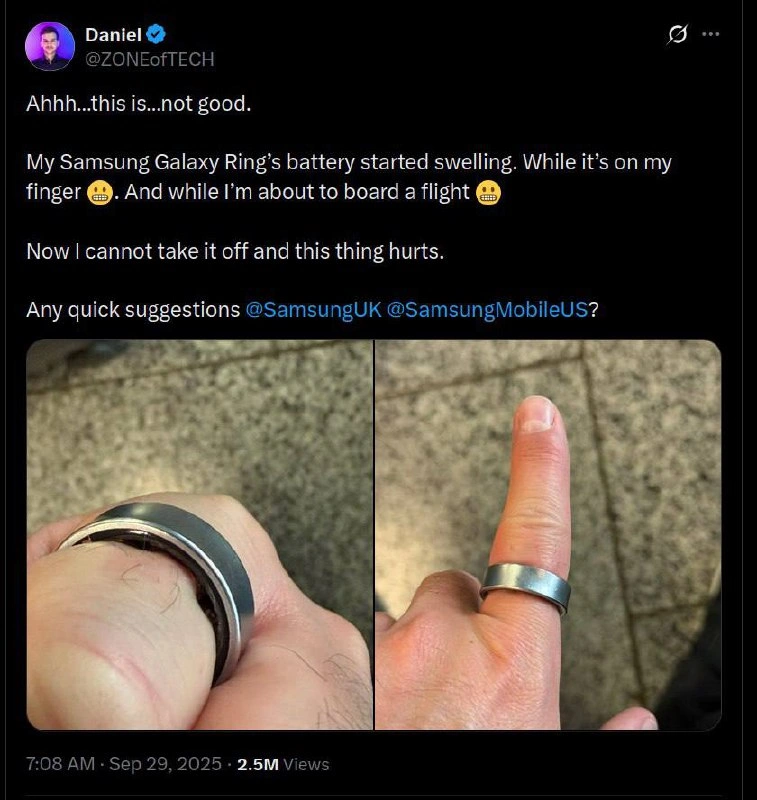
Imagine you have a cool new smart ring that’s like a tiny computer on your finger. It can do neat things, maybe measure your heart rate or send you messages, and it has a little battery inside to power it. Now imagine that one day, as you’re about to go on a big airplane trip, your ring starts to act funny. The battery inside is broken so it swells up like a little balloon. But since the battery is stuck inside the metal ring, the whole ring starts to get tight on your finger – really tight, like it’s suddenly a size too small. It squeezes your poor thumb and now you can’t pull the ring off. It hurts a lot, and you’re getting scared because it’s stuck and your finger is getting red!
This is exactly what happened to someone named Daniel with his Samsung Galaxy smart ring. It’s kind of like a scene from a cartoon, but also serious: imagine a ring that traps your finger right when you need to head onto an airplane. He’s worried and probably thinking, “Oh no, what do I do now?!” He even went on Twitter (a place where people post messages) to ask Samsung for help quickly. It’s a bit funny in a shocking way because you don’t expect a high-tech gadget to turn into a finger trap. Usually when we say a project has a “big problem” we mean it figuratively, but here the gadget literally made a big physical problem. It’s like if you had a toy that suddenly blew up like a balloon and stuck to you. People find it funny to read about (since they’re not the one stuck!), but it’s also kind of scary.
Think of it this way: maybe you’ve heard adults joke about having a “million things to do” (a big backlog of tasks) that just keeps growing. In this story, it’s as if one of those undone tasks – making sure the ring’s battery is safe – turned into a real-life growing problem. The battery grew bigger (swelled) and became a real hassle. So the phrase “swelling backlog” is like saying “the growing pile of problems” — and in this case the pile of problems actually grew inside the ring. The humor is that it’s a literal and physical interpretation of a phrase that’s usually just an expression.
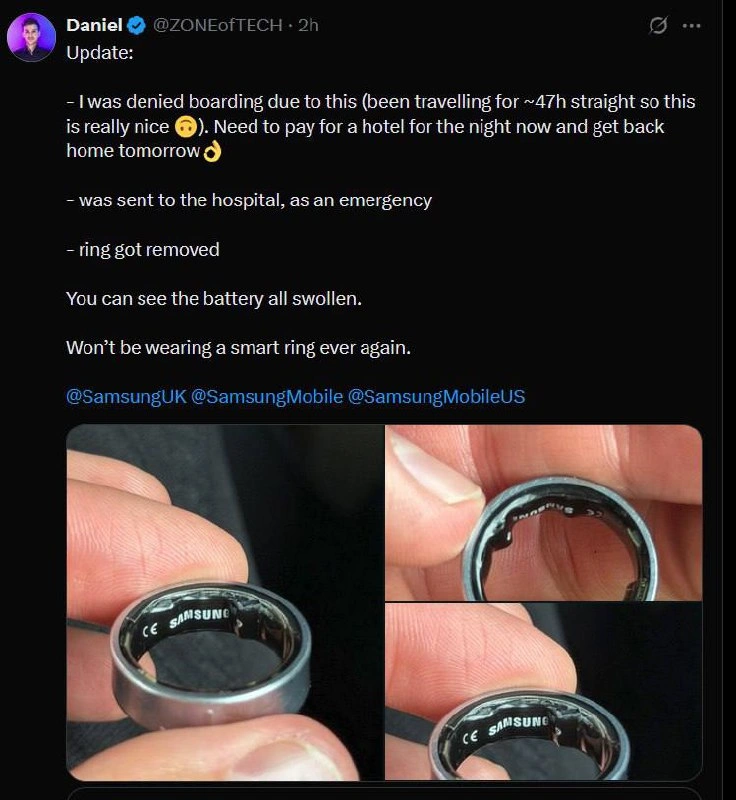
In plain terms, why is this meme shared? Because it’s surprising and a little ridiculous. It shows how even fancy gadgets can fail in very human ways. Imagine a brand new ring gadget that was supposed to be helpful ends up being something you might need a firefighter or doctor to cut off. That’s not what anyone expects when they buy new tech! It’s the kind of unexpected situation that makes you laugh a bit (poor guy, who would have thought a ring battery could do that?) but also feel relieved it’s not happening to you. So, “Ring Gone Wrong” pretty much sums it up: a high-tech ring went wrong in a dramatic way, becoming a little trap on someone’s finger. The story is funny afterwards when everyone is safe, but at the moment it happened it must have been quite scary for Daniel. It’s a reminder that sometimes new inventions have surprising problems – like a ring that hugs a bit too tightly – and that’s why testers and engineers have to be super careful. In the end, it’s a tale of a gadget mishap that makes us both laugh and learn a lesson about safety.
Level 2: Wearable Woes
Let’s break down what’s happening here in simpler terms. We have a wearable technology device – essentially a smart ring (think of it like a mini fitbit or smartwatch, but ring-shaped). Being an IoT (Internet of Things) gadget, it’s designed to be worn on your body and connect to your phone to do cool things like track your health or notify you of messages. Cool, right? But here’s the catch: unlike software which lives in the digital world, hardware like this ring has to obey the unforgiving laws of physics and chemistry. In this case, the ring contains a lithium-ion battery, which is a small rechargeable battery that gives the ring power. Lithium-ion batteries are used everywhere (phones, laptops, even electric cars) because they can hold a lot of energy for their size. However, they have a known quirk: if they malfunction, they can swell up or even burst. “Battery swelling” means the battery sort of puffs up like a tiny balloon because of gas forming inside it (caused by chemical reactions when the battery is damaged or mischarging).
Now usually, devices are built with a bit of extra space or vents so if a battery swells, it won’t harm anything – maybe your phone back cover pops off, for example. But a ring is a solid loop; it can’t expand easily. So if the battery inside it swells, the only thing it can push against is your finger. That’s why in the tweet Daniel says “I cannot take it off and this thing hurts.” The ring got tighter and probably stuck on his thumb because the battery inside expanded. Imagine wearing a ring that suddenly shrinks on your finger – it would pinch you and you wouldn’t be able to slide it off. This is basically a high-tech version of a finger trap, and quite a literal one at that! It’s a nightmare scenario for any user and a huge problem for the company.
Now, shipping a product “to prod” is developer slang for releasing something to the public or to the production environment (where real users use it). So “shipping an IoT ring to prod” means Samsung released this smart ring into the real world. When developers or engineers do that, they usually have a list of known issues or tasks left to do, called a backlog. Think of a backlog as a to-do list of improvements and fixes. Sometimes due to deadlines, not everything on that list gets done before launch. They might hope to fix remaining issues in the next update or next version. The meme calls this situation “discovering the literal swelling backlog” because the backlog (the unresolved issues, like perhaps a battery problem they should have fixed) is now “swelling” in a very literal sense – the battery is inflating. It’s a play on words: normally a “swelling backlog” means an increasing number of tasks, but here it’s a battery swelling incident. In other words, an issue that might have been lurking in that task list has physically manifested as the battery swelling. It’s a clever (if painful) pun that developers find ironic and funny.
Let’s touch on why this is especially bad timing: he’s about to board a flight. Airplanes and swollen batteries are a bad mix. You might recall or have heard that a few years back, a Samsung phone (the Galaxy Note7) had a battery flaw that made some catch fire. It was such a risk that airlines banned them mid-flight, and there were announcements about not bringing them on planes. Since then, any sign of a battery overheating or swelling on a plane is taken very seriously (flight attendants have fire-resistant bags and protocols for battery fires). Now in Daniel’s case, he has a smart ring that’s acting up right before he boards. He can’t take it off, and it’s hurting him. That’s not only scary health-wise, but also exactly the kind of thing airport security (TSA) or the airline would be deeply concerned about – a device that could potentially catch fire on someone’s hand on the plane. Yikes. The context tag rfq_at_airport_security hints that this could turn into an awkward conversation with airport security, possibly involving tools to cut the ring off. (RFQ could humorously stand for “Really Freaking Quick” assistance, which is what he needs!).
From a quality assurance (QA) perspective – that’s the testing phase – this suggests some oversight. QA is supposed to catch issues under various scenarios: different temperatures, pressures, usage patterns, etc. With IoT devices, testing is tricky because you have to consider real-world conditions. Did they test what happens if someone wears the ring on a long flight? Or what if the ring is squeezed or gets warm? We don’t know, but clearly something slipped through. IoT QC oversight means the Quality Control (QC) or QA process for this Internet of Things device didn’t catch a critical flaw. For a hardware product, missing such a bug is especially serious. Unlike software that can be patched with a download, if a hardware device has a defect, the only fix might be to recall it – basically ask customers to return it or replace it, which is costly and embarrassing (the tag wearable_recall_nightmare refers to this nightmare scenario of having to recall a wearable gadget).
Now, let’s talk about the human side: the user Daniel is facing a very real problem – pain and anxiety. A swollen battery can get hot and even burn. The ring is stuck, so his thumb might be swelling too (fingers can swell if constricted, which makes removal harder – a vicious cycle). He’s asking Samsung publicly for “any quick suggestions.” Realistically, the suggestions might be: seek immediate help to cut off the ring (airport medical services have tools for ring removal, similar to what firefighters or ER doctors use for stuck rings), or cool the hand (to reduce swelling in the finger), and definitely do not board with it if it’s a hazard. It’s a scary situation! The meme is highlighting this ridiculous edge case: no one expects their fancy new smart ring to turn into a finger trap that might catch fire, especially not right as they’re about to fly. But edge cases are just that – rare, unexpected scenarios that can and do happen.
For a junior developer or someone new to tech, the takeaway is: hardware has its own kind of bugs. In software, a bug might crash your app. In hardware, a bug can have physical consequences – like a burnt finger or a smoke alarm going off. It underscores why testing and safety margins in hardware are so important. A phrase often used is “hardware humor” or HardwareTradeoffs – meaning the funny (or not-so-funny) compromises hardware designers have to make. For example, to get good battery life in a tiny device, you use a high-energy battery, but that can be riskier. To make a device slim and fashionable, you reduce protective casing, but then any failure can be more dangerous. These are the trade-offs. This scenario shows a trade-off that went wrong: the desire to have a powerful ring in a tiny form led to a situation where a small failure isn’t contained. And because it’s an IoT device, connected and modern, we sometimes forget it can fail as any gadget can. It’s a reminder that even cutting-edge tech can have very down-to-earth problems – like “Ouch, it’s stuck on my thumb!”.
In simpler terms, the meme is joking that the developers or engineers “shipped” this product to customers with some known issues (their backlog wasn’t empty), and one of those issues literally blew up (swollen battery) in the customer’s hands (or on his finger). It’s a mix of engineering insight, cautionary tale, and schadenfreude (a German term meaning we secretly laugh at someone else’s misfortune – though we do hope Daniel got that ring off safely!). Developers who see this will chuckle and wince at the same time, thinking: “There but for the grace of God go all of us and our projects.” It’s a prime example of an edge case that became a headline. And for any junior folks: now you know why your senior colleagues sometimes insist so much on testing and safety – they’re trying to avoid exactly this kind of scenario where a bug jumps out of the computer and bites someone in real life.
Level 3: Backlog Bites Back
This meme’s title, “Shipping an IoT ring to prod, discovering the literal swelling backlog,” is a darkly funny play on developer lingo. In software, a backlog is that ever-growing list of tasks, bugs, and features we haven’t tackled yet. It has a habit of “swelling” when deadlines loom and corners get cut. Every experienced engineer knows the uneasy feeling of deploying something while silently praying none of those ignored issues blow up in our face. Well, here we have a literal blow-up: the ring’s battery swelled up like an overstuffed sprint board, and it literally bit the user (finger, in this case) at the worst possible time. It’s as if all the unresolved hardware bugs in the project backlog manifested physically in one dramatic moment. The humor (tinged with horror) comes from that one-two punch of irony: “shipped to prod” implies they released this IoT device to real users, and now an unfixed issue (battery swelling) became a painfully real production incident. You can almost hear a jaded senior engineer muttering, “Feature shipped on time? Check. Backlog swollen to bursting? Also check.”
This scenario is the embodiment of the senior-dev proverb: “If anything can go wrong in production, it will – and at the worst possible time.” In true Murphy’s Law fashion, the Galaxy Ring’s failure occurs right as the user is boarding a flight. Seasoned folks in tech remember the Samsung Galaxy Note7 debacle, where phones were spontaneously combusting – so much that the FAA banned them on flights. No company wants a repeat of that PR nightmare. Yet here we are: a next-gen Samsung gadget causing airport drama. You can imagine the panic on the support and engineering teams when this tweet with 😬😬 emojis and 2.5 million views started making rounds. That’s basically an incident report gone viral. The user even tags @SamsungUK and @SamsungMobileUS publicly asking for “quick suggestions” – translation: urgent help needed, your product is literally hurting me. It’s a far cry from a quiet support ticket. Instead, it’s a full-on public Sev1 incident. Any senior engineer or product manager reading that tweet likely felt their stomach drop: this is the kind of fire you can’t just SSH into a server to fix or push a quick hotfix for.
The humor here is laced with collective PTSD for anyone who’s dealt with production issues. We laugh (a bit nervously) because we’ve all seen minor oversights turn into big problems. Of course, for software folks, a swelling backlog might mean overtime and a nasty email from the boss – not a physical object clamped on a customer’s body. The meme exaggerates this contrast: technical debt in a project can feel burdensome, but here technical debt got so bad it’s literally cutting off blood flow! It’s an extreme, almost cartoonish depiction of a production bug. But it’s also a cautionary tale: those pesky “low priority” issues (like, say, concerns about battery heat or swelling in testing) have a way of biting you later. Quite literally, ignoring a hardware trade-off or rushing through IoT device QA created a scenario where the “edge case” became front-page news.
Senior engineers will also appreciate the subtext about hardware vs software release cycles. In software, “ship to prod” is often semi-reversible – you can roll back or patch quickly. In hardware, once you’ve shipped units to customers, any serious flaw is out in the wild and painfully costly. You can’t exactly git revert a thousand smart rings or auto-update a physical battery. The meme is essentially gallows humor about a hardware bug that no amount of late-night code deploys can fix remotely. If a user can’t even take the device off, you know you’ve got a hands-on (pun intended) issue. Likely as not, Samsung’s mitigation here would involve something old-fashioned and expensive: advising the user to seek medical help to cut off the ring (imagine the embarrassment and liability), and then issuing a recall or replacement program for others. That’s the hardware equivalent of a full system rollback – only with EMTs and apologetic PR statements involved.
In the bigger picture, this highlights an industry pattern: IoT (Internet of Things) devices are proliferating rapidly, and companies rush to be first to market in new gadget categories (smart ring, anyone?). But moving fast and breaking things doesn’t work so well when “breaking things” could mean burned customers (literally). Internally, there were probably tickets or test reports hinting at a potential battery swelling issue. Perhaps engineers raised a flag: battery runs hot under certain conditions, or finger swelling tests needed. And perhaps management said: “Noted, but we have a launch date, let’s fix it in version 2.0.” Classic technical debt gamble. And here, that gamble led to an engineer’s worst nightmare: a safety issue on a live product, and a viral tweet calling them out. It’s the kind of incident that triggers all-hands meetings, post-mortems, and some very awkward calls with executives. In other words, the backlog came back to bite – and it chose a very literal, very painful way to do it.
To seasoned developers, there’s also a wry nod in the phrase “swelling backlog” – we use that metaphor all the time, but rarely does it escape metaphorical confines like this. It’s as if the universe said, “Oh, you think your backlog is a pain? Let me show you real pain.” It’s funny because it’s absurd, and we laugh because it’s better than crying. This meme perfectly captures the too real feeling of a production issue that’s spiraled out of control. And like any war-torn veteran of on-call duty, one can only respond with a mix of sympathy for the poor soul wearing that ring and a sarcastic, head-shaking chuckle at the sheer absurdity of it all.
Level 4: Li-ion Pressure Trap
Deep inside this wearable fiasco is some hardcore hardware science at play. The Samsung Galaxy Ring likely uses a tiny Lithium-ion battery (probably a lithium-polymer micro-cell) tucked into that sleek metal band. Now, lithium-ion chemistry is great for packing energy into wearables, but it’s also notoriously finicky about how it's treated. When a Li-ion cell is overcharged, overheats, or is just defectively manufactured, it can produce gas inside the battery pouch. In a phone, a swelling battery might push the screen out or make the case bulge. But in a ring – a rigid metal circle – that gas has nowhere to go. The result? The battery expands inward, turning the ring into a vise grip on the poor user’s finger. Essentially, the gadget’s power source became a mini pressure vessel, and the user’s thumb was the release valve (ouch). This is a textbook lithium-ion failure mode: internal cell pressure skyrockets (thanks to our friend PV = nRT from basic chemistry, where trapped gas and even slight heat cause volume expansion). Usually devices have some mechanical failsafe (like a pressure vent or a bit of empty space) for swelling cells, but a slim ring has no room for such luxuries. It’s like trying to cage a growing pufferfish in a metal hoop – something’s gotta give, and unfortunately it was the user’s circulation.
To make matters worse, the timing of this incident flirts with another physics wrinkle: airplane cabin pressure. The tweet mentions this started “while I’m about to board a flight”. Airplane cabins are pressurized to about 8,000 feet altitude equivalence. That lower ambient pressure would exacerbate any battery swelling. Think of it like this: the battery has built-up internal gas (high pressure), and as the external pressure drops during ascent, the differential increases – the cell wants to puff even more. Hardware engineers actually test for this scenario in safety labs (high-altitude or low-pressure testing) to catch exactly such failures. If Samsung’s QA missed this edge case, the ring could pass ground tests but still balloon at 30,000 feet. We’ve seen a similar phenomenon with sealed bags of chips expanding on flights; here it’s a sealed battery cell expanding in a sealed ring. The phrase thermal runaway also lurks in every engineer’s nightmares here – if the swelling continued unchecked, a battery can overheat and catch fire (the infamous chain reaction that grounded the Galaxy Note7 phones in 2016). In a worst-case scenario, a thermal runaway in a device strapped to your finger on a plane is a scene straight out of a horror story (or at least a news headline). Modern Li-ion cells have protection circuits to prevent overcharging and overheating, but in such a tiny form factor, the Battery Management System (BMS) is likely minimal. There’s only so much you can miniaturize safety electronics. As a result, when something goes wrong in a tiny battery, it really goes wrong – no graceful degradation, just immediate hardware failure clamped around your thumb. The ring essentially became a miniaturized containment failure – a high-tech finger trap where the electrochemistry fought against the industrial design. This is the bleeding edge of IoT hardware design: pushing the limits of battery tech so far that the laws of physics push back, literally around your finger.
Beyond the battery itself, consider the design trade-offs the engineers faced. They needed to cram a radio (Bluetooth), sensors, and that battery into a fashionable ring. Likely they chose a lithium-polymer coin cell bent into a ring shape, maximizing capacity to give decent battery life (who wants to charge their smart ring every 4 hours?). But high energy density + tiny enclosure = razor-thin safety margins. If the manufacturing of that battery had even a slight impurity or if the charging firmware mismanaged a cycle, the cell could start breaking down internally. In larger devices, there’s often a bit of air gap or a pressure vent in the battery casing – some phone batteries have a creased foil that can unfold to accommodate swelling. On this ring, any expansion just translates to mechanical force on the metal casing. This is mechanical engineering 101 clashing with chemical reality: a rigid ring will always constrain a swelling battery, so the pressure finds the weakest point – in this case, the soft flesh of a thumb. Ouch indeed.
From a systems engineering view, this incident is a cascade of failures: the Quality Assurance process didn’t catch a hazardous edge case, the physical design lacked an emergency release mechanism, and the battery chemistry decided to throw a tantrum at 35,000 feet. It underscores how incredibly challenging hardware QA is compared to software. There’s no unit test for “battery doesn’t swell while on a human finger mid-flight.” You either preempt it by exhaustive testing and sound design, or you find out the hard way in production. Here, they found out in production – in the most memorable way possible.
Description
A tweet from Daniel (@ZONEofTECH) posted at 7:08 AM Sep 29, 2025 with 2.5M views. The text reads: 'Ahhh...this is...not good. My Samsung Galaxy Ring's battery started swelling. While it's on my finger. And while I'm about to board a flight. Now I cannot take it off and this thing hurts. Any quick suggestions @SamsungUK @SamsungMobileUS?' Two photos show the Samsung Galaxy Ring on the user's finger -- one showing the ring from above with visible swelling/deformation, and another showing the finger being squeezed by the expanding ring. This is the original incident post documenting a dangerous battery malfunction in a consumer wearable device in real-time
Comments
7Comment deleted
Samsung Galaxy Ring: the only wearable where 'battery expansion' is both a firmware feature and a medical emergency. At least the Note 7 didn't physically trap you
Nothing like discovering your ring’s load test was your actual finger - talk about a hotfix that needs the fire department, not GitHub
This is what happens when your ring finger becomes a literal hotfix deployment environment - complete with thermal throttling, memory pressure, and an imminent kernel panic at 30,000 feet
When your IoT device takes 'ring buffer overflow' a bit too literally and implements it in hardware. This is what happens when your wearable's power management strategy is 'expand or die' - though in this case, it's more like 'expand AND potentially cause a medical emergency.' Nothing says 'move fast and break things' quite like a lithium cell deciding to demonstrate thermal expansion principles while you're trying to board a flight. At least it's not a Note 7 situation... yet. Pro tip: when your smart ring starts implementing its own version of 'hot swapping,' it's time to call the fire department, not customer support
Classic DFMEA debt: a wearable that enforces vendor lock‑in by swelling to the customer - P0 with no rollback, and MTTR depends on airport security’s bolt cutters
Nothing like discovering your wearable shipped with a literal ring buffer and no overflow handler - cell swells, finger deadlocks, and the only rollback requires a jeweler with wire cutters
Hardware's memory leak: silently bloats until the host - your finger - goes down hard