Skip to content
DevMeme
6604 of 7435
WaveSpeedAI Announces Google Veo 3.1 Integration for AI Video Generation
AI ML Post #7237, on Oct 8, 2025 in TG

WaveSpeedAI Announces Google Veo 3.1 Integration for AI Video Generation

Why is this AI ML meme funny?

Level 1: Big Hype, Tiny Fix

Imagine a toy car company announcing a new model with fireworks and trumpets. They shout, “No more tiny rides! Our latest toy car can run for a whole minute instead of 30 seconds, and it never loses a wheel now! The future of fun is here!” Most people would chuckle at how dramatic that sounds for a small improvement – the car runs a bit longer and doesn’t wobble as much, nice, but it’s not exactly a flying car. This meme is like that. It’s making fun of a company that is talking very big about some fixes and upgrades that, while good, are not earth-shattering. In simple terms, the company is saying, “Our AI videos will look a bit clearer, the characters won’t magically change faces anymore, and the videos can be a little longer – isn’t that amazing?!” The funny part is the huge fanfare they’re making out of what is basically just making their product work more like it’s supposed to. It’s like saying “I put on my shoes correctly today – I’m a fashion genius!” 😂 The meme gets us to smile because we all know someone (or some company) who brags way too much about something that’s only a small step.

Level 2: Fixed Faces, Short Films

So what’s actually going on in this AI video update? Google Veo 3.1 appears to be an upgraded AI/ML tool for creating videos with AI-generated content. The tweet lists new features in a very excited tone. Let’s break them down in plain terms:

  • Ultimate Character Consistency: Earlier AI video models had a funny (and creepy) habit of changing a character’s face or details from one frame to the next – as if your main character had a shape-shifting problem. These were those notorious face shift glitches. For example, in one frame the character’s eyes might be blue and in the next frame suddenly brown, or their whole face subtly changes shape. This update promises to fix that, keeping the character’s appearance consistent throughout the video. In simple terms, the AI will remember what the person or character is supposed to look like, instead of inadvertently creating twins and doppelgängers frame-by-frame. This makes the storytelling seamless instead of unintentionally hilarious or scary.

  • Native 1080p output + Cinematic Presets: 1080p is a video resolution (1920x1080 pixels, often called Full HD). Many earlier AI video generators could only produce lower resolution clips (to save on computing power, they might have been limited to 480p or 720p, which look less sharp). Now, it can generate videos in full HD, meaning more detail and clarity – no more blocky or blurry outputs by default. The “cinematic presets” part likely refers to built-in style settings or filters to make the video look more like a professional movie. Think of presets like Instagram filters but for video generation: one might make colors warmer, another might add dramatic contrast and letterboxing (black bars) for a movie-like feel. They call them “fantastic” to sound exciting, but it’s basically a convenience feature – you can choose a pre-defined style for your video instead of manually tweaking settings. It’s nice, but not mind-blowing; it’s akin to a camera app adding new photo filters.

  • Multi-Prompting for Multi-Shot: This one sounds buzzword-heavy. Multi-shot suggests the ability to create a video composed of multiple scenes or camera angles (like a short story made of different shots). Multi-prompting implies you can guide each scene with a different prompt (a prompt is the text or input describing what the AI should generate). However, the tweet says “from just a single image,” which is a bit confusing. It might mean you can give one image as a starting point, and the AI will automatically come up with a sequence of scenes based on it – effectively generating a mini story or storyboard. For example, you provide an image of a character or a place, and the AI creates a short film with multiple parts: maybe an opening scene, a middle scene, and an ending scene, all by interpreting that one image and some overall instructions. In simpler terms, instead of getting just one continuous shot from the AI, you can now get a little series of shots – like scenes in a movie – more easily. Before, you might have had to generate those scenes one by one manually and stitch them together yourself. Now the system does the heavy lifting, possibly by internally using multiple prompts or splitting your prompt automatically into sub-prompts for different shots. It’s a quality-of-life improvement for creators, but the way it’s phrased makes it sound more magical than it is.

  • Video Length Extended to 1 Minute: Previously, if you used this AI video tool, you could only generate very short clips (say 10 seconds, 15 seconds, or maybe 30 seconds long) because of technical limitations (generating video with AI is super computationally intensive, and longer videos exponentially increase the processing). Now they’ve improved things so you can get up to a 60-second video. That’s four times longer than 15 seconds, so from a technical standpoint, it’s a significant improvement – it means the model or system is more efficient or running on better hardware to handle more frames. But from a viewer’s perspective, 1 minute is still a short video (think of how Vine videos were 6 seconds, TikToks often 15-60 seconds). The announcement underlines “1 Minute” as if it’s a huge deal. It is notable progress for AI, but the meme is poking fun at how the company presents it like a gigantic leap for storytelling (“Ready to step into the future of flawlessly cinematic AI storytelling?”). Essentially, they’re saying “Now our AI can generate a whole minute of video for you!” – which is cool, but we’re still far from AI making a full-length movie or even a 10-minute short film.

The overall tone of the tweet is extremely upbeat and a bit salesy. Each feature is announced with emojis and grand language, like they just cured a disease. 😅 If you’re a junior developer or new to these IndustryTrends, it’s important to recognize this as a form of marketing hype. Companies, especially in fast-moving fields like AI, often present any improvement as revolutionary. Yes, these updates will genuinely make the AI’s output better: videos will look sharper (1080p), characters will be stable (no jittery mutant faces), and you can get longer, more complex outputs (multiple scenes up to 60s long). Those are all positive steps! But the humor here comes from realizing that the way it’s advertised is exaggerated. It’s like patch notes for a video game being written like a cinematic trailer. The tweet even says “Say Goodbye to AI Video ‘Fails’!” and “The era of inconsistent AI video is officially over,” which feels over the top. In reality, there will still be fails and inconsistencies – they may have reduced them, but new quirks or limitations will pop up (for example, maybe now all faces are consistent, but perhaps the cinematic lighting sometimes flickers, who knows).

This kind of marketing language is very common in tech (AIHype is everywhere right now). As a newcomer, it’s good to celebrate progress but also keep a bit of skepticism. When someone says “flawlessly cinematic AI storytelling,” take it with a grain of salt. The meme basically nudges us to laugh at how every incremental version (3.1 in this case) is hyped as a game-changer. Veteran engineers have seen this pattern with many technologies – each release note claims “we fixed all the problems, it’s perfect now!” and yet, a few weeks later, users find new bugs or limitations. It doesn’t mean the update is bad; it just means the marketing is deliberately inflated. So, enjoy the better AI videos, but don’t be too surprised if “the era of inconsistent AI video” isn’t completely over just yet. 😉

Level 3: The One-Minute Revolution

The tweet from WaveSpeedAI hypes “Google Veo 3.1” as if it’s a moon landing for generative video – 🚀 complete with siren emojis and declarations that “the era of inconsistent AI video is officially over.” Seasoned developers can’t help but smirk at this AIHypeCycle pattern. We’ve survived countless AI_Hype vs Reality moments where marketing trumpets a minor version bump as an “epic evolution”. Here, a bunch of incremental tweaks are being sold as the end of all ai_video_consistency nightmares. In reality, it’s more like the end of this week’s nightmares, with next week’s bug-fest just around the corner. The only thing “epic” is the marketing team’s thesaurus.

Let’s decode those 🙌 release-note superlatives for what they really are:

Marketing Claim Developer Translation
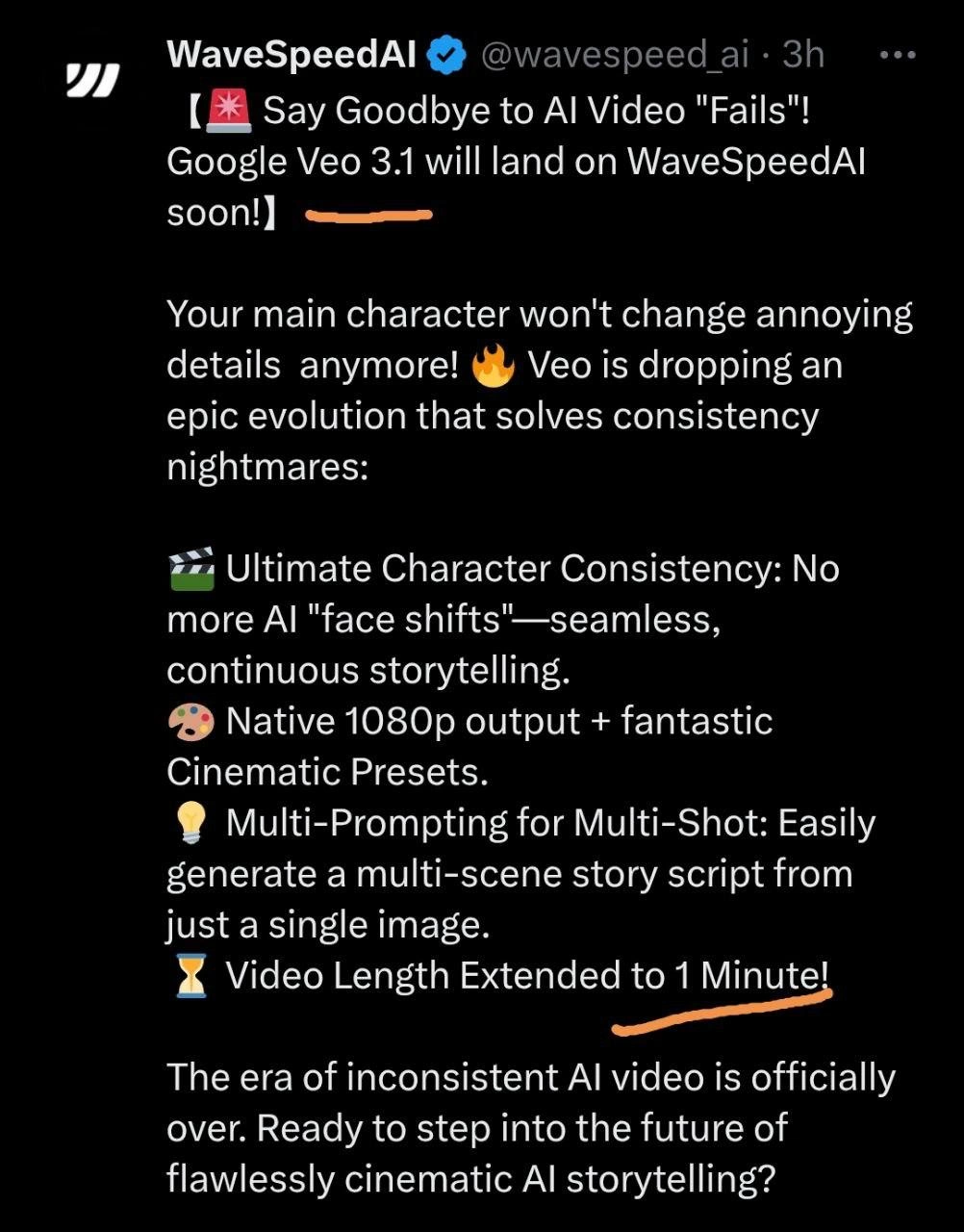
“Ultimate Character Consistency” – no more face shifts Finally fixed those face_shift_glitches where the hero’s face morphed between frames (basically, the AI stops forgetting what the character looks like every other second).
“Native 1080p output + fantastic Cinematic Presets” Now outputs at 1080p (Full HD) instead of some potato resolution. Plus, a few preset filters for that Hollywood Instagram flair. Still waiting on 4K, guys.
“Multi-Prompting for Multi-Shot” from one image Probably just chaining multiple prompts/scenes together behind the scenes. In other words, a fancy loop that stitches short clips into a slightly less short clip.
“Video Length Extended to 1 Minute!” (underlined, no less) Wow, a whole 60 seconds! Up from what... 15? It’s like saying a toddler grew an inch – progress, sure, but we’re still far from a feature-length film. 🎥

In short, Google Veo 3.1 is addressing obvious shortcomings of earlier AI video tools: jittery faces, low-res output, ultra-short clips. These were well-known pain points (the kind that gave AIGeneratedContent a bad rep with creepy morphing faces and blink-and-you-miss-it videos). Now they’ve patched some holes: improved ai_video_consistency so characters don’t shapeshift every frame, bumped the resolution to something from this decade, and extended the ai_video_length_limit to a whopping one minute. To a battle-scarred engineer, calling this an “era” where all AI video fails are vanquished is 😏. We’ve heard “this changes everything!” too many times. Sure, these updates will make AI-generated videos less laughable – fewer random face swaps and higher fidelity than 480p blur – but let’s not pretend multi_prompting workflows and “cinematic presets” are equivalent to James Cameron’s studio. It’s incremental evolution dressed up as a revolution, a textbook case of IndustryTrends_Hype where each release notes reads like a victory lap.

The humor here comes from that familiar IndustrySatire: only a veteran dev (or anyone who’s seen hype wag the dog) could read “The era of inconsistent AI video is over” without an eye-roll. We know there’s always another corner case ready to torch that grand proclamation. As soon as you declare “no more fails,” some new AIHumor glitch will emerge – maybe the face stays consistent but the cinematic background starts melting 😅. In tech, the real “era” that never ends is the era of overpromise and underdeliver. And hey, we’ve made peace with it – after all, if every 0.1 version update truly solved things, what would we have left to satirize?

Description

A screenshot of a tweet from @wavespeed_ai announcing that Google Veo 3.1 will soon be available on the WaveSpeedAI platform. The post highlights key features: Ultimate Character Consistency (no more AI 'face shifts'), Native 1080p output with Cinematic Presets, Multi-Prompting for Multi-Shot (generate multi-scene story scripts from a single image), and Video Length Extended to 1 Minute. The tweet declares 'The era of inconsistent AI video is officially over.' Orange underlines emphasize specific claims. This is a promotional announcement for AI-generated video technology improvements, particularly addressing the well-known consistency issues in generative video models
Comments

7
Anonymous ★ Top Pick The era of inconsistent AI video is officially over -- until you actually try to generate two frames where the character has the same number of fingers
  1. Anonymous ★ Top Pick

    The era of inconsistent AI video is officially over -- until you actually try to generate two frames where the character has the same number of fingers

  2. Anonymous

    Fantastic - by version 3.1 they’ve reinvented Vine with 1080p, only now each sixty-second clip rents another TPU pod on your bill

  3. Anonymous

    Ah yes, 'character consistency' - the same promise we've been hearing since GPT-2 could barely string together coherent paragraphs. Next they'll tell us the model finally understands that hands have exactly five fingers and won't randomly turn your protagonist into their own evil twin mid-scene

  4. Anonymous

    Ah yes, Google Veo 3.1 promising to solve AI video consistency - because nothing says 'production-ready' like marketing copy that needs to explicitly reassure you the main character won't randomly morph into a Lovecraftian horror mid-scene. I'm sure this will age as well as 'Google+ will replace Facebook' and 'Stadia is the future of gaming.' At least when our legacy codebases have consistency issues, we can blame the seven different teams who touched it over a decade - these models can't even keep a face stable for 60 seconds on their first try

  5. Anonymous

    Nice - “ultimate character consistency” means linearizable faces with a 60‑second TTL; after that, Raft elects a new protagonist

  6. Anonymous

    Great, Veo 3.1 fixes identity drift; now ship the patch that addresses requirement drift - and maybe lift the 60‑second TTL on “cinematic”

  7. Anonymous

    Veo 3: Where diffusion models finally ace temporal consistency without a LoRA fine-tune per frame shift

Use J and K for navigation