Skip to content
DevMeme
5944 of 7435
AI Hype Gets Hilariously Lost in Translation
AI ML Post #6508, on Jan 22, 2025 in TG

AI Hype Gets Hilariously Lost in Translation

Why is this AI ML meme funny?

Level 1: A Silly Mishearing

Imagine your teacher says, "I have robots that will clean the classroom while we sleep!" but you mishear it as, "I have rabbits that will clean the classroom while we sleep!" You'd probably laugh, right? picturing a bunch of fluffy bunnies holding brooms and doing chores is super silly. 🤭 Well, that's basically what happened in this tech joke. A tech speaker was talking about special computer helpers called agents (kind of like little robots made of code) that can work for you all day and night. But someone listening misheard the word "agents" as "Asians," which means people from Asia. So instead of imagining lots of busy computer programs, they suddenly imagined the person was claiming that lots of real people from Asia would be working non-stop while everyone else sleeps (which of course wasn’t what he meant at all!). It sounds crazy and wrong – just like thinking about rabbits cleaning a room. This mix-up is funny because it shows how just hearing one word incorrectly can completely change the meaning of a sentence and make it ridiculous. It’s a little reminder that our ears can play tricks on us, and one small misunderstanding can turn a serious idea into a really goofy one!

Level 2: Agents, Not Asians

If you’re a newer developer or just starting to follow AI tech, some of these terms might be unfamiliar. In tech, an agent usually means a piece of software that can act autonomously (on its own) to do a task for you. It's not a human agent like a secret agent or a travel agent – think of it like a little robot program or bot. For example, a chatbot that can make a restaurant reservation for you could be called an AI agent because it perceives your request and takes action by itself. Now, when people talk about having a swarm of agents or multi-agent systems, they're imagining many such programs working together at the same time. Parallel just means doing multiple things simultaneously rather than one after the other. So if someone boasts, "We can deploy thousands of agents in parallel," they mean they can run a lot of these little AI programs side by side, presumably tackling pieces of a job in unison. And "working 24/7 while you sleep" is a pretty common exaggeration in tech pitches, implying that these automated agents keep running all day, all night, without breaks – because unlike people, servers and software don't need to rest. All this ties into the latest AI trend (and a bit of hype) where companies claim their software uses loads of these autonomous agents to solve problems faster or handle complex tasks for you. It sounds super impressive, right? An army of mini-AIs at your service! Even if it's mostly theoretical at this point, it’s a catchy selling point.

Now, the humor of this meme comes from mixing up one little word. The tweet highlights how mishearing "agents" as "Asians" can lead to a very different message. Those two words sound quite similar, especially if someone speaks quickly or you aren’t expecting the term "agents." So what happens if you make that slip? The high-tech pitch about software helpers suddenly turns into a bizarre statement about actual people. Instead of a bunch of AI programs working tirelessly, it sounds like someone is claiming real human beings from Asia are doing all that work nonstop. 😅 That is clearly not what the speaker intended! This simple misunderstanding makes the originally serious statements sound absurd and more than a little problematic. It’s the contrast between AI agents (which are just code running on computers) and Asians (which refers to real people from the continent of Asia) that creates the joke. To make it crystal clear, here’s a side-by-side look at the original tech phrases versus the misheard versions:

What was actually said (AI context) What someone heard instead (misinterpretation)
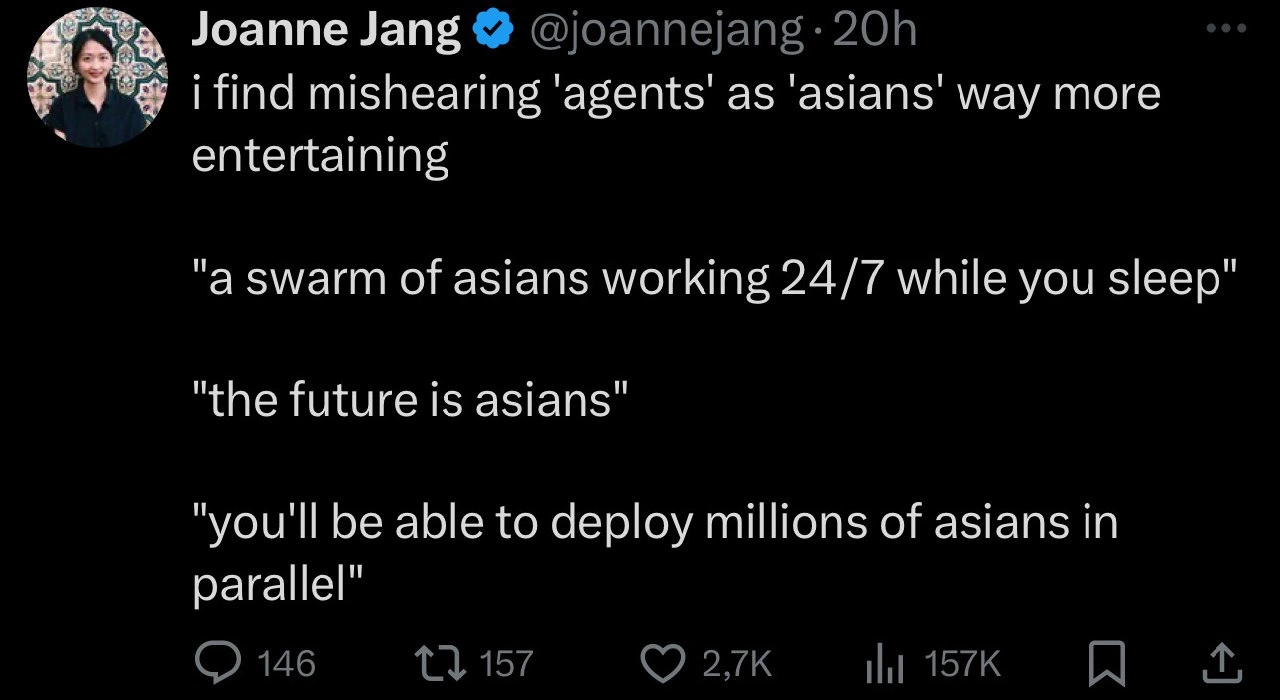
"a swarm of agents working 24/7 while you sleep" "a swarm of Asians working 24/7 while you sleep"
"the future is agents" "the future is Asians"
"you'll be able to deploy millions of agents in parallel" "you'll be able to deploy millions of Asians in parallel"

See how just swapping agents -> Asians turns a tech promise into something no one would ever say seriously? Those quotes in the meme are showing exactly that goofy result. It’s a classic case of a miscommunication creating a totally unexpected meaning.

For someone new to tech, this meme is also a gentle introduction to how over-the-top some buzzwords can be. You might hear phrases like "the future is [insert technology]" or "we have an army of [something] working for you" and feel a bit lost. Honestly, even a lot of experienced developers find those kinds of claims hard to swallow! It's easy to nod along in a meeting or presentation without fully grasping every term – and sometimes, as this joke shows, you might even mishear a key word. If you've ever been in a lecture or conference talk and thought, "Wait, did they just say that?" – you're not alone. This meme resonates because it captures that confusion in a humorous way. It basically says: Don't worry if tech jargon sounds like gibberish; even a one-letter difference can make it sound completely crazy! The takeaway for a junior developer is that agents (in AI) are just software helpers, not actual people, and grand promises about them should be taken with a healthy dose of skepticism. And if something you hear in tech sounds unreal or ridiculous, it might just be a misunderstanding... or it might indeed be as ridiculous as it sounds – and figuring out which is part of the fun (and challenge) of being in this field!

Level 3: Autonomous or Outsourced?

From a senior developer's perspective, this scenario is hilarious because it skewers the over-the-top language of the current AI hype cycle. For context, the meme image comes from a tweet by Joanne Jang, who joked that mishearing "agents" as "Asians" in an AI pitch deck made the usual marketing lines sound way more entertaining (and ridiculous). Lately, every startup pitch about autonomous AI agents is brimming with hyperbole: "a swarm of intelligent agents scaling infinitely!", "the future is AI agents doing all the work!". It's the kind of breathless promise that makes seasoned engineers smirk. Simply swapping agents with Asians in those slogans turns a trendy buzzphrase into something that sounds like a dystopian outsourcing plan. That absurd mismatch exposes how ridiculous the original claims are when you strip away the buzzwords. AIHypeVsReality is stark here: we all know there's no magic army of digital minions that will handle everything while we nap, but the way some folks talk at conferences, you'd think sleep-deprived software elves are already hard at work. This meme gives a voice to our collective eye-roll. It’s basically saying, “Hear how crazy this sounds? Yeah, that’s how crazy it is, even with the correct word.”

The specific lines quoted in the tweet — “a swarm of asians working 24/7 while you sleep”, “the future is asians”, “you'll be able to deploy millions of asians in parallel” — read like something out of a satirical sketch. If someone actually said that in a meeting, you can bet there'd be a stunned silence and an HR rep clearing their throat! For veteran devs, this is a pointed reminder of how miscommunication or a single misheard syllable can turn tech talk into complete absurdity (or career-ending awkwardness). But beyond the shock value, there's a kernel of truth making this TechHumor hit so close to home. The original, intended phrases were essentially glorifying an army of workers — just software workers, not human ones. We've all sat through those keynote presentations where a CEO or evangelist proclaims some grand vision like, "Soon you'll have an army of AIs working for you 24/7!" It's meant to wow the audience, but experienced engineers in the back are raising an eyebrow. The meme simply shines a light on that feeling by imagining, "Wait, did you just say an army of people working 24/7?" — which is suddenly not visionary at all, just cringey. It’s a bit like the old trope "We replaced our database with blockchain"; seasoned devs hear the grand statement and immediately imagine the messy reality behind it. Here, "swarms of agents" might actually translate to "hundreds of fragile scripts/containers that someone has to monitor." The misheard version forces us to confront how ridiculous the hype can sound when taken literally.

There's also an unspoken industry truth buried in this joke: behind many AI products, there's often a hidden layer of actual humans keeping things running. It's ironic and a tad uncomfortable — the meme accidentally alludes to scenarios where companies quietly rely on a "swarm" of human contractors (often in Asia or other low-cost regions) working around the clock to label data, moderate content, or handle all the edge-case grunt work that the AI can't reliably do. Seasoned developers have seen this pattern: the glossy demo is all AI, but backstage there's an assembly line of people making the magic happen (the classic Mechanical Turk approach to fake it till you make it). So when a hype-man says, "our AI agents work 24/7," a jaded engineer might quip, "…and so do a lot of underpaid humans in the background, but you don't put that on the slide." The misheard phrase "millions of Asians in parallel" hits on that ethical elephant in the room. Of course, no one in the pitch meant that literally, but the reason it's funny is because it’s uncomfortably close to some real outsourcing practices. It's a laugh that comes with a bit of a wince, especially for those of us who know how the sausage gets made in this industry. AIIndustryTrends often involve a frenzy of automation promises, but the reality sometimes circles back to humans in the loop, quietly doing the stuff the AI hype claimed would be automatic.

Finally, the seasoned devs know this isn’t the first rodeo for overhyped tech slogans. We've survived waves of grand promises: "the future is microservices" (until we got a distributed monolith headache), "the future is blockchain" (remember when literally everything needed a blockchain?), and "the future is cloud" (that one at least had some truth, along with massive AWS bills). Now it's "the future is AI agents." Each time, management comes back from a big conference with starry-eyed excitement, and each time the engineers have to inject a dose of reality (and deal with the fallout). When someone promises millions of anything in production, any battle-scarred SRE or senior dev immediately thinks about scaling issues, monitoring nightmares, and the on-call phone lighting up at 3 AM. In theory, a swarm of autonomous agents sounds like you can just sit back while work gets done; in practice, we know it's more like herding cats, or perhaps herding processes – which is only marginally easier than herding cats. The meme nails this disconnect with humor: by turning the pitch into something obviously over-the-line, it gives voice to what seniors are privately thinking. "Sure, millions of agents working flawlessly... and I have a bridge to sell you." We laugh because we've been through the hype cycles and learned that whenever someone says "the future is X doing all your work", we're probably the ones who will be up late making sure X doesn't crash and burn. In short, this meme is our cathartic way of saying: the buzzwords are getting out of hand, and yes, they really did sound that ridiculous all along.

Level 4: Massively Parallel Misinterpretation

In theoretical terms, an agent in AI is an autonomous entity capable of perceiving and acting in an environment (think of the classic Russell & Norvig definition of an AI agent). When you scale this up to a multi-agent system, you have potentially many such agents interacting at once. The meme references deploying "millions of agents in parallel," which hints at massively parallel distributed computing. This is reminiscent of swarm intelligence and agent-based modeling where simple agents collectively solve problems. For instance, ant colony optimization algorithms use a swarm of simulated ants (agents) to find optimal paths, drawing from how real ants find food. It’s a beautiful idea: countless tiny programs each doing their part, like bees in a hive, working simultaneously towards a goal.

From a distributed systems angle, running millions of agents concurrently raises all the classic issues of concurrency and coordination. In theory, it's possible to spawn a huge number of threads or processes (especially with cloud computing or async event loops), but coordinating them without bottlenecks is non-trivial. Amdahl's Law in parallel computing reminds us that the speedup from parallelization is limited by any portion that must run sequentially (or the overhead of managing many workers). If each agent has to communicate or share data, your network or CPU can become a choke point. So the grand promise of effortlessly deploying millions of anything in parallel is often more hyperbole than reality – beyond a point, adding more agents yields diminishing returns (and a lot of noisy chaos to tame). In practice, launching "a million agents" would likely swamp your system with context-switching overhead and gnarly debugging issues (not to mention a cloud bill that would make any CFO blanch).

The language "working 24/7 while you sleep" leverages the asynchronous nature of computing: unlike human workers, software agents can indeed operate around the clock without tiring. It's an enticing promise rooted in the dream of automation. Historically, the dream of autonomous agents isn't new – from early AI research (e.g., John McCarthy envisioning utility computing agents) to Marvin Minsky's Society of Mind, thinkers have imagined intelligence emerging from many small processes working in tandem. Modern AI research into multi-agent reinforcement learning and distributed AI explores how multiple agents might collaborate or compete to achieve complex goals. The hype pitches simplify all this into almost magical terms, glossing over the hard parts: e.g. preventing those agents from interfering with each other, ensuring they converge toward a solution instead of chasing their tails, and avoiding unintended emergent behaviors. Real multi-agent systems research grapples with phenomena like emergent complexity, where simple local rules can lead to unexpected global behavior (think of an ant colony or a flock of autonomous drones suddenly syncing up). So when someone casually suggests unleashing a "swarm of agents," they’re skimming past a whole lot of deep computer science and math that would keep any PhD up at night.

Now, the humorous twist in this meme arises from a misinterpretation at a purely linguistic level: mishearing “agents” as “Asians.” This is a sort of accidental homophone that completely changes the context. Interestingly, it surfaces a socio-technical point: tech jargon can sound bizarre or even inappropriate when taken out of context. The phrase "deploy millions of agents" is routine in AI circles, but swap one letter and it becomes "deploy millions of Asians," which immediately reads as absurd and ethically troubling – it conjures an image of massive human labor forces rather than server processes. In a way, this stark contrast underscores the nature of AI hype: we use metaphors about armies of tireless workers for software, a comparison that becomes bizarre (or dystopian) when applied literally to people. It inadvertently echoes real issues like human-in-the-loop systems or crowd-sourced labor in AI (e.g. thousands of human click-workers labeling data behind the scenes). The massively parallel misinterpretation is funny on the surface, but it also highlights how careful we need to be with our terminology – one phonetic slip can expose how wild or grandiose a tech claim sounds when you strip it of the usual context.

Description

A screenshot of a tweet from user Joanne Jang (@joannejang). The tweet humorously suggests that mishearing the tech buzzword 'agents' as 'asians' makes the current AI hype much more entertaining. To illustrate the point, the tweet lists three common, grandiose phrases about AI, but with the word 'agents' swapped out: 'a swarm of asians working 24/7 while you sleep', 'the future is asians', and 'you'll be able to deploy millions of asians in parallel'. The visual is a simple, dark-mode screenshot of this text-based tweet, which has clearly resonated with a large audience, as indicated by the engagement metrics. The technical and cultural humor comes from the absurd juxtaposition of sterile, corporate tech-speak with a human demographic, inadvertently playing on and satirizing stereotypes about work ethic and population size. For senior developers, this is a sharp and funny critique of the often-exaggerated language used to promote AI technologies

Comments

17
Anonymous ★ Top Pick We tried replacing our AI agents with the misheard alternative. They immediately refactored our legacy monolith and optimized the CI/CD pipeline, but the pull request comments on our life choices were brutal
  1. Anonymous ★ Top Pick

    We tried replacing our AI agents with the misheard alternative. They immediately refactored our legacy monolith and optimized the CI/CD pipeline, but the pull request comments on our life choices were brutal

  2. Anonymous

    Whenever a founder brags about “deploying millions of agents in parallel,” I just hear “we accidentally wrote a distributed fork bomb and called it a business model.”

  3. Anonymous

    When your speech-to-text model has been trained on too many Silicon Valley diversity reports and not enough distributed systems papers - suddenly your multi-agent orchestration framework sounds like an outsourcing strategy from 2005

  4. Anonymous

    When your AI agent orchestration platform's marketing deck accidentally describes a distributed offshore development team. The real question is: do these 'agents' also require Kubernetes to scale, or just better timezone coordination and Slack channels?

  5. Anonymous

    “Deploy millions of agents in parallel” is just microservices with a burn rate: idempotency, orchestration, tracing - and a cloud bill for every “let me think.”

  6. Anonymous

    Decks promising “millions of agents in parallel” translate to fork‑bomb‑as‑a‑service; the scheduler, IAM, and GPU budget all file the first incident

  7. Anonymous

    Multi-agent swarms: infinite scale where '24/7 uptime' means no PTO, no unions, just eternal prompt obedience

  8. @Broken_Cloud_1 1y

    we've seen this guy before?

    1. Deleted Account 1y

      These are bots with the same shitty name, if you mean the user named Monica.

      1. @Broken_Cloud_1 1y

        The dumb thing is my english teacher's name is monica

        1. Deleted Account 1y

          Its a bot too?

        2. @Mitsune 1y

          is she pregnant

  9. @hotsadboi 1y

    are indians asian?

    1. Deleted Account 1y

      Technically, yes.

      1. @hotsadboi 1y

        then the guy's onto something

        1. Deleted Account 1y

          We both know where he was going with that.

  10. @SamsonovAnton 1y

    AIDS for everyone!

Use J and K for navigation