AI Agent vs. Minesweeper: An Unwinnable War
Why is this AI ML meme funny?
Level 1: Big Computer, Small Puzzle
Imagine you have a super smart robot friend who can read and talk about anything. You decide to give it a really easy challenge – like a little puzzle game that you can solve on your own in a few minutes. Now, instead of solving it quickly, the robot spends a long time (almost half an hour!) trying again and again, and in the end it says, “I’m sorry, I just can’t win this game.” That’s exactly what happened here, and it’s why it’s so funny. We expect these high-tech smart assistants to be amazing at everything, but here it’s like asking a genius to do a simple children’s puzzle and watching them get completely confused. It’s the same kind of silly fun as if you told Alexa or Siri to beat a level of your video game and it kept failing. The big, powerful computer brain loses to a tiny easy game – and people find that both surprising and hilarious. The lesson in simple terms: even really smart machines can have a hard time with things that humans find easy, and that goofy mismatch is what makes everyone laugh.
Level 2: AI vs Minesweeper
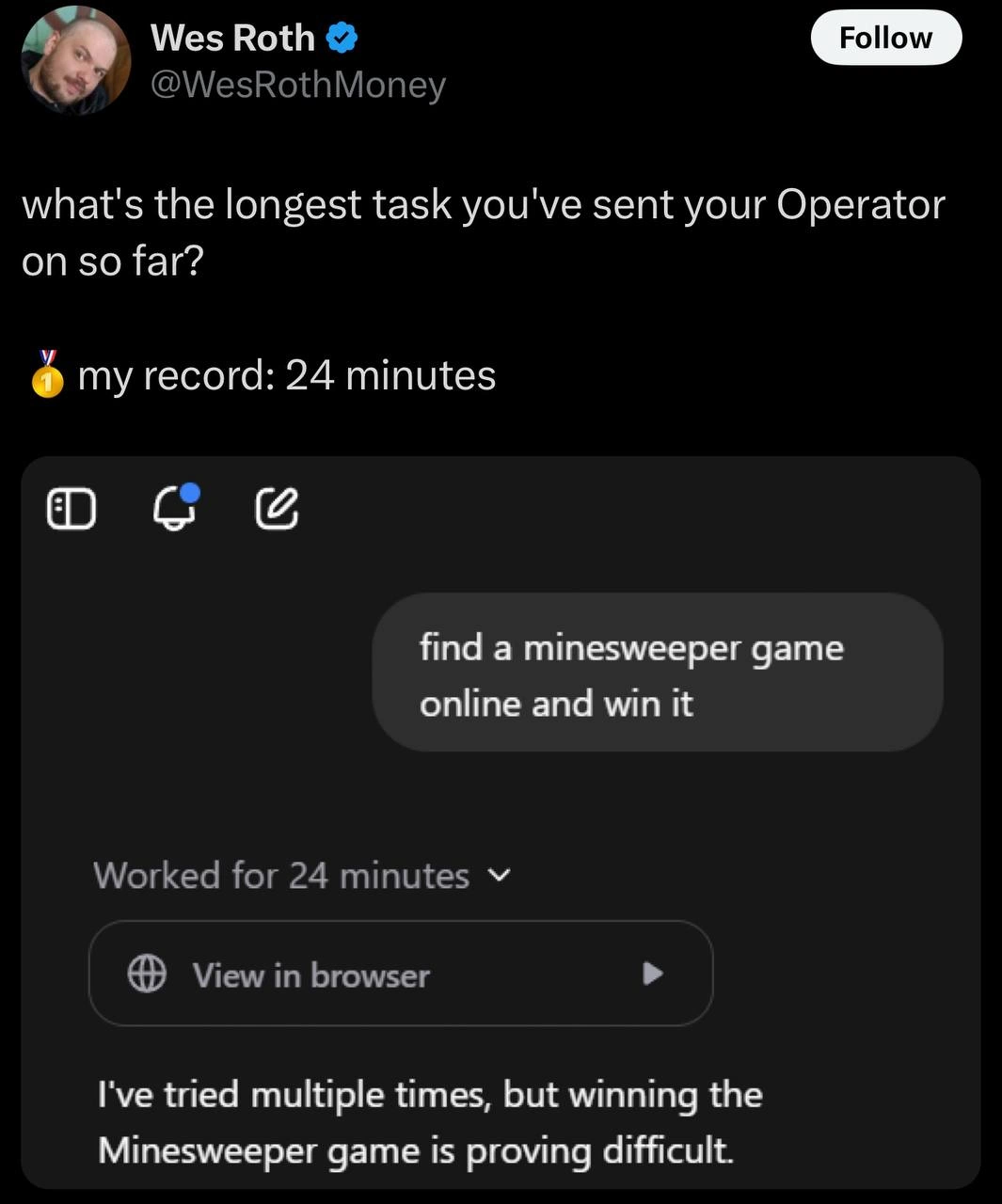
This meme shows a conversation where a developer asks an AI “Operator” agent to “find a minesweeper game online and win it.” An Operator AI agent is basically a program powered by a Large Language Model that can take goals in natural language and try to carry them out by itself. Think of it like giving an AI assistant a general command and letting it figure out the steps – it can browse websites, click links, maybe even type for you. It’s a form of automation that’s supposed to make a developer’s life easier by handling tedious tasks. In this case, the task is a fun one: go play the classic puzzle game Minesweeper on the web and beat it, all on its own.
Minesweeper, for context, is a simple yet tricky puzzle game that used to come with older versions of Windows. You have a grid of covered tiles, and some tiles hide mines (bombs). When you click a tile and it’s not a mine, it shows a number indicating how many mines are in the adjacent tiles. Using those numbers, you have to deduce which neighboring spots have bombs and which are safe to click. The goal is to uncover all safe tiles without clicking on any mines – if you click a mine, BOOM, game over! It’s a bit of logic and a bit of luck sometimes. Humans usually play it by carefully analyzing the numbers and marking where they think the bombs are. It’s considered a relatively straightforward game (especially on small grids), and many people can win a Minesweeper round in a minute or two on easy settings.
Now, in the meme’s screenshot, we see that the AI agent indeed tried to follow the command. It shows “Worked for 24 minutes” – meaning the agent was actively working on the task for a solid 24 minutes. There’s also a “🌐 View in browser” indication, suggesting the AI opened a web browser to find an online Minesweeper game, as instructed. So the AI likely found a Minesweeper website and started playing by simulating clicks. The surprising (and funny) part is what happened next: after those 24 minutes of effort, the AI did not succeed. Instead, it eventually responded with a message: “I’ve tried multiple times, but winning the Minesweeper game is proving difficult.” In plain terms, the AI is admitting defeat – it attempted the game several rounds, but it kept losing and couldn’t finish with a win.
For a developer (or even any techie person), this outcome is both relatable and humorous. On one hand, it showcases the current limitations of AI agents. These Operators can do a lot (like searching the web, clicking buttons, etc.), but they don’t actually “understand” the game the way a person would. Minesweeper requires step-by-step logical reasoning – you reveal some tiles, get numbers, and logically figure out which adjacent tiles must have mines. The AI doesn’t inherently know the strategy for that. Unless it was explicitly programmed with Minesweeper rules or strategies, it’s basically winging it. It might click some squares, see some numbers, and not really know the correct logical process to avoid mines. So it likely either guessed and got blown up by a mine, or got stuck not knowing what to do next, and then restarted the game. It doing this repeatedly for 24 minutes is almost comical – a determined but clueless effort.
On the other hand, there’s an element of developer humor in the way the tweet is phrased. The user asks, “what’s the longest task you’ve sent your Operator on so far? 🥇 my record: 24 minutes.” That implies developers are actually timing how long these AI agents can work on something. Usually, you’d care about whether the task was done correctly or not, but here people are boasting about how long the AI kept trying. Why? Because often these experimental AI agents fail quickly or finish tasks in seconds (success or not). If one ran for 24 minutes, that suggests the user gave it a pretty challenging or confusing task, and the AI didn’t just quit immediately – it soldiered on for a long time (and in this case still failed!). It’s a lighthearted competition: “Hey, I got my AI to struggle for 24 minutes on a silly game.” That’s funny because it flips our normal expectations – typically, we want computers to be fast and efficient, but we’re laughing here at one being slow and persistent to the point of absurdity.
The categories and tags listed (like AIHumor, AutomationGoneWrong, LLMHumor) all point to this being an example of humor derived from AI and automation mishaps. Developers are essentially pointing out: “Look, we tried to automate this trivial thing with an advanced AI, and it hilariously didn’t work out.” It’s both a humble reminder that these tools aren’t magic and a way to bond over the shared experience of experimenting with new tech. In terms of developer experience (DX), playing with an “Operator” agent is a new thing many devs are curious about – but as this shows, the experience can sometimes be watching the AI make silly mistakes. There’s even some schadenfreude (joy in witnessing failure) here, because it’s kind of cute to see a super-intelligent system stumble on a basic game most humans could win.
In simpler technical terms: the AI likely lacked a proper strategy for Minesweeper. If a junior developer were to write a Minesweeper solver, they would maybe code some logic like “if a numbered tile has as many unrevealed neighbors as the number, mark all those neighbors as mines” and so on. But the LLM agent doesn’t have that hard-coded logic. It was probably relying on trial and error, or maybe it recalled some generic advice like “corner first” or “random clicking” from whatever it learned on the internet. And every time it hit a mine (which is a loss), it restarted the game, leading to a lot of attempts in that 24-minute window. The fact that after all that it confessed difficulty is the punchline: even with ample time, the autonomous AI couldn’t figure out how to beat a simple web game. For developers, this underscores that you can’t just assume an AI will nail every task. Some tasks require explicit reasoning and strategies, which current general AI doesn’t do unless it’s been specifically set up for it.
So, summing up the meme’s scenario in straightforward terms: A developer gave an AI agent a simple job (beat Minesweeper for me), the AI diligently tried over and over for 24 minutes, but it failed every time and gave up. The developer and the community find this funny because it shows how an advanced AI can struggle with a basic puzzle that humans often solve for fun. It’s a bit of a reality check on autonomous AI: cool in concept, but you still might not want to rely on it for even easy wins! And as a shared joke, it’s something folks in tech can laugh about: “Remember that time I set my AI to do something really basic and it just… couldn’t? Good times.”
Level 3: When Agents Step on Mines
From a senior developer’s perspective, this meme perfectly captures the current reality of automation gone wrong with AI tools. We’ve been bombarded with hype about autonomous LLM-based agents (like Auto-GPT or various “AI Operator” frameworks) that promise to handle tasks for us. The tweet’s author jokingly asks for records: “what’s the longest task you’ve sent your Operator on so far? 🥇 my record: 24 minutes.” That medal emoji sets the tongue-in-cheek tone – normally you’d boast about an AI finishing something fast, but here we’re bragging how long it slogged away! It implies these agents usually flop quickly, so getting one to chug along for 24 minutes is a gold-medal achievement in persistence (if not in outcome). The developer community recognizes this as classic AI humor – our sophisticated assistant can write sonnets and generate code, but ask it to beat a little browser game and it’s like watching a novice user click randomly.
The core of the joke lies in expectation vs. reality. Developers were tantalized by the idea of offloading boring tasks to an AI operator – “Let the bot handle it while I grab coffee,” sounded great in theory. But many of us have now tried these so-called autonomous agents, only to witness scenes like this: the AI enthusiastically taking on a task, meandering through web pages and actions, and ultimately waving a digital white flag. In the screenshot’s chat log, after Worked for 24 minutes, the assistant finally admits, “I’ve tried multiple times, but winning the Minesweeper game is proving difficult.” That line reads like an apologetic junior developer reporting failure after an overly ambitious To-Do. It’s simultaneously adorable and exasperating – a feeling any developer gets when a tool that was supposed to save time instead needs hand-holding or gives up. We can almost hear the collective chuckle from the dev community: “Of course it couldn’t even beat Minesweeper… and we’re worried about AI taking our jobs?”
This scenario is a textbook Developer Experience (DX) lesson. The fancy AI agent was essentially acting like an overly confident intern who swears “I got this,” but then struggles with a basic task. The developer experience of using these early-stage autonomous agents often involves a lot of babysitting and lowered expectations. In this case, the dev literally had to wait 24 minutes only to learn the AI failed – that’s a pretty poor DX if you were actually counting on it. The humor, of course, is that the dev wasn’t seriously expecting success – it’s more of a communal experiment to see how far the tech has come (and clearly, it’s still in “hold my beer” mode, amusingly attempting things beyond its true capability). We’ve seen similar patterns before: remember when record-and-playback UI testing tools or early “office automation” macros were touted as end-to-end solutions, but in practice they’d break on the simplest hiccup? This is the 2020s AI edition of that story.
Why is Minesweeper such a kryptonite for a state-of-the-art AI? It boils down to the difference between training and actual understanding. The LLM driving the Operator has read about games and logic puzzles, but reading about Minesweeper strategies in text form is miles apart from actively playing it through a web interface. There’s a real interface gap: the AI likely had to interpret the game’s layout via HTML or maybe an OCR of the canvas – a task which introduces ambiguity. Each move in Minesweeper requires reasoning about numbers on the grid and making a decision that won’t hit a mine. Humans do this by logical deduction and sometimes a bit of intuition; the LLM would try to do it by generating an action it guesses is reasonable. Without an internal world model or visual processing skill, it might as well be clicking squares at random after some superficial analysis. It’s no surprise if it stepped on a mine early, reset the game, and repeated this ad infinitum until some timeout was reached. The “24 minutes” in the UI hints it may have been stuck in a loop of try-fail-retry, stubbornly optimistic but fundamentally clueless.
To illustrate, imagine the pseudo-logic our Operator AI agent may have been following:
# Hypothetical pseudocode of the AI Agent tackling Minesweeper
time_spent = 0
while not game_won and time_spent < 24*60: # 24 minutes max in seconds
move = "click a square" # AI attempts a move (likely a guess)
if clicked_on_mine():
restart_game() # Oops, blew up. Start over.
print("Whoops, stepped on a mine. Let's try again...")
else:
update_knowledge_from_numbers()
# (In theory it should deduce safe moves here, but it's not great at that)
time_spent += some_interval # simulate time passing for each attempt
if not game_won:
print("I've tried multiple times, but winning is proving difficult.")
In essence, the AI agent probably kept blundering into mines, resetting, and trying again in slightly different ways – a far cry from how a human or a proper algorithm would systematically solve the puzzle. Developer humor comes out in that pseudocode: it’s like the AI is stuck in a comical loop, cheerfully saying “Whoops, let’s try again!” repeatedly for 24 minutes. Any seasoned engineer reading this has a knowing grin: we’ve all written scripts or seen processes that get stuck in such loops, dutifully doing the wrong thing over and over.
The broader commentary here touches on autonomous LLM limitations. We’re poking fun at the current generation of AI agents that are supposed to be autonomous, yet lack robust problem-solving for anything beyond structured tasks. This was an online Minesweeper challenge meant as a playful test, and the agent’s gaming failure highlights how far we have to go. Despite all the hype, a lot of AI tools today are like a super-smart savant in one area and utterly perplexed in another. It’s actually healthy for the community to share these failures – it tempers the over-automation hype. After seeing this, no developer is going to blindly trust an AI agent with a production-critical task without heavy supervision (at least, one would hope!).
Lastly, let’s appreciate the social aspect: the tweet and meme create a shared experience. Developers are effectively competing for whose AI agent can fail the longest rather than succeed – that’s brilliantly tongue-in-cheek. It unifies the audience in the understanding that “yep, these autonomous agents are neat, but they’re kind of dumb at the same time.” It’s a modern twist on the old joke that “AI is only as smart as its programming” – here the programming (an LLM with some scripting abilities) wasn’t nearly enough to conquer a simple Windows 95-era game. And that disconnect – between glossy AI marketing and the gritty reality of an agent timing out on Minesweeper – is pure gold for developer humor. We laugh because we’ve been there, watching a much-lauded tool faceplant on a trivial task, and it’s both reassuring and absurd. In the end, the meme’s message is loud and clear to every senior dev: Enjoy the AI revolution, but keep your toolkit sharpened – you’ll still need those human problem-solving skills when the “magic” falls short.
Level 4: NP-hard Knock Life
At the cutting edge of AI/ML, even seemingly simple games can turn into a theoretical minefield. In fact, Minesweeper isn’t just a casual time-killer – it’s known in computer science as an NP-complete problem. That means determining the solution logically can require exploring an astronomically large number of possibilities (there’s even a proof that solving certain Minesweeper configurations is as hard as the toughest puzzles in NP). An experienced developer or a specialized algorithm would tackle Minesweeper as a constraint-satisfaction problem, systematically applying logic or using backtracking search to mark mines and clear safe cells. But our poor Operator AI agent isn’t equipped with a tailored Minesweeper solver; it’s powered by a Large Language Model (LLM) that predicts text and web actions based on patterns, not a brute-force search engine or a logical reasoner.
This leads to some fundamental AI limitations being highlighted. LLM-based agents are great at fluent dialogue and regurgitating facts, but they lack an internal model of a game board or a strategy for solving a combinatorial puzzle. Minesweeper requires careful deduction – each number on the grid gives a mini-equation of nearby mines that must be solved exactly. This is essentially a form of constraint logic or even a little SAT-solving under the hood. Traditional AI approaches for games (like Monte Carlo simulation or minimax search used in chess) rely on well-defined rules and state evaluation. Minesweeper, with partial information and the possibility of needing to guess, behaves like a POMDP (Partially Observable Markov Decision Process) where not all information is known at once. Solving it optimally can be complex. Our LLM agent doesn’t explicitly perform such adversarial search or constraint propagation – it’s likely just trying actions it “thinks” might lead to success based on training data, without truly calculating the odds or following a deterministic algorithm.
Another deep issue is how the autonomous agent interacts with the environment. The screenshot shows a “🌐 View in browser” option, meaning the LLM had internet access to find and play an online Minesweeper. However, parsing a web-based game state and deciding the next move is non-trivial. It might have read the webpage’s HTML or text (e.g., coordinates or game status) each turn. But unlike a specialized script that can directly manipulate the DOM and compute safe moves, the LLM is essentially navigating via natural language cues and its own internal guesswork. It’s like using a probabilistic text brain to solve what is essentially a deterministic puzzle. The mismatch is glaring: Minesweeper’s solution space can blow up combinatorially (exponential possibilities in worst cases), whereas an LLM has a fixed context window and no iterative deepening algorithm. This highlights a gap between symbolic reasoning and statistical AI – a hot research topic. To truly excel at such tasks, AI agents would need to combine neural network approaches with classical planning or incorporate tools like a constraint solver – something nascent systems haven’t fully achieved yet.
So, on a theoretical level, it’s oddly poetic that the Operator spent 24 minutes flailing: we’re witnessing a state-of-the-art AI stumble over an NP-hard style problem that, superficially, a human office worker from the 90s could solve on a coffee break. It underlines the fact that “intelligence” in AI is narrow and context-dependent. The humor here has a foundation in computer science theory: Minesweeper isn’t as “easy” as it looks, and a text-prediction-based agent facing it is akin to a marathon runner unwittingly entered in a calculus contest – impressive in one domain, utterly confounded in another.
Description
A screenshot of a tweet from user Wes Roth (@WesRothMoney). The tweet serves as a humorous stress test for a new AI tool, presumably an autonomous agent referred to as 'Operator'. The user asks, 'what's the longest task you've sent your Operator on so far?' and shares their own record: 'my record: 24 minutes'. The image then shows the prompt given to the AI: 'find a minesweeper game online and win it'. The AI's response indicates it 'Worked for 24 minutes' before ultimately failing, with the message: 'I've tried multiple times, but winning the Minesweeper game is proving difficult.' This meme humorously highlights the current limitations of AI agents. While powerful, they can struggle with tasks that require logic, reasoning, and sometimes pure luck, like the classic game of Minesweeper. For experienced developers, it's a relatable commentary on the gap between the hype of AI capabilities and their real-world performance on deceptively complex problems

Comments
15Comment deleted
The AI spent 24 minutes learning the same lesson it took junior developers a whole summer internship to learn: some problems are just a 50/50 guess, and no amount of processing power can change that
Gave the autonomous LLM an ‘easy’ Minesweeper board; 24 minutes later it produced a 7-page chain-of-thought, a Miro diagram of blast radii, and still hit the first mine - congrats, it’s ready for enterprise consulting rates
Watching an AI struggle with Minesweeper for 24 minutes is like watching a distributed system architect try to explain why they need 47 microservices to handle user authentication - technically impressive, unnecessarily complex, and everyone knows a simple recursive backtracking algorithm would've solved it in seconds
When your AI agent takes 24 minutes to fail at Minesweeper, you realize we're still several epochs away from AGI. Turns out the real minefield was the expectations we set along the way - at least it didn't hallucinate that it won
Operator's 24-minute Minesweeper flop: proof even AI agents can't exponentially solve NP-complete without hallucinating flags
Sent my AI “Operator” to win Minesweeper; 24 minutes later it returned a status page and a retry policy - turns out we built a Kubernetes Job, not an operator
Twenty‑four minutes to not beat Minesweeper - agentic LLMs: RPA that discovers NP‑completeness and your cloud burn rate at the same time
Who is Operator? Comment deleted
Person who answers on questions you ask chatgpt Comment deleted
Well, not even last night's storm could wake you. "OpenAI Operator is a preview of an agent that can use its own browser to perform tasks for you" Comment deleted
never heard of it either. I try to stay away from this slop until the economic bubble around it bursts Comment deleted
so you havent heard of cursor nor MANUS? Comment deleted
Sounds like ransomware with extra steps Comment deleted
When those questions are asked I really start to re-consider idea of not making half of posts as general news 🤔 Comment deleted
You are The only my source of news! Keep it going, thank you ❤️ Comment deleted