Pokémon-style special move: reschedule meetings twice, then cancel without remorse
Why is this Meetings meme funny?
Level 1: Skip the Meeting
Imagine you have a really boring class at school that you don’t want to go to. Now think of a funny superpower where you can delay that class twice and then make it disappear completely. You’d probably feel pretty happy to avoid something you didn’t like, right? That’s exactly what’s happening in this joke. The person is an adult who really doesn’t like meetings (meetings are like work appointments where people talk about stuff). They joke that if they were a Pokémon (a make-believe battle creature with special powers), their special power would be making a meeting get pushed back, then pushed back again, and finally canceled for good. It’s silly because grown-ups usually feel they have to attend meetings, just like kids have to attend class. Saying you’d cancel a meeting (and not feel sorry about it) is like a kid saying “I wish I could cancel school and not get in trouble.” It’s funny and a bit naughty. The second part of the joke is the person admitting, “Haha, reading my own tweets, I sound like a bad employee… and since I’m my own boss, I agree!” It’s like if you skipped your chores and then told yourself, “Yep, I’m being lazy and that’s totally true.” So in simple terms: this meme makes us laugh because it’s someone proudly skipping a boring meeting (their version of a boring class) and treating that like a cool special trick. Even if you’re not an office worker, you can understand the happy feeling of something boring getting canceled – it’s a little victory that everyone secretly loves.
Level 2: Calendar Chaos
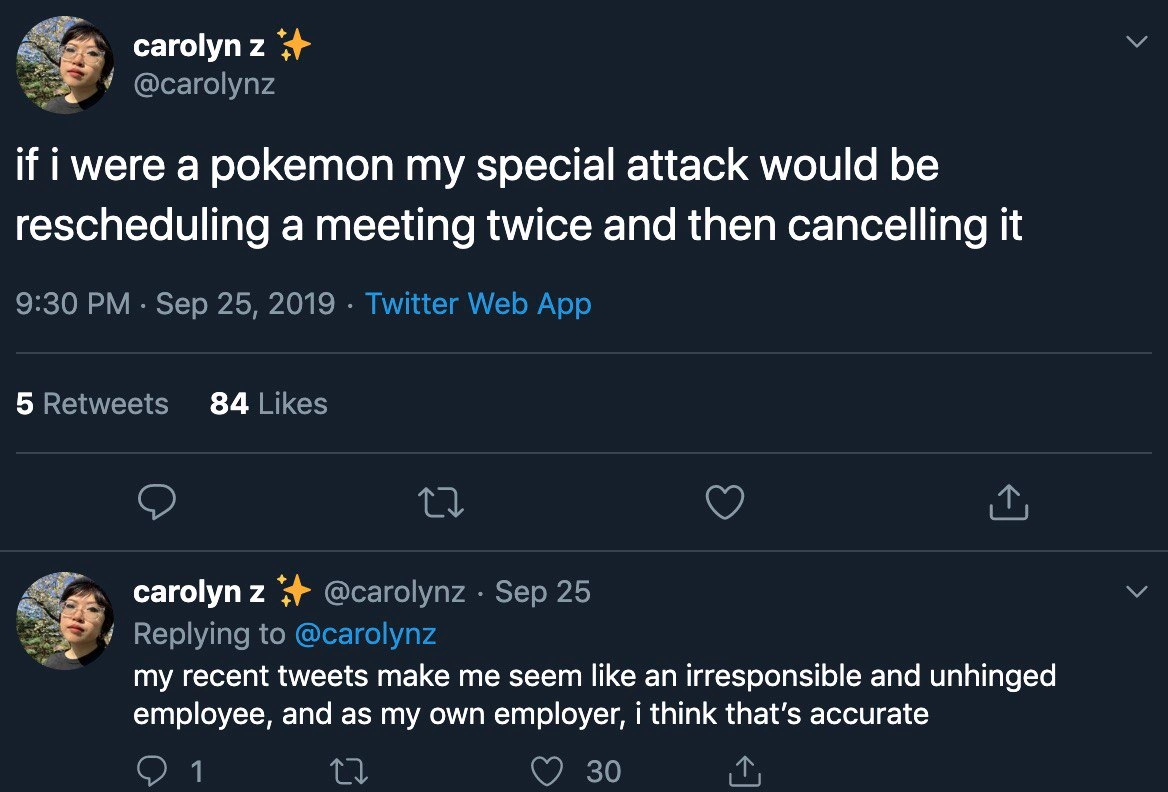
This meme is a screenshot of two tweets joking about rescheduling meetings and then canceling them, using a fun Pokémon metaphor. The first tweet says, “If I were a Pokémon, my special attack would be rescheduling a meeting twice and then cancelling it.” In simpler terms, the person is saying: “My ultimate skill at work is to move a meeting to a later time two times, and then finally cancel it altogether.” It’s a comedic way to brag about avoiding meetings. The second tweet (a reply by the same person) admits, “My recent tweets make me seem like an irresponsible and unhinged employee, and as my own employer, I think that’s accurate.” Here they’re joking that based on their tweets they look like a bad worker, and since they are their own boss, they agree with that assessment. This adds a layer of self-mockery: they’re basically laughing at themselves for being both the rule-breaker and the rule-maker in their world.
Let’s break down why this is funny and what it all means:
Pokémon reference: Pokémon are creatures in a famous video game series, and they battle using special moves or “attacks” (like Pikachu using Thunderbolt). Saying “if I were a Pokémon, my special attack would be X” is a playful way to declare a personal signature move. It’s taking a mundane real-life action (messing with meeting schedules) and blowing it up into a fantastical game context. For many developers (and people in tech), this reference is super relatable humor because a lot of us grew up playing Pokémon or at least know of it. It’s geeky and lighthearted. In Pokémon terms, an attack used twice and then a finishing move sounds like a strategy you’d use in the game. Here, rescheduling a meeting twice are like two setup moves, and cancelling it is the final knockout punch. Of course, there’s no actual Pokémon move called “Cancel Meeting” – that’s the joke! The contrast between a monster battle and office life makes it absurd and funny.
Meeting culture & rescheduling: In many workplaces (especially in software teams), there are a lot of meetings: daily stand-ups, planning meetings, retrospectives, sync-ups, you name it. It can become MeetingOverload, where there are so many meetings that people feel they can’t get “real work” done. Rescheduling a meeting means changing it to a new time or day (often because someone can’t attend or something more urgent came up). Doing this twice suggests the meeting kept getting bumped off – maybe everyone was too busy or dreading it. Finally cancelling means it’s not happening at all anymore. The tweet jokingly treats this common chain of events (reschedule, reschedule, cancel) like a powerful skill. Why twice? Possibly because it’s hilariously specific – it paints a picture of someone dodging the meeting repeatedly until it dies. The phrase “without remorse” shows they don’t feel bad about it. Usually, cancelling a meeting last-minute might inconvenience others and you’d apologize. But here, the person is proudly unapologetic, implying the meeting was probably useless anyway! This is a nod to how developers often feel: if a meeting isn’t valuable, its cancellation is actually a relief.
Communication overhead: This term refers to the extra time and effort spent on communication in a team. Think of all the emails, Slack messages, calls, and meetings it takes to coordinate work — that’s overhead. It’s necessary to some extent, but too much becomes a burden. For a junior developer, imagine you spend an hour in a meeting talking about work, that’s one less hour actually doing the work. That’s why people complain about meeting fatigue – feeling mentally tired or frustrated from too many discussions and not enough action. In software teams, a bit of communication is vital (you need to know what your team is doing, or clarify requirements), but endless discussion can stall progress. The meme taps into that frustration: by cancelling a meeting, you eliminate the overhead entirely for that slot. It’s like cutting out the middleman and getting back to coding or other tasks. So the “special attack” is essentially destroying the communication overhead monster with one decisive blow. Cue the cheers from every programmer who’s sat through a redundant status meeting.
Relatable workplace humor: This tweet went modestly viral (notice it had some retweets and likes), meaning people saw themselves in it. It’s relatable pain because a lot of employees, not just developers, have experienced a meeting that keeps being postponed and then dropped. Maybe it was a meeting that nobody really wanted to have, or schedules were just impossible to line up. When it finally gets canceled, everyone secretly goes “Yesss!” but in professional settings you often have to pretend to be polite about it. Here, the tweeter is just openly celebrating it in a funny way. It’s like saying out loud what many think privately. That kind of “I’m so done with this” honesty packaged as a joke is common in DeveloperHumor on Twitter and other forums.
Self-employed context: The person says they are their “own employer.” This suggests they work for themselves (maybe they’re a freelancer, or run a one-person company). So when they say they seem like an irresponsible employee, the only boss who would scold them is… themselves! It’s a funny paradox: they’re simultaneously the naughty employee and the boss who’s annoyed at that employee. By saying “I think that’s accurate,” they’re basically rolling their eyes at themselves. For a junior reading this, it’s good to know in tech there are folks who are self-employed, meaning they have to manage their own time. If they slack off or cancel things, it directly affects their own business. Here the poster makes light of it, implying, “Haha, my boss side agrees I’m kind of chaotic.” It’s a bit of sarcasm, showing that as a boss they acknowledge the behavior (rescheduling/canceling meetings) is not very professional, but they humorously “approve” of it anyway. It adds depth to the joke — not only are they canceling meetings, they’re essentially giving themselves permission to do so without consequences. That’s the perk of being self-employed: no HR meeting to discuss your meeting cancelling habit!
Twitter and dark mode: The image itself is a Twitter screenshot with white text on a dark background — that’s Twitter’s dark mode theme. Many developers love dark mode in their apps and IDEs (it’s easier on the eyes), so it’s almost an inside nod that even the tweet’s appearance aligns with developer preferences. The top tweet had 5 Retweets and 84 Likes, indicating people found it funny or worth sharing. The reply had some likes too. The format of two tweets is shown like a mini conversation (though here both tweets are from the same user, one replying to their own tweet for comedic effect). This is a common way on Twitter to add a follow-up joke or an afterthought. In the text,
@carolynzis the username of the person, and you see timestamps (Sep 25, 2019) which show when it was posted. These details aren’t crucial to the joke’s meaning, but they make it clear it’s a real tweet and give a sense of authenticity — like this is a genuine thought someone shared that others related to.
In summary, this meme uses a playful Pokémon metaphor to poke fun at corporate meeting culture. It exaggerates a simple workplace scenario (moving and canceling a meeting) into an epic-sounding “special attack.” For developers and office workers, it’s a lighthearted way to vent: “Wouldn’t it be great if avoiding pointless meetings was a superpower?” The humor comes from recognizing a common experience (too many meetings) and giving it a nerdy twist. Everything from the dark-mode tweet aesthetic to the relatable scenario screams RelatableHumor for anyone in tech who has looked at their packed calendar and wanted to just blow it up.
Level 3: Meeting Overload KO
Tweet: “if i were a pokemon my special attack would be rescheduling a meeting twice and then cancelling it”
Reply: “my recent tweets make me seem like an irresponsible and unhinged employee, and as my own employer, i think that’s accurate”
Ah yes, the ol’ reschedule-reschedule-cancel combo — a tried and true tactic in the battle against endless meetings. In this meme (a screenshot of two tweets in Twitter’s dark mode), a developer jokes that their signature move, if they were a Pokémon, would be to postpone a meeting twice and then ax it entirely. It’s presented as a Pokémon-style special attack, like unleashing a secret technique to slay the dreaded Meeting Overload monster. And honestly, seasoned developers are smirking because they’ve all wanted to pull this move at some point (if they haven’t already). In the world of software teams, where calendar invites breed like Zubats in a cave, cancelling a meeting at the last minute can feel like landing a critical hit for your sanity.
This humor hits home for anyone who’s suffered from chronic MeetingFatigue. Picture a senior engineer with a calendar so packed that coding happens in the margins. We’ve seen how communication overhead balloons as teams grow: every new project manager or stakeholder adds another channel, another weekly sync, another 30-minute “quick alignment” call. (In fact, the number of communication lines in a group of n people grows as $n(n-1)/2$ – meaning meetings tend to explode as team size increases). The result? An army of meetings evolving faster than a Pikachu on a Thunder Stone, draining productive hours like a wild time-management fail. No wonder devs fantasize about nuking needless meetings from orbit.
Rescheduling a meeting twice is a passive-aggressive art form many veterans know well. The first reschedule might be due to a “priority production issue”, the second perhaps “scheduling conflicts” – classic excuses to push a meeting out. By the third attempt, everyone’s secretly hoping it’ll just disappear. Cancelling it without remorse is the punchline: the tweet’s author feels zero guilt for vanquishing this meeting. That phrase is key – no remorse. It satirizes how, in corporate culture, we’re supposed to apologize for canceling (“So sorry, something came up!”). But here the developer revels in it, like a victorious Pokémon trainer declaring “Gotcha! The meeting fainted.”
The reply tweet (from the same person) adds a self-deprecating twist: they admit these tweets make them look like a crazy, irresponsible employee. And as their own boss (yes, they’re apparently self-employed), they humorously confirm it: “I think that’s accurate.” This is a tongue-in-cheek acknowledgement that skipping meetings might be unprofessional – but when you’re your own employer, you only answer to yourself. It’s a bit of self_employed_humor: the boss version of them is giving a nod of approval (or at least acceptance) to the wild-employee behavior. For battle-scarred devs, there’s truth here: if you’re a freelancer or running your own show, you have the freedom to blow off a meeting (maybe with a client) – but you also bear all the risk. The tweet packages that duality as a joke, basically saying “Yep, my boss-self knows my worker-self is nuts, and we’re both fine with it.”
This quirky Pokémon reference spices up what could be a dull complaint about meetings. By framing “reschedule twice then cancel” as a special attack, the author implies it’s their superpower move to defeat workplace nonsense. It’s nerdy DeveloperHumor gold: mixing childhood gaming nostalgia with adult workplace reality. Every Pokémon has flashy moves (Thunderbolt, Fire Blast, etc.), and here our dev’s move is “Calendar Annihilation” – not very effective against code bugs, but super effective against meeting overload. The contrast is ridiculous, which is why it’s funny: we don’t expect corporate time-management to sound like an epic battle move. It’s that absurdity that makes technical folks chuckle and go “I wish I could do that!”
Let’s be honest, experienced engineers often develop a sixth sense for which meetings are fluff. They know when a meeting’s likely to be a waste of time (the kind that could’ve been an email or a Jira comment). Canceling such a meeting can actually be a productivity boost, freeing up an hour to squash a bug or implement a feature. That’s the underlying catharsis here – it’s relatable pain. As a battle-scarred dev, you’ve probably fantasized about having a “Cancel Meeting” button you could hit as easily as issuing a git push. This meme basically celebrates doing exactly that, and feeling great about it. It pokes at the unspoken truth: a lot of us feel overloaded by constant context-switching and would cheer if someone mercifully Thanos-snapped half our meetings away.
In broader context, this tweet emerged in 2019, but its sentiment is timeless in tech. Even in Agile teams that tout “individuals and interactions”, people secretly cherish when the daily stand-up mysteriously gets canceled on a Friday. It’s like finding a rare candy on your desk – unexpected and delightful. The meme exaggerates that feeling to Pokémon proportions. And the cynic in every senior dev is grinning, because we’ve all seen the meeting culture beast and dreamed of one-shotting it with a special move. In short, this tweet leveled up our collective wishful thinking: what if dodging meetings were a competitive sport? If so, this author just announced their championship strategy. It’s hilarious, it’s relatable, and it’s a tiny bit rebellious – the perfect recipe for developer humor on Twitter.
Description
Dark-mode screenshot of two consecutive tweets displayed in the standard Twitter Web App layout. The first tweet reads, “if i were a pokemon my special attack would be rescheduling a meeting twice and then cancelling it” and shows a timestamp of 9:30 PM · Sep 25 2019, plus ‘5 Retweets’ and ‘84 Likes.’ The reply from the same user underneath says, “my recent tweets make me seem like an irresponsible and unhinged employee, and as my own employer, i think that’s accurate,” accompanied by one reply and 30 likes. Visually there are avatar circles (faces blurred) on the left, white text on a dark navy background, and the usual retweet, like, and share icons. Technically, the joke satirizes meeting culture in software teams: the constant rescheduling and eventual cancellation many developers endure, highlighting communication overhead and workplace fatigue with a playful Pokémon reference
Comments
6Comment deleted
Meet Schedulachu: uses Exponential Backoff Meeting - reschedules in 2¹, 2², 2³ hours, then garbage-collects the invite before anyone’s context switch completes
The real superpower is realizing that the meeting could have been async all along, but only after everyone's already blocked their calendars three times across four time zones
This is the senior engineer's version of 'Agility +100' - the ability to dodge meetings with such precision that even your calendar starts questioning its own existence. It's particularly effective when you're both the IC and the manager, creating a perfect deadlock where you can't fire yourself for poor attendance but also can't promote yourself for excellent meeting avoidance skills. The real power move is when your calendar becomes a distributed system with eventual consistency - the meeting might happen, just not in any timeline you can predict
The saga pattern of scheduling: orchestrate two retries, then compensating action - total cancellation
Rescheduling twice then canceling is calendar three-phase commit: prepare, prepare, abort - the only strong consistency is your destroyed flow state
Enterprise scheduling at scale: acquire everyone’s calendar lock twice, abort the transaction, and watch system throughput crater from context-switch thrashing