The True Purpose of a 'Gaming' PC
Why is this DataScience meme funny?
Level 1: Better Than Fortnite
Imagine you got the most powerful new computer that everyone says is perfect for playing the coolest video games like Fortnite. But instead of using it to play a game, you use it to work on a school coding project or do something nerdy – and that actually makes you happier than any game would! It’s like buying a super fast sports car, but the thing that makes you almost cry with joy is using it as a really smooth ride to the library. 😅 Most people would think, “Whoa, you have this amazing machine, why aren’t you playing games on it?” But for you, seeing your coding program run quickly on the screen is even more exciting. The funny part is how unexpected it is: usually games are the fun thing and homework or coding is the boring stuff. In this story, it’s the opposite – the work feels like play to him. He even calls the guy at the store a “nerd” for suggesting games, which is silly because he then goes home and does something even nerdier. So the meme is joking that for this person, using the computer for coding is better than Fortnite, and that twist is what makes it hilarious and heartwarming at the same time.
Level 2: Gaming Rig for Coding
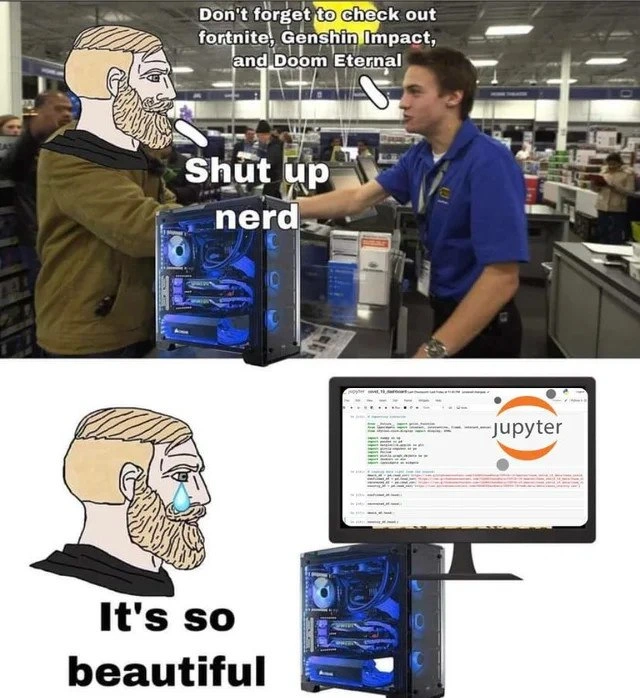
In this meme’s story, a guy buys a super-powerful gaming PC – the kind of desktop with a clear side panel showing off its components and glowing with neon RGB lights. “RGB” means the PC’s fans and parts can light up Red, Green, Blue in all sorts of colors, a very popular feature in custom gaming rigs. The employee at the store (wearing a blue polo, which looks like a Best Buy uniform) is excited for the customer and recommends some popular video games to try out: Fortnite, Genshin Impact, and Doom Eternal. These are all big, graphics-heavy games (often called AAA games, meaning high-budget, top-quality titles). It’s pretty normal that if someone gets a new high-end PC, the first thing they want to do is install a game like Fortnite and see the amazing graphics and smooth performance. Fortnite is an online battle royale game that’s hugely popular, Genshin Impact is a beautiful open-world adventure game, and Doom Eternal is a fast-paced shooter known for its intense action – each of these would really show off what a “beast” PC can do with its powerful graphics card.
But the joke starts when the customer replies, “Shut up, nerd.” That’s already a funny response because the store clerk was just making a friendly suggestion. The customer calling him a “nerd” is ironic, since being super into those games is actually pretty cool and common nowadays. The bearded Wojak character (a meme cartoon persona with a beard) representing the customer clearly thinks he is not the nerd here – even though he’s about to do something far more nerdy! In the second panel (the next image), we see what the customer actually does with his new monster PC once he’s home. Instead of launching any game, he has opened up a program called Jupyter Notebook on his monitor. Jupyter Notebook isn’t a video game at all; it’s an interactive coding environment. Basically, it lets you write and run code (often Python code) right in your web browser, and you can see the results, graphs, or errors immediately below the code. It’s a favorite tool in the Data Science and scientific programming community for things like analyzing data, visualizing results, or experimenting with machine learning models. The interface on the screen in the meme shows some Python code and a big orange circle logo with the word “jupyter”. There’s also a red block of text – that’s a stack trace, which is a fancy term for an error message in programming. It lists a bunch of steps that led to an error in the code (perhaps something went wrong in his Python script). To non-coders, that screen probably looks confusing or boring – just text on a white background with an error. No 3D graphics, no game character, nothing moving at all. Yet, the guy is staring at it with a tear in his eye and saying “It’s so beautiful.”
Why is this funny? It’s because we expect someone with a powerful new PC to be most excited about playing games on it, but this person is a programmer (likely a data scientist from the context), and what excites him the most is seeing his coding setup in action. He’s not interested in using the machine for entertainment; he’s using it as a high-end work tool, and that genuinely makes him happy – to the point of tears (in a humorous, exaggerated way). It’s highlighting how different his priorities are. The store employee mentioned games like Fortnite because that’s the common thing to do. But the customer is so hardcore into coding that he even dismisses that suggestion rudely. It’s as if he’s saying, “Don’t waste my time with games; I have real work (or fun, in his view) to do.” In reality, many developers and especially people in fields like machine learning or data analysis do buy expensive “gaming” computers or GPUs for their projects. They might not actually play much on them; instead, they run heavy computations. For example, training a machine learning model or crunching a huge dataset can use a lot of computing power – sometimes even more than a game would. So our meme character sets up Jupyter Notebook first thing, which likely means he’s installing programming libraries, maybe checking how quickly his new PC can run through some code. The red error text (the stack trace) suggests he ran something that broke (maybe he pushed the machine too hard or just has a bug in code), but instead of being upset, he’s thrilled just to see that his environment is running. It’s “beautiful” to him in the sense that this powerful computer is now his playground for coding.
To put it simply, this meme is comparing gaming vs. coding as ways to use a powerful computer. The guy in the meme clearly prefers coding. The humor comes from the contrast: everyone expects him to be gaming on that fancy rig, but instead he’s opening an editor/IDE (Integrated Development Environment) – in this case, Jupyter Notebook, which is like an interactive programming notebook. It’s also funny how he calls the store clerk a nerd for suggesting games, whereas usually the person who loves coding and data science would be considered the nerdy one! It’s a playful way of saying “my hobby (coding) is cooler to me than your hobby (gaming).” The meme is very relatable to programmers or data scientists who often spend a lot on good hardware for development. Many of us have indeed fired up a new machine and gone straight to installing coding tools, maybe even before any games. Seeing that Jupyter interface load up quickly or watching code execute in a blink on a high-end CPU/GPU can give a little rush of happiness. So when the character says “It’s so beautiful,” he’s echoing that geeky joy – the same kind of joy a gamer might feel seeing a beautiful game world, but here it’s about a sleek coding workflow on a powerhouse PC. In short, it’s showing how for some people in tech, code > games, meaning they truly find coding on great hardware more satisfying than playing the latest video game.
Level 3: Ray Tracing vs Stack Tracing
This meme nails a very developer humor scenario: investing in top-tier gear, but using it in an unexpected way. The first panel sets us up in a big electronics store (think a Best Buy checkout counter). Our protagonist, depicted as the bearded Wojak character (a common meme figure for relatable scenarios), has purchased an absolute monster of a PC. It’s got the transparent case with glowing RGB fans, the kind of rig any gamer would drool over. The blue-shirt store employee enthusiastically says, “Don’t forget to check out Fortnite, Genshin Impact, and Doom Eternal!” – rattling off a list of popular, graphics-intensive AAA games perfect for testing a new gaming PC. This is exactly what you’d expect when someone buys high-end hardware: “Go home and enjoy all those gorgeous games at ultra settings!” But the bearded customer shoots back, “Shut up, nerd.” – which is instantly funny because who’s the real nerd here? The employee’s suggestion is actually pretty mainstream – Fortnite and those titles are massively popular. The customer, however, sees himself as above that kind of casual nerdiness. Little do the people in the store know, he has much geekier plans for this machine. The humor lies in this role reversal: the gamer in the blue polo is being called a nerd by the data guy who’s about to do something arguably even nerdier with the PC. It’s an inside joke poking fun at how different tech enthusiasts prioritize different things. In the hierarchy of nerd-dom, our data scientist evidently thinks playing games is child’s play compared to the serious, big-brained fun of coding and data crunching. 😄
In the second panel, we see the payoff. The same RGB-lit tower is now set up at home, humming beside a monitor. But instead of a game’s start menu or some jaw-dropping 3D graphics, what’s on the screen? The Jupyter Notebook interface – basically a browser window with some Python code and a big orange Jupyter logo. The code cell shown has produced a long red error trace (you can see lines of text and an error message in red). And our bearded hero is gazing at this scene with a tear rolling down his cheek, captioned with “It’s so beautiful.” This is hilarious to anyone who’s used Jupyter or done programming, because it’s such a heartfelt reaction to something so… mundane to outsiders. Jupyter Notebook is immensely useful, but visually it’s the opposite of flashy – it’s mostly just text on a white background, a few graphs at best. Seeing a stack trace (basically a spit-out of error text) isn’t usually cause for celebration either; typically that means your code failed somewhere. But in the context of the meme, this is exactly what the guy wanted from his new PC. The first “launch” on his machine wasn’t a game at all – it was a coding environment. That red error text is proof that he’s pushing the machine, running real code, maybe even testing its limits. It’s the developer equivalent of firing up a new game and seeing stunning graphics. For him, launching Jupyter and seeing it run (even with an error) is like witnessing a work of art. The high-resolution monitor filled with Python traceback is his version of beautiful scenery. It’s a comical exaggeration of how developers and data scientists can get emotional about their tools and projects. While a gamer might shed a tear at a game’s gorgeous visuals or storyline, a data geek might well up when they finally have the compute power to handle a heavy dataset or when they see their code running at warp speed without crashing. Here the tearful “It’s so beautiful” really sells that joke – he’s moved by the sight of his coding setup on this powerful rig.
This hits home for a lot of folks in tech. Many experienced developers have anecdotes of buying a high-end “gaming” laptop or desktop for work or study. Sure, it’s marketed with FPS and ray tracing benchmarks, but we care about how fast it can compile code or train a model. The meme plays on that common reality. For instance, it’s not unheard of for a programmer to splurge on a new GPU like an NVIDIA RTX 3080, ostensibly to experiment with machine learning or run VMs, and then joke that the only game it ever runs is maybe TensorFlow or a Docker container. In fact, in the data science community, it’s a running joke that we buy “gaming” GPUs to do no gaming at all — we just make the GPUs calculate linear regressions and neural network weights all day. The mention of Fortnite, Genshin Impact, and Doom Eternal by the clerk is tongue-in-cheek, because those were some of the hottest titles around 2020 known for pushing hardware. Yet this guy likely won’t even install them. His idea of testing this new PC is seeing how fast a Pandas dataframe of 10 million rows gets processed, or how quickly he can visualize a complex chart in a Jupyter cell. The disparity is comedic: one person’s fun is another person’s work, and vice versa. And when work feels like fun (as it clearly does for him), you get these humorous scenarios.
The phrase “Shut up nerd” itself is layered with irony. Usually that insult is thrown at the socially awkward tech geek, not by him. In the meme, the data scientist calling the clerk a nerd suggests he considers gaming trivial compared to the grand pursuit of coding. It’s a playful jab at how some programmers might half-jokingly see themselves as doing something more substantial or “elite” than just gaming. Of course, many developers are also gamers, but there’s a kernel of truth in how we often prioritize our projects or learning new frameworks over leisure gaming. When the new PC arrives, the priorities are clear: set up the development environment, install necessary libraries, maybe ensure the GPU drivers are working for compute tasks. The first boot might involve checking the CUDA version or running pip install jupyter. Only after all that might any games even be downloaded (if ever). The meme resonates because it exaggerates this tendency – the data_scientist_priorities here are so skewed that AAA games aren’t even on the radar; what brings a tear to his eye is an open notebook and a wall of code. Every developer who has excitedly fired up a text editor, IDE, or notebook on a new ultra-powerful machine – and felt that giddy satisfaction at how slick and fast everything is – sees themselves in this comic moment. It’s equal parts relatable humor and a celebration of loving what you do. The powerful RGB PC isn’t just a gaming toy; it’s a productivity beast, a playground for coding, and that’s truly beautiful to this user.
Level 4: Frames vs FLOPS
Under the hood, this meme highlights a fascinating intersection of hardware designed for gaming and its use in heavy-duty data science computations. A "beast" gaming PC typically boasts a high-end GPU capable of pushing out hundreds of video frames per second in a graphically intense game. Modern AAA titles like Fortnite or Doom Eternal leverage techniques like real-time ray tracing and complex physics simulations, which means the graphics card is crunching floating-point operations (measured in FLOPS, or Floating Point Operations Per Second) at an insane rate to render each frame. Now, that same GPU architecture – thousands of parallel cores optimized for matrix and vector calculations – can be repurposed to accelerate scientific and analytical tasks. In fact, the rise of general-purpose GPU computing (GPGPU) means those fancy graphics processors are often double-tasking as number-crunchers for AI and data analysis. Instead of drawing alien landscapes in a game, the GPU might be in a Jupyter Notebook session in overdrive, inverting huge matrices or training a neural network by performing billions of math operations. The underlying linear algebra that powers neural networks or large-scale data processing makes GPUs sweat just as much as rendering a 4K explosion in a game. So whether it's calculating trajectories of bullets in a shooter or gradients in a neural network, a high-end PC's cores and memory bandwidth are being pushed to their limits in parallel. The meme humorously celebrates this dual identity of hardware: the same RGB-clad rig that could max out Genshin Impact can also churn through a massive dataset or a machine learning algorithm at lightning speed.
What’s technically beautiful here is how versatile that high-end PC is. The Jupyter Notebook interface on the screen might look simplistic – essentially a web page with text fields – but it’s backed by a powerful Python kernel process. When our bearded data scientist runs code, that kernel can call highly-optimized libraries (NumPy, Pandas, TensorFlow, PyTorch, etc.) that exploit the machine’s full specs. For example, if he’s doing deep learning, the code is offloading work to the GPU via CUDA cores just like a game does via graphics shaders. The PC’s CPU (with many cores and threads) and GPU (with thousands of smaller cores) might both be firing on all cylinders. In a game you’d measure performance by high FPS (frames per second); in data science you might measure it by how fast you can train a model or crunch through millions of data points. Both are about maximizing throughput: one in visuals, the other in pure computation. The meme’s second panel even shows a red stack trace (an error dump) on the Jupyter screen – a sight any programmer knows well. To an outsider, that’s just an intimidating error message. But to the seasoned coder, it’s feedback from an intensive process, maybe an out-of-memory exception or a bug discovered while utilizing all that power. The joke is that even this Python exception output is “beautiful” to the user, because it means his powerful new toy is doing real work. There’s an almost poetic contrast: ray tracing vs. stack tracing – the GPU could be calculating rays of light in a game, but here it’s generating a stack trace from a code execution. And the owner couldn’t be happier! Fundamentally, this speaks to how high-performance hardware enables both immersive gaming experiences and serious computational science. The meme finds humor in the idea that a rig built for visual glory is being worshipped for textual output – yet from a tech perspective, it’s all the same glorious silicon muscle being flexed in different ways.
Description
A two-panel meme that subverts expectations about high-end computer usage. In the top panel, a 'Chad' Wojak character is buying a powerful, blue-lit gaming PC at an electronics store. The sales clerk suggests, 'Don't forget to check out fortnite, Genshin Impact, and Doom Eternal'. The Chad character dismissively replies, 'Shut up nerd'. The scene implies he's a typical gamer. In the bottom panel, the same character is at home, looking at his new computer setup with a tear of joy streaming down his face, exclaiming, 'It's so beautiful'. The monitor is not displaying a game, but a Jupyter Notebook with Python code, showing imports for libraries like pandas, numpy, and sklearn. The prominent Jupyter logo is visible. The humor lies in the twist: the powerful 'gaming' hardware was purchased not for leisure, but for demanding computational tasks like data science or machine learning, which the character finds genuinely beautiful and emotional

Comments
9Comment deleted
Some see a 4090 and think 'ray tracing.' I see a 4090 and think 'batch size.' We are not the same
Nothing like expensing a liquid-cooled 4090 as a “capacity-planning testbed” and then using every watt of it to shave 20 ms off a Jupyter cell that re-renders a seaborn heatmap
After 15 years of optimizing distributed systems and arguing about CAP theorem, nothing hits quite like watching a junior engineer discover they can mix markdown, code, and matplotlib plots in the same document - it's like watching someone discover fire, except the fire is a 200MB kernel that crashes when you accidentally print a million-row dataframe
The eternal developer paradox: spending $3000 on an RTX 4090 'for tensor operations' while your actual ML models train on a cloud instance at $0.50/hour because your local environment has 47 conflicting CUDA versions and you haven't successfully run nvidia-smi without sudo in three years
Upgraded to a 4090 so Jupyter would finally feel “fast” - then remembered our heaviest workload is pandas.apply under the GIL; the only thing running in parallel is the case fans
I don’t benchmark with FPS - my KPI is tqdm steps/sec before Jupyter throws a CUDA OOM at batch_size=2
Forget ray-traced 8K; nothing renders more beautifully than a reproducible notebook on the first kernel launch
ewww python Comment deleted
s/jupyter/gentoo/g Comment deleted