Compiler Warnings Are Just Suggestions, Right?
Why is this Compilers meme funny?
Level 1: Smelly Fort, Smelly Code
Imagine you built a little fort out of old cardboard boxes and junk. You’re really proud of it, even though it’s crooked and a bit smelly. Now your friend comes over, crawls out of the fort holding their nose, and says, “Yuck, it smells funny in there!” But you grin and say, “No it doesn’t!” even though, well, it does smell. In this story, the smelly fort is like a messy piece of computer code. The friend is like a computer program (the compiler) that checks the code and notices something’s not right. The friend complaining about the bad smell is like the compiler giving a warning, saying “there might be a problem here.” And the person ignoring it is the developer saying “everything’s fine!” The joke is that pretending the bad smell isn’t there doesn’t make it go away – just like ignoring hidden problems in code won’t magically fix them. It’s funny because we’ve all seen someone deny an obvious problem. The lesson? If something smells funny, in forts or in code, it probably needs cleaning up, not covering up.
Level 2: Warnings Are Clues
Let’s break it down simply. A compiler is a program that converts the code you write (in C, C++, Java, etc.) into something the computer can run. As it compiles, it checks your code. If you do something outright wrong (like use a variable that doesn’t exist or have a syntax error), it throws a compiler error and stops – your code won’t run until you fix it. But if your code is technically runnable yet suspicious, the compiler gives a warning. Warnings are the compiler’s way of saying, “Hmm, this looks odd. Are you sure you want to do that?” They don’t stop the program from running, but they’re hints that there might be a mistake or a CodeQuality issue.
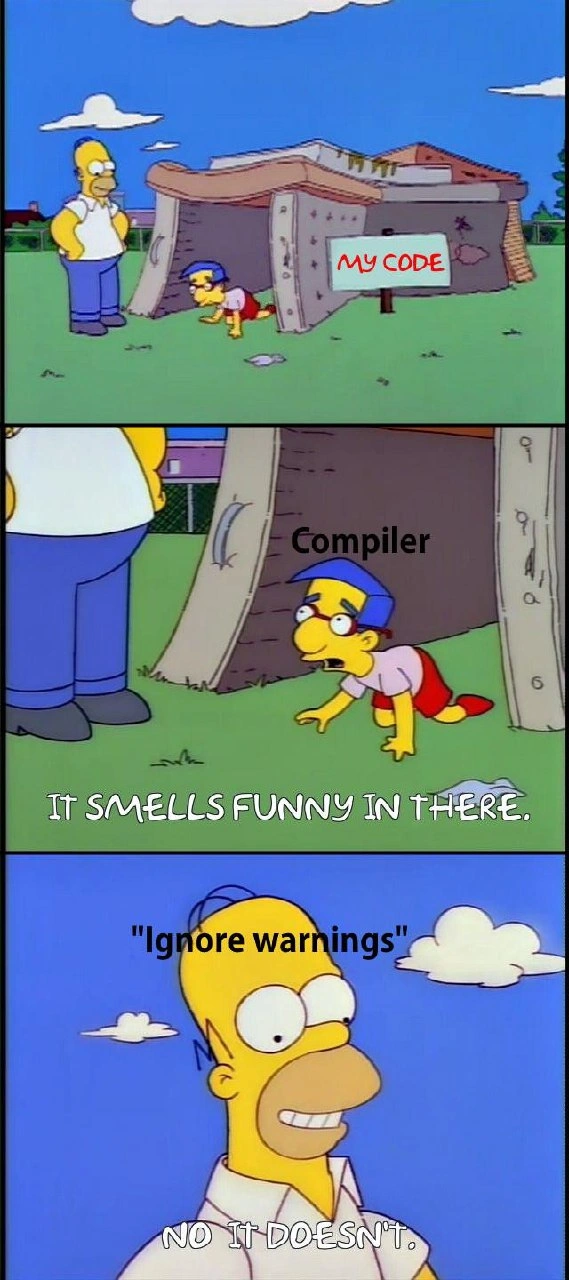
In the meme, Homer’s shaky cardboard fort labeled "MY CODE" is like a messy program. Milhouse crawling out and saying “It smells funny in there” represents the compiler pointing out a code smell – something in the code seems off. Homer’s character smiling and saying “No it doesn’t” represents a developer choosing to ignore warnings. In real life, a code smell isn’t about actual smell; it’s a metaphor developers use for any hint that code might be poorly designed or have a bug lurking. For example, if the compiler says “warning: variable ‘x’ set but not used,” that’s a clue you have an extra variable or you forgot to use x somewhere – maybe a bug in your logic.
Consider a simple C example of a warning:
#include <stdio.h>
int main() {
int a = 5;
if (a = 0) { // Oops: using '=' instead of '=='.
printf("Positive!\n");
}
printf("a is %d\n", a);
return 0;
}
When you compile this with warnings enabled (e.g. gcc -Wall), the compiler might shout:
warning: suggest parentheses around assignment used as truth value [-Wparentheses]
This is the compiler saying, “You used = inside an if. Did you mean == for comparison? This looks like a mistake.” Here the program will compile and run, but always prints “a is 0” and never “Positive!” because if (a = 0) actually sets a to zero instead of checking it. The compiler warning is a helpful clue to a bug. If a developer ignores that warning, their program might behave incorrectly and they might not realize why. This is exactly the kind of BugsInSoftware scenario the meme warns about in a funny way.
By labeling Homer as "Ignore warnings", the meme shows a common newbie mistake or bad habit: ignoring the compiler’s advice. Maybe the developer thinks, “It’s just a warning, the code still works… I’ll deal with it later.” But “later” might never come, and those little issues pile up. That pile-up of unresolved issues is what we call TechnicalDebt – like a debt, you can get away with it for a while, but it’ll come due eventually, often with interest in the form of debugging headaches. Good developers learn that keeping code clean (addressing warnings, improving code smells) early on saves a lot of pain. It’s like cleaning up spills when they’re small instead of letting a bad smell spread.
So, the meme is classic CodingHumor for developers. It exaggerates the scenario: the compiler (Milhouse) clearly tells the dev something is wrong (the fort smells). But the overconfident dev (Homer) just denies it, insisting everything is fine. Every programmer has seen or done this: maybe you had 5 warnings and said “eh, it runs!” Once you understand these terms: compiler warnings (non-fatal alerts), code smell (a hint of bad design), and technical debt (problems saved for later), the humor and the lesson become clear. Don’t be Homer with the smelly fort – listen to the Milhouse compiler!
Level 3: Stench of Technical Debt
The Simpsons analogy nails it: Homer’s collapsing cardboard fort labeled "MY CODE" is a flimsy codebase held together by hope and duct tape. Milhouse as the Compiler crawls out saying "It smells funny in there." In real projects, that “smell” is a code smell – subtle hints of deeper problems in the code. Those compiler warnings you see during build are basically the compiler sniffing out something odd: maybe an uninitialized variable, a useless assignment, a deprecated API, or a suspicious type cast. Seasoned developers know that a funky odor in code means accumulating technical debt. Each ignored warning is like another moldy pizza box in Homer’s fort: it doesn’t break the fort immediately, but it makes the whole structure nastier and more likely to collapse.
This meme gets a chuckle from experienced devs because we’ve all seen the “it compiles, ship it!” attitude. Junior me proudly built brittle forts of code, oblivious to the warnings scrolling by. Senior me has been woken at 3 AM by that fort catching fire. CodeQuality suffers when warnings are dismissed; today’s minor warning often becomes tomorrow’s major bug. For example, a trivial-sounding warning about an unused variable might hint you skipped handling a case, or that you left debug code in production. Ignoring a null-pointer warning or an integer overflow warning? – that’s begging for a crash or a data corruption down the line. It’s classic DeveloperHumor because it’s painfully true: developers sometimes pretend a smelly codebase is fine, much like Homer grinning under a blue sky insisting “No it doesn’t” smell. We’ve seen managers or teammates wave away concerns: “Those warnings are harmless, our app works… until it doesn’t.”
Under the hood, compilers and static analysis tools act like that friend with a sensitive nose. They flag CodeSmells that don’t stop the build (they’re not full CompilerErrors), but they’re uncomfortable signs something’s off. The meme exaggerates the denial: the compiler (Milhouse) explicitly says it stinks, and the dev personified by Homer just denies reality. It’s a gentle jab at our tendency to get defensive about our “brilliant” code. The BugsInSoftware tag and the whole scenario ring true – ignore enough warnings and you’ll create a nest of bugs that’s as stable as, well, a soggy cardboard fort. The industry has even invented practices to fight this exact issue: many teams use flags like -Werror (treat warnings as errors) so you can’t ignore them, or linters that refuse to let you build dirty forts at all. Because let’s face it, pretending your code doesn’t reek won’t save you when someone (or something like a compiler) comes sniffing.
Description
A three-panel meme using a scene from 'The Simpsons'. In the first panel, Homer Simpson stands outside a shabby, makeshift fort with a sign that reads 'MY CODE' in red letters. Milhouse is crawling out of the fort. In the second panel, a close-up shows Milhouse, now labeled 'Compiler', saying, 'IT SMELLS FUNNY IN THERE.' This represents the compiler issuing warnings about potential issues in the codebase. In the final panel, Homer, representing the developer and labeled with '"Ignore warnings"', has a strained, dismissive smile and replies, 'NO IT DOESN'T.' This meme hilariously captures the common developer anti-pattern of ignoring compiler warnings. It analogizes these warnings to a 'funny smell' - a clear indicator of underlying problems (code smells or technical debt) - that some developers willfully ignore to save time, often leading to bigger issues down the line
Comments
7Comment deleted
Ignoring compiler warnings is like telling your GPS 'I know a shortcut' right before driving into a lake. The machine tried to tell you, but your hubris has a higher priority
We hit “zero-warning” SLA by aliasing -Werror to -Wignore; smell’s still there, but the dashboard’s mint-green
Twenty years later, that unused variable warning is now a load-bearing component of our authentication system and removing it causes production to catch fire
Every senior engineer has been Homer at least once - staring at 247 compiler warnings thinking 'those are just suggestions' until production catches fire at 2 AM. The real tragedy isn't ignoring the warnings; it's that the doghouse labeled 'MY CODE' is somehow still standing, which only reinforces the behavior until the next major refactor reveals it was held together by duct tape and prayer all along
Compiler warnings: the faint whiff of future prod outages no architect ignores - until Jira sprint closes
“Ignore warnings” in CI: converting the compiler from a guardrail into a scented candle so undefined behavior can ship as a feature
Turning off warnings just moves undefined behavior from the compiler log to your incident tracker - with interest compounded every sprint