Lost Luggage Becomes Web Security Audit
Why is this Security meme funny?
Level 1: Lost Bag Detective
This is like asking a store clerk where your suitcase went, getting no help, and then finding the store's messy notebook open on the counter with all the clues inside. It is funny because the customer solves the mystery in the most programmer way possible, but it is also embarrassing for the company because the unofficial path worked better than the official one.
Level 2: Authorization Turbulence
In web development, authentication asks "Who are you?" and authorization asks "What are you allowed to access?" A site can correctly log someone in and still fail authorization if it lets that user view another person's records by changing an ID, replaying a request, or calling an API endpoint directly.
BrowserDevTools can show network requests made by a web page. A developer might use it to inspect which endpoints the airline site calls when showing booking or luggage information. That is normal debugging behavior. It becomes a security issue if those endpoints reveal private data, accept identifiers they should reject, or rely on the user interface to hide sensitive actions instead of enforcing rules on the server.
The image is funny because the passenger's lost luggage turns into a SecurityVulnerabilities story. Most people would call support again. A software engineer may start tracing requests, reading response payloads, and checking whether the system exposes the answer somewhere the official process does not. That curiosity can reveal a bug, but it also shows why companies need clear responsible-disclosure paths and customer-support workflows that do not make technical users desperate.
Level 3: Baggage-Claim Pentest
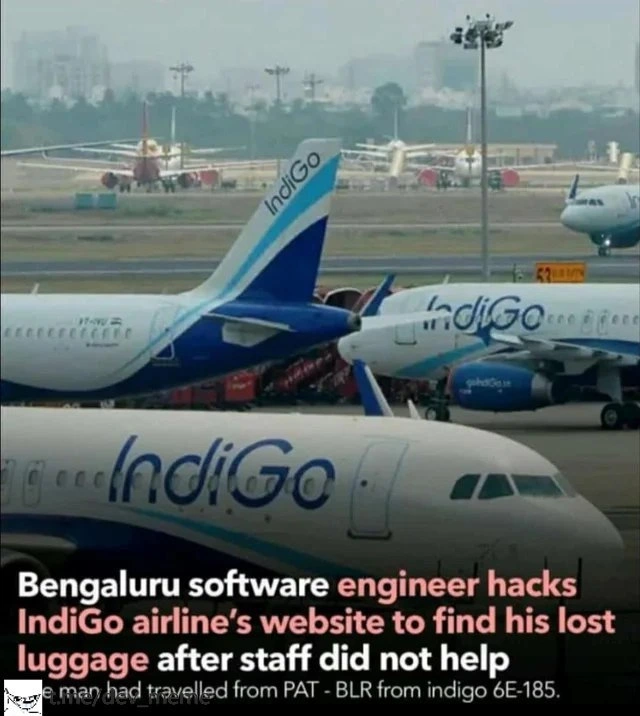
The image presents a news-style caption over IndiGo aircraft:
Bengaluru software engineer hacks IndiGo airline's website to find his lost luggage after staff did not help
and, in smaller text:
The man had travelled from PAT - BLR from indigo 6E-185.
The comedy is painfully specific: customer support fails, so the passenger allegedly turns into an incident-response team of one. That is why developers laugh with a little professional discomfort. The meme is not just "programmer does hacking." It is the ancient enterprise ritual where a user discovers that the official process is less effective than poking the system directly.
From a WebSecurity perspective, the scary implication is not that someone used dark magic. The phrase "hacks the website" could cover anything from opening BrowserDevTools and following network calls to exploiting a genuine BrokenAccessControl flaw. The most plausible class of issue, based only on the text and the luggage-tracking scenario, would be some form of SensitiveDataExposure: an endpoint returning baggage, passenger, route, or contact details without properly checking that the requester is allowed to see them. That is not elite movie hacking. That is the backend quietly trusting the front end, which is how the 3 AM incident channel gets its exercise.
The real joke targets the organizational failure chain. Airlines run complex operational systems: booking, check-in, baggage routing, airport handoffs, notifications, customer support queues, and partner integrations. When those systems fail, the user sees one simple problem: "Where is my bag?" If support cannot answer, the technical user starts asking different questions: What does the web app call? Is there an internal tracking ID? Does the API expose more than the UI shows? Is an object identifier guessable? Is authorization enforced server-side, or did someone believe hiding a button counts as security?
That last question is where the satire bites. SecurityMisconfiguration and weak access control often come from reasonable-looking shortcuts: ship the feature, trust the logged-in session, filter in the client, assume nobody will inspect the request, assume route numbers are harmless, assume support staff need broad lookup tools, assume the airline brand is not accidentally publishing a scavenger hunt. Each assumption saves time until a lost suitcase creates a motivated tester with nothing to lose but patience.
The post caption says #news (#old), which fits the screenshot's tabloid rhythm: this is framed less as a polished case study and more as a "you will not believe what a developer did when process failed" story. The funniest part is also the worst operational lesson: if your users can self-serve by exploiting gaps better than your staff can help through official channels, the bug is not just in the website.
Description
A news-style meme image shows several IndiGo airplanes parked at an airport, with one large plane in the foreground and others visible behind it. The bold caption at the bottom reads: "Bengaluru software engineer hacks IndiGo airline's website to find his lost luggage after staff did not help". Smaller text below says: "The man had travelled from PAT - BLR from indigo 6E-185." The developer humor comes from a customer-support failure escalating into an improvised web-security investigation, where a passenger apparently gets better results from the website than from the airline process.
Comments
17Comment deleted
Nothing motivates a penetration test like baggage support returning HTTP 404.
How Can u write Above Photo like that? Comment deleted
There's two spaces at the beginning of the post that are a link to the image, which is stored on external server. And what we see is a preview Comment deleted
I'm not sure if it's possible to do this manually or you need a bot that uses the API to send such messages though Comment deleted
Did they succeed tho? Comment deleted
if someone is interested in this "hack" details, here you go: https://mobile.twitter.com/_sirius93_/status/1508423479594733568 Comment deleted
thanks all, https://mobile.twitter.com/_sirius93_/status/1508432531183779840 Comment deleted
>presses F12 >hacks by that measure my jail time is long overdue Comment deleted
nono, he doesn't just press F12 he presses Ctrl+Shift+i 🙃 Comment deleted
imagine the audacity Comment deleted
I don't have to imagine Comment deleted
manjaro Comment deleted
no, base arch Comment deleted
nice Comment deleted
Was the luggage found? Comment deleted
yes, the luggage was swapped with someone elses' and the 'hacker' found out the other person's phone number (via html inspect 🤦), called them and fixed the luggage problem Comment deleted
that was after they called the airport multiple times btw - the airport didn't even bother calling the other person Comment deleted