Reaching Google Page Two While Debugging: The Classic "This Is Fine" Moment
Why is this Debugging Troubleshooting meme funny?
Level 1: Pretending It’s Fine
Imagine you’re in a kitchen trying to bake a cake, and suddenly the oven catches fire. 😨 Flames are popping up, but you don’t know where the fire extinguisher is. Instead of panicking, you just stand there, holding a cup of juice, saying, “It’s okay, I can fix this,” with a nervous smile. Clearly, everything around you is not okay, but you’re pretending it is because you don’t know what else to do. That’s exactly the feeling this meme jokes about. In the picture, a little dog sits calmly while the whole room is on fire, saying “This is fine.” It’s like when you have a big problem (like a hard puzzle or a broken toy) and none of the usual ways to fix it are working. You start to feel worried, but you still say “it’s fine” hoping if you stay calm, you’ll figure something out. The meme is funny because we know the dog should be freaking out, but instead he acts totally calm – just like sometimes we do when we’re overwhelmed but don’t want to show it. It’s a way to laugh at that feeling of being in trouble but trying to act normal.
Level 2: Stack Overflow Drought
For newer developers, let’s break down why reaching Google’s second page during troubleshooting is portrayed as a nightmare scenario. Debugging is the process of finding and fixing errors or bugs in your program – kind of like detective work for code. In daily coding, when you hit a problem (say an error message or a weird behavior), the go-to move is usually to search the internet for that error. Most of the time, the answer shows up on the first page of results, often on Stack Overflow (a famous Q&A forum where programmers post questions and get answers) or in official documentation. Page 1 is where you expect to find solutions quickly.
Now, what happens if you go through all those first-page links and still have no answer? You tweak your search terms (maybe including the exact error code, or the name of the programming language or framework), and still nothing useful pops up. You then click “2” to see more results – you’re now on Google page two. In developer lore, page two is joked to be the place where answers go to die (there’s an old joke that “the best place to hide a dead body is page 2 of Google results” because hardly anyone goes there!). Hitting page two means you’re desperate. It’s like turning to the very back of the textbook because none of the usual examples helped, or searching the attic for a tool because the toolbox is empty.
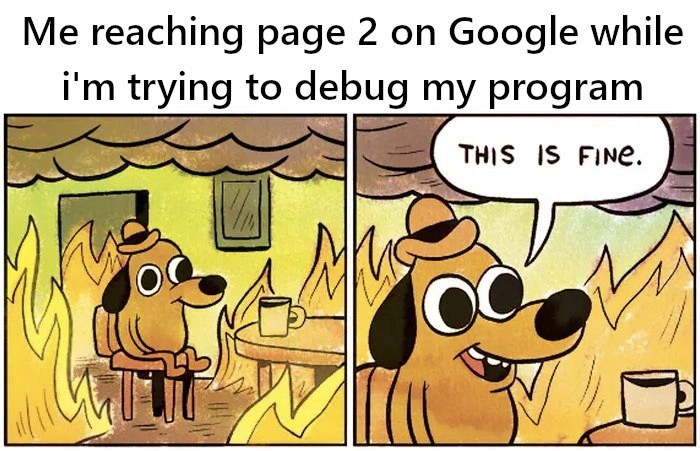
In the meme, the top text says: “Me reaching page 2 on Google while I’m trying to debug my program.” The cartoon image below it is a dog in a room that’s literally on fire, yet the dog is unnaturally calm, saying “This is fine.” This is a popular meme image used to joke about situations that are obviously very not fine, but where we pretend they are. Here’s how it connects:
- “This is fine” dog: This comic character is often used to represent denial or pretending everything is okay in the middle of a crisis. Developers share this image when they deploy code that’s breaking things or when the system is crashing but they have to stay calm. It’s a way to poke fun at the coping mechanism – acting calm under pressure even if you’re freaking out inside.
- Debugging denial: When you’re debugging and nothing is working, you might tell yourself “It’s okay, I’ll figure it out” even as more things go wrong. It’s important to stay calm, but it can feel like you’re the dog ignoring the flames. The “flames” in a debug context could be the program throwing dozens of errors, users complaining, or your boss asking for updates.
- Why page 2 = flames: Usually, the solutions to common bugs are well-known and appear quickly in search results. If you’re on page 2, it implies this bug is uncommon or even unique. That’s scary! It’s like an alarm that says “uh oh, none of the experts on the internet have a quick answer for this.” It might mean you’re dealing with a very rare problem, or something misconfigured in a unique way. It could also mean the bug is very new (maybe caused by a new update) and no one else has asked about it online yet.
- Stack Overflow drought: We often rely on Stack Overflow for comfort – it usually has someone who asked the exact same question. If that is coming up empty, a developer feels alone. Imagine you’re used to always having a teacher or friend who knows the answer, but suddenly no one does. It’s a bit of a lonely, sinking feeling.
So, the developer in the meme is basically saying: “I’ve tried everything obvious, I’m now digging through obscure search results, and I’m LOW-KEY PANICKING – but I’ll just pretend it’s all under control.” This is super relatable in the developer experience. Perhaps you remember the first time you encountered an error you just couldn’t solve quickly. Maybe you got a strange crash in your app, you Googled the error message, and found nothing helpful. You might have changed your search query a few times, clicked more links, and ended up on some random blog or a years-old forum discussion with zero answers. That moment feels frustrating and scary – you realize you might have to figure it out yourself through trial and error. The meme exaggerates it by comparing it to sitting in a burning room calmly – of course in reality, you might feel more frantic. But as a developer, you also learn you have to stay calm and systematically work through the problem, even if internally you’re stressed.
In sum, the meme is relatable humor for developers:
- It equates a tough debugging session with a disaster scenario (fire everywhere).
- It highlights the habit of acting optimistic outwardly (“No worries, I’ll solve it soon!”) while inside you’re concerned you’ve hit a dead end.
- It underscores how vital Google and Stack Overflow are in daily programming – so much that losing them (not finding answers) is like losing water in a fire.
Anyone who’s spent long hours fixing a stubborn bug knows the mix of anxiety and determination that comes when quick fixes don’t work. We chuckle at this cartoon because we’ve all had a moment of staring at a screen full of errors, no solution in sight, and thought, “This is fine… I’m fine… everything’s fine,” while it decidedly was not fine.
Level 3: Page 2 Inferno
When a seasoned developer finds themselves clicking “Next” to see Google’s second page of results, an internal alarm bell goes off. It’s the programming equivalent of a four-alarm fire. Why? Because reaching page 2 on Google for an error usually means all the obvious answers have burned away. The meme mashes this scenario with the iconic “This is fine” dog calmly sipping coffee in a burning room – a darkly comic illustration of debugging denial.
In a healthy situation, the fix for your bug is right there on page 1: maybe a well-upvoted Stack Overflow answer or an official doc. If you’re on page 2, you’re officially in uncharted territory. The developer’s world is metaphorically on fire – perhaps a production system is down or a bizarre bug is halting progress – yet they’re sitting there smiling nervously, pretending everything’s under control. It’s funny because it’s true: experienced engineers have all faced that nightmare where the usual resources come up empty, and the only thing to do is calmly sip coffee while internally screaming.
This meme hits on a shared trauma in coding culture:
- Search Result Desperation: Getting zero hits or irrelevant answers for your copied error message. You refine the query five different ways, and still nothing useful. By page 2 or 3, you’re clicking sketchy forum links from 2008, essentially digging through ashes for a clue.
- Stack Overflow Drought: The well of quick answers has run dry. All the top hits were things you’ve already tried, or they don’t apply. The one thread you find might have zero replies or an answer like “figured it out, never mind” – infuriatingly unhelpful.
- Debugging in flames: Meanwhile, logs are exploding with errors (the flames), and maybe users or QA are pinging you for updates. Like the dog in the burning house, you tell everyone “It’s fine, I got this,” even as you feel the heat. Outward calm, inner panic.
- Copium and Denial: Developers joke about using copium (coping mechanisms) – maybe you quip “
It’s always DNS” or “must be a caching issue” as a dark joke. It’s easier than admitting you have no idea yet. This gallows humor is our way of whistling in the dark while we scramble for a fix.
The humor works on multiple levels. It highlights our heavy reliance on communal knowledge and search engines: we’ve all become accustomed to finding a solution in seconds. When that safety net isn’t there, it feels like free-fall – the code is on fire and we’ve got nothing but a coffee cup (or energy drink) to clutch. Yet developers often maintain a façade of confidence. In stand-ups or incident calls, an engineer might calmly report, “We’re investigating an unusual issue,” all while frantically trying obscure keywords in another monitor. This absurd split between the calm appearance and the chaotic reality is exactly what the flaming-room dog portrays.
From an industry perspective, it’s a commentary on developer experience (DX) and the unwritten truth that not every bug has a known solution online. Modern programming is built on layers of abstraction and third-party frameworks; nine times out of ten, someone else has hit the same problem and posted the answer. But that tenth time – oh boy. You’re spelunking the depths of Google, maybe even daring to open page 3 or try Bing (the horror! 😅). You might find yourself reading source code of a library or digging into GitHub Issues with a sinking feeling. The meme captures that point of no return: you realize you are essentially alone with this bug, yet you soldier on, saying “this is fine” because what else can you do? It’s a rite of passage for developers to experience at least one “page 2” debugging nightmare, and we laugh (painfully) at this cartoon because we’ve all been that dog, smiling in the flames of a production issue.
Description
The image uses the two - panel “This is fine” cartoon. A heading in bold black lettering sits above both panels reading: "Me reaching page 2 on Google while i'm trying to debug my program". In the left panel, a wide-eyed cartoon dog wearing a small hat calmly sits at a wooden table, coffee mug in front, as bright yellow-orange flames engulf the entire room, walls, door, and window. The right panel zooms in on the same dog, still surrounded by fire, smiling nervously while a speech bubble says "THIS IS FINE." The visual humor equates digging past page one of search results with a full-on production fire that the developer pretends is under control, capturing the experienced engineer’s dread when Stack Overflow and doc sites have nothing left to offer
Comments
6Comment deleted
When you hit page two of Google, you’re not debugging anymore - you’re doing digital archaeology, so `git blame --since=2005` might be faster
The only time a senior engineer willingly ventures to Google page 2 is when the bug has survived three refactors, two architecture reviews, and that one junior who claimed they 'fixed it in their local branch'
Reaching page 2 of Google while debugging is the software engineering equivalent of checking the error logs in /var/log/ancient_curses. At that point, you're not finding solutions - you're discovering that three other developers had this exact problem in 2009, none of them solved it, and the last forum post just says 'nevermind, fixed it' with no explanation. The 'This is Fine' dog perfectly captures that moment when you realize your 'quick bug fix' has evolved into an archaeological expedition through deprecated Stack Overflow threads, and you're now seriously considering whether rewriting the entire module might actually be faster than understanding why this works in dev but explodes in prod
Page two of Google is the unofficial P1 runbook: after git bisect and disabling -O2, you’re copy-pasting from a 2009 blogspot in another language and calling it root cause
Page 2 Google: optimizing query regret at O(n²) time complexity while prod burns
Page two of Google is the signal to stop googling and start engineering - write the repro, turn on tracing, git bisect the culprit, then enjoy authoring the Stack Overflow answer you wished existed