The Classic 'Quick Task' Estimation Failure
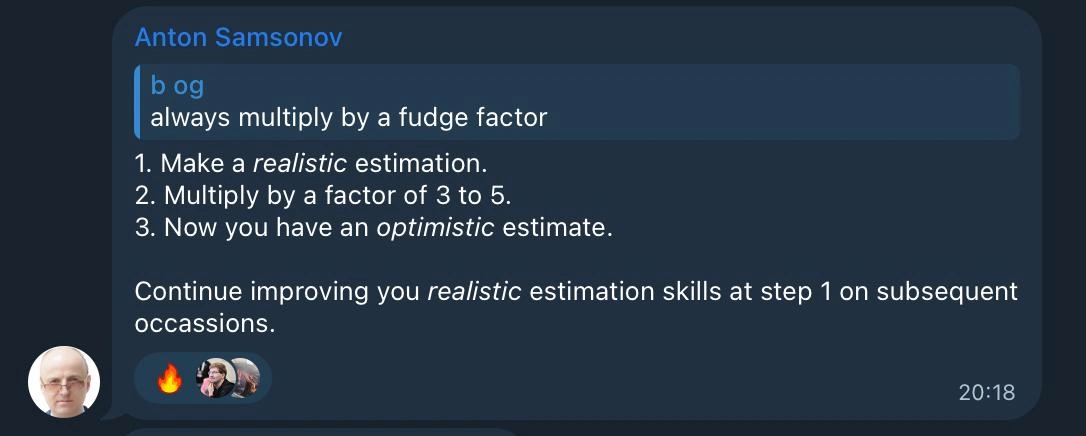
Why is this ProjectManagement meme funny?
Level 1: Longer Than Expected
For example, imagine you think cleaning your room will only take 10 minutes. But as soon as you start, you find a bunch of toys under the bed that you forgot about, and then you accidentally knock over a box of Lego pieces that you now have to pick up. Before you know it, hours have gone by and you’re still not finished. What you thought would be a quick, easy chore has turned into an all-day project. This meme is joking about that exact situation. It shows how we often think something will be simple and fast, but it ends up becoming much more complicated and long. We expected a short, easy adventure, but we got a much bigger, crazier one instead. It’s funny because everyone can relate to being way too hopeful about a task and then discovering, “Wow, this is taking a lot longer than I thought!”
Level 2: Little Task, Big Hours
In simpler terms, this meme highlights the gap between what we planned to do and what actually happened, especially in the world of Agile software development. Let’s break down the scenario:
- Sprint: A sprint is a short, fixed-length period (often 1 or 2 weeks) in Agile where a team tries to complete a set of tasks or user stories. Think of it as a mini project timeline. When we say an “8-hour sprint task,” we mean a piece of work that was supposed to take about 8 hours (roughly one workday) within that sprint.
- Estimate (8h): This is how long the team expected the task to take. In planning meetings (like Scrum planning sessions), developers often guess or estimate the effort required for each item. 8 hours was the optimistic guess here — perhaps for adding what sounded like a simple feature or fixing a minor bug.
- Actual Time (68h): This is how long the task actually ended up taking in reality – a whopping 68 hours of work. 68 hours is about eight and a half full working days! That huge jump usually means things went very wrong or many unforeseen problems came up. If you were tracking this in a tool, you’d see “Time Spent: 68h” logged for something that was supposed to be 8h. It’s the kind of overrun that makes everyone on the team raise an eyebrow.
- Scope Creep: This term describes when a task quietly grows bigger and more complicated than originally planned. For example, you start out trying to add a “simple” form field, but then discover you need to modify the database, fix a related bug, update some tests, and handle new edge cases. The scope (what needs to be done) creeps outward with each discovery, causing the time required to snowball.
- Deadline Pressure: This means the stress of an upcoming due date or commitment. Under a tight deadline, teams sometimes give very optimistic estimates (like saying “Yeah, we’ll get it done today”) because they feel pressure to fit the work in quickly. This can backfire when the task turns out to be more complex than anyone anticipated.
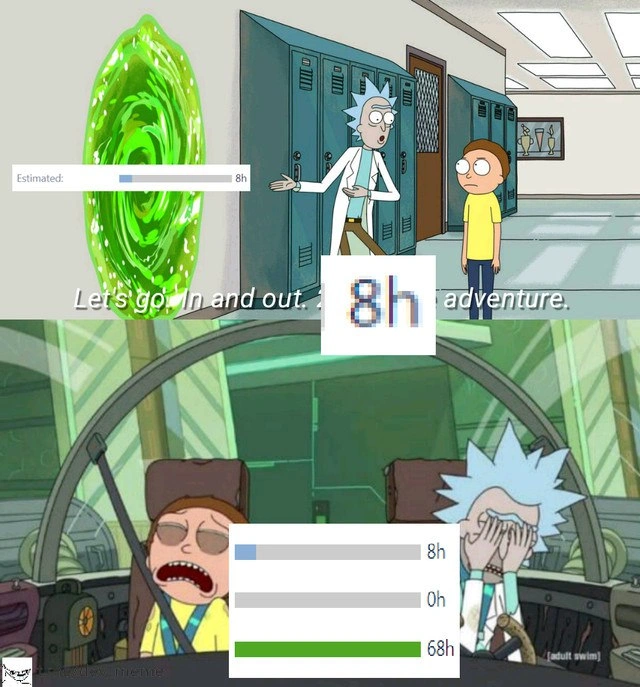
Now, looking at the meme panels: In the first image, Rick confidently says something like, “This will be quick and easy.” That’s like a developer promising, “Let’s jump in and fix this issue real fast; it won’t take more than 8 hours.” Morty stands there like the junior dev (or the trusting project manager) nodding along, believing it’ll be an in-and-out job. There’s even a little progress bar graphic above Rick’s portal labeled Estimated: 8h – just like in a project tracker where a task shows an initial time estimate of 8 hours. Everything seems straightforward at this point.
Then the second image shows what actually happened. Morty is screaming and Rick is covering his face – basically, the task turned into chaos and stress. That nice little progress bar has morphed into a bar chart with some very telling numbers: a tiny blue bar for 8h (what we planned), a barely-there grey bar for 0h remaining (meaning by the original plan, the time was up), and a giant green bar for 68h (the actual time spent). It’s exactly the kind of graph a tool like Jira might display after you log all your hours on a task: Original Estimate: 8h vs. Time Spent: 68h. Seeing that huge green bar is almost comical – it’s so much bigger than the plan that you have to laugh. In a team meeting (like a retrospective, where the team discusses what went well or badly after a sprint), this would definitely prompt an awkward discussion: “So... our one-day task took nearly nine days. What happened?”
For a new developer, the takeaway is that estimating software tasks is really hard. Even if something looks simple at first, you can hit unexpected snags. Maybe a library you needed isn’t working right, or you run into a weird bug that takes days to figure out. Perhaps the feature’s requirements weren’t clear, and you had to do a bunch of extra work once you understood what was actually needed (hello again, scope creep!). This kind of surprise happens a lot. Every programmer eventually has that moment where they think, “I’ll be done by this afternoon,” but then they end up working late into the night – or multiple nights. It’s almost a rite of passage in development to severely underestimate a task at least once.
Agile teams try to manage this uncertainty by working in short sprints and being ready to adjust their plans. Many teams use story points (a rough, relative size estimate) instead of hours to estimate tasks, precisely because hours can be so misleading. But even story points aren’t magic – you can still underestimate the complexity. A story point estimation fail like the one shown in the meme is when a task thought to be “small” blows up way beyond what anyone expected. The meme is poking fun at how our best-laid plans can go spectacularly wrong. It resonates with developers because everyone remembers the first time they said “oh, it’s a quick fix” and lived to regret it. It’s both a funny cautionary tale and a bit of comfort: it reminds us that hey, it happens to all of us. In other words, “We thought it would be a quick 8-hour adventure... but it turned into a 68-hour saga.”
Level 3: Portal to Scope Creep
Rick’s breezy line, “Let’s go, in and out, 8h adventure,” in panel one is basically the overconfident sprint planning meeting we’ve all seen. It’s the team lead or developer swaggering in, opening a glowing green portal of optimism and telling everyone this task will be a cinch. That portal is like diving into a codebase for a supposedly “quick fix” or new feature – it looks straightforward at a glance. Morty watching Rick is every junior dev or project manager who trusts that confidence. In the meme, a little progress bar overlay above the portal says Estimated: with a short blue fill and 8h. That’s exactly how managers like tasks to look: neatly estimated at a single digit of hours. Eight hours, in and out, we’ll be done by the end of the day, no sweat. Famous last words in software.
Then we get to panel two and reality punches through. Morty is strapped in the spaceship seat screaming in panic, and Rick is face-palming – this is the developer duo in full crisis mode after things have gone horribly wrong. On top of that image is a brutal chart: a tiny blue bar for 8h (the original estimate), an almost invisible grey bar for 0h (meaning no time was supposed to be left by now), and an enormous green bar stretching out to 68h. This looks just like a spent vs. estimate report from a project tracker: the blue planned line vs. the green actual hours logged. And wow, is that green bar massive – 68 hours of work for a task that was supposed to take 8! That’s an overshoot of cosmic proportions, something any seasoned engineer instantly recognizes with a wince (and maybe a chuckle). The meme perfectly visualizes that sinking feeling when you check your time tracking and see you blew the estimate out of the water. It’s the “oh no, this took way longer than we ever imagined” moment captured in a simple graphic.
The humor here hits home because it’s rooted in truth. In software development (and project management in general), we constantly deal with this gap between estimation and reality. An optimistic plan collides with unforeseen complexity – and guess which wins. The meme exaggerates it (8h vs 68h) for comic effect, but not by much! Every senior dev has a war story of a “one-day task” turning into a multi-week slog. Why does this happen? Often we uncover unknown bugs, hidden requirements, or we get hit by classic scope creep. Scope creep is when the task quietly expands: maybe while adding that “simple feature,” you discover the code around it is a mess and needs refactoring, or a reviewer points out additional cases to handle, or the client slips in a “small change” that isn’t small at all. Before you know it, your straightforward 8-hour job has opened a can of worms. And of course, deadline pressure often plays a role too – under the gun, we might give a rosy estimate just to keep higher-ups happy, only to eat those words later. This meme nails that collective experience of scrambling under a deadline as the task scope balloons beyond control.
The inclusion of Rick and Morty adds an extra layer for those who know the show. It parodies the famous scene where Rick says, “In and out, 20-minute adventure,” and then everything goes off the rails. In our developer version, 8h is the new 20 minutes – a wink to how even an entire workday can be woefully insufficient for the chaos that awaits. There’s also a nod to an old programmer in-joke known as Hofstadter’s Law, which states: “It always takes longer than you expect, even when you take into account Hofstadter’s Law.” In other words, even if you know things usually run over, they still run over. That giant 68h bar is basically Hofstadter’s Law saying “told you so!” to anyone who believed the 8h estimate. It's a sly way of acknowledging the almost scientific inevitability of underestimation in our field.
From an Agile project management perspective, this meme also pokes fun at our beloved Scrum rituals. In sprint planning, teams often estimate tasks in story points or hours, trying to predict the future in good faith. But here we see a spectacular story point estimation fail. It’s a reminder why many teams prefer abstract points over exact hours – because saying “this is 2 story points” feels safer than claiming “this is 8 hours” when you know that number might explode. The chart shown is reminiscent of tools like Jira: you enter an Original Estimate (say, 1 day) and then log work as you go. When you close the task, the software might display something like Original Estimate: 8h, Time Spent: 68h. Ouch. In the retrospective meeting, the team has to explain how their one-day task ate up over a week. Cue the awkward laughter and the lessons learned: maybe the task was underestimated, maybe new sub-tasks kept appearing, or maybe Murphy’s Law (anything that can go wrong, will go wrong) paid a visit.
Now, you might wonder, if this happens so often, why do smart developers keep falling into the same trap? The cynical answer: incentives and optimism. There’s often an unspoken pressure to keep estimates low. Perhaps a manager or client is eager for a quick delivery, and no one wants to be the "bad guy" saying it might actually take 3-4 days. So people convince themselves that the best-case scenario will happen – “Sure, we can do it in 8 hours!” – and everyone nods. Challenging an optimistic estimate in planning can feel like rocking the boat. So the team commits to the rosy timeline, crosses their fingers, and hopes nothing goes wrong. Of course, reality usually has other plans. When things blow up, you end up with overtime, stressed developers, and that dreaded huge green bar of shame. And next time? Well, humans are eternally hopeful (or forgetful) creatures, so the cycle repeats.
In essence, this meme is a badge of shared suffering and dark comedy in the developer world. It says, “Look, we’ve all been Rick and Morty on this wild ride.” Seasoned engineers laugh (maybe a bit bitterly) because they’ve lived this exact scenario: confidently jumping into a task thinking it’s a quick win, then grinding through far more work than anticipated. The meme is both cathartic and cautionary. It’s cathartic because it tells you you’re not alone – even the best of us get it horribly wrong sometimes. And it’s cautionary because next time you’re about to utter “this should only take a few hours,” you might remember Rick face-palming at that 68-hour fallout and think twice. In the world of software, nothing is truly “in and out” – and that’s why this meme draws equal parts laughter and sighs from development teams.
Description
A two-panel meme using the 'In and Out, 20 Minute Adventure' format from the show Rick and Morty. In the top panel, Rick is confidently telling Morty, 'Let's go. In and out. 8h adventure.' A progress bar with the text 'Estimated: 8h' is overlaid on the green portal next to them. This sets up the expectation of a contained, predictable task. The bottom panel shows a starkly different reality: Rick and Morty are inside their spaceship, looking completely exhausted and traumatized. Overlaid on this scene are three progress bars. The first shows the original 8h estimate. The second is empty, showing 0h. The third, a green bar, shows the actual time taken: a grueling 68h. The meme humorously captures the universal experience in software development where a task, initially estimated to be straightforward (8 hours), spirals into a multi-day ordeal (68 hours) due to unforeseen complexities. This is a classic joke about the fallibility of time estimation in tech, resonating with any developer who has seen a 'quick fix' or 'simple feature' turn into a marathon debugging or deployment session
Comments
7Comment deleted
That's the project manager's 8-hour estimate vs. the developer's 68-hour reality after discovering the legacy code is held together by a single, undocumented shell script
“Sure, it’s just an 8-hour column rename… right up until you find it hard-coded in a COBOL batch job, a decade of Excel macros, and the VP’s Tableau dashboard - 68 hours later you’re drafting a rollback policy with finance.”
The only deployment that actually takes 8 hours is the one where you accidentally push to prod at 5pm on Friday and spend exactly 8 hours in denial before checking Slack on Saturday morning
Every senior engineer knows the universal constant: multiply any estimate by π, add the number of microservices involved, then square it if the task touches legacy code. This meme perfectly captures the moment you confidently tell the PM '8 hours' for what seems like a simple feature flag, only to discover it requires migrating three databases, updating four deprecated APIs, resolving a race condition that's existed since 2015, and somehow involves that one Perl script nobody understands but everyone's afraid to touch
An “8h” estimate is the P50 assuming no dependencies; the other 60 hours are IAM perms, flaky CI, a surprise schema migration, and explaining to the PM why “in and out” violates the CAP theorem of schedules
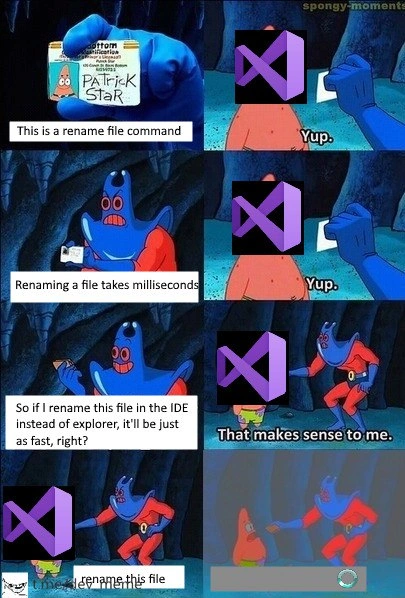
That 8h 'smoke test' portal? Straight to the event horizon of a 68h foreign key migration regret
8h estimate translates to 68h in enterprise time: 1h coding, 7h yak shaving, and 60h waiting on a firewall rule, a CAB approval, and the microservice nobody admits owning