When Your Python Script Meets a Retired White Hat
Why is this Security meme funny?
Level 1: Big Shoes to Fill
Imagine a little kid proudly showing his drawing to his dad, but the dad used to be a famous artist. The kid might have just scribbled a cute stick figure, while the dad once painted huge beautiful murals. It’s a bit funny because the dad’s skills are so much bigger, but the moment is also very sweet. The dad kneels down, smiles, and pats the child on the head, saying “Great job, I love it!” The child feels happy and proud. In this meme, the situation is just like that, but with coding: the child wrote a tiny computer program, and the dad was a big expert in computer hacking. The difference is huge (like a toy car compared to a real race car), and that’s why it’s amusing. But the heart of the joke is warm and encouraging: even though the dad could do incredible things, he’s still super proud of his kid’s little achievement. It’s like a kid making a small sandcastle and showing it to a parent who builds real houses – the parent smiles and says “Wow, that’s awesome!” The meme is funny because of the big gap in skill, and it’s heartwarming because the dad is supportive. In simple terms: the child did something small, the dad has done something huge, and both of them are happy about the small thing. It shows that everyone starts small, and parents (or mentors) love to see those first little successes.
Level 2: Python vs Pentester
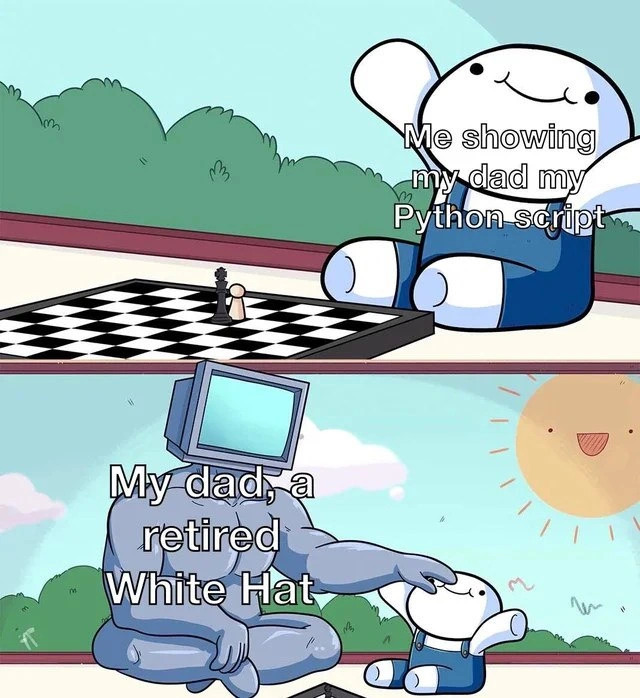
In this meme, a junior developer (the child character) is proudly showing a small Python script to his father. Python is a popular programming language known for its clean syntax and beginner-friendly style, so it’s often one of the first languages new coders learn. A “script” usually means a short program that automates a simple task or demonstrates a basic concept. So the kid has likely written a little program – maybe something like printing a message, doing a basic calculation, or a tiny game. For a newcomer, that’s a big achievement. The child is really excited — you can imagine him saying, “Dad, look! I made the computer do something cool!” This excitement is captured by the top cartoon: the kid sits next to a chessboard with only a pawn and a king on it, grinning widely. The pawn on the board represents the kid’s small accomplishment (pawns are the smallest chess pieces), and the lone king could represent the “problem” he solved or maybe just be there to show it’s a simple scenario (one pawn versus one king is a very minimal chess situation, just like his minimal script).
Now, the twist is who he’s showing it to: his dad is a retired “White Hat” hacker. White Hat hackers are the good guys in the cybersecurity world. The term comes from old cowboy movies where good guys wore white hats and bad guys wore black hats. So a white hat hacker is someone who uses hacking skills ethically, usually to help organizations find and fix security weaknesses. (By contrast, a “black hat” hacker is a malicious hacker who breaks into systems for personal gain or causing harm.) This dad likely had a career in security or ethical hacking – think of jobs like penetration tester, security analyst, or cybersecurity engineer. He would have spent years legally breaking into computer systems (with permission) to find vulnerabilities before real hackers (black hats) could exploit them.
The meme shows the dad in the bottom panel as this giant, muscular figure with a CRT monitor for a head. A CRT monitor is one of those old, boxy computer screens from the 1980s and 1990s (before flat screens were common). Drawing the dad with a CRT head is a fun way to say, “he’s old-school and literally has a computer for a brain.” In other words, Dad has loads of tech knowledge and probably comes from an earlier generation of computing. The muscular body symbolizes that he’s “strong” in computer skills – a kind of superhero of hacking. The dad is shown gently patting the kid, which indicates he’s supportive and proud, not judgmental. Even though the father’s skills are legendary compared to the child’s, he’s encouraging rather than dismissive. This dynamic is something many of us find heartwarming: it suggests the parent is saying, “Good job, keep it up!” It’s a bit like a master craftsman admiring a child’s first project – the scale is totally different, but the pride and encouragement are real.
Let’s break down why this scenario is amusing and relatable for developers:
- Huge skill gap: The child is at the beginning of their coding journey, and the dad is at the very advanced end of the spectrum. It’s like someone who just learned to ride a bike showing their skills to a retired pro cyclist. The difference is enormous! In tech terms, the kid might just know how to use basic
print()statements and loops, whereas the dad knows how to break into computers (and secure them) at an expert level. - Parental pride: Many developers have been in this kid’s shoes, excitedly sharing their first programs with family or mentors. And many experienced tech folks have felt like the dad, remembering their own start and feeling proud to see the next generation learning. If your parent or mentor is highly skilled in tech, showing them your first code can be both exciting and a little intimidating. This meme captures that feeling in a cute, visual way.
- Generational tech differences: The dad being a “retired” hacker implies he probably did his hacking in earlier decades. He might have used older programming languages (like C or C++ or even assembly language) and tools that young coders today might find archaic. For example, he might talk about securing systems running on old mainframes or writing scripts on MS-DOS, whereas the kid is using modern Python on a sleek laptop. The CRT monitor head reinforces this idea of the old generation of tech versus the new generation (the kid doesn’t have a monitor head; he’s just a normal cartoon, meaning he’s a normal person learning computers in a more modern era).
- Security vs coding focus: The child’s Python script could be about anything – maybe a little game, or just a simple automation – but it’s likely not specifically about hacking or security. Meanwhile, the dad’s expertise is specifically in security and hacking. So you have a hacker vs coder kind of contrast. The dad’s skills include things like understanding how malware works, how to test a web application for vulnerabilities, how to do a penetration test (which means trying to break into a system to test its defenses), and knowing lots of security tools and techniques. For instance, Dad probably knows how to perform an SQL injection attack or how to crack a password hash, or use tools like network scanners to find open ports on a machine. These are very advanced skills that take years to learn. The kid, on the other hand, might just have learned how to define a function in Python or how to use a library to, say, fetch weather data. Both are valid computing tasks, but one is obviously far more complex and advanced.
- Simpler analogy in the meme: The chessboard with a pawn and king can be seen as an analogy. In chess, a pawn is the least powerful piece and a king is the objective to protect or checkmate. Having only those two on the board is an extremely simplified scenario, possibly indicating the child’s script is a very simplified “game” or example. The dad being huge and outside the chessboard (patting the kid) shows that he operates on an entirely different level; he’s not even in the same “game” right now. It’s a visual way to say, “The kid is playing a tiny game, while Dad has dealt with the whole chess tournament.” The muscular computer dad design is a common meme way to portray something or someone as the ultimate version of their kind (in this case, the ultimate computer expert).
Despite the differences, the mood of the meme is positive. The parental_expectations here are not overbearing or critical; instead, the parent is kindly acknowledging the child’s work. It’s showing an ideal scenario: the experienced parent who could easily hack into systems is still impressed with their kid’s first steps in coding. This reflects an important truth in the developer community: everyone starts somewhere, and good mentors or parents remember that. The dad likely sees himself in the kid from years ago – after all, maybe decades back he wrote his first BASIC or Python program and showed it to someone proudly. The caption “My dad, a retired White Hat” emphasizes that the father has an ethical_hacking_background, meaning he has spent a career doing good through hacking skills (like securing companies from cyber attacks).
For a junior developer or someone new to coding, this meme is both funny and encouraging. It’s funny because the difference in knowledge is shown in such an exaggerated way – the idea of showing a tiny script to someone who has elite hacking skills is a bit like presenting a paper airplane to a NASA engineer. But it’s also encouraging because the expert (the dad) is shown as gentle and proud. It sends a message: no matter how simple your project is, those who know more than you aren’t necessarily going to laugh at you; many will be happy that you’re learning. In the tech world, a lot of learning happens through mentorship and support, so seeing the dad pat the kid’s head is a nice reminder of that dynamic.
To sum it up, this meme uses a father-son scenario to highlight the generation skill gap in tech. On one side, a beginner playing with Python – on the other, a seasoned security professional parent with decades of hacking experience. It’s relatable if you’ve ever been the beginner eager to impress, or the expert watching a newbie start out. The tags like DeveloperHumor, Python, WhiteHat, Security all point to these aspects: it’s humor that developers (especially in security) will get, it involves Python coding, and it features the concept of a White Hat hacker. The relatable_developer_experience tag is there because many people in tech have experienced something like this in real life. Maybe you showed your code to a parent or teacher who had way more experience, or conversely, your child or a younger student showed you something they made. It can be a funny feeling because of the discrepancy in knowledge, but it’s also a proud moment.
In simpler terms: the meme is saying “Here I am with my little coding project, and here’s my dad who used to professionally hack computers – he’s basically a legend. I’m excited to show him my work, and he’s happy to see me learning.” It’s a sweet, funny snapshot of python_beginner_pride meeting hacker veteran wisdom. Anyone who’s been involved in teaching or mentoring in tech (or who had a techie parent) will smile at this because it’s true: today’s beginners could be tomorrow’s experts, and the best experts often encourage the next generation, no matter how small their first program is.
Level 3: Pawn to Pwn
At first glance, this meme paints a vivid picture of a massive skills gap between a novice coder and a veteran hacker. In the top panel, a cute cartoon kid (with a big smile and blue overalls) proudly shows off a tiny Python script – symbolized by a nearly empty chessboard with just a lone white pawn facing a black king. In the bottom panel, we meet the dad: a gigantic muscular figure with an old CRT monitor for a head, labeled “retired White Hat.” The contrast is both hilarious and endearing to seasoned developers. The child’s meager pawn-sized accomplishment is being presented to a father who’s essentially a chess grandmaster of computers. It’s a classic developer humor scenario: the junior showing a “hello world” level project to a senior security guru. The white hat dad is an ethical hacker—the kind of person who spent his career finding and patching security holes, outsmarting malicious hackers (the “black hats”), and generally being the good guy in the cybersecurity world.
For those deep in tech, the chessboard metaphor speaks volumes. A lone pawn versus a king is like a minimal tool confronting a major challenge. In chess, a pawn can technically become powerful (if it reaches the end of the board and gets “promoted” to a queen), which is a clever nod to how a small script or exploit, in the right hands, can escalate privileges and “pwn” a system. The meme exaggerates this: the kid’s Python script is that little pawn – simple, limited, maybe just printing "Hello, world!" – while the dad has the experience to turn tiny vulnerabilities into checkmate scenarios in real-life security. White Hat hackers are basically the chessmasters of computer security, always thinking a few moves ahead to protect systems. This dad probably spent years performing penetration tests (authorized hacks) on complex networks, scripting custom tools to ferret out vulnerabilities, and keeping up with every CVE and exploit technique. He’s likely comfortable with everything from analyzing network packets at the byte level, to writing buffer overflow exploits in C, to cracking encryption ciphers. Meanwhile, the kid’s biggest coding triumph might be automating a little task or solving a programming puzzle on that chessboard-like setup.
The humor hits home for developers because we’ve all been on one side of this exchange or the other. Seasoned devs and security pros remember the pride of our first programs – and how laughably simple they seem in hindsight compared to “real” software or hacking. The father figure having a CRT monitor for a head is a nod to his old-school tech background: he comes from the era of bulky monitors, command-line interfaces, and manual memory management – a time when debugging meant staring at hex dumps and Stack Overflow was just “the stack overflowing” (literally). The muscular body represents his formidable skills and experience; he’s a powerhouse of knowledge. By contrast, the kid with the pawn and basic script represents the start of the journey. This disparity is funny to experienced folks because it’s so relatable: think of a newbie sysadmin bragging about configuring a home router in front of someone who has managed entire data center networks, or a CS student excitedly explaining a simple Caesar cipher to a parent who has done penetration testing for banks. The meme’s charm is that the dad isn’t mocking the child at all – he’s gently patting the kid’s head, showing encouragement.
That wholesome twist resonates in tech culture: many of us had mentors or senior colleagues (or parents in tech) who celebrated our “little wins” even though they’d solved far tougher problems. It highlights a positive side of the generation skill gap – the security professional parent passing the torch in a supportive way. And let’s be honest, the relatable developer experience here also has a tinge of imposter syndrome humor. As juniors, we often feel like that little pawn showing off a trivial script, while the seniors around us seem like buff computer demigods who could break into the Pentagon with a few keystrokes (albeit ethically!). It’s both humbling and comforting: humbling because we see how far there is to go, comforting because even the “CRT monitor head” dad likely started as a curious kid writing simple code too. The meme cleverly compresses that entire journey — from Python beginner pride to seasoned ethical_hacking_background — into one cute scene. No wonder developers find it adorable and funny: it’s basically the “are you winning, son?” meme for the coding world, but with a heartwarming “I’m proud of you, keep at it” vibe instead of judgment.
To experienced eyes, every detail pops with meaning. The pawn vs king chess endgame underscores how a tiny advantage or skill (pawn/script) can be significant when nurtured — a reference a security veteran might appreciate, since hacking often feels like a high-stakes chess match against attackers. The label “retired White Hat” suggests a long career of outwitting threats; these folks have stories of late-night incident responses and zero-day discoveries that would make any tech discussion spicy. In contrast, “my Python script” screams innocence and starting small — it might be something like:
# Baby's first Python script example:
for i in range(3):
print("Look, Dad! I made a script!", i)
Simple, right? But every expert was a newbie once. The dad’s seen scripts like this a million times, yet he’s portrayed as patient and proud. In real life, a veteran white hat might think back to his first “hack”, maybe tweaking QBASIC or writing a script on a Commodore 64, and smile at his kid’s enthusiasm. The meme strikes a chord because it exaggerates reality in a truthful way: knowledge in tech is exponential, and the gap between a beginner and an expert can feel comically large. Yet, we also know that given time and encouragement, that little Python pawn can promote into a queen — today’s scripting kid could be tomorrow’s security king (or rather, White Hat hero). It’s a relatable, optimistic inside joke for the developer community, wrapped in a cute comic format. And for those of us senior devs or security engineers, it’s a gentle reminder of how far we’ve come and the importance of nurturing the next generation, delivered with a side of smiles.
Let’s put the differences in perspective:
| Newbie’s Python Wins | Dad’s White Hat Feats |
|---|---|
| Writing a 10-line script that runs | Securing an entire server or network |
| Printing “Hello World” successfully | Finding a zero-day exploit in the wild |
Basic Python loops and if statements |
Advanced penetration testing with custom tools |
| Automating a tiny task on a PC | Automating large-scale security audits |
| Solving a simple puzzle in code | Solving real-world cybersecurity challenges |
This tongue-in-cheek comparison highlights why the meme is funny. It’s the “script kiddie” vs. seasoned hacker trope, but portrayed in the most wholesome way imaginable. The child’s perspective is “Look what I made, isn’t it cool?” while the dad’s perspective (with all his knowledge of hacker vs coder battles and hard-won wisdom) is “That’s adorable – keep going, you’ve got potential.” For veteran developers, the humor lies in recognizing both themselves in the big CRT dad (battle-hardened by years of tech life) and in the enthusiastic kid they once were. They know the pawn is at the beginning of the board, but one day it’ll cross to the other side. The meme perfectly captures that mentor-mentee energy, making us laugh and maybe go “aww” at the same time.
Description
A two-panel comic meme format from TheOdd1sOut illustrates a wholesome but humbling tech moment. In the top panel, a small, simple cartoon character labeled "Me showing my dad my Python script" proudly presents their work next to a chessboard. In the bottom panel, the character is being affectionately patted on the head by a much larger, muscular figure with a CRT monitor for a head. This powerful figure is labeled "My dad, a retired White Hat." The meme humorously contrasts the pride of a budding programmer with the vast, unseen expertise of a seasoned cybersecurity professional (a 'White Hat' hacker). It speaks to the generational knowledge gap and the feeling of being a novice in the presence of deep, specialized experience, a common feeling for developers at all levels when encountering true masters of a specific domain
Comments
7Comment deleted
It's cute when a junior shows you their first Python script for port scanning. It's less cute when their retired white-hat dad quietly points out that the script just accidentally DDoS'd the family's smart toaster and pawned the home network
Demoing my 40-line Python script to dad is basically explaining how a pawn moves to the guy who once pivoted from a dot-matrix printer’s firmware to root on Solaris over a 2400-baud modem
"Great, now explain why you're using pickle to deserialize user input, storing secrets in environment variables called 'PASSWORD123', and why your SQL queries look like f-strings had a baby with Bobby Tables."
The beautiful irony here: while most developers dread showing code to non-technical family members, this developer's retired White Hat dad probably spent decades writing Python exploits, parsing packet captures, and automating penetration tests. That 'simple script' you're nervously presenting? Dad's already mentally refactored it, identified the SQL injection vulnerability you missed, and is wondering why you're not using context managers. He's just too proud to mention it
When your hello-world.py survives a retired pentester's gaze: 'Son, that's buffer-overflow proof gold.'
When your dad’s a retired white hat, “Nice script” means “why is shell=True, where’s the threat model, and did you mean to commit your .env?”
Showed my retired white hat dad my Python script; he studied it like a chess endgame: mate in two - pickle.loads on input, then shell=True