Skip to content
DevMeme
2879 of 7435
The Illusion of Progress in Marathon Meetings
Meetings Post #3183, on Jun 3, 2021 in TG

The Illusion of Progress in Marathon Meetings

Why is this Meetings meme funny?

Level 1: Expecting Magic

Imagine your teacher is explaining a new homework assignment to the class. You’re sitting at your desk listening to the instructions. Now picture the teacher, halfway through the explanation, suddenly asking, “So, have you finished the homework yet?” Sounds silly, right? You haven’t even had a chance to start! That’s exactly what’s happening in this meme. The boss is like that teacher, expecting the programmer to have the work done while they’re all still sitting in the meeting talking about it. It’s funny (and ridiculous) because everyone knows you can’t finish a task if you’re not given time to actually do it. The joke shows how frustrating it feels when someone in charge expects magic – basically wanting the result without allowing the actual work to happen.

Level 2: Can’t Code in Meetings

In simpler terms, this meme highlights how meetings can mess with a developer’s ability to get work done. Let’s break down the scene: a team is using an Agile process (common in software development) where work is divided into user stories – basically features or tasks written from a user’s perspective. Each story gets an estimate before the team starts working on it. Here, one developer gave an estimate for a story (perhaps saying it might take a couple of hours of work). That happened during a planning meeting – likely a sprint planning or estimation meeting where everyone discusses what needs to be done and how difficult it might be.

Now, the funny (or frustrating) part: the manager or product owner immediately asks two hours later if that story is finished while the team is still in the meeting. In real life, if you’re stuck in a conference room (or on a Zoom call) for two hours talking about the work, you obviously haven’t had any time to actually do the work! The developer’s surprised response – “While sitting in this same meeting that I gave the estimate?” – is basically saying, “How could I possibly be done? I haven’t even gotten to my keyboard yet!” This highlights a misunderstanding some managers have: an estimate is just an educated guess about how long something might take under normal working conditions, not a countdown that magically produces a result at T+X hours no matter what.

Let’s define a few terms to make sure everything’s clear:

  • Agile: A way to manage projects that emphasizes breaking work into small chunks, frequent reassessment of plans, and lots of communication. Scrum is a popular Agile framework, which includes ceremonies (meetings) like sprint planning, daily stand-ups, demos, etc. The idea is to be flexible (“agile”) and adjust to change, rather than sticking to a rigid long-term plan.
  • User Story: A short description of a feature told from an end-user’s perspective, e.g., “As a shopper, I want to filter products by price so I can find cheap options quickly.” It’s basically a task or feature the devs need to implement. In Agile, instead of a giant spec doc, work is chunked into these bite-sized stories.
  • Story Points: A unit of measure for estimating the relative effort or complexity of a user story. It’s often an abstract scale (like using Fibonacci numbers 1, 2, 3, 5, 8...) where a 2-point story might be “pretty easy” and an 8-point story is “very hard,” relative to each other. Importantly, story points are not strict hours; they are more like sizing (small, medium, large). One team’s 2 points might be another team’s 5 points – it’s a team-relative metric. The key is that they help the team gauge how much work they can take on in a sprint (a time-boxed iteration, often 1-2 weeks).
  • Sprint Planning Meeting: Typically at the start of a sprint, the team and the product owner get together to decide which stories to do in that sprint. They discuss each story, clarify what’s needed, and often estimate them (if not already estimated). This meeting can last a couple of hours for a two-week sprint. It’s supposed to help the team plan their workload.

In the meme, it sounds like during such a planning meeting, the developer said something like “This story is about 2 hours of work” (either explicitly in hours or implicitly by giving it, say, 1 or 2 story points which roughly correspond to a small task). The problem is the manager treats that estimate as a deadline that starts right away, even though the developer hasn’t started actual work yet due to the meeting. It’s as if the clock started ticking the moment the dev said “2 hours,” with no allowance for the fact that those 2 hours were immediately swallowed by discussion. This is a common newbie surprise in the workplace: not all “work hours” are available for coding because you have meetings, emails, and other overhead.

Think about the schedule for that developer on that day:

[09:00 - 11:00] 🗓️ Sprint Planning Meeting – (Discussing tasks, giving estimates)
[11:00]         🤷 Manager: “So, is that story done now?”
[11:01]         🤦 Developer: *internal screaming* (“...I haven’t even started!”)

The timeline above is essentially what the meme is showing. The developer is facepalming because the question “Have you finished that story?” right after the planning session is absurd. It’s highlighting the concept of meeting time sink: time spent in meetings is time not spent coding. New developers often learn quickly that a day filled with meetings means crunch time later or pushing the task to tomorrow, because you just couldn’t start it when you planned to.

The tags like MeetingHumor, AgilePainPoints, and DeveloperFrustration all point to this everyday conflict: developers need quiet time to concentrate and write code, whereas managers need meetings to coordinate and get updates. When those two collide, you get scenes like this. Junior devs might not have experienced this exact situation yet, but they’ll likely relate to smaller versions of it – like when a teacher or boss assigns work and then keeps interrupting or holds you up with other things. The meme exaggerates it (a manager literally expecting work done during the meeting), but it’s rooted in truth. Meetings vs. coding is always a balancing act in real projects. Good teams try to keep meetings short and purposeful. If you’re new to Agile teams, you’ll soon find that a 2-hour planning meeting is often necessary at the start of a sprint – but everyone also knows you can’t expect the actual coding to start until after.

So, the developer’s snarky response in the meme is something a lot of us have wanted to say: essentially, “How do you expect me to finish writing the code when you’ve had me sitting here the whole time talking about it?” It’s a lesson in plain terms: unrealistic deadlines or expectations can come from not accounting for real-world constraints (like meetings, research, or just the fact that coding isn’t instant). And if you ever become a manager or tech lead, remember this meme – don’t be that person who schedules a long meeting and then immediately asks “Done yet?” 😉.

Level 3: Story Points Paradox

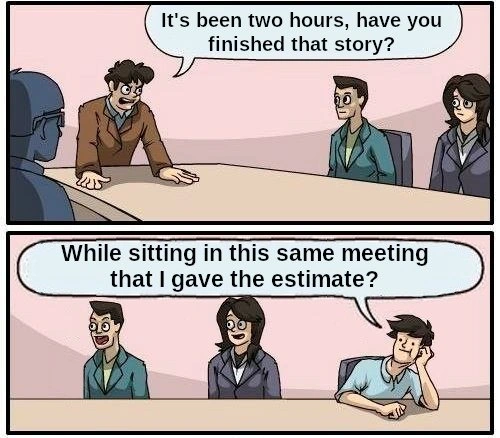
Manager: “It’s been two hours, have you finished that story?”
Developer (wide-eyed): “While sitting in this same meeting that I gave the estimate?”

This meme lands a direct hit on an Agile anti-pattern: the absurd expectation that software can be developed simultaneously with the meeting that’s supposed to plan it. The scene is a sprint planning (or similar) session where a developer has just estimated a task – say a user story – and barely two hours later the manager is already asking for the deliverable. It’s a classic case of estimate vs. reality whiplash. The humor (tinged with pain) comes from how manager expectations can completely ignore the reality of meeting time sinks and context-switching. In other words, the boss acts as if the code could be written by osmosis while everyone’s still sitting around a table. Sure, boss, let me just conjure the feature out of thin air while I listen to you recap Q3 OKRs. 😏

Seasoned developers recognize this scenario immediately. It’s the Story Points Paradox: a task estimated at “~2 hours of effort” somehow triggers a manager’s timer, even though those 2 hours were consumed by the meeting overhead itself. In proper Agile practice, story point estimation is a fuzzy relative measure of complexity ("3 points" meaning roughly ‘small’ or comparable to other 3-point tasks), not a literal hour-countdown. But some managers can’t resist transmogrifying points into hours and then into a deadline (“2 hours have passed, TikTok, where’s my deliverable?”). This disconnect is exactly what’s being satirized. The manager’s question reveals a fundamental misunderstanding of what an estimate is: a good-faith guess, not a promise of instant delivery. It’s like Schrödinger’s software – the code is somehow expected to be both being worked on and finished, while the developer is trapped in the planning meeting. In reality, once you “open the box” (i.e. actually check if it’s done), surprise! The code is definitely not written yet, because the poor dev hasn’t been given a single minute of uninterrupted development time.

From a senior engineer’s perspective, this comic highlights several tragically familiar dynamics:

  • Misused Story Points: Story points are meant for relative sizing, but here they’re treated as precise hours. This is Agile 101 gone wrong. A user story estimated at 2 points (or even “2 hours”) doesn’t magically write itself in 2 actual hours – especially not if those hours are spent in a conference room. Managers converting points to time as if 1 point = 1 ideal hour are engaging in cargo-cult agile.
  • Meeting Overload: The meme underscores how excessive meetings kill developer productivity. Agile ceremonies like sprint planning or backlog grooming are supposed to be time-boxed and efficient. But a 2+ hour meeting isn’t Agile, it’s a throwback to waterfall-era marathons. Developers live on a maker’s schedule – we need contiguous blocks of time to actually build and debug. Every hour spent in a meeting is an hour we’re not coding. Here the entire estimated effort window vanished into the meeting itself. No wonder nothing got done!
  • Unrealistic Deadlines & Manager Pressure: The manager’s impatient question – “Have you finished that story?” – just two hours after estimation, betrays a certain magical thinking (or maybe product owner misunderstanding of engineering). It reflects the pressure-for-instant-results culture. The dev’s incredulous response (“While I’m sitting in this meeting, really?”) is a polite version of what every engineer has wanted to retort when asked for status the second a task is assigned. The humor is a coping mechanism: we laugh because otherwise we’d cry at how common this scenario is.
  • Agile Irony: Agile methodologies were designed to improve on heavyweight processes: shorter feedback loops, more realistic planning, and open communication. Ironically, some organizations implement Agile in name but not in spirit – daily stand-ups that drag on forever, planning meetings that boil the ocean, and managers who treat velocity like a hard science. This meme pokes fun at that irony: the Agile meeting intended to help the team has become a time sink that actively undermines the sprint. It’s agile-meets-Irony: “We value responding to change over following a plan,” yet here we have a plan (2-hour estimate) with zero flexibility and no allowance for the very meeting that created it.

Every veteran developer can swap war stories about this kind of situation. We’ve seen management/PMs schedule back-to-back meetings and then wonder why nothing is delivered by EOD. 🙄 We’ve experienced the deadline pressure of a manager who treats an estimate as a guarantee, oblivious to the fact that real-world software development involves build environments, debugging, unexpected hiccups – and yes, that meetings themselves have a cost. The shared laughter arises from a place of developer frustration: it’s the laugh of recognition. We’ve all wanted to facepalm when a higher-up asks “Is it done yet?” immediately after sucking up our whole morning discussing it. The meme gives us a brightly colored, anonymous comic outlet to say what we wish we could in those meetings: “How on earth could it be done? We haven’t left the room!”

Historically, this mismatch between management expectations and engineering reality isn’t new. In the era of waterfall projects, managers would draft month-long Gantt charts and still ask for fixes overnight. Agile was supposed to fix that by emphasizing communication and realistic iteration. Yet here we are in 2021, with JIRA tickets and story points, reliving a mini waterfall moment. Plus ça change, plus c’est la même chose – the more things change, the more they stay the same. The meme resonates with devs because it confirms a cynical truth: sometimes the biggest obstacle to getting work done is the process that’s supposed to help get work done. Meetings about work can straight-up prevent work. This comic exaggerates it just enough to be funny, but not so much that it stops being painfully true.

Bottom line? The meme is a satirical nod to everyone who’s ever sat in a long “planning” meeting watching the clock tick, and thinking to themselves: “If we weren’t in this meeting, the code might actually be written by now.” It’s a high-five (or maybe a sympathetic headshake) from one dev to all others who’ve been there, done that, and got the t-shirt that says “I survived the meeting that should have been an email.” It’s funny because it’s true – and that truth is practically a rite of passage in our field.

Description

A two-panel comic strip depicting a meeting in a corporate setting. In the first panel, an agitated manager leans across a conference table, asking a developer, 'It's been two hours, have you finished that story?'. The other attendees look on passively. In the second panel, the perspective shifts to the developer, who is leaning back in his chair with a bored, sarcastic expression. He replies, 'While sitting in this same meeting that I gave the estimate?'. His colleagues react with amusement and surprise. The meme hilariously captures a common frustration among developers: the expectation of productivity while being held captive in non-productive meetings. It highlights the disconnect between management's perception of time and the reality that meetings, especially long estimation or planning sessions, directly consume the time needed to actually perform the work, making the manager's question utterly absurd
Comments

8
Anonymous ★ Top Pick This is the corporate equivalent of a distributed transaction that holds a lock on a developer's brain for two hours and then wonders why no commits were processed
  1. Anonymous ★ Top Pick

    This is the corporate equivalent of a distributed transaction that holds a lock on a developer's brain for two hours and then wonders why no commits were processed

  2. Anonymous

    It was a two-hour task - right up until management acquired a non-reentrant “all-hands meeting” lock and starved the only worker thread

  3. Anonymous

    The only thing more optimistic than a junior's time estimate is a PM believing developers can complete a story while simultaneously explaining why it takes two sprints to implement a dropdown menu

  4. Anonymous

    Ah yes, the classic Schrödinger's Sprint: where a story is simultaneously estimated, in progress, and blocked by the meeting discussing its progress. The developer exists in a quantum superposition of 'working' and 'explaining why they're not working' until management observes them, at which point the wave function collapses into pure frustration. Bonus points if this is a 'quick sync' that's now entering hour three, and the Jira ticket still shows 'To Do' because nobody could actually *do* anything while *talking* about doing it

  5. Anonymous

    Per Little's Law, once a 2-hour status meeting is part of your WIP, throughput trends to zero - yet the burndown still expects O(1) delivery

  6. Anonymous

    Asking if a two-hour story is done during the two-hour status meeting is like holding the mutex and wondering why the thread made no progress

  7. Anonymous

    Classic PM alchemy: turning an 8-point story into a 2-hour miracle via sheer force of meeting momentum

  8. @lirys 5y

    👍🏻

Use J and K for navigation