Skip to content
DevMeme
4231 of 7435
When work and life both burn, DevOps wonders if that’s balance
MentalHealth Post #4625, on Jul 2, 2022 in TG

When work and life both burn, DevOps wonders if that’s balance

Why is this MentalHealth meme funny?

Level 1: Double Trouble

Imagine you’re having a really rough time both at school and at home. For example, say one day you got in trouble with your teacher and later that day you also broke your favorite toy at home. You might throw up your hands and jokingly say, “Wow, everything at school and everything at home is ruined. Is this what adults mean by balance?” It sounds silly, right? Normally, when people talk about balance, they mean sharing good things or time evenly – like balancing study time and play time so you feel happy with both. But in this joke, the person is saying their work and life are balanced because both are equally bad.

It’s like having two plates and on each plate you get some food. You hope one plate has a yummy treat and the other has healthy veggies – a nice balance of things you like and things that are good for you. But instead, imagine both plates have burnt vegetables that taste awful. Yuck! You’d look at those plates and laugh a bit sadly, “Well, at least they’re balanced – both plates are gross!” Of course, that’s not the kind of balance anyone wants. You’re making a joke to cope with the disappointment.

In the meme, the grown-up (who is a computer engineer) is basically doing the same thing. They’re super tired and upset because their job is going badly and their personal life is also tough. By asking “Is this work/life balance?” they’re joking in a sad way. It’s funny because of the twist: usually work/life balance means good balance (some work, some fun). Here it’s a bad balance (all trouble, no fun), which is the opposite of what we expect.

The feeling behind the joke is a bit like when you’ve had a terrible day and you kind of shrug and laugh because if you don’t laugh, you might cry. Even a kid can understand that sometimes you joke about something bad to make it feel a tiny bit better. The face the person uses (that 😐 neutral emoji) is how you look when you’re totally done and have no smile left. Yet, by turning their misery into a question that sounds clever, they get people to smile and say “I feel that too!”

So, in very simple terms: the meme is funny because the person calls a really bad situation a “balanced” situation. It’s like saying, “Both halves of my life are on fire, so hey, that’s fair!” It’s an upside-down way to use the word “balance.” People who see this and have felt overworked or overwhelmed might chuckle and think, “I know that feeling.” It’s a way of showing empathy and humor at the same time. Even if you’re not an adult with a job yet, you can relate by remembering a time when everything seemed to go wrong at once. The meme takes that feeling and makes a little joke out of it – a kind of “laughing through the pain” moment that many of us understand, no matter our age.

Level 2: All Work, No Play

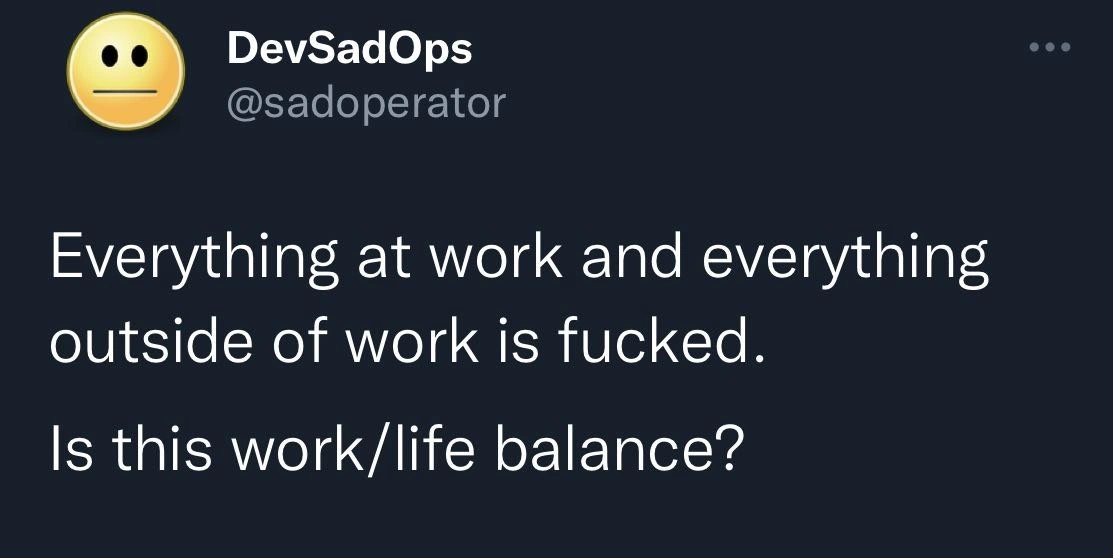
At first glance, this meme looks like a simple Tweet on a dark background. The user name DevSadOps (@sadoperator) is immediately telling – it’s a play on the term DevOps, with “Sad” inserted to show the user is a sad operations person. DevOps usually refers to a set of practices that combine Development and IT Operations, where engineers work on both writing code and keeping servers running. A person in a DevOps or SRE (Site Reliability Engineering) role often maintains systems, fixes outages, and handles deployments. They have a duty called on-call, meaning at any given time (day or night) one team member is designated to respond if something breaks. This meme is written from the perspective of an on-call DevOps engineer who is very, very tired and frustrated.

The Tweet text says: “Everything at work and everything outside of work is f*ed. Is this work/life balance?” (We’ve censored one word here, but it was fully spelled out in the meme, highlighting the author’s high level of frustration). Let’s unpack that:

  • “Everything at work is messed up” – This means the person’s job is going badly right now. Perhaps all their projects are on fire: servers crashing, code broken, deadlines missed. In DevOps terms, maybe they just dealt with a major outage or they’re drowning in alerts from monitoring tools. They feel like the entire workplace is chaos.

  • “Everything outside of work is messed up” – This means their personal life is also not going well. Maybe they’re so busy or stressed from work that they have no energy for household tasks, family, or hobbies. Perhaps their sink is overflowing with dirty dishes, or they haven’t slept properly in days. Essentially, their life outside the office feels as disorganized and painful as work does.

  • “Is this work/life balance?”Work/life balance is a common phrase meaning a healthy mix of work and personal life. A good work/life balance would mean you have enough time and energy for your job and for your life (family, rest, fun, etc.), without one wrecking the other. It’s something many companies encourage in theory. Here, the author is asking this question sarcastically. They know this isn’t the real meaning of work/life balance. They’re joking that since both work and life are equally horrible, maybe that technically counts as having them “balanced.” It’s a bitter joke: normally you want both sides to be positive and stable, but they have both sides negative and in chaos.

The humor is sarcasm. Sarcasm is when someone says something but means the opposite or mocks the idea. In the meme, the person doesn’t truly think this is a good work/life balance – they are mockingly calling their situation “balanced” to emphasize how bad things are everywhere. It’s like saying “Great, I’m failing at everything equally – mission accomplished!” when you obviously mean the situation is awful, not great. This kind of dark sarcasm is common in developer humor and internet jokes, where people make light of tough situations.

Now, for some context: The meme is presented as a Twitter screenshot in dark mode. Dark mode is just a color scheme where the background is black or dark and the text is light-colored. Many developers prefer dark mode on their screens (IDEs, terminals, and yes, Twitter too) because it’s easier on the eyes during long hours, especially at night. The fact it’s dark mode with a neutral-face emoji avatar (the 😐 expression) adds to the mood: it visually looks a bit gloomy or serious, which matches the tired, “nothing is good” feeling of the text.

The handle @sadoperator is likely not a real person’s account but an anonymous or parody name used just for this meme. “Operator” in tech can mean someone who runs systems (like a systems operator). By calling themselves a sad operator, they communicate right away that they’re an unhappy person running tech operations. It’s an immediate clue that this tweet is about sadness in a DevOps role. The display name “DevSadOps” cleverly flips the term DevOps. In a normal scenario, DevOps culture is often portrayed with positive words like collaboration, speed, and efficiency. Here it’s “DevSadOps” to highlight the opposite feeling: sadness or burnout despite being in DevOps. This small detail is a nod to MentalHealth concerns in the tech industry – many tech workers struggle with stress and unhappiness, even in roles that are supposed to streamline work.

Let’s clarify burnout too. Burnout is a state of extreme exhaustion (mental, emotional, and often physical) caused by excessive and prolonged stress. In the tech world (MentalHealthInTech is a trending topic for this reason), burnout can happen when someone works very long hours, is constantly on call, or feels overwhelmed by the demands of their job. Common signs are feeling detached or cynical about work, having trouble accomplishing tasks you normally could, and feeling exhausted no matter how much rest you get. In this meme, the person is basically waving a flag saying “I’m burned out”. They imply they can’t find joy at work or outside of it. That’s a scary place to be, and unfortunately many developers and SREs have experienced something like this during crunch times or intense on-call periods.

On-call duty deserves a bit more explaining for those new to it. If you’re “on call,” it means that for a certain period (say a week or a few days), you are the designated responder if anything goes wrong with the systems or software your team manages. Companies usually have an on-call rotation schedule so the same person isn’t on call all the time. But when you are on call, you carry a phone or have an app that will alert (buzz or ring loudly) anytime, day or night, if there’s a critical problem – like a server going down or a bug in the latest release causing big errors. It’s like being a doctor on emergency duty, but for software systems. So imagine trying to relax at home and always having a little worry in your mind that “the phone could ring and I’ll have to jump back into work.” It’s stressful. If an SRE is on call and the system is unstable, they might get paged multiple nights in a row. This destroys sleep and any sense of separation between work and personal time. On_call_exhaustion is absolutely a thing: you see folks with eye bags and jittery caffeine habits after a tough on-call week.

The meme text mentions “everything outside of work” being messed up. For a DevOps engineer or developer, that could be a result of being overworked. If you’re working late nights or weekends handling incidents, you might start skipping basic life stuff: maybe you haven’t done laundry, or your room is a mess, or you miss social events. Your friends or family might be upset that you’re always busy. You yourself might feel too tired to enjoy your hobbies. This leads to a feeling that your outside-of-work life is falling apart. It’s a common complaint in tech: “I have no life because of this job.” When the meme says everything outside is messed up, it suggests a pretty extreme case where absolutely nothing is going right personally, perhaps as a consequence of job stress (though it could also be other life issues coincidentally happening at the same time – sometimes life problems pile on).

So why is this meme funny to developers? It might not be “ha-ha” funny; it’s more of a dry, knowing chuckle. It’s funny because it’s relatable in a dark way. People in tech often joke about “working hard and then going home to… more problems” as a way to acknowledge how tough it can be. It’s a form of TechHumor where you make fun of your own misery. The question “Is this work/life balance?” is phrased like a genuine inquiry, but it’s obvious the person is poking fun at their situation. It plays on the absurdity that “hey, if both halves of my life are ruined, they’re technically in balance with each other.” No one actually wants that kind of balance, and that irony is what gives the meme its edge.

Also, note that we don’t see any replies or likes in the screenshot. It’s just the tweet content on a plain background. This minimalism is done on purpose so the viewer focuses on the message. The little three-dot menu icon in the top right is part of Twitter’s interface (for options on a tweet). Including it makes the image look like a real screenshot rather than just plain text. A lot of meme-makers do this to add authenticity to the fake tweet. The absence of likes or replies might also subconsciously imply, “this is just a lone shout into the void,” which matches the theme of feeling isolated and overwhelmed.

In summary, at this level, you should understand the meme as follows: it’s showing a DevOps/SRE person joking that their work and personal life are both a disaster, and they sarcastically call that sad state a form of “balance.” The humor is in the irony – normally balance is positive, but they use it to label a very negative situation. Key terms like work/life balance (good in theory), burnout (bad and happening here), and DevOps on-call (the job context causing this stress) all combine to explain why this person feels so done with everything. It’s a bit like a resigned sigh turned into a joke. People in tech share things like this to feel less alone and to maybe prompt companies to notice the human cost of constant overwork. The meme lives under tags like DeveloperBurnout and MentalHealthInTech because it bluntly highlights those issues, even though it does so with humor.

Level 3: Load Balanced Burnout

In the bleak humor of this meme, a battle-weary Site Reliability Engineer (SRE) is essentially saying: “Both my job and my personal life are on fire — does that count as balance?” It’s a brutally sarcastic twist on work/life balance. Usually, work/life balance means allocating healthy time to work and quality time to life. Here, the engineer has achieved balance by making sure everything is equally terrible. This dark punchline lands because it’s too real for many in DevOps culture. The Twitter-style format (dark-mode UI, a neutral 😐 avatar, the handle @sadoperator for “DevSadOps”) sets the stage: it looks like a genuine late-night Tweet from an exhausted on-call engineer. The bold, uncensored language (“everything... is fucked”) jolts us with honesty. It’s the voice of DeveloperFrustration and burnout, delivered as TechHumor.

For senior engineers, this hits home. We’ve all seen the 3 AM pager alert and the 8 AM standup meeting that follows, running on fumes. The meme’s bluntness is a coping mechanism – a form of DeveloperHumor where sarcasm is used to vent. The question “Is this work/life balance?” isn’t really asking for an answer; it’s a bitter rhetorical sarcasm. It mocks the corporate mantra of “find balance” by showing an outcome where balance is achieved in the worst way. Both spheres of life weigh equally heavy with problems – an equilibrium of misery. In a twisted sense, the SRE has load-balanced their stress: the load is distributed evenly between work chaos and life chaos. There’s even an inside-joke in the wording: DevOps folks use “load balancing” to distribute traffic evenly across servers for reliability. Here, everything is catastrophically even, so “balanced” becomes a grim pun.

Let’s break down why this scenario is painfully familiar in DevOps/SRE and CorporateCulture:

  • On-Call Exhaustion: SREs often carry an on-call phone (or PagerDuty app) 24/7. That means even when they’re “off work,” a 2 AM outage can yank them back. After weeks or months of this, you start living in a state of constant semi-readiness, like a firefighter sleeping in boots. It’s relentless context-switching: one minute you’re watching a movie, the next you’re SSH-ed into a server frantically trying to resurrect a database. This chronic context-switch fatigue erodes the boundary between work and personal time. It’s not surprising that both start to feel broken.

  • Everything at Work is on Fire: In tech we jokingly say “this is fine” while our project burns, referencing that famous dog-in-burning-room meme. Here the “fire” is literal and metaphorical: production incidents, technical debt explosions, or a nightmare deployment that just won’t stabilize. The SRE behind @sadoperator clearly has a job where new fires ignite before the last ones are out. They might be dealing with cascading failures (database replication lag today, DNS outage tomorrow, then a surprise memory leak in a microservice). Each day’s a DevOps adventure in chaos. After enough on_call_exhaustion, you become emotionally numb – like that neutral-face emoji avatar – because you expect everything to break.

  • Everything Outside of Work is on Fire: Burnout doesn’t confine itself to office hours. When work drains all your energy, your personal life suffers. Maybe the SRE hasn’t had a full weekend off in months, straining their relationships or health. Chores pile up, sleep schedules collapse, and any attempt at relaxation is haunted by the fear of the next pager beep. It’s the kind of DeveloperBurnout where you’re so fried that even off days feel like you’re just waiting for the next disaster. Perhaps they missed a friend’s wedding due to an urgent release, or they’re too mentally spent to enjoy hobbies. Now personal errands are failing (bills missed, laundry overflowing) just like the servers at work. In short, life is as messy as production.

  • Dark Humor as a Coping Mechanism: The tweet’s tone is pure gallows humor – laughing at a hopeless situation. In tech, this is often called SadOps (a play on DevOps) when the optimism of “automation and collaboration will save us!” gives way to “I’m so tired, everything is broken, haha (cry)”. By calling themselves DevSadOps, the author openly admits they’re jaded. It’s a witty acknowledgement that the shiny ideals of DevOps can descend into burnout if the company’s culture isn’t healthy. The meme taps into MentalHealthInTech issues: using a joke to say what many feel but often hide – I’m not okay. This resonates strongly with other engineers who have been there, creating a sense of “you’re not alone, we get it”. Even the minimal Twitter UI (no likes or replies visible) adds to the solitude: it’s like a lone late-night thought, floating in the void, with just that little menu icon suggesting “there’s nothing to do but silently acknowledge this.”

  • Work/Life Balance Irony: Companies love to tout WorkLifeBalanceTips – take walks, don’t check email after 6 PM, etc. But for many SREs and developers in high-pressure roles, those tips ring hollow. When your pager keeps going off or deadlines constantly require crunch, “don’t check email at home” is laughably unrealistic. The meme brutally satirizes that disconnect. It’s basically saying, “Hey, my employer says I should balance work and personal life. Well, guess what – they’re balanced alright: both are dumpster fires!” This exposes a corporate culture failure: management might be paying lip service to employee well-being without addressing the workload or team size issues that cause burnout. The result is an existential DevOps humor moment – a question that sounds philosophical (“What is work/life balance, truly?”) but is really a cry of frustration.

To a seasoned engineer, there’s even a whiff of Murphy’s Law here: anything that can go wrong will go wrong. It’s as if Murphy’s Law applied simultaneously to production systems and personal life. The universe achieved a cruel symmetry: both spheres achieving maximum entropy (disorder) at once. Ironically, in systems theory, maximum entropy can be seen as a form of equilibrium – nothing improving, nothing worsening, just uniformly bad. This tweet encapsulates that idea in human terms. Balance by entropy: not the balance anyone asked for.

We can even express the joke in code form, because why not let the DevOps engineer in us articulate it with an if statement:

// Check if everything is broken equally (dark work/life balance)
bool workLifeBalanced = (work.Status == "on fire" && life.Status == "on fire");
if (workLifeBalanced) {
    Console.WriteLine("At least it's balanced 😐");
}

Here our fictional code sets workLifeBalanced to true only if both work and life are “on fire.” The output “At least it’s balanced 😐” is exactly the tweet’s sentiment in a nutshell, complete with a deadpan emoji. It’s the SRE’s hollow laugh at the end of yet another 18-hour day bridging a 2 AM server outage and a 6 PM personal crisis. The code is a tongue-in-cheek way to formalize the meme: balance achieved when both halves collapse in sync.

Ultimately, the meme’s humor is a release valve. DeveloperHumor often takes the form of “laugh so you don’t cry.” By phrasing their despair as a witty question, the author invites others to smirk and nod knowingly. It fosters a dark kind of camaraderie among tech folks: Yeah, we’ve been burned out like that too. The candor about everything being “fubar” (fouled up beyond all recognition) cuts through the fake positivity that sometimes pervades corporate communications. It replaces it with raw, relatable honesty. And that’s why, despite (or because of) the profanity and gloom, this meme resonates. It’s a bitter laugh at the end of a long, flaming day – the kind of joke you only share with people who truly understand the grind. In the end, “Is this work/life balance?” doesn’t seek an answer. It’s a weary punchline that tells a whole story: The system is stable now, because everything crashed together. Balance has been achieved, and it’s devastatingly sardonic.

Description

Dark-mode Twitter screenshot. Avatar is a neutral-face emoji, username reads “DevSadOps” with handle “@sadoperator.” Tweet text in large white font says: “Everything at work and everything outside of work is fucked. Is this work/life balance?” The minimal UI shows only the three-dot menu in the upper-right corner, no reply or like counts. Visually simple, it relies on blunt language and the SadOps name to convey a burned-out Site Reliability Engineer’s perspective. Technically, the meme satirizes perpetual on-call stress and the elusive goal of work-life balance in DevOps culture, highlighting mental-health challenges and chronic context-switch fatigue familiar to senior engineers
Comments

6
Anonymous ★ Top Pick I’ve reached true work-life balance: both prod and my personal life are breaching their SLOs, so at least the error budget is evenly distributed
  1. Anonymous ★ Top Pick

    I’ve reached true work-life balance: both prod and my personal life are breaching their SLOs, so at least the error budget is evenly distributed

  2. Anonymous

    Finally achieved perfect work-life balance: my Kubernetes cluster is failing at exactly the same rate as my personal relationships

  3. Anonymous

    Ah yes, the elusive 'work-life balance' that HR promised: when your production incidents at 3 AM perfectly complement your personal life falling apart during business hours. It's not burnout if everything burns equally, right? At least your monitoring dashboards are consistently red across all environments - including the one called 'mental health.' The real SRE achievement here is maintaining 100% uptime on existential dread while your SLOs for happiness hover around 0.001%. But hey, at least you're not showing bias toward any particular domain of suffering - that's what we call 'balanced' in the post-incident review

  4. Anonymous

    When your SLOs for home and prod both breach, that isn’t work/life balance - it’s a load‑balanced incident queue with the error budget exhausted on each shard

  5. Anonymous

    Achieved perfect WLB: both shards degraded, zero healthy replicas across environments

  6. Anonymous

    Work/life balance achieved: prod and my personal life now burn their error budgets at the same rate - one PagerDuty, two failure domains

Use J and K for navigation