DEF CON Finds The Worst Attack Surface
Why is this Security meme funny?
Level 1: A Silly Remote Control
Imagine a remote-control toy that someone else can secretly control because the remote has a bad lock. Now imagine the toy is extremely personal and the security conference has to put it on a giant slide. That is the joke: the technical problem is real, but the object makes every normal cybersecurity phrase sound ridiculous.
Level 2: IoT Gets Real
IoT means "Internet of Things": ordinary physical devices that include software and some kind of network or wireless connection. Penetration testing is authorized security testing where researchers try to find weaknesses before malicious attackers do. Code execution means making a device run attacker-controlled instructions or behavior.
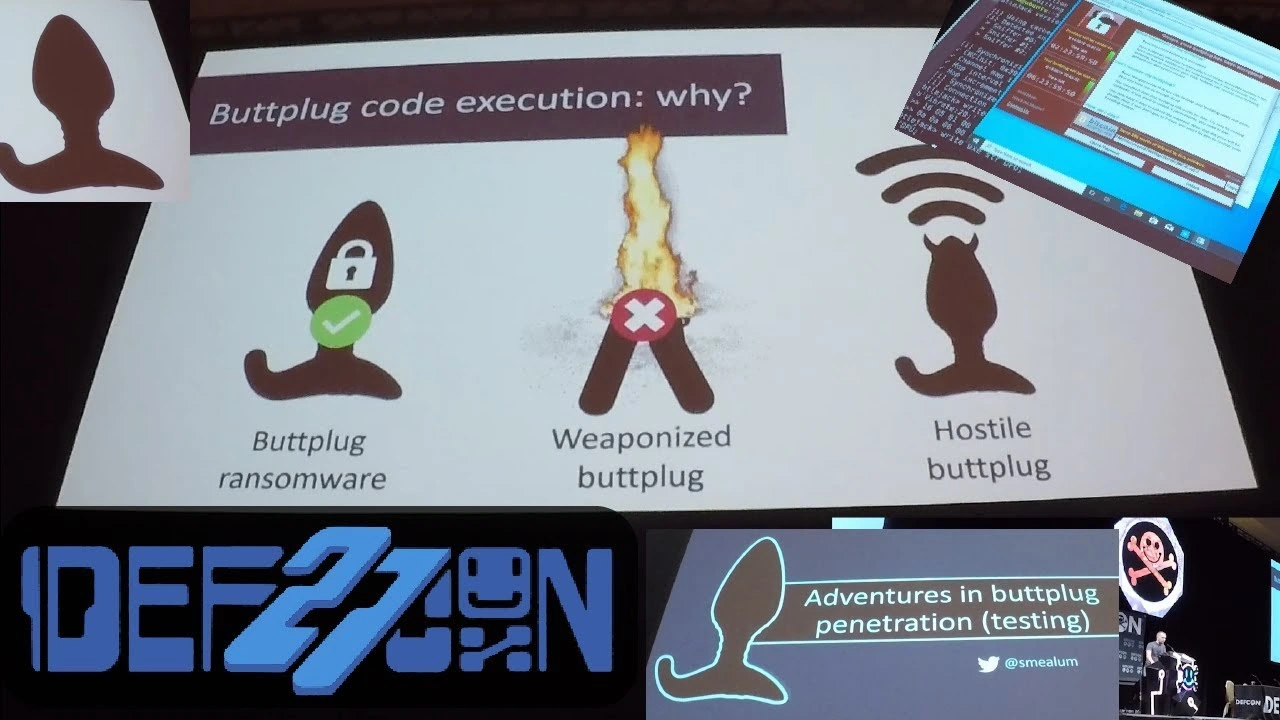
The image shows an adult device treated like any other connected product. The laptop and wireless icon imply remote communication. The lock icon on "Buttplug ransomware" suggests an attacker could prevent normal use until a demand is met. "Weaponized buttplug" and "Hostile buttplug" exaggerate the physical danger for comic effect, but the underlying lesson is serious: when software controls hardware, security bugs can affect the physical world.
For newer developers, the important lesson is that embarrassing products still need professional engineering. Input validation, authentication, secure updates, and safe failure modes matter whether the device is a thermostat, a toy, a router, or something nobody wants mentioned in the sprint review.
Level 3: The Worst Endpoint
The slide collage is doing security comedy with the subtlety of a crash dump. The largest visible title asks:
Buttplug code execution: why?
Below it are three threat-model labels: "Buttplug ransomware", "Weaponized buttplug", and "Hostile buttplug". The inset title reads "Adventures in buttplug penetration (testing)", and the DEF CON branding makes clear that this is framed as security research, not just a random dirty joke. The humor comes from applying completely normal cybersecurity language to the least dignified connected device possible.
From a security perspective, the structure is familiar. A device has firmware, wireless control, a protocol, maybe an app, maybe cloud integration, and therefore an attack surface. If an attacker can influence commands, update behavior, authentication, pairing, or input parsing, then the usual categories appear: denial of service, unauthorized control, data leakage, persistence, and in the worst case code execution. Nothing about that checklist is exotic. The absurdity is that the asset under discussion is personal, physical, and deeply not something anyone wants turning into an incident report.
That is why the ransomware and hostile-device labels land. IoT security keeps rediscovering that "smart" often means "networked before threat-modeled." A harmless-seeming gadget becomes a small embedded computer attached to the real world. Once software controls a motor, heater, lock, camera, medical sensor, or any other physical effect, bugs stop being abstract. "Remote code execution" is already bad on a server. On a device with direct bodily context, the phrase suddenly develops a compliance department, a legal department, and several very quiet meetings.
The pun on penetration testing is the obvious surface joke, but the deeper developer joke is architectural: every connected device eventually has to answer boring questions like authentication, firmware updates, input validation, failsafe behavior, and disclosure handling. DEF CON talks are good at turning those boring questions into memorable nightmare fuel. This slide just made sure nobody in the room would ever forget the threat model.
Description
The image is a collage of slides from a DEF CON presentation about connected sex-toy security, with a large slide reading "Buttplug code execution: why?". Three illustrated device icons are labeled "Buttplug ransomware", "Weaponized buttplug", and "Hostile buttplug", including lock, checkmark, fire, X, wireless-signal, and laptop imagery. A lower inset shows the DEFCON logo and a title slide reading "Adventures in buttplug penetration (testing)" with the handle "@smealum", plus a small skull-and-crossbones graphic and a speaker on stage. The technical joke is that the standard security vocabulary of code execution, ransomware, hostile devices, and penetration testing becomes brutally literal when the target is an IoT device with wireless control.
Comments
1Comment deleted
Every connected device eventually asks the same architecture review question: what is the blast radius of giving it Bluetooth and a firmware update path?