Skip to content
DevMeme
5746 of 7435
A Developer's Late-Night Contemplation on Machine Learning and Physics
AI ML Post #6299, on Oct 8, 2024 in TG

A Developer's Late-Night Contemplation on Machine Learning and Physics

Why is this AI ML meme funny?

Level 1: Not Cheating, Just Science

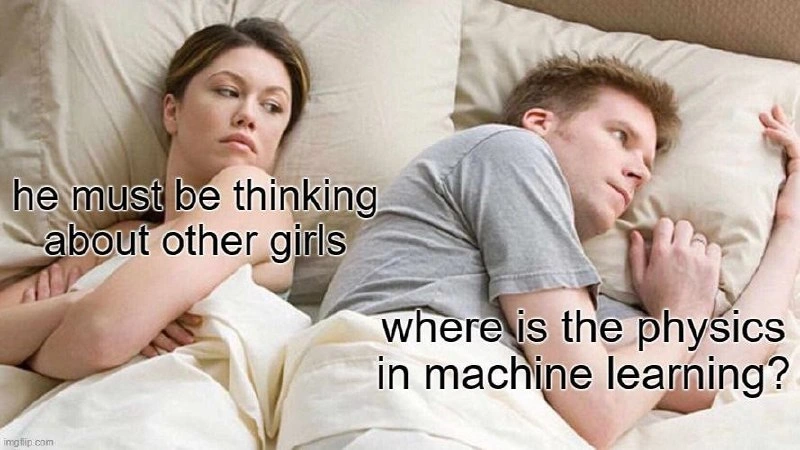
Imagine you see a couple in bed. The woman looks worried and thinks, “He must be thinking about someone else.” But the man is wide awake thinking, “Did I do my science project right? Does it follow the real-world rules?” It’s funny because she thinks he’s worried about love, but actually he’s worried about science!

It’s like if your friend thought you were upset because you lost a game, but really you’re upset because your toy rocket isn’t obeying gravity in a game and that makes no sense. One person is guessing a normal worry (like relationship stuff), but the other person has a completely different, super-nerdy worry. The joke is that his brain is filled with physics and machine learning instead of anything romantic. In simple terms: he’s not thinking about another girl at all – he’s thinking about why his computer’s predictions don’t follow the rules of nature. That big difference between what she assumes and what he’s actually thinking is what makes it silly and humorous. Even if you don’t know much about AI, you can laugh because basically, he’s more concerned about his homework or work problem than typical “guy in a relationship” thoughts. It’s a goofy misunderstanding: she’s jealous of an imaginary girl, but the real “other woman” in his mind is just science.

Level 2: Teaching AI the Rules

Let’s break down the meme in simpler terms. We have a common scene: a couple in bed, and the woman thinks, “He must be thinking about other girls.” This is a popular meme template. The twist here is what the man is actually thinking: “Where is the physics in machine learning?” He’s not daydreaming about another person at all – he’s deep in a nerdy thought spiral! So why is this funny to developers and data scientists? Because it’s so true to life for tech folks. Often, when someone in tech looks distant or preoccupied, they might be mentally debugging code or puzzling over a technical problem instead of the “normal” stuff. Here, the guy is a data scientist or ML engineer losing sleep over a specific technical concern: his AI models might not know about real-world physics.

Now, what does “physics in machine learning” mean, and why would anyone worry about it? In machine learning, especially with deep learning (those complex neural networks often imagined as layers of neurons or as giant function fitting machines), we usually feed in a lot of data and let the model find patterns. If you give an ML model enough examples, it can learn to make predictions – but it doesn’t automatically know why things work that way in the real world. Physics is the set of rules that govern how the universe works – like gravity, energy conservation, or how fluids flow. Real objects and systems obey those rules. A classic ML model, if not guided, might come up with a solution that fits the data but breaks those real-world rules in scenarios it never saw in training.

For example, imagine you train a neural network to predict how a ball will bounce. You give it some video data of a ball dropping and bouncing. If the model is just blindly learning from data, it might notice, say, five bounces in each clip and learn “after five bounces the ball stops.” If you then ask it about a higher drop, a naive model might predict the ball still only bounces five times, or maybe even starts bouncing higher each time (oops!). A human with physics knowledge knows the ball should bounce lower and eventually stop because of energy loss – that’s a conservation of energy rule and friction at play. But the ML model doesn’t know energy or gravity; it just knows patterns in data. This is a simple example of a model accidentally overfitting to a pattern that isn’t a true law – it’s just a quirk of the training dataset. In more serious cases, say predicting weather, a pure ML model might output results that create or destroy heat or moisture out of thin air, because it wasn’t explicitly taught those can’t happen. In other words, a black-box ML model can sometimes behave in ways that a scientist would immediately flag as nonsense.

That’s why people in AI are talking about physics-informed models. It means building your AI/ML models so they respect known rules of the domain. Instead of treating the neural network like a mysterious box that can do anything, you teach it the rules. For instance, if you know total mass should stay constant in a closed system, you can design the model to always enforce that – maybe by adding a special term in its learning process that says “hey, if mass isn’t conserved, that’s a bad prediction.” By doing this, the model is less likely to suggest something impossible. Physics-informed neural networks (PINNs) are a fancy name for neural nets that have equations (like physics formulas) woven into their training. It’s like giving the model a bit of a science textbook along with the data.

So the guy in the meme is basically thinking: “Are our AI models grounded in reality, or are they just guessing?” This is a common worry in advanced DeepLearning projects. When you’re a junior in ML, you might be amazed that a neural net can fit data so well. But as you gain experience, you start noticing when the model’s predictions don’t make sense in real-life terms. You learn terms like “garbage in, garbage out” and see why domain knowledge matters. If you’ve ever worked on a project where you had to use real-world knowledge to fix a model’s predictions, this scenario clicks. Maybe your first time deploying a model, you realized you needed to put some constraints on it – like telling a predicted probability to never go below 0 or above 1 (since those are the only valid ranges), or making sure a generated plan follows basic rules (e.g., a schedule that doesn’t double-book a person). Those are simple constraints; in science-heavy fields, the constraints are things like “momentum must be conserved” or “the chemical quantities must balance out.”

This meme is tagged AIHypeVsReality because it reflects a reality-check moment. The hype says “AI can do anything! Just feed it data!” But the reality is, if you ignore proven principles (like physics) and rely solely on data, you can get burned by bizarre outcomes. The man’s worry shows he’s aware of that and is trying to figure out how to combine the power of data-driven MachineLearning with the reliability of physics. It’s a trend in the field now – not just making ever-bigger networks, but making smarter ones that understand the world’s rules. And on a personal level, it’s totally relatable: who hasn’t had a night where you lie in bed thinking about a tricky bug or concept from work or school? The poor woman assumes it’s something personal or romantic bothering him, but nope – it’s good old scientific nerdiness at work.

Level 3: Hype vs. Laws of Nature

Why is this meme so painfully on point for seasoned data scientists? It highlights the clash between AI hype and the unforgiving laws of nature. The woman in the meme assumes her partner’s silence means he’s got typical relationship worries (“he must be thinking about other girls…”). But the punchline text reveals the true source of his insomnia: “Where is the physics in machine learning?” This contrast is funny because it flips a common romantic insecurity on its head—turns out the guy isn’t cheating; he’s obsessing over physics-informed models. It’s an absurdly nerdy worry, yet AIHumor aficionados find it relatable. Why? Because many of us have been that sleepless data scientist lying awake, debugging models or pondering some arcane bug, while our partners or friends have no clue what’s eating us. It’s a classic bed_thoughts_meme scenario of partner assumptions vs reality, but here the reality is ultra-nerdy.

From a senior developer’s perspective, this joke also lands because it satirizes a real IndustryTrends_Hype debate. In recent years, MachineLearning (especially deep learning) has been sold as a magic black-box that can solve anything with enough data. Companies and research teams often dived headfirst into AIHypeVsReality situations: building fancy models that fit the data remarkably well, yet occasionally yield results that make domain experts spit out their coffee. Think of a neural network predicting a perpetual motion scenario, or a climate model that “learned” it could violate conservation of mass—unintentionally, of course—because nobody told it not to. Seasoned scientists and engineers see these bloopers and groan. They know that ignoring proven scientific laws is a recipe for disaster, no matter how good your GPU cluster is. This meme’s guy is basically one of those experienced folks who can’t ignore the nagging thought: our fancy AI might be fundamentally flawed if it doesn’t know basic physics.

It’s funny, yes, but it’s also a bit of a collective nerdy sigh. The humor arises from shared experience: RelatableDevExperience in data science means recalling times when a model did something ludicrous that a first-year physics student would know is impossible. The caption “where is the physics in machine learning?” points to that very gap. There’s a growing acknowledgment in AI that we swung the pendulum too far into pure data-driven NeuralNetworks. Many early projects enthusiastically tossed out domain expertise (“Who needs equations? We have data and deep networks!”) during the hype wave. The result? Models that sometimes overfit and pick up spurious patterns that violate common sense or scientific truth. An experienced ML engineer has probably battled such an overfitting model that, say, predicted overfittingModels like a stock price could grow forever exponentially (forgetting economic or physical limits), or that a satellite’s orbit wouldn’t decay because the model never saw atmospheric drag data. These moments are equal parts hilarious and horrifying – hilarious in retrospect, horrifying if you deployed that model in the real world!

So now the trend is correcting course: enter physics_informed_models. The guy in bed is onto the hot topic: PINNs vs black-box approaches. Physics-informed neural nets (PINNs) are a direct response to the “black box insomnia” he’s experiencing. In the dev community, we joke that “it’s not cheating if you use the textbook” – meaning, it’s okay (actually essential) to bring known scientific laws into your AI model rather than letting it guess in the dark. The fact that this is what keeps him up at night (and not anything like jealousy or personal woes) is the comedic exaggeration that resonates, especially with those of us who have felt the anxiety of a model that just doesn’t feel trustworthy.

To senior folks, the meme also hints at a bit of I-told-you-so toward the AI hype. We remember earlier eras of simulation and modeling where everything was physics-based. Then came the deep learning revolution where, for a while, data was king and physics was “old school.” The meme’s joke is that the guy can’t sleep because he realizes you actually do need both – a melding of old-school physics and new-school ML. It’s a nod to how the field is evolving: the initial euphoria of “neural nets can do anything!” has matured into “neural nets can do more if we respect what centuries of science have taught us.” In other words, reality (the laws of nature) is reasserting itself over pure hype. And nothing says “senior perspective” like worrying about fundamental correctness at 3 AM while everyone else is hyped about shiny demo results. The humor has a tinge of “we’ve all been there”: ironically chuckling at our own obsessive thoughts. After all, when you’re dating or are a dev, sometimes the other girl is really just Newton or Einstein stealing your man’s attention!

Level 4: Deep Laws vs Deep Learning

At the cutting edge of Machine Learning, researchers are grappling with how to embed first-principles physics into neural networks. This meme’s insomniac data scientist is essentially asking a deeply technical question: “How can we enforce the laws of physics within a deep learning model?” In theoretical terms, he’s pondering how to add domain knowledge constraints (like conservation of energy or Newton’s laws) to a black-box DeepLearning model so it doesn’t spit out physically impossible results.

In classical modeling, we rely on equations of motion and field equations (think of Maxwell’s equations for electromagnetism or Navier-Stokes for fluid flow) that are grounded in real-world physics. A vanilla NeuralNetwork doesn’t inherently understand any of these laws; it just crunches numbers to minimize an error. The humor here hides a real research frontier: how to blend data-driven learning with first-principles truths. One approach gaining traction is Physics-Informed Neural Networks (PINNs). These models incorporate differential equations directly into the training process. For example, if we know a system must obey F = m·a (force equals mass times acceleration), we can augment the loss function to penalize predictions that violate that law. Formally, we define a total loss like:

# Pseudo-code illustrating physics-informed training
data_loss    = criterion(predicted, observed_data)
physics_loss = penalty_function(predicted)  # e.g. deviation from F - m*a = 0
total_loss   = data_loss + λ * physics_loss  # λ weights the physics constraint

Here, physics_loss is high whenever the model’s predictions break the rules (like non-conservation of mass or energy), nudging the network to respect fundamental laws. In math-speak, we’re regularizing the solution space towards physically plausible functions. This loss vs laws tug-of-war ensures the learned model doesn’t just fit the data but also satisfies underlying equations. Some PINNs go even further: they embed the actual differential equations (PDEs) into the network’s structure or use automatic differentiation to enforce that the network’s outputs $u(x,t)$ satisfy equations like $u_{tt} = c^2 u_{xx}$ (wave equation) at all points. It’s cutting-edge stuff at the intersection of AI_ML and computational physics.

The technical payoff? A model that generalizes better and won’t, say, predict a perpetual motion machine or negative absolute temperatures just because the data was quirky. By injecting hard constraints or physics-based loss terms, these models uphold conservation laws, symmetries, and other invariants that pure data-fitting might overlook. The man’s late-night question “where is the physics in machine learning?” reflects a sophisticated awareness: without built-in physics, an ML model could violate reality’s rules. In essence, he’s yearning for models that honor the elegant structure of the universe (like energy conservation or entropy increase) even as they learn from messy real-world data. This is a grand challenge in modern AI research – blending the rigor of physics with the flexibility of overfitting models. The fact that this thought keeps him awake shows just how profound and hard this problem is: it’s not just coding anymore, it’s confronting the boundaries of what our models understand about the world.

Description

This image uses the 'He must be thinking about other girls' meme format. A man and a woman are shown in bed, lying with their backs to each other. The woman has a concerned and suspicious look on her face, with superimposed text that reads, 'he must be thinking about other girls'. In contrast, the man is wide awake, staring thoughtfully into the distance, with text over him revealing his actual thoughts: 'where is the physics in machine learning?'. The humor stems from the vast difference between the woman's relational insecurity and the man's deeply abstract, scientific preoccupation. For an experienced tech audience, this is relatable as it portrays how developers can become engrossed in complex, fundamental questions about their field at any time, often to the bewilderment of their partners. The question itself is non-trivial, touching upon the intersection of information theory, statistical mechanics, and computation

Comments

13
Anonymous ★ Top Pick It's all fun and games until you realize your loss function is just a Hamiltonian and you're not sure if your optimizer is finding a true ground state or just another local minimum
  1. Anonymous ★ Top Pick

    It's all fun and games until you realize your loss function is just a Hamiltonian and you're not sure if your optimizer is finding a true ground state or just another local minimum

  2. Anonymous

    Nothing kills romance faster than realizing your loss function forgot about the Navier-Stokes constraints

  3. Anonymous

    After 15 years of building ML systems, you realize the real physics in machine learning is the conservation of energy - specifically, how gradient descent always finds the path of least resistance to overfit your training data while maximizing your AWS bill's potential energy

  4. Anonymous

    This perfectly captures the existential crisis of every ML engineer at 2 AM: we've built models that can generate photorealistic images and beat humans at Go, yet we're essentially doing high-dimensional curve fitting with millions of parameters and zero understanding of causality. Meanwhile, physicists are over here with their elegant equations that actually explain *why* things happen, not just predict *what* happens given enough training data. The real question isn't where the physics is - it's whether we're just glorified polynomial regressors with fancy activation functions and a GPU budget that would make a small country jealous

  5. Anonymous

    After two decades, I’ve found that ‘physics in ML’ means sneaking invariances and PDE residuals into the loss, then pretending SGD respects conservation laws while product demands real‑time inference on a phone

  6. Anonymous

    Nothing keeps you up like realizing your LSTM just invented a perpetual‑motion CFD surrogate because the loss function forgot mass conservation

  7. Anonymous

    She frets over other girls; he's lamenting how transformers conserve attention but ignore conservation laws

  8. @Lexi_Stechenko 1y

    big question

  9. @radiroma 1y

    I dont get it

  10. @Carolus99 1y

    Same

  11. @AlexAparnev 1y

    well... it was BOLTZMANN machine... and later neural DIFFUSION... i guess... 🥴

  12. @Gotfr1d 1y

    For those who don't get it: https://www.nobelprize.org/prizes/physics/2024/press-release/

    1. @SamsonovAnton 1y

      This year’s two Nobel Laureates in Physics have used tools from physics to develop methods that are the foundation of today’s powerful machine learning. John Hopfield created an associative memory that can store and reconstruct images and other types of patterns in data. Geoffrey Hinton invented a method that can autonomously find properties in data, and so perform tasks such as identifying specific elements in pictures. 🤯

Use J and K for navigation